wayground logo

Free Printable Worksheets

Font size

S
M
L
XL
Worksheets

Unit 8: Kinetics and Equilibrium Review

Total questions: 87

Worksheet time: 1hrs 11mins

Name
Class
Date
1.
Under the collision theory, the particles must collide with  ____ and ____ for a reaction to occur.
a)
sufficient rate and sufficient energy
b)
sufficient surface area and correct orientation
c)
sufficient catalyst and sufficient energy
d)
sufficent energy and correct orientation
2.
More collisions correspond to a: 
a)
Faster reaction rate  
b)
Slower reaction rate
c)
Constant reaction rate 
d)
None of the above
3.
Which of the following is NOT a factor affecting reaction rate?
a)
temperature
b)
catalysts
c)
particle size
d)
polarity
4.
Reaction rate means...
a)
amount of product formed
b)
speed of reaction
c)
concentration of reacting particles
d)
combining reactants with products
5.
Decreasing the particle size increases the reaction rate because
a)
It makes particles move faster
b)
It increases the likelihood of collisions with the correct geometry
c)
It decreases the surface area available to react
d)
It increases the number of collisions
6.
To slow down a chemical reaction you will do one of the following:
a)
Place the reactants in hot water
b)
Place the products in ice bath
c)
Place the reactants in a ice bath
d)
Keep stirring the reactants with a stirring rod
7.
Why does a higher temperature increase the rate of a reaction?
a)
it increases both the frequency and energy of particle collisions
b)
it only increases the frequency of particle collisions
c)
it only increases the energy of particle collisions
d)
it reduces the activation energy of the reaction
8.
Which of the following increase the reaction rate?
a)
less surface area
b)
lower temperature
c)
an inhibitor
d)
increased concentration
9.
Which term is defined as a measure of the disorder of a system?
a)
heat
b)
entropy
c)
kinetic energy
d)
activation energy
10.
Which expression represents the ΔH for a chemical reaction in terms of the potential energy, PE, of its products and reactants?
a)
 PE of products + PE of reactants
b)
PE of products - PE of reactants
c)
PE of products × PE of reactants
d)
PE of products ÷ PE of reactants
11.
Which factors must be equal in a reversible chemical reaction at equilibrium?
a)
 the activation energies of the forward and reverse reactions
b)
the rates of the forward and reverse reactions
c)
the concentrations of the reactants and products
d)
 the potential energies of the reactants and products
12.
Given the equation representing a reaction at equilibrium:
N2(g) + 3H2(g) <--> 2NH3(g) + ENERGY
Which change causes the equilibrium to shift to the right?
a)
 decreasing the concentration of H2(g)
b)
decreasing the pressure
c)
 increasing the concentration of N2(g)
d)
increasing the temperature
13.
Adding a catalyst to a chemical reaction results in
a)
 a decrease in activation energy and a decrease in the reaction rate
b)
a decrease in activation energy and an increase in the reaction rate
c)
an increase in activation energy and a decrease in the reaction rate
d)
an increase in activation energy and an increase in the reaction rate
14.
Which process is accompanied by a decrease in entropy?
a)
boiling of water
b)
condensing of water vapor
c)
subliming of iodine
d)
melting of ice
15.
Given the reaction:
N2(g) +O2(g) +182.6 KJ <--> 2 NO(g)
Which change would cause an immediate increase in the rate of the forward reaction?
a)
increasing the concentration of NO(g)
b)
 increasing the concentration of N2(g)
c)
decreasing the reaction temperature
d)
 decreasing the reaction pressure
16.
Which sample has the greatest entropy?
a)
NH3(g)
b)
NH3(l)
c)
NH3(s)
d)
 NH3(aq)
17.
Given the accompanying potential energy diagram for a reaction:
Which interval on this diagram represents the difference between the potential energy of the products and the potential energy of the reactants?
a)
1
b)
2
c)
3
d)
4
18.

Given the reaction at equilibrium:

C2 + D2(g) <-->2 CD(g) + energy

Which change will cause the equilibrium to shift?

a)

increase in pressure

b)

addition of a noble gas

c)

addition of heat

d)

addition of a catalyst

19.
 Given the equation representing a reaction:
N2O4(g) <--> 2NO2(g)

Which statement describes this reaction at equilibrium?
a)
The concentration of N2O4(g) must equal the concentration of NO2(g).
b)
The concentration of N2O4(g) and the concentration of NO2(g) must be constant.
c)
 The rate of the forward reaction is greater than the rate of the reverse reaction.
d)
The rate of the reverse reaction is greater than the rate of the forward reaction.
20.
For a given reaction, adding a catalyst increases the rate of the reaction by
a)
 providing an alternate reaction pathway that has a higher activation energy
b)
 providing an alternate reaction pathway that has a lower activation energy
c)
using the same reaction pathway and increasing the activation energy
d)
using the same reaction pathway and decreasing the activation energy
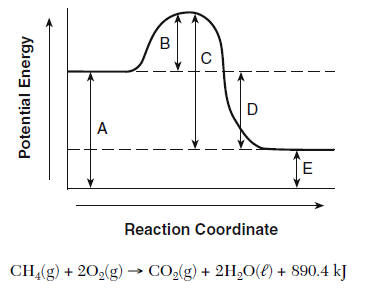
21.
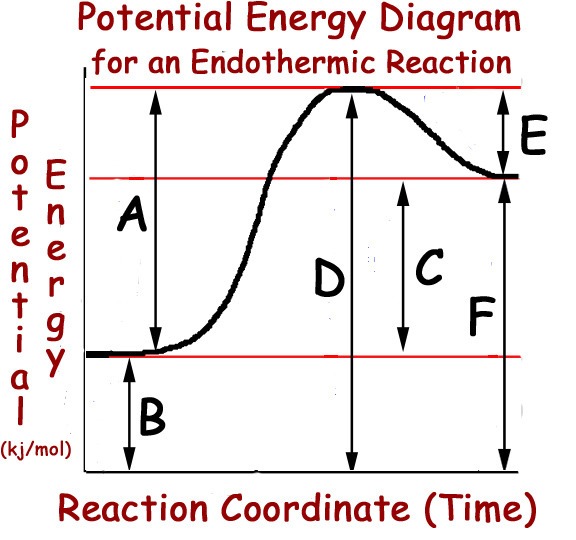
What letter represents ΔH?
a)
A
b)
B
c)
C
d)
D
22.
At what time the reaction reached equilibrium?
a)
t1
b)
t2
c)
t3
d)
t4
23.
What kind of reaction is this?
a)
Endothermic
b)
Exothermic
c)
Cannot be determined
24.
A chemical reaction that requires energy is a
a)
exothermic reaction 
b)
endothermic reaction 
c)
over reaction 
25.
In an exothermic reaction, heat is ...
a)
taken in
b)
given out
26.
Which letter corresponds to the activation energy of the forward reaction?
a)
A
b)
B
c)
C
d)
D
27.
Which factors increase the rate of a reaction.
a)
increasing temperature
b)
increasing concentration
c)
increasing surface area
d)
all of these
28.
Compared to the rate of inorganic reactions, the rate of organic reactions generally is
a)
slower because organic particles are ions
b)
slower because organic particles contain covalent bonds
c)
faster because organic particles are ions
d)
faster because organic particles contain covalent bonds
29.
If a catalyst is added to a system at equilibrium and the temperature and pressure remain constant, there will be no effect on the
a)
rate of the forward reaction
b)
activation energy of the reaction
c)
rate of the reverse reaction
d)
heat of reaction
30.
When one mole of a certain compound is formed from its elements under standard conditions, it absorbs 85 kiloJoules of heat. A correct conclusion from this statement is that the reaction has a
a)
ΔH equal to –85 kJ/mole
b)
ΔH equal to +85 kJ/mole
c)
 Δequal to –85 kJ/mole
d)
 Δequal to +85 kJ/mole
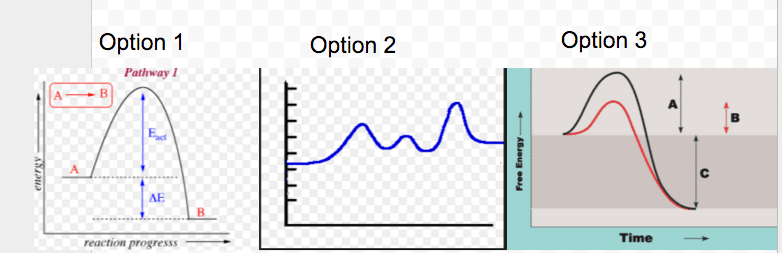
31.
Which picture shows how a catalyst would change the rate? 
a)
Option 3
b)
Option 2
c)
Option 1
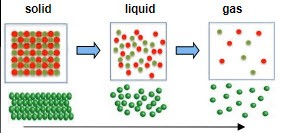
32.
Entropy increases from solid, liquid to gas. Why?
a)
Molecular disorder increases
b)
Molecular randomness decreases
c)
Molecules are more energetic
d)
Molecules are more reactive
33.

Which represents a decrease in entropy?

a)

sublimation of CO2

b)

boiling water

c)

condensation of steam on cold glass

d)

NaCl dissolving in water

34.

The entropy will usually increase when

a)

a molecule is broken into two or more smaller molecules

b)

a reaction occurs that results in an increase in the number of moles of gas

c)

a solid changes to a liquid

d)

all of these

35.

Systems in nature tend to undergo changes toward

a)

lower energy and less disorder

b)

lower energy and more disorder

c)

higher energy and less disorder

d)

higher energy and more disorder

36.

Which sample has the lowest entropy?

HINT - Look at the phase of each chemical....

a)

1 mole of KNO3(l)

b)

1 mole of KNO3(s)

c)

1 mole of H2O(l)

d)

1 mole of H2O(g)

37.

Which phase change represents a decrease in entropy?

a)

solid to liquid

b)

gas to liquid

c)

liquid to gas

d)

solid to gas

38.
Which phase of matter has the greatest motion and least orderly arrangement?
a)
solid
b)
liquid
c)
gas
39.

Entropy of a system increases when a reaction increases the number of particles.

a)

True

b)

False

40.
A catalyst works by
a)
changing the order of the reaction
b)
increasing the temperature
c)
lowering the activation energy
d)
making the activated complex
41.
What type of reaction is shown in the reaction pathway?
a)
endothermic reaction
b)
exothermic reaction
42.

How do you calculate Enthalpy of a reaction?

a)

ΔH = ΔHproducts - ΔHreactants

b)

ΔT = q / mC

c)

ΔG = ΔH -TΔS

d)

E = mc2

43.

In the reaction picture, the energy will be on product or reactant

a)

Product

b)

Reactant

44.

What is the symbol for enthalpy?

a)

Δe

b)

h

c)

ΔH

d)

ΔE

45.
Two reactant particles collide with proper orientation.The collision will be effective if the particles have
a)
high activation energy
b)
high ionization energy
c)
sufficient kinetic energy
d)
sufficient potential energy
46.

Which statement describes all of the PE diagram's the best.

a)

A. is most exothermic

b)

B. is most exothermic

c)

C. is most exothermic

d)

D. is most exothermic

47.
Which term refers to the difference between thepotential energy of the products and the potential energy ofthe reactants for any chemical change?
a)
heat of deposition
b)
heat of fusion
c)
heat of reaction
d)
heat of vaporization
48.
Which numbered interval on the diagram would change when a catalyst is added?
a)
B & C
b)
C & D 
c)
E & C
d)
A & D 
49.
In table I the reaction of hydrogen and oxygen to form water is best described as
a)
exothermic, because energy is released
b)
endothermic, because energy is released
c)
exothermic, because energy is absorbed
d)
endothermic, because energy is absorbed
50.
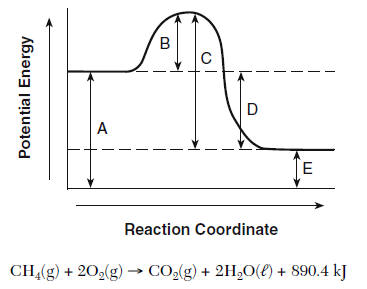
Given the reaction:
CH4(g) + 2 O2(g)  2 H2O(g) + CO2(g)
What is the overall result when CH4(g) burns according to this reaction?
a)
Energy is absorbed and H is negative.Δ
b)
Energy is absorbed and ΔH is positive.
c)
Energy is released and ΔH is negative.
d)
Energy is released and ΔH is positive
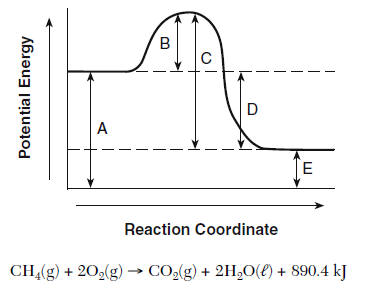
51.
Interval C in this potential energy diagram could be changed by adding a ________?
a)
Cookies
b)
More energy
c)
Catalyst
d)
Changing the temperature
52.
Which interval represents the heat of reaction for the reaction?
a)
A
b)
B
c)
D
d)
E
53.
Which interval represents the activation energy of the forward reaction?
a)
A
b)
B
c)
C
d)
E
54.
When one mole of a certain compound is formed from its elements under standard conditions, it absorbs 85 kiloJoules of heat. A correct conclusion from this statement is that the reaction has a
a)
ΔH equal to –85 kJ/mole
b)
ΔH equal to +85 kJ/mole
c)
 Δequal to –85 kJ/mole
d)
 Δequal to +85 kJ/mole
55.
Compared to the rate of inorganic reactions, the rate of organic reactions generally is
a)
slower because organic particles are ions
b)
slower because organic particles contain covalent bonds
c)
faster because organic particles are ions
d)
faster because organic particles contain covalent bonds
56.
A piece of Mg(s) ribbon is held in a Bunsen burnerflame and begins to burn according to the equation:
2Mg(s) + O2 (g)  −>   2MgO(s).
The reaction begins because the reactants
a)
are activated by heat from the Bunsen burner flame
b)
are activated by heat from the burning magnesium
c)
underwent an increase in entropy
d)
underwent a decrease in entropy
57.
Adding a catalyst to a chemical reaction changes the rate of reaction by causing
a)
a decrease in the activation energy
b)
an increase in the activation energy
c)
a decrease in the heat of reaction
d)
an increase in the heat of reaction
58.
If a catalyst is added to a system at equilibrium and the temperature and pressure remain constant, there will be no effect on the
a)
rate of the forward reaction
b)
activation energy of the reaction
c)
rate of the reverse reaction
d)
heat of reaction
59.

Which of the following increase the reaction rate?

a)

less surface area

b)

lower temperature

c)

increasing pressure

d)

increased concentration

60.

If the temperature is reduced, a reaction rate will ______

a)

increase

b)

decrease

c)

stay the same

61.

If the concentration of a reactant is increased, the reaction rate will ___________.

a)

increase

b)

decrease

c)

stay the same

62.

The ____________ states that atoms, ions, or molecules must collide in order to react.

a)

transition state

b)

activation energy

c)

rate law

d)

collision theory

63.
Rate of chemical reaction means
a)
amount of product formed
b)
speed of reaction
c)
concentration of reacting particles
d)
combining reactants with products
64.
Grinding a seltzer tablet into powder increases the rate of reaction due to...
a)
increased concentration of reactants
b)
increased surface area
c)
increased speed of particles.
d)
better orientation of reactants
65.
True or False? The higher the concentration of a solution the less solutes it has in it.
a)
True
b)
False
66.
Smaller particle size allows for a _________ surface area to be exposed for the reaction.
a)
larger
b)
smaller
67.

For the reaction N2(g) + 3H2(g) <--> 2NH3(g) + 92 kJ;

what happens to the concentration of N2 when heating up the chamber this takes place in?

a)

concentration of nitrogen increases

b)

concentration of nitrogen decreases

c)

concentration of nitrogen stays the same

68.

For the reaction N2(g) + 3H2(g) <--> 2NH3(g) + 92 kJ;

what happens to the equilibrium position by adding a catalyst to this reaction?

a)

Shifts to the left (reactants)

b)

Shifts to the right (products)

c)

No effect

69.

Which system at equilibrium will be least affected by a change in pressure?

a)

3 H2(g) + N2(g) ↔ 2 NH3(g)

b)

2 S(s) + 3 O2(g) ↔ 2 SO3(g)

c)

AgCl(s) ↔ Ag+(aq) + Cl– (aq)

d)

2 HgO(s) ↔ 2 Hg(g) + O2(g)

70.

Given the reaction: N2(g)+O2(g)+182.6kJ    2NO(g)N_{2\left(g\right)}+O_{2\left(g\right)}+182.6kJ\ \ ↔\ \ 2NO_{\left(g\right)}  
Which change would cause an immediate increase in the rate of the forward reaction (i.e., cause shift toward products)?

a)

increasing the concentration of NO(g)

b)

increasing the concentration of N2(g)

c)

decreasing the reaction temperature

d)

decreasing the reaction pressure

71.
Which of the two graphs reaches equilibrium?
a)
The left one.
b)
The right one.
c)
Both of them.
d)
Neither.
72.

For the reaction...

H2 (g) + Cl2 (g) <=> 2HCl (g) + heat

If the pressure in the system is increased, the equilibrium position will _______.

a)

shift to the left

b)

shift to the right

c)

not shift position at

73.

HEAT + H2CO3 --> CO2 + H2O

If carbonic acid is added, this reaction will shift...

a)

right

b)

left

c)

no change

74.

HEAT + H2CO3 --> CO2 + H2O

If carbon dioxide is added, this reaction will shift...

a)

right

b)

left

c)

no change

75.

HEAT + H2CO3 --> CO2 + H2O

If water is decreased, this reaction will shift...

a)

right

b)

left

c)

no change

76.

HEAT + H2CO3 --> CO2 + H2O

If carbonic acid is removed, this reaction will shift...

a)

right

b)

left

c)

no change

77.

HEAT + H2CO3 <--> CO2 + H2O

If the mixture is placed in a larger container, the reaction will shift...

a)

right

b)

left

c)

no change

78.

HEAT + H2CO3 --> CO2 + H2O

If the temperature is decreased, this reaction will shift...

a)

right

b)

left

c)

no change

79.

If volume increases, the reaction shifts to the side with ______ moles of gas.

a)

Less

b)

More

80.

How would equilibrium shift if volume is increased.

2 NO(g) + O2(g) ⇄ 2 NO2(g)

a)

Shift Left

b)

Shift Right

c)

No Change

81.

How will equilibrium shift when NO is added?

2 NO(g) + O2(g) ⇄ 2 NO2(g)

a)

Shift Left

b)

Shift Right

c)

No Change

82.

How will equilibrium shift when Br2 is added?

2 NO(g) + Br2(g) ⇄ 2 NOBr(g)

a)

Shift Left

b)

Shift Right

c)

No Change

83.

How does equilibrium shift when SO3 is removed?

2 SO2(g) + 2 O2(g) ⇄ 2 SO3(g)

a)

Shift Left

b)

Shift Right

c)

No Change

84.

How will equilibrium shift when volume is decreased?

H2(g) + Cl2(g) ⇄ 2 HCl(g)

a)

Shift Left

b)

Shift Right

c)

No Change

85.

How will equilibrium shift when heat is added?

2 NO2(g) + HEAT ⇄ N2O4(g)

a)

Shift Left

b)

Shift Right

c)

No Change

86.

How will equilibrium shift when heat is removed?

H2(g) + I2(g) ⇄ 2 HI(g) + HEAT

a)

Shift Left

b)

Shift Right

c)

No Change

87.

How will equilibrium shift when HBr is removed?

2 HBr(g) ⇄ H2(g) + Br2(g)

a)

Shift Left

b)

Shift Right

c)

No Change