
 Worksheets
Electron Configuration & Half-Lives
Total questions: 84
Worksheet time: 2hrs 44mins
How much of a 100.0g sample of Au - 198 is left after 8.10 days if its half - life is 2.70 days?
12.5 g
25.0 g
50.0 g
6.25 g
The half - life of radon - 222 is 3.8 days. How much of a 100 g sample is left after 15.2 days.
50.0 g
25.0 g
12.5 g
6.25 g
A 50.0 g sample of N - 16 decays to 12.5 g in 14.4 seconds. What is it's half - life?
14.4 sec
7.2 sec
3.6 sec
1.8 sec
The half - life of K - 42 is 12.4 hrs. How much of a 750 g sample is left after 62.0 hrs?
187.5 g
93.8 g
46.9 g
23.4 g
If 100 g of Au - 198 decays to 6.25 g in 10.8 days, what is the half - life of Au - 198?
1.8 days
2.7 days
3.6 days
5.4 days


Negatively charged particles emitted from a nucleus at a high speed are
X-rays
gamma particles
alpha particles
beta particles
A helium nucleus with two protons and two neutrons is called a(n)
electroscope
gamma particle
alpha particle
beta particle
The amount of material left after two half-lives is ____ of the original value.
double
one-half
one-fourth
four times
The most penetrating type of radiation is
the gamma ray
the beta particle
the alpha particle
the uranium atom
The most penetrating type of radiation is
the gamma ray
the beta particle
the alpha particle
the uranium atom
When the strong force is not enough to hold the nuclei together permanently, what occurs?
solids become liquids
nuclear fusion occurs
the nuclei decay
carbon -12 changes to carbon-14
The half-life of lead is about 11 hours. How much of a 150 gram sample of lead is left after 22 hours
75 g
50 g
37.5 g
13.6 g
The half-life of Thorium-234 is 24 days. How many half-lives have passed after 96 days?
One half-life
Two half-lives
Three half-lives
Four half-lives
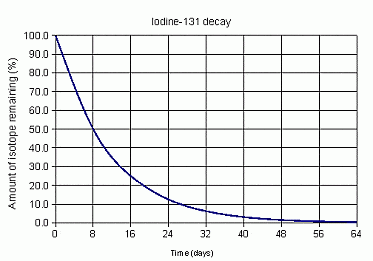
The % of the parent isotope remaining after 1 Half Life.
50%
25%
12.5%
6.25%
The % of the parent isotope remaining after 2 Half Lives.
50%
25%
12.5%
6.25%
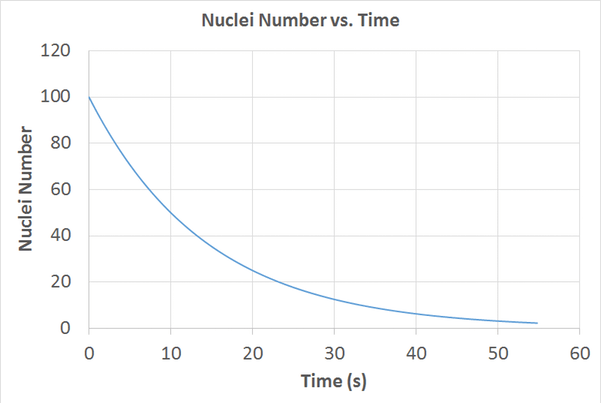
What is the Half life of this isotope?
5 seconds
10 seconds
15 seconds
20 seconds
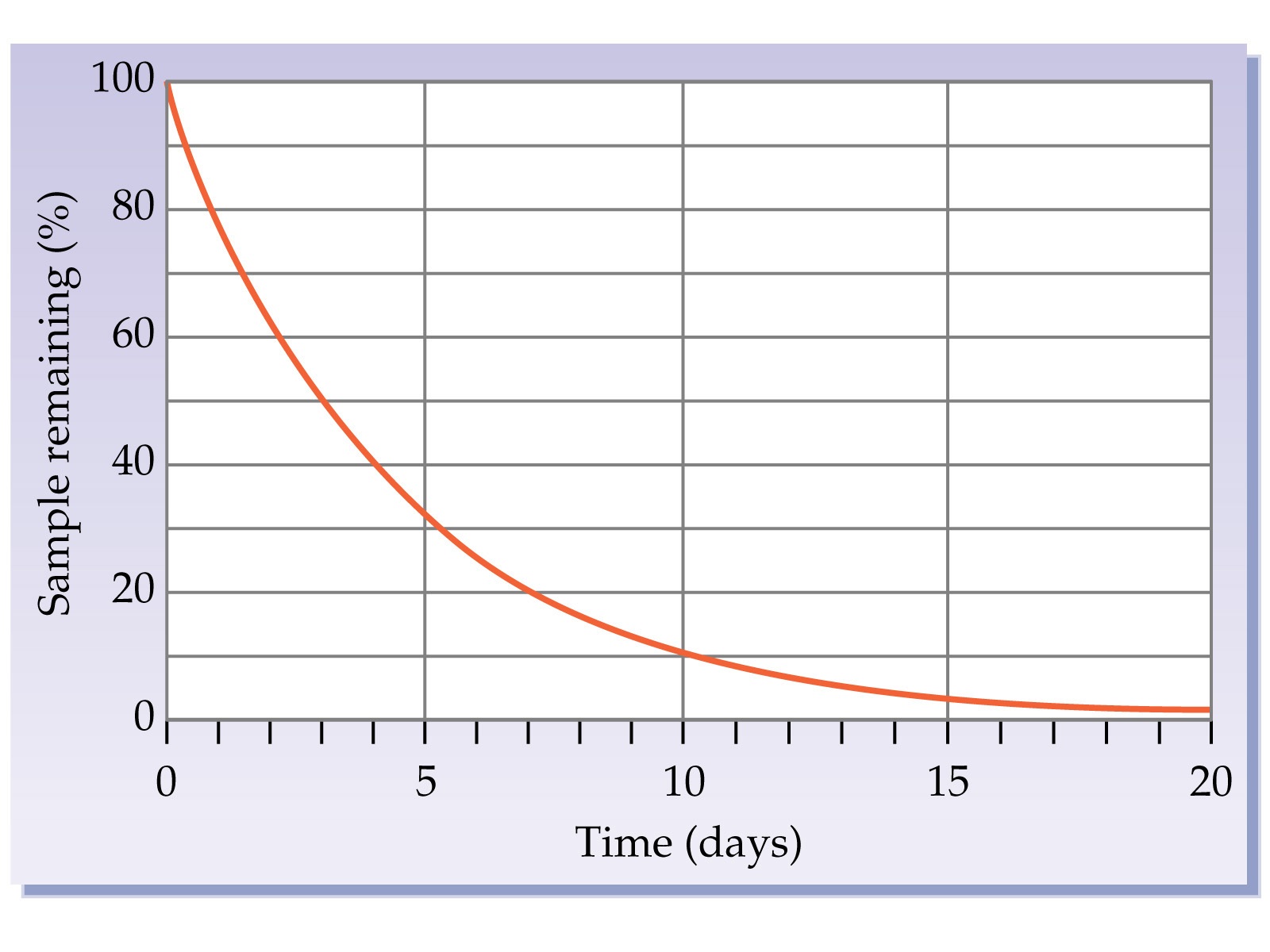
What is the Half Life of this isotope?
3 days
5 days
8 days
10 days

Why do some elements have half-lives?
they radioactively decay
half of their atom gets stolen
They are Twizzlers that break in half
What is the only difference between two different isotopes of the same element?
Number of neutrons
Number of protons
Number of electrons
Size of atom

After the third half-life, how much of the sample is left?
1/2
1/3
1/16
1/8

Choose the correct electron configuration for Beryllium (Be).
1s1
1s2 2s2
1s2 2s2 2p1

Choose the correct electron configuration for Chlorine (Cl).
1s2 2s2 2p1
1s2 2s2 2p6 3s2
1s2 2s2 2p6 3s2 3p5

Choose the correct electron configuration for Nickel (Ni).
1s2 2s2 2p6 3s2 3p6 4s2 3d8
1s2 2s2 2p6 3s2 3p6 4s2 3d2
1s2 2s2 2p6 3s2 3p6 4s10

Choose the correct electron configuration for Krypton (Kr).
1s2 2s2 2p6 3s2 3p6 4s8 3d8
1s2 2s2 2p6 3s2 3p6 4s2 3d8 4p3
1s2 2s2 2p6 3s2 3p6 4s2 3d8 4p6

Choose the correct electron configuration for Terbium (Tb).
1s2 2s2 2p6 3s2 3p6 4s2 3d10 4p6 5s2 4d19 5p6 6s2
1s2 2s2 2p6 3s2 3p6 4s2 3d10 4p6 5s2 4d10 5p6 6s2 4f9
1s2 2s2 2p6 3s2 3p6 4s2 3d10 4p6 5s2 4d10 5p6 6s2 4f5
Choose the correct electron configuration for Beryllium (Be).
1s1
1s2 2s2
1s2 2s2 2p1
Choose the correct electron configuration for Chlorine (Cl).
1s2 2s2 2p1
1s2 2s2 2p6 3s2
1s2 2s2 2p6 3s2 3p5


Choose the correct electron configuration for Nickel (Ni).
1s2 2s2 2p6 3s2 3p6 4s2 3d8
1s2 2s2 2p6 3s2 3p6 4s2 3d2
1s2 2s2 2p6 3s2 3p6 4s10
Choose the correct electron configuration for Krypton (Kr).
1s2 2s2 2p6 3s2 3p6 4s8 3d8
1s2 2s2 2p6 3s2 3p6 4s2 3d8 4p3
1s2 2s2 2p6 3s2 3p6 4s2 3d8 4p6

What element has the following electron configuration: 1s2 2s2 2p6 3s2?
Ca+2
Ca
Mg
Na
Ar
Match the elements with their electron configuration! (3 minutes)
1s2 2s2 2p3
Nitrogen, N
1s2 2s2 2p6 3s2 3p3
Phosphorus, P
1s2
Helium, He
1s2 2s2 2p6 3s2 3p6
Argon, Ar
1s2 2s2 2p6 3s2 3p6 4s2 3d5
Manganese, Mn
What is the configuration for Carbon?
1s2 2p2
1s2 2s2 2p2
1s1 1s2 2s2 2p2
1s2 2s2 is which element?
Lithium
Beryllium
Helium
Boron
Iron (Fe) configuration is
1s2 2s2 2p6 3s2 3p3
1s2 2s2 2p6 3s2 3p6 4s2
1s2 2s2 2p6 3s2 3p6 4s2 3d6
1s2 2s2 2p6 3s2 3p6 4s2 4d6
Which element is 1s2 2s2 2p6 3s2 3p6 4s2 3d7?
Cobalt
Nickel
Manganese
Chromium
Write the configuration for Oxygen
1s2 2s2 1p4
2s2 2p4
1s2 2s2 3p4
1s2 2s2 2p4
Write the configuration for Phosphorus
2s2 2p6 3s2 3p3
1s2 2s3 2p6 3p3
1s2 2s2 2p6 3s2 3p3
1s2 2s2 2p5 3s2 3p3
Which element is 1s2 2s2 2p6 3s2 3p6 4s1?
Sodium (Na)
Lithium (Li)
Potassium (K)
Calcium (Ca)
Choose the correct configuration for Zinc
1s2 2s2 2p6 3s2 3p6 4s2 3d10
1s2 2s2 2p6 3s2 3p6 4s2 3d9
1s2 2s2 2p6 3s2 3p6 3s2 3d10
1s2 2s2 2p6 3s2 3p6 4s2 3d8
Choose the correct element for 1s2 2s2 2p6 3s2 3p6 4s2 3d10 4p5
Chlorine
Bromine
Krypton
Sulfur
Choose the correct configuration for Neon (Ne).
1s2 2s2 2p6 3s2 3p6
1s2 2s2 2p6 3s2
1s2 2s2 2p6
1s2 2s1 2p6
1s22s22p63s2
1s22s22p63s23p64s23d10
What is the electron configuration of Ag?
1s2 2s2 2p6 3s2 3p6 4s2 3d10 4p6 5s1 4d10
[Kr] 5s2 4d9
1s2 2s2 2p6 3s2 3p6 4s2 4p6 5s2 4d9
1s2 2s2 2p6 3s2 3p6 3d10 4s2 4d10 4p6 5d10 5s2 4d9
How many valence Electrons does Copper Have?
1s2 2s2 2p6 3s2 3p6 4s2 3d9
6
9
17
2
[Xe] 6s25d9


[Ar]4s2

Which orbital shows a violation of Hund's Rule?
A
B
C
D
None of these

Which orbital shows a violation of the Pauli Exclusion Principle?
A
B
C
D
None of these

Which orbital shows a violation of the Aufbau Principle?
A
B
C
D
None of these

What is incorrect about this orbital diagram?
Both arrows in the 2p box should be pointing up
Nothing
One of the electrons in the first 2p box should be placed in the second 2p box, still pointing down
One of the electrons in the first 2p box should be placed in the second 2p box, pointing up


Which type of orbital has the lowest energy?
p orbital
d orbital
s orbital
f orbital

