
 Worksheets
Energy nd Matter in an Ecosystem
Total questions: 68
Worksheet time: 59mins
Which process do plants use to turn sunlight into food energy?
photosynthesis
cellular respiration
transpiration
evaporation
Which organism is an example of a producer?
moth
mushroom
rose bush
cheetah
In the food chain below, which is the producer?
grass --> mouse --> snake --> hawk
grass
mouse
snake
hawk
Why does every food chain begin with a producer?
animals are all herbivores
decomposers produce some food for animals
animals produce their own food
animals cannot create their own food
What do plants need to produce their own food?
sunlight, water, and oxygen
sunlight, water, and carbon dioxide
water, oxygen, and carbon dioxide
water, soil, and oxygen
An organism that gets energy fro eating another organism is --
a producer
a habitat
a consumer
photosynthesis
Which organism doesn't belong in this group?
Tree, Fox, Grass, Strawberry Plant
tree
fox
grass
strawberry plant
What is the role of the rabbit in this food chain?
sun --> plant --> rabbit --> snake
to give energy to the snake
to give energy to the plant
to get energy directly from the sun
to make its own food
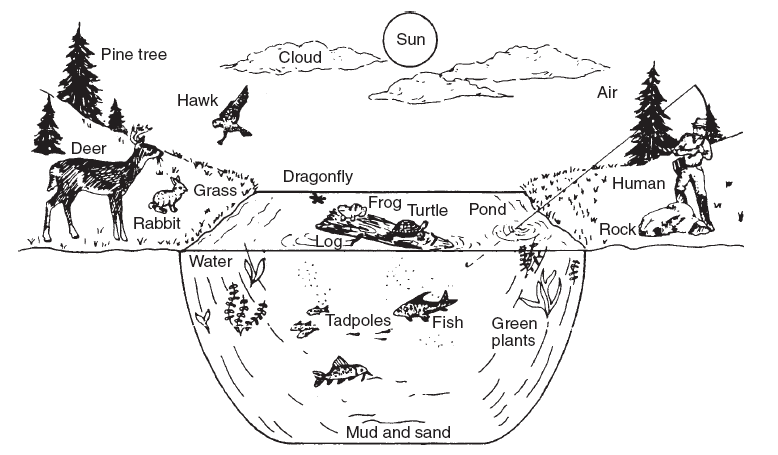
What is the primary source of energy for the ecosystem pictured above?
Grass and Green plants
Hawks and Deer
Tadpoles and Fish
Sun
Organisms that obtain energy by feeding on other organisms
Producer
Consumer
Decomposer
Organisms that break down wastes and dead organisms and return the raw materials to the environment
Producer
Consumer
Decomposer
Which of these shows a possible food chain for an ecosystem?
shark--> fish --> plankton -->sun
sun --> plankton --> fish --> shark
plankton --> sun --> fish --> shark
plankton --> fish --> shark --> sun
A biotic factor is
any living thing in an ecosystem
any non living thing in an ecosystem
all the members of one species
sunlight




What would happen to the bird if the green fish died out?
the bird population would grow
the bird population would die out
the smaller fish will die out
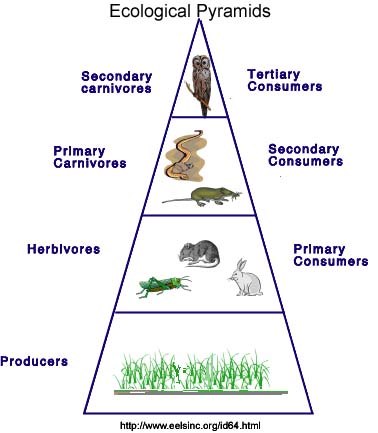
What is the bottom layer of the an energy pyramid?
producer
tertiary consumer
Secondary consumer
primary consumer
the top layer of an energy pyramid a primary consumer?
true
false
What does an energy pyramid show?
Energy flow in a community
Longest lifespans
The stronger animal the higher it is on the pyramid
What would happen if their were no producers?
Every population would grow larger
Everything would die out
The animals would make their own food
decomposers are producers.
true
false
Which is a producer?
Deer
Tall grass
Lion
Worm

What is this called?
Food Web
Abiotic Factors
Food Chain
None of the above

What is this called?
Food Web
Food Chain
Abiotic Factors
None of the above
If a frog is the prey, what could be the predator?
Grass
Insect
Snake
Snail
What does a Primary Consumer eat?
Tertiary Consumers
Secondary Consumers
Producers
None of the above

An organism that lives by breaking apart dead organic matter into simpler parts is...
Scavenger
Consumer
Decomposer
Carnivore
A third-level consumer has to be which type?
Carnivore
Decompser
Producer
Herbivore

An animal that eats other animals is a....
Carnivore
Omnivore
Herbivore
Decomposer
In a food web, arrows point at:
who gets energy
who get eaten
Both of the above
None of the above

What does a food web represent?
All connections of energy flow throughout all organisms in a ecosystem.
The specific ways that mutualism is carried out.
A single pathway or energy flow between organisms.
How carnivores get their food.
Bacteria, fungi, and earthworms are examples of:
Scavengers
Predators
Prey
Decomposers

Which of the following is a herbivore?
Cricket
Frog
Hawk
Shrew
A community of living and nonliving things in their natural environment makes up a
Food Web
Eco System
Food Chain
None of the above

__________ is an organism that only eats meat for energy.
Omnivore
Borivore
Carnivore
Herbivore

__________ is an organism that eats BOTH plants and animals for energy.
Omnivore
Darnivore
Carnivore
Herbivore

Bears eat fish, insects, plants, seeds, nuts and young elk. They are called __________.
Franivore
Carnivore
Herbivore
Omnivore
A hawk needs to eat many mice and rabbits becasue
there are lots of mice and rabbits in an ecosystem
the hawk gets only part of the energy from animals it eats
the hawk in a part of a large food web

Which of these organisms would receive energy from the snake?
Plant
Rabbit
Mouse
Hawk
An animal that eats only animals is called:
Consumer
Omnivore
Herbivore
Carnivore
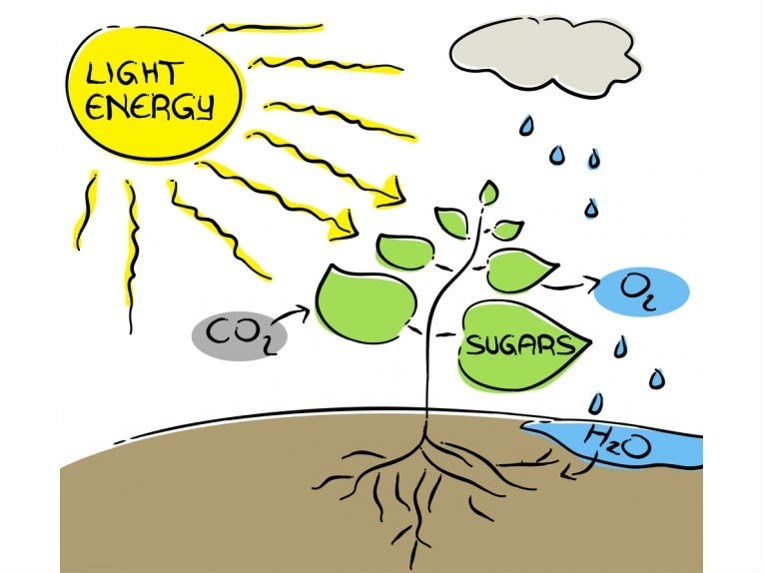
What is the source of energy for plants to make food?
other plants
the sun
the moon
animals
What do plants need to make food?
water & oxygen
water & carbon dioxide
oxygen & dirt
carbon dioxide & oxygen
How do plants get the water they need to make food?
roots bring water in from the soil
the leaves bring water in from the air
the flowers collect water
seeds spread out to find water
What is the food that plants make called?
glucose
oxygen
leaves
carbon dioxide
Glucose is a kind of --
meat
air
sugar
leaf
Which shows the REACTANTS for photosynthesis?
oxygen & carbon dioxide
dirt & oxygen
water & carbon dioxide
carbon dioxide & leaves
Which gas do plants release during photosynthesis?
oxygen
carbon
helium
carbon dioxide
What are the PRODUCTS of photosynthesis?
oxygen & glucose
carbon dioxide & oxygen
glucose & carbon dioxide
glucose only
How are plants beneficial to animals?
they eat harmful animals
they provide oxygen & food for animals
they provide carbon dioxide for animals
they produce glucose for animals to eat

