
 Worksheets
Semester 1 Review (Science)
Total questions: 63
Worksheet time: 47mins
When friction between two objects causes electrons to build up on one object it is called
electric charge
electric force
electric drive
gravity
When electrons suddenly jump from the object they have built up on that is called static discharge.
True
False
Static electricity is the _______________ form of electricity.
human-harnessed (man-made)
natural
Where does static electricity happen?
where there are electrical wires
anywhere electric charges build up
only in outer space
underground
Lightning can only travel from the sky to the ground.
True
False
Lightning happens when there is
static discharge
static distancing
electric fencing
not enough electric charge
Click all that are examples of getting an electric shock from static electricity.
person shocking another person by touching them
person getting shocked by touching metal frame as they are getting off a trampoline
person getting shocked by grabbing an electric fence
person getting shocked by holding a live electrical wire
Electric force causes electrically charged objects with opposite charges to
attract
repel
All examples of static cling happen in a clothes dryer.
True
False
In order for static electricity to cause your hair to stand up, your hairs must all have the
same charge
different charges
no charge at all

Tasha made this model. In her model the bulb is not lit.
Which of these statements best explains why the bulb is not lit?
The wires are connected to the wrong battery terminals.
The bulb is burned out.
The switch is open.
A wire is missing.

Eileen tried each of these setups to make a working circuit.
In which setup would the bulb light?
Setup A
Setup B
Setup C
Setup D
Adam made a circuit. His light bulb did not light up. Which of these could NOT be the cause?
open switch
dead battery
closed circuit
loose connection
Alicia turned on a light switch. What does turning a switch on do?
open a circuit, allowing electricity to flow
close a circuit, allowing electricity to flow
open a circuit, stopping electricity from flowing
Close a circuit, stopping electricity from flowing
Ashley is classifying some objects as conductors or insulators. What is the difference between conductors and insulators?
A conductor allows electrical current to flow through it easily, while an insulator does not.
An insulator allows electrical current to move through it easily, while a conductor does not.
A conductor has a static charge, while an insulator does not.
An insulator is a metal, while a conductor is not a metal.

Four students are planning to do science projects. Only one of the projects is an experiment. Which student is doing an experiment?
Selene
Walden
Mya
Sasha
Mariella knows that copper is a good conductor of electricity. Why might a gold coin also be a good conductor?
It is also a metal.
It has a shiny surface.
It resists current flow.
It bends easily.

Kala wants to make a simple circuit with a battery, a lightbulb, and a switch. She connects the lightbulb to the switch with one wire, and the batter with another wire, as shown in the picture.
To have the lightbulb turn on, Kala must do one last step before closing the switch. Which step must she do?
Add a wire connecting point A to point D.
Add a wire connecting point A to point B.
Add a wire connecting point C to point A.
Add a wire connecting point D to point B.
Richard designed an experiment to test different materials to determine if they were an insulator or a conductor. He tested a wooden Popsicle stick, a plastic spoon, a metal spoon, and an eraser. He set up a simple circuit connecting a battery to a light bulb with a small gap. One at a time he connected the circuit with the chosen test materials and recorded whether the light bulb came on.
Based on what you know about electrical conductors, which material made the bulb shine?
The wooden Popsicle stick
A plastic spoon
A metal spoon
An eraser
Pam’s teacher asked her group to design a simple electric circuit.
What materials would be necessary for Sam and her group to complete a simple circuit to turn on a bulb?
Battery, wire, and bulb
Battery and bulb
Wire, bulb, and switch
Battery, wire, and switch
Which of the following is an example of human-harnessed electricity?
Lightning striking a building
Getting a small shock when touching a doorknob
A hydroelectric dam
Socks sticking together in a dryer

The diagram shows an electrical circuit.
What object below could be placed in the open space to act as a conductor and complete the circuit?
penny
toothpick
eraser
crayon
What is one disadvantage to having an electromagnet?
An electromagnet is a magnet that can be turned off and on.
An electromagnet is much less expensive than a permanent magnet.
An electromagnet is always stronger than a permanent magnet.
An electromagnet needs a power source to operate.
Based on your knowledge of electromagnets and permanent magnets, why would cranes in a junk yard use an electromagnet instead of a permanent magnet?
Because an electromagnet is always stronger than a permanent magnet
Because an electromagnet is always weaker than a permanent magnet
Because only the electromagnet attracts metal
Because the electromagnet can be turned on and off

The image shows a magnet with iron filings on a piece of paper. Where is the magnetic field the strongest?
The magnetic fields are the strongest in the middle of the magnet.
The magnetic fields are the strongest under water.
The magnetic fields are strongest at the poles.
The magnetic fields only have strength at night.

Students are investigating to see if magnets will attract objects through different materials. They observe that the setup shown works and that the magnet attracts the object.
The object will most likely still be attracted to the magnet if which of the following changes occur?
The magnet is moved much farther away from the glass.
The glass is replaced by a piece of paper.
The nail is replaced with a plastic spoon.
The glass is replaced with a thick piece of wood.


Which of the following is the best insulator?
metal paper clip
wood log
bowl of water
penny
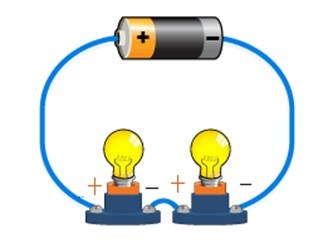
What will happen when you remove a bulb from the circuit pictured?
The other bulb will become brighter.
The other bulb will turn off.
The other bulb will become dimmer.
It will remain a closed circuit.

In the drawing of the electromagnet, A is the
battery
wires
metal nail
negative charges
When two substances are mixed together but their properties do not change they are called a
mixture
solution
chemical change
When one substance reacts with another it is a ____ change.
chemical
physical
If you put your skittle candy on a plate with water the color will come off. What type of change is this?
chemical
physical
Using a hot plate to heat a solid until it changes color and releases an odor would provide evidence of a chemical change because the particles cannot be changed back. This is what type of change?
chemical
physical
Substances that change in appearance but not in composition are an example of a ___ change.
chemical
physical
When two substances are combined and create their own heat and light, this is a _______ change.
chemical
physical

What is the process of breaking down rocks, soil, and minerals through exposure to the atmosphere and environmental factors?
Weathering
Erosion
Deposition
None of the above
Which process is responsible for the wearing away of rocks and soil by wind, water, or ice?
Earthquakes
Erosion
Volcanic Activity
Landforms
Which process is responsible for rapid alterations in the Earth's surface caused by natural events like earthquakes or volcanic eruptions?
Erosion
Deposition
Fast Changes
Fu

A teacher set up the model shown to represent the formation of a landform. What landform does this model most likely represent?
Delta
Cave
Canyon
Sand dune

A canyon with tall, vertical sides is shown. Which of the following most likely led to the formation of this canyon?
Rapidly moving water
A hurricane
Burrowing animals
Volcanic activity
The student created a model for his Science Class. Which model best represents the formation of a delta?
A student carefully placed pieces of gravel in a hill.
A student set up a tray of sand and blew through a straw to form a hill of sand.
A student poured water into a stream table filled with dirt and observed sediments get deposited at the end of the table in a triangular shape.
A student packed damp sand in a tray then scraped a large ice cube along the bottom.

A wide, round-bottom valley is shown below. This valley was most likely formed by –
Tornadoes
Glacial movement
Flash flooding
Deposition by the wind


A glacier deposited large amounts of sediment after it had melted. Is this an example of a constructive or destructive force?
constructive
destructive
Is the example below describing a constructive or destructive process?
A sand dune is created at the beach.
constructive
destructive
Is the example below describing a constructive or destructive process?
Waves eroded away the sand of the beach.
constructive
destructive
Is the example below describing a constructive or destructive process?
A volcano erupts and erodes the top of the mountain away...
constructive
destructive
Which of the following can help prevent mudslides?
sand
wind
plants
rain
Why are barrier islands important along the Georgia coastline?
protects our beaches from erosion
makes for a great vacation spot
stops sharks from coming too close to the shore
What are two ways scientist control flooding?
volcanoes, mountains
levees, dams
dunes, sandbars
people, animals

