
Font size
 Worksheets
Energy Test
Total questions: 71
Worksheet time: 46mins
What is the unit of measurement for work?
meters
newtons
m/s
Joules
You have to push with 15 N of force to move it 10 meters. How much work do you do?
15 Joules
150 Joules
1.5 Joules
.67 Joules
500 J of work is done by a person who uses a force of 50N to move a box, how far does it go?
10 m
0.1 m
25,000 m
10 J
Newtons are the unit for _____________.
Work
Distance
Acceleration
Force
Picking up a box is an example of____________
Work
Not Work
You exert 200 J of work by pulling on an object with 20 N of force. What distance is the object moved?
.01 m
10 m
10 J
4,000 m
Power is measured in ___________.
meters
joules
newtons
watts
The law of Conservation of Energy says________
energy is constantly created
energy can not be created or destroyed instead it changes from one form to another
energy can not change forms

What is the total mechanical energy for the position of the ball indicated by the blue circle?
0 J
50 J
100 J

What is the total mechanical energy that the ball would have when it is in the position indicated by the blue circle?
0 J
50 J
100 J

How much kinetic energy would the ball have at the position indicated by the blue circle?
0 J
50 J
100 J
If the ball has a mass of 4kg, what would be the velocity of the ball at the position indicated by the blue circle?
KE = 21mv2
0 m/s
5 m/s
25 m/s
If the direction an object is displaced is the same as the direction of a force applied to it:
Positive work is done.
Negative work is done.
No work is done.
If the direction of an applied force is anti-parallel (opposite) to the direction an object is moving:
Negative work is done.
Positive work is done.
No work is done.
If the direction an object is displaced is perpendicular to the direction of a force applied to it:
No work is done.
Positive work is done.
Negative work is done.
How much power is required to do 40.2 J of work in 3.3 s?
12.18 W
132.66 W
43.5 W
0.08 W
The lineman push on the weighted sled to accelerate it across the football field. Is this an example of positive, negative or zero being done on the sled?
Positive
Negative
Zero
Aaron pulls on the handle of the locked classroom door but fails to open it. Is this an example of positive, negative or zero being done on the wall?
Positive
Negative
Zero
Lamar Gant, U.S. powerlifting star, became the first man to deadlift five times his own body weight in 1985. Deadlifting involves raising a loaded barbell from the floor to a position above the head with outstretched arms. Determine the work done by Lamar in deadlifting 300 kg to a height of 0.90 m above the ground.
2.6 x 10³ J
4.8 x 10³ J
1.5 x 10³ J
3.7 x 10³ J
During the Powerhouse lab, Jerome runs up the stairs, elevating his 102 kg body a vertical distance of 2.29 meters in a time of 1.32 seconds at a constant speed. Determine the work done by Jerome in climbing the stair case.
2.30 x 10³ J
2.35 x 10⁵ J
2.42 x 10³ J
2.6 x 10³ J
During the Powerhouse lab, Jerome runs up the stairs, elevating his 102 kg body a vertical distance of 2.29 meters in a time of 1.32 seconds at a constant speed. Determine the power generated by Jerome.
1.73 x 10³ W
1.48 x 10³ W
1.91 x 10³ W
1.27 x 10³ W
You do work against gravity when you walk up some stairs.
True
False
Which is the best example that something has kinetic energy?
a car parked on a steep hill
a tennis ball rolling across the court
a picture hanging on the wall
a piece of coal before it's burned

Kinetic energy is...
energy carried in ultraviolet waves
energy stored in food
energy in motion
energy from splitting an atom

The faster an object moves, the ________ kinetic energy it has.
more
less
none of the above
all of the above

Which letter shows where kinetic energy is stored or at its maximum point?
Y
W
X
Z

Where does this roller coaster have the MOST KINETIC energy?
A
B
C
D

When Gabriel sleds down this hill, when is his Kinetic Energy the LEAST?
1
2
3
4

Which number shows kinetic energy at its maximum?
three
two
four
five
A stretched rubber band represents what type of potential energy?
gravitational potential energy
elastic potential energy
chemical potential energy
kinetic potential energy
Work Done =
F x d
GPE =
m x g x h
Kinetic Energy =
0.5 x m x v2
Elastic Potential Energy =
0.5 x k x e2
Speed =
d / t
Energy stored because of gravity is called:
Gravitational Potential Energy
Kinetic Energy
Mechanical Advantage
Chemical Energy
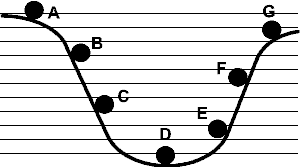
At which point does the ball has the greatest gravitational potential energy (GPE)?
A
G
D
C
G
Which would have the LEAST gravitational potential energy (GPE)?
A ball sitting on the ground
Moon viewed from the Earth
An airplane flying 30,000 feet above the ground
A rock sitting on top of Mt. Everest

You throw a ball into the air as shown in the diagram. At what point does the ball have the most gravitational potential energy?
W
X
Y
Z

At which position does the child on the swing have the most gravitational potential energy?
W
X
Y
Z

At which point on the roller coaster is the gravitational potential energy the greatest?
W
X
Y
Z
Which of the following is the correct equation for calculating an object's gravitational potential energy?
PE = mgh
PE = mg / h
PE = mg + h
PE = gh
Calculate the gravitational potential energy of a car with a mass of 1300kg at the top of a 52m high hill.
4.86 x 10⁵ J
6.56 N
6.62 x 10⁵ J
None of the answers are correct
Calculate the gravitational potential energy of a 65kg climber on top of Mount Everest (8800m high).
6.86 x 10⁵ N
7.20 x 10⁶ J
5.61 x 10⁶ J
None of the answers are correct
A diver has 3400J of gravitational potential energy after stepping up onto a diving platform that is 6 meters above the water. What is the divers mass in kilograms?
85kg
64m
58kg
None of the answers are correct

What is the GPE at point A
14 J
12 J
6 J
8 J

What is the KE at point B?
14 J
12 J
6 J
8 J

What is the Total Energy of the system?
14 J
12 J
6 J
8 J

What is the KE at point D?
14 J
12 J
6 J
8 J

What is the GPE at point E?
14 J
12 J
6 J
8 J

What is the Total Mechanical Energy at point A?
500,000 J
400,000 J
200,000 J
50,000 J
What is the Kinetic Energy at point B?
500,000 J
400,000 J
300,000 J
50,000 J
What is the Kinetic Energy at point C?
500,000 J
400,000 J
300,000 J
50,000 J
What is the Kinetic Energy at point D?
500,000 J
250,000 J
300,000 J
50,000 J
What is the GPE at point E?
500,000 J
250,000 J
300,000 J
100,000 J
What is the GPE at point F?
500,000 J
250,000 J
300,000 J
0 J
What is the KE at point F?
500,000 J
250,000 J
300,000 J
0 J

What is the KE 1/4th of the way down?
15,000 J
3,750 J
7,500 J
11,250 J
What is the KE 1/2 of the way down?
15,000 J
3,750 J
7,500 J
11,250 J
What is the KE at the bottom?
15,000 J
3,750 J
7,500 J
11,250 J
An object that is moving has
chemical energy
chemical energy
potential energy
kinetic energy
elastic energy

As a pendulum swings from its highest to lowest position, what happens to its kinetic and potential energy?
The PE and KE increase and decrease together
The PE decreases while the KE increases
Impossible to know without knowing the mass
The PE and the KE decrease and increase together.

At which point in the picture must the cart have the most MECHANICAL energy?
Point 1
Point 2
Point 3
They would all be the same
Match the following Types of Energy with their equation
Kinetic Energy
21mv2
Gravitational Potential Energy
mgh
Elastic Potential Energy
21kx2
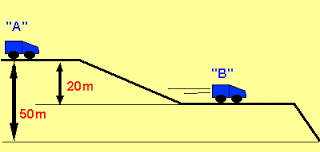
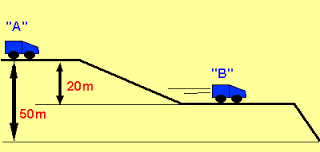
In diagram 2, if the mass of the car is 600 kg, what is the change in potential energy from point A to point B?
411,600 J
294,000
176,400 J
117,600 J
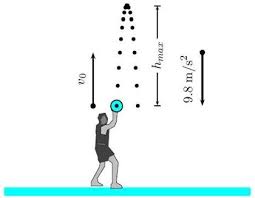
If a 0.5 kg ball is thrown up with 250 J of kinetic energy, how high will it go?
(HINT: At the ball's highest point it has stopped.)
KE = 1/2mv2 , PE = mgh
g = 9.8 m/s2
51 m
25.5 m
12.76 m
31.6 m
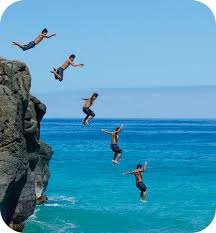
A cliff diver with a mass of 125 kg jumps off a 50m high cliff, how fast will he be traveling just before he hits the water? (His height at this point is 0m)
(HINT: Find PE first. then KE = 1/2mv2
g = 9.8 m/s2
61,250 m/s
980 m/s
31.3 m/s
247.5 m/s

Where will the roller coaster have the most total mechanical energy? Check all that apply. Neglect friction and air resistance.
1
2
3
4

The skateboarder shown above has a potential energy of 2,800 J and kinetic energy of 0J at a height of 4 meters. How much total mechanical energy will she have after 2 seconds? Neglect friction and air resistance.
2000J
1600J
1400J
2800J

