
 Worksheets
Science Benchmark 3 Review
Total questions: 58
Worksheet time: 1hrs 14mins


CHOFeNaNPb
How many elements are in this compound?

Humans feel hungry when their empty stomachs contract and when glucose levels in the blood drop. Both of these situations stimulate neurons that send messages to the brain which are interpreted as hunger. What body systems are involved in this process as described?
digestive, muscular, integumentary, and respiratory
digestive, excretory, integumentary, and respiratory
circulatory, excretory, nervous, and skeletal
circulatory, digestive, muscular, and nervous
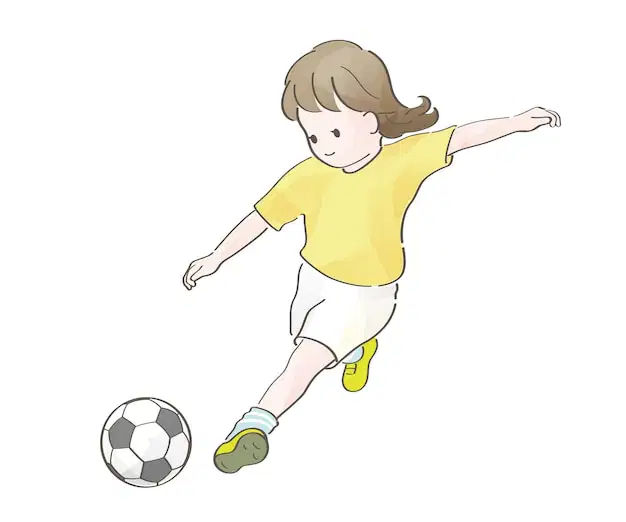
The diagram shows a possible movement in the human body.
Which body systems would best coordinate this movement?
A nervous, muscular, and skeletal
B circulatory and respiratory
C nervous and respiratory
D excretory, circulatory, and respiratory
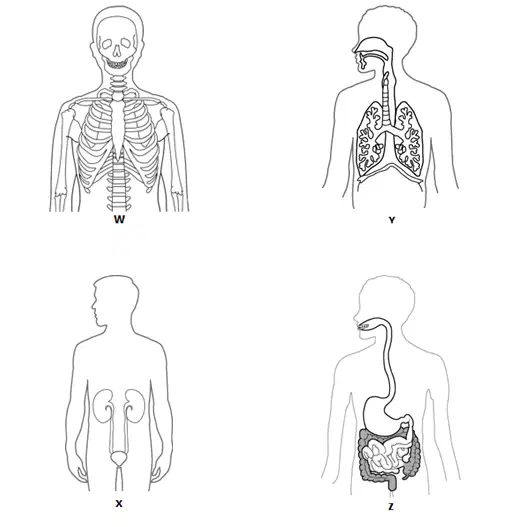
The images show different human body systems.
With which systems does the circulatory system
interact to help remove wastes from the body?
W and Y
W and Z
X and Z
X and Y
A particular mountain stream is home to a population of salamanders that are red in color. In the past year, a second population of salamanders that are dark blue in color moved into the same stream. Scientists researching the stream have recently discovered young salamanders that are red with dark blue patches on their bodies.
What can the scientists conclude from this evidence?
A The salamanders are suffering from a bacterial disease.
B The salamanders are on the verge of becoming extinct.
C The salamanders undergo asexual reproduction.
D The salamanders undergo sexual reproduction.
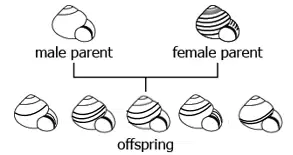
A female parent snail with a striped shell and a male parent with no stripes produce five offspring, as shown.
Which statement best explains the reason for variation among the offspring?
A In sexual reproduction, only the male parent passes genes to the offspring.
B In sexual reproduction, only the female parent passes genes to the offspring.
C In sexual reproduction, offspring inherit genes from both parents, and each offspring has a new combination of traits.
D In sexual reproduction, the male parent passes its genes to male offspring, and the female parent passes its genes to female offspring.
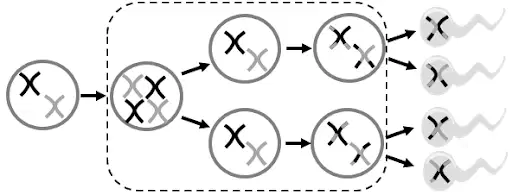
How does the process inside the box on the model influence the genes of an offspring?
A The process creates new genes, which increases the genetic variation in the offspring.
B The process exchanges genes, which results in genetic variation in the offspring.
C The process duplicates chromosomes, which results in more genetic information in the offspring.
D The process removes chromosomes, which results in less genetic information in the offspring.

Which stage of Mitosis is being shown and described:
Chromosomes line up in the middle.
interphase
prophase
metaphase
anaphase

Which stage of Mitosis is being shown and described:
Daughter cells are pinched apart and parent cell's cytoplasm is divided between the 2 new cells.
Cytokinesis
Metaphase
Anaphase
Telophase

Which stage of Mitosis is being shown and described:
The nucleus begins to disappear and chromosomes form.
Telophase
Anaphase
Prophase
Interphase

Which stage of Mitosis is being shown and described:
Chromosome pairs are split and tugged to opposite ends of the cell
Prophase
Metaphase
Anaphase
Telophase

What stage of Mitosis is being shown and described:
Cell carries out its normal functions, grows and prepares to divide, and the DNA is copied/duplicated.
Interphase
Telophase
Anaphase
Prophase

What stage of Mitosis is being shown and described:
New nuclear membrane begins to form around each new nucleus and the cell is pinched.
Anaphase
Telophase
Metaphase
Cytokinesis

What stage of Meiosis is being shown and described:
The homologs of each chromosome pair separate and are pulled to opposite ends
Prophase 1
Metaphase 1
Anaphase 1
Telophase 1

What stage of Meiosis is being shown and described:
Copied pairs partner up, chromosomes condense and nuclear membrane disappears.
Prophase 1
Metaphase 1
Anaphase 1
Telophase 1

What stage of Meiosis is being shown and described:
The pairs line up in the center of the cell.
Prophase 1
Metaphase 1
Anaphase 1
Telophase 1

What stage of Meiosis is being shown and described:
Cell divides into 2 daughter cells. (2n...Diploid cells)
Prophase 1
Metaphase 1
Anaphase 1
Telophase 1

What stage of Meiosis is being shown and described:
Each chromosome is made up of 2 copies of a homolog/2 chromatids
Prophase 2
Metaphase 2
Anaphase 2
Telophase 2

What stage of Meiosis is being shown and described:
Chromatids split forming individual chromosomes and are pulled to opposite ends of the cell.
Prophase 2
Metaphase 2
Anaphase 2
Telophase 2

What stage of Meiosis is being shown and described:
Both cells divide producing 4-1n cells (haploid) containing half the number of chromosomes
Prophase 2
Metaphase 2
Anaphase 2
Telophase 2

What stage of Meiosis is being shown and described:
Each chromosome lines up in the middle of the cell.
Prophase 2
Metaphase 2
Anaphase 2
Telophase 2
Involves two parents
External fertilization
Internal fertilization
Sexual reproduction
Asexual reproduction
The joining of male sex cells and female sex cells
Asexual reproduction
Fertilization
Pollination
Internal fertilization
Type of reproduction where each parent gives 50% of their genetic material to offspring
Asexual reproduction
Sexual reproduction
Internal development
External development
Lots of offspring are created in a short amount of time during
Asexual reproduction
Sexual reproduction
Both
Which has the most genetic variation (unique offspring)?
Asexual reproduction
Sexual reproduction
Both
Which processes help to cycle carbon through ecosystems?
cellular respiration and photosynthesis
photosynthesis and transpiration
transpiration and the calvin cycle
calvin cycle and krebs cycle
How many oxygen atoms are in the products for the chemical reaction below?
4Fe + 3O2 → 2Fe2O3
2
3
5
6
The Law of Conservation of Mass says that matter can neither be __________ or __________.
created; destroyed
recycled; renewed
subtracted; added
joined; separated
How many atoms are in the products below?
4Fe +3O2 → 2Fe2O3
7
10
17
20
H2 + O2 --> H2O
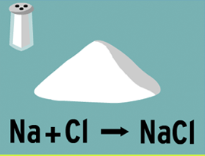
When sodium and chlorine combine to form sodium chloride, sodium chloride is the:
Originator
Reactant
Product
Produce

