
Font size
 Worksheets
Digestive and Excretory
Total questions: 35
Worksheet time: 20mins
The colon is another name for which structure?
Stomach
Pancreas
Large intestine
Small intestine
Which of the following correctly matches the subdivision of the small intestine with its role?
Critical vitamins are mainly absorbed in the ileum.
The majority of chemical digestion occurs in the duodenum.
Nutrients are mostly absorbed into the blood from the jejunum.
All of the above are accurate matches of structure to function.
In which of the following structures does chemical digestion not occur?
Mouth
Esophagus
Small intestine
Stomach
Which of the following structures creates a substance that makes it possible for us to digest fats?
Pancreas
Liver
Small intestine
Stomach
Which of the following structures secretes enzymes that help us digest carbohydrates, lipids, and proteins?
Liver
Mouth
Pancreas
Large intestine
The hepatic portal system includes the which takes in nutrient-filled blood from the digestive tract and sends it towards the heart through the to be oxygenated.
hepatic portal vein; inferior vena cava
hepatic artery proper; inferior vena cava
hepatic portal vein; superior vena cava
hepatic artery proper; superior vena cava
Which of the following accurately reflects the order in which the bolus travels through the small intestine?
Ileum ->
jejunum
->duodenum
Jejunum-> duodenum-> ileum
Duodenum-> ileum-> jejunum
Duodenum-> jejunum->ileum
Which of the following organs does not serve as a temporary storage reservoir for a substance in the digestive or urinary systems?
Rectum
Bladder
Pancreas
Gallbladder
Which of the following statements about the digestion of macromolecules is false?
Lipids and proteins get broken down into fatty acids and amino acids.
Absorbed molecules are transported in capillary blood to the liver before heading to the heart.
The chemical digestion of carbohydrates begins in the mouth.
Pepsin secreted by stomach glands, along with pancreatic enzymes, are essential in the digestion of proteins.
Which statement below correctly matches the structure with its function?
The rectum opens to the exterior of the body where feces is eliminated.
The gallbladder stores and concentrates bile that isn’t immediately needed.
The small intestine mechanically and chemically digests our food until it is considered to be chyme.
The pharynx connects the oral cavity to the stomach.
Which statement below correctly describes an endocrine function of the pancreas that aids in digestion?
Acinar cells secrete pancreatic enzymes into the stomach.
Duct cells secrete bicarbonate and water into the small intestine.
Antidiuretic hormone (ADH) is released through the pancreatic duct to aid in osmoregulation.
Pancreatic islets release insulin and glucagon to aid in carbohydrate metabolism.
Which of the following statements about the large intestine is false?
It is the main site of absorption in the alimentary canal.
It removes water that remains in waste.
It is subdivided into the ascending, transverse, and descending portions.
It contains a wide variety of bacteria that aid in digestion.
Reactions that link simple molecules into more complex ones are and result in an overall of energy.
anabolic; absorption
catabolic; absorption
anabolic; release
catabolic; release
Glucose serves as our body’s main energy fuel during the nutritional state. Body reserves serve as our body’s main energy fuel when the GI tract is .
absorptive; full
postabsorptive; full
absorptive; empty
postabsorptive; empty
1. Which of the following is not considered an essential nutrient?
Water
Nucleic acids
Minerals
Proteins
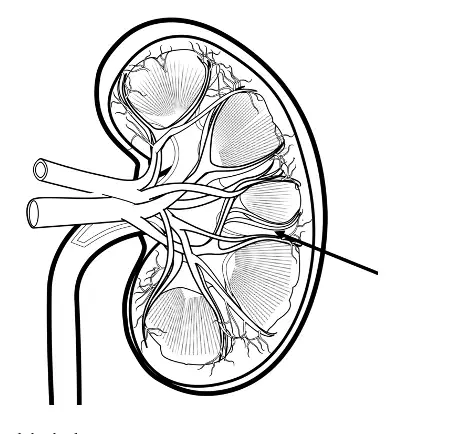
The portion of the kidney indicated by the arrow in the figure to the right between the pyramid like shapes is the
fibrous capsule.
renal medulla
renal pelvis
renal column
Which of the following is not considered a major function of the kidney?
Regulation of blood pressure.
Red blood cell production.
Regulation of blood pH.
Retaining nutrients the body needs.
All of the above are functions of the kidney.
When a substance in the blood is moved from the capillaries into the filtrate, this is known as
absorption
reabsorption
secretion
micturition
Which of the following structures acts as a mechanical filter between the blood and Bowman’s capsule?
Glomerulus
Proximal convoluted tubule
Distal convoluted tubule
Loop of Henle
A patient is admitted to the ER complaining of immense pain. An ultrasound indicates the presence of a kidney stone. Which of the following best describes the main location of the patient’s pain?
Medially, in the lower pelvis.
On the side, just anterior to the liver.
In the dorsal body wall, lateral to the vertebral column.
In the thoracic cavity, lateral to the heart.
Explain the main function of the small intestine and two ways its structure aids in accomplishing this function.
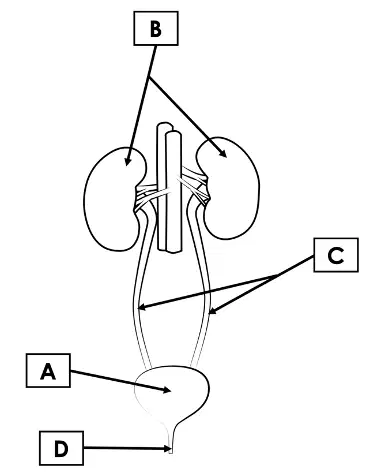
Identify structure A
Bladder
Kidneys
Ureters
Urethra
Identify structure B
Bladder
Kidneys
Ureters
Urethra
Identify structure C
Bladder
Kidneys
Ureters
Urethra
Identify structure D
Bladder
Kidneys
Ureters
Urethra
What are the main functions of the excretory system?
deliver oxygen to the body
deliver nutrients to the body
remove water and waste from the body
remove disease from the body

Name structure A
Collecting duct
Proximal convoluted tubule
Distal convoluted tubule
Glomerulus

Name Structure B
Bowmans Capsule
Loop of Henle
proximal Convoluted tubule
Collecting duct

Name structure D
Glomerulus
Bowmans Capsule
Collecting duct
Loop of henle

Select which statements describe how the structure of A is related to its function:
Thin to shorten the diffusion pathway
Large blood supply to increase rate of diffusion
Permeable membrane to allow for increase in rate of diffusion
All of the above

What is the function of structure A?
For the selective re-absorption of glucose
To filter the small molecules in the blood to create the glomerular filtrate
For osmoregulation
Which organ is part of the alimentary canal?
teeth
pancreas
stomach
liver
Salivary amylase is an enzyme that breaks down ___ in the ___.
fats; mouth
carbs; mouth
proteins; mouth
carbs; stomach
The involuntary, wave-like muscle contractions that move food in the correction direction in the digestive tract is referred to as:
chyme
deglutition
peristalsis
voluntary waves
What is the function of bile?
thick mucus that protects the mucosa
detergent that emulsifies fats
serves to decrease the pH (increase acidity) in the stomach
serves to increase the pH (increase alkalinity) in the small intestine

