
NEW
Font size
 Worksheets
Q3 Final Review
Total questions: 40
Worksheet time: 1hrs 11mins
Actual yield = 62g
Calculate the percent yield.
What is the limiting reactant is 12 moles of P4 react with 15 moles of O2?
CH4 + 2O2 --> 2H2O + CO2
What is the volume of CO2 produced when 16g of O2 reacts?
1.09 L
5.6 L
11.2 L
45.7 L


How many grams of aluminum sulfate would be formed if 250g H2SO4 completely reacted with aluminum?
Fe2O3(s) + 3H2(g) → 2Fe(s) + 3H2O(l)
How many moles of iron can be made from 6 moles H2?
According to the kinetic molecular theory, which statement describes the particles in a sample of an ideal gas?
The particles have attractive forces between them.
The particles are considered to have negligible volume.
The particles are constantly moving in circular paths.
The particles collide, decreasing the total energy of the system.
A sample of a gas in a rigid cylinder with a movable piston has a volume of 11.2 liters at STP. What is the volume of this gas at 202.6 kPa and 300. K?
22.4 L
5.10 L
24.6 L
6.15 L
Which phrase describes the motion and attractive forces of ideal gas particles?
random curved-line motion and no attractive forces
random straight-line motion and strong attractive forces
random straight-line motion and no attractive forces
random curved-line motion and strong attractive forces
Which graph best represents the pressure-volume relationship for an ideal gas at constant temperature?


At approximately what temperature does the solubility of sodium chloride, NaCl, match the solubility of potassium dichromate, K2Cr2O7?
60oC
30oC
50oC
83oC
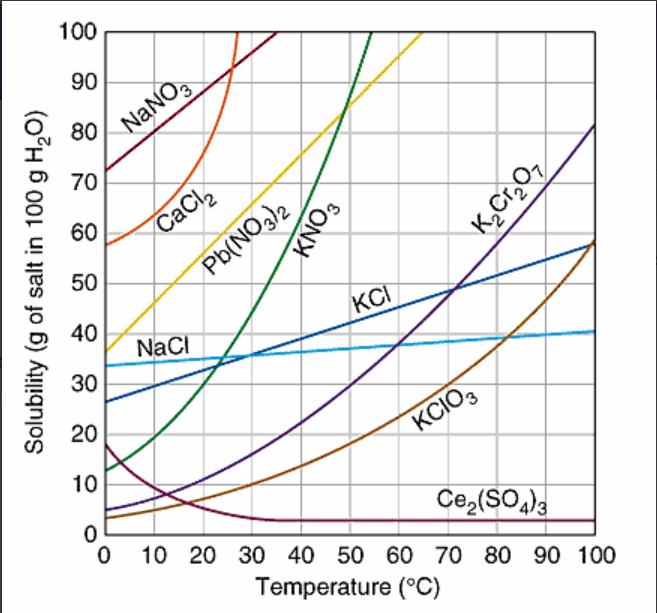
When 42 grams of potassium chloride, KCl, is dissolved in 100 grams of water at 50oC, the solution can be correctly described as:
supersaturated
saturated
unsaturated
Which solute does not increase in solubility as the temperature increase?
NaCl
SO2
KClO3
KNO3
You can make a solute dissolve more quickly in a solvent by
adding more solute
adding ice
heating the solvent
removing some solvent
Why does stirring a solute increase the rate of dissolving?
It increases the amount of fresh solute that interacts with the solvent
It decreases the amount of fresh solute that interacts with the solvent
it increases the gravitational force between the particles
it increases the strong force between the particles
Why does increasing the temperature of a solution increase the rate of dissolving?
it increases the kinetic energy of the particles and causes more interaction between the solute and solvent
it increases the potential energy of the particles and causes more interaction between the solute and solvent
it decreases the kinetic energy of the particles and causes more interaction between the solute and solvent
it decreases the potential energy of the particles and causes more interaction between the solute and solvent
Which change will have the least effect on the solubility of a solid?
increase in temperature
increase in surface area
decrease in temperature
decrease in pressure
Which of the following pairs of solutions produces a precipitate when combined?
Cu(NO3)2 and NaCl
Fe(NO3)3 and MgCl2
Cu(NO3)2 and K2CO3
CaCl2 and NaNO3
When solutions of MgCO3 and Fe2(SO4)3 are combined, what precipitate(s) forms?
MgSO4
neither form a precipitate
MgSO4 and Fe2(CO3)3
Fe2(CO3)3
What is the molarity of a 0.5L sample of a solution that contains 60.0 g of sodium hydroxide (NaOH)
0.8 M
1.5M
3.0M
6.0M
Which of the following is the correct formula for calculating molarity?
moles/liters of solution
moles/kg of solvent
# particles/Avogadro's #
theoretical yield/actual yield
Which of the following types of solutions has more room to dissolve solute?
supersaturated
saturated
unsaturated
What is the molality of a solution in which 3.0 moles of NaCl is dissolved in 1.5 Kg of water?
2.0 M
0.22 m
135 m
2.0m
Electrolytes
don't conduct electricity
conduct electricity
Since "like dissolves like", water and oil will not mix because
both of them are polar
both of them are nonpolar
oil is polar and water is nonpolar
oil is nonpolar and water is polar

Attractions between the negative Oxygen atom of one water molecule and the positive Hydrogen atom of another water molecule are called
Covalent bonds
Ionic bonds
Hydrogen bonds
Polar bonds
What type of compounds is water able to dissolve?
ionic and polar covalent compounds.
polar covalent and nonpolar covalent compounds.
polar covalent compounds only.
ionic compounds only.
What would the molarity of a solution be if you took 10 mL of a 13M stock solution and made a 300 mL solution?
390M
230M
0.43M
0.26M
Which of the following is the Dilution Formula?
V1M1 = V2M2
M = m/V
V = mT
PV = nRT

