
 Worksheets
Study Guide for Earth's Systems Test - 6th
Total questions: 63
Worksheet time: 34mins
The movement of water into the air as water vapor and back to the Earth's surface as liquid or solid
sun
transpiration
water cycle
evaporation
major source of thermal energy that powers the water cycle.
sun
water cycle
evaporation
transpiration
thermal energy is absorbed by liquid water and changes to a gas called water vapor
sun
condensation
evaporation
precipitation
water vapor (gas) cools down and changes to liquid to form clouds.
condensation
water vapor
precipitation
runoff
water falling back to the Earth's surface as rain, sleet, hail or snow.
precipitation
evaporation
condensation
runoff
water that flows along the ground returning to rivers, ponds, lakes, and oceans.
runoff
groundwater
precipitation
accumulation
forms when water vapor cools down and the water condenses (Gas - Liquid)
cloud
water cycle
sun
transpiration

What is the role of the sun in the water cycle?
provide heat energy for evaporation
provide heat energy for condensation
dry out the soil for runoff to occur
provide thermal energy for accumulation

What process is shown by letter B in the diagram?
condensation
transpiration
evaporation
precipitation
During evaporation, water changes from a _________ to a __________.
solid, liquid
gas, liquid
liquid, gas
liquid, solid

What process is show by letter A in the diagram?
condensation
evaporation
accumulation
precipitation

What is shown by letter D in the diagram?
runoff
groundwater
melting
vapor

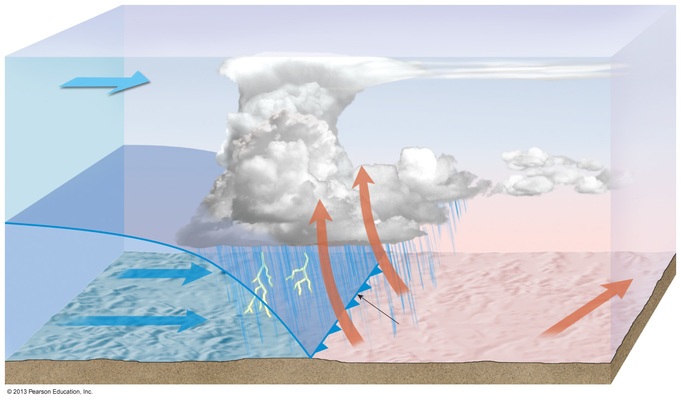

Overcast skies & mild precipitation is weather you'd see at what type of front?
warm
cold
What type of weather will you see along a cold front?
Thunderstorms
Sunny skies
Gentle rain
No weather
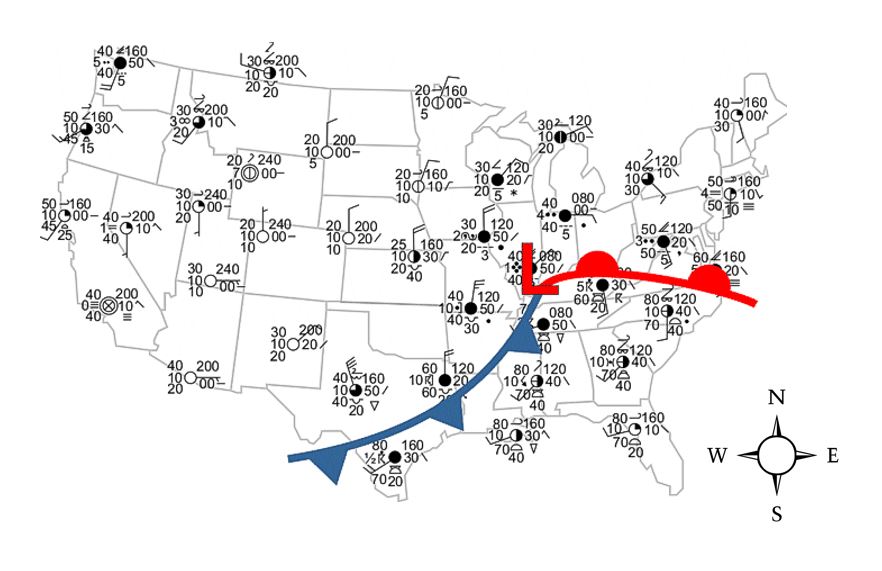

What city will experience decreasing temperatures in the next day?
Denver
El Paso
Memphis
Los Angeles


What causes a drought
Not receiving Water or snow
The sun gets to hot
There is no sun
What kind of wind do hurricanes need to form?
Low wind
Strong wind

What is this?
tornado
hail
thunderstorm
dust storm

What is this?
flood
hail
thunderstorm
blizzard

What is this?
hurricane
blizzard
ice storm
dust storm
What are some types of extreme weather?
hurricanes
Floods
drought
All of the above
Where do most hurricanes form?
over the ocean near the equator
in the midwestern and southern United States
along warm fronts
along cold fronts
Which of the following statements about tornadoes is not true?
A tornado can be associated with thunderstorms.
Tornadoes can have wind speeds of over 150 miles per hour.
Tornadoes never actually touch the ground.
Tornadoes are common in hurricanes.
A prevailing wind in an area blows against a mountain range. Where would a drought most likely occur?
on the windward side of the mountain range
on the leeward side of the mountain range
on top of the mountain range
all around the bottom of the mountain range
What is a flash flood?
a flood that is caused by a water spout
a flood where the water disappears quickly
a flood that occurs without any rainfall
a flood in which the water rises suddenly
What is climate?
the condition of the atmosphere at any given time and place
cloud cover and temperature
precipitation and humidity at a given time and place
weather conditions in an area over a long period of time
Climate is affected by many factors including:
latitude, elevation, and proximity to bodies of water
tides and currents
wind
snow and sleet
The side of a mountain range that faces the oncoming wind and receives precipitation:
Climate
Windward
Leeward
Monsoon
The side of a mountain range that faces away from the wind and receives little to no precipitation:
Windward
Leeward
Monsoon
Climate


The driving force of the Water Cycle is?
The troposphere
The Sun
The oxygen
The clouds

How does a region’s latitude affect its average temperature?
Regions closer to the equator are cooler.
Regions farther from the equator are warmer.
A region’s distance from the equator does not affect its temperature.
Regions closer to the equator are warmer.

What type of front and resulting weather condition will Denver most likely experience?
cold front and clear skies
cold front and snow
warm front and clear skies
warm front and rain

This graph shows Earth's average ocean surface temperatures from 1880 to 2015. The ocean temperatures (the line in the center of the grey area) are shown as the number of degrees Fahrenheit above or below the average for 1971–2000. Which conclusion does the graph support?
Average ocean surface temperature steadily declined between 1880 and 2015.
Increases in carbon dioxide have increased surface ocean temperatures since 1970.
Since 1970, average ocean temperatures have been increasing.
There has been no significant change in average ocean surface temperature over the time period studied.
The change in average ocean temperature from one year to the next is greater than the long-term change.

What hemisphere is the United States in?
Southern
Up
Northern
Equador

What part of the Earth is the hottest?
The middle- Equator
Antarctica
South Africa
Sahara Desert

How can climate change affect the oceans?
Melt polar ice making the oceans change temperature
Make ocean levels rise and flood some land
Make some hurricanes and typhoons longer, more destructive
All 3 are correct

