wayground logo

Free Printable Worksheets

NEW

Font size

S
M
L
XL
Worksheets

Genetics Review: March 9th

Total questions: 40

Worksheet time: 1hrs 11mins

Name
Class
Date
1.
An offspring will receive how many alleles from each parent to determine a specific trait?
a)
one
b)
two
c)
three
d)
five
2.
Which of the following is a phenotype?
a)
BB
b)
Bb
c)
bb
d)
Blue eyes
3.
having two of the same genes for the trait (sometimes called purebred).
a)
homozygous
b)
hetrozygous
c)
protein
d)
chromosome
4.
Incomplete dominance means that the traits are
a)
expressed equally
b)
dominant
c)
recessive
d)
blended
5.
One form of a gene is called_______________
a)
a DNA
b)
a Phenotype
c)
a trait
d)
an allele
6.
If green is dominant over purple, then what is the genotype for this individual?
a)
Purple
b)
Green
c)
GG
d)
gg
7.
Which is the correct phenotype for this organism?
a)
BB
b)
blue
c)
green
d)
bb
8.
In pea plants, the tall allele is dominant to the short allele. What key would demonstrate this?
a)
Tall = T
Short = S
b)
Tall = T
Short = t
c)
Tall = t
Short = T
d)
Tall = TT
Short = tt
9.
A heterozygous long-tusked elephant is crossed with a homozygous recessive short-tusked elephant. What is the probability of the offspring having short tusks?
a)
0%
b)
25%
c)
50%
d)
75%
10.

Which of the following genotypes is homozygous dominant?

a)

Yy

b)

yY

c)

yy

d)

YY

11.

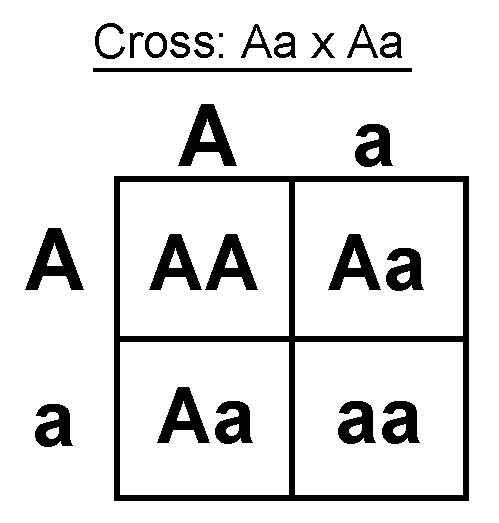
What is the genotypic ratio of the offspring?

a)

3:1

b)

1:3

c)

1:2:1

d)

2:2

12.

What are the phenotype percentages of the offspring?

(A-Brown fur color; a-white fur color)

a)

50 % Brown fur and 50% White fur

b)

25 % Brown fur and 75% White fur

c)

75 % Brown fur and 25% White fur

d)

0% Brown fur and 100% White fur

13.
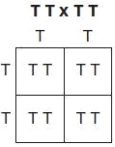
What are the possible genotypes for this cross?
(Click the picture to see it without the text)
a)
TT = 25% Tt= 50% tt=25%
b)
all tall
c)
TT= 75% tt = 25%
d)
Tt = 100%
14.
If you cross a black guinea pig with a white guinea pig and the offspring are gray, what type of dominant trait would that be.
a)
incomplete dominance
b)
codominance
c)
codependant
d)
cooperative
15.

B=Brown fur

b=tan fur

What percent of the offspring would be tan when you cross BbxBb?

a)

75%

b)

25%

c)

50%

d)

100%

16.
In rabbits, black fur (B) is dominant over brown fur (b). If a rabbit has brown fur, what can you conclude about its genotype?
a)
It is BB.
b)
It is Bb
c)
It is brown
d)
It is bb.
17.
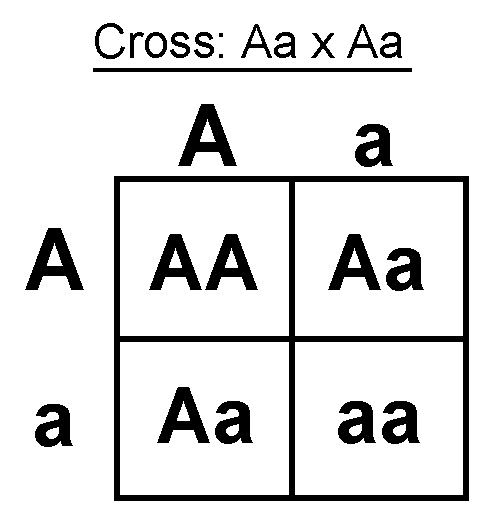
This punnett square shows a cross between
a)
A hybrid Parent and a Homozygous parent
b)
A heterozygous parent and a heterozygous parent
c)
Two homozygous parents
d)
Two Hybrid Parents
18.
 One dog carries homozygous, long-haired traits (SS), and its mate carries homozygous short-haired traits (ss). Use a Punnett square to determine the probability of one of their offspring having long hair.
a)
100%
b)
75%
c)
50%
d)
25%
19.
Why are there no white rabbit babies?
a)
The white gene is not present in any of the babies.
b)
It takes two recessive genes to show the trait.
c)
Grey is a better color.
d)
Baby five will be white.
20.

In pea plants, round seeds (R) are dominant to wrinkled seeds (r). Which of the following represents the genotype of a pea plant that is heterozygous?

a)

RR

b)

round

c)

Rr

d)

wrinkled

e)

rr

21.

In pea plants, round seeds (R) are dominant to wrinkled seeds (r). Which of the following represents the genotype of a pea plant that is homozygous dominant?

a)

RR

b)

round

c)

Rr

d)

wrinkled

e)

rr

22.

In mice, black fur (B) is dominant to white fur (b). According to the Punnett square shown, the offspring in box 4 would:

a)

be white.

b)

be heterozygous.

c)

be gray.

d)

be homozygous.

23.

If black fur is dominant and white fur is recessive, what genotype would an organism with white fur have?

a)

FF

b)

Ff

c)

ff

24.

In mice, black fur (B) is dominant to white fur (b). According to the Punnett square shown, how many offspring would be black?

a)

0

b)

1

c)

2

d)

3

e)

4

25.
What allele combination should go in the missing box?
a)
AA
b)
Aa
c)
aa
d)
none of these
26.
T - tall and t = short
In the punnett square below, what belongs in the missing square
a)
tt
b)
Tt
c)
Bb
d)
TT
27.
In a certain species of plant, the color purple (P) is dominant to the color white (p).
According to the Punnett Square, what is the probability of an offspring being purple?
a)
25%
b)
0%
c)
100%
d)
50%
28.
In the punnett square shown, what must the genotype of the missing parent be?
a)
BB
b)
Bb
c)
bb
d)
Tt
29.

How is the Punnett Square set up?

a)

Parents genotypes on the inside and offspring is on the outside

b)

The genotypes of each parent are on the sides and the offspring is in the boxes

c)

Grandparents genotypes on the sides and offspring in the box

30.
What is the probability of heterozygous offspring?
a)
25%
b)
50%
c)
0%
d)
100%
31.
Aa, DD, bB, yy are all examples of
a)
genotypes
b)
phenotypes
32.
What ratio of the offspring from the cross shown will be homozygous recessive for the  trait of tallness? 
a)
0 in 4
b)
1 in 4
c)
2 in 4
d)
4 in 4
33.
Which of the following genotypes is homozygous dominant?
a)
A
b)
Aa
c)
AA
d)
aa
34.
Which of the following genotypes is heterozygous?
a)
Bb
b)
BB
c)
bb
d)
B
35.
What you see, or the physical appearance.
a)
Genotype
b)
Phenotype
c)
Homozygous
d)
Heterozygous
36.
Each one of the boxes on the Punnett Square represents what probability of an offsprings' genotype?
a)
25%
b)
1%
c)
10%
d)
0%
37.
T - tall and t = short
In the punnett square below, what belongs in the missing square
a)
tt
b)
Tt
c)
Bb
d)
TT
38.

What are the possible phenotype(s) of the offspring? (A-Brown hair; a-blond hair)

a)

50 % Brown Hair and 50% Blond Hair

b)

25 % Brown Hair and 75% Blond Hair

c)

75 % Brown Hair and 25% Blond Hair

d)

0% Brown Hair and 100% Blond Hair

39.

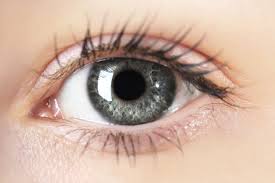
Brown eyes are dominant over blue eyes. What is the probability that the offspring will have brown eyes in this cross?

a)

25%

b)

50%

c)

75%

d)

100%

40.

When organisms are better adapted to their environment they will survive and reproduce more successfully than organisms less adapted. This process is called what?

a)

Selective breeding

b)

Natural Selection

c)

Cloning

d)

Evolution of all species