
 Worksheets
BIOL 223 - Muscle Exam Review
Total questions: 41
Worksheet time: 21mins
What type of muscle has the appearance of a feather?
Convergent
Fusiform
Pennate
Parallel
Which of the following is true of an isometric muscle contraction?
the length of the muscle increases during the contraction
it is responsible for rapid movements of the extremities
the contraction is divided into concentric and eccentric
the amount of tension increases during the contraction
How are muscle named?
(select all that apply)
Location
Action
Greek name
Attachment
When a skeletal muscle contracts to cause a given movement, the more movable end of attachment of the muscle is termed its
origin
insertion
antagonist
synergist
Which of the following would represent incomplete tetanus?
multiple contractions with slight relaxation between each peak
multiple contractions followed by a long rest period
a long rest period before contractions start
multiple contractions with no relaxation
Of the following muscle types, which type is not branched and has one nucleus per cell?
skeletal muscle
cardiac muscle
smooth muscle
all of the above
Eccentric muscle contractions occur when
a person slowly lowers a heavy weight
no tension is developed in the muscle
a person rapidly raises a lighter weight
a length of the muscle decreases
The tissue surrounding an entire muscle is known as
epimysium
perimysium
endomysium
superficial mysium
The tissue that surrounds a myofiber is known as
endomysium
perimysium
endomysium
superficial mysium
What must be passed for action potential to occur?
Threshold
Repolarization
Depolarization
ATP
What is the smallest muscle contraction?
Twitch
Complete Tetanus
Incomplete Tetanus
Treppe
The functional connection between a nerve axon terminal and a muscle fiber is called a(n)
T tubule
I Band
synapse
vesicle
Muscles that work together to cause a movement are
antagonist
fixator
synergist
prime mover
What type of molecule is acetylcholine?
a protein
a neurotransmitter
an activator ion
a calcium binding molecule
What muscle is branched with striations?
Smooth
Cardiac
Skeletal
None of the above
Where does Ca+ released from?
Sarcoplasm
Sarcolemma
Sarcoplasmic Reticulum
Triad
The ability of a muscle to be stimulated is called?
contractility
elasticity
extensibility
excitability
Acetylcholine is a (a)
When a skeletal muscle contracts to cause a given movement, the relatively stationary end of attachment of the muscle is termed its
origin
insertion
antagonist
synergist
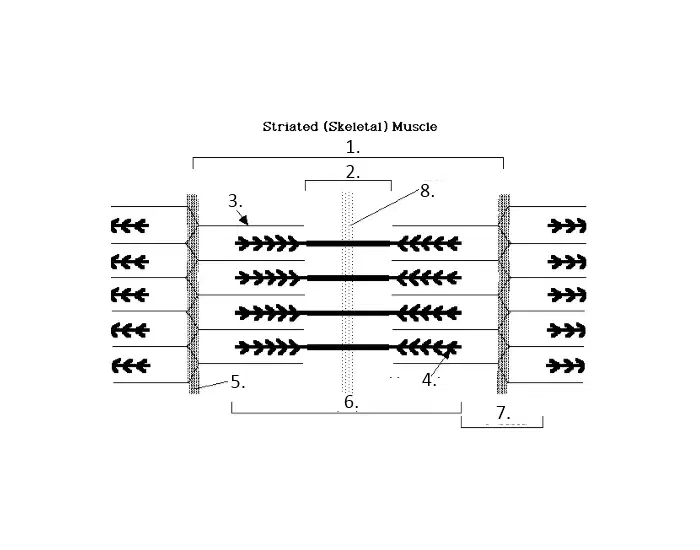
What is #2?
I band
A band
M line
H zone
When the myosin head (of the thick filament) flexes into a bend, while releasing ADP and inorganic phosphate, pulling the thin filament along with it, this is called the
action reaction
power stroke
recovery stroke
muscle tone
The ability of a muscle to be stimulated is called
contractility
elasticity
extensibility
excitability
A type of muscle that extends a joint is known as a(n)
flexor
extensor
rotator
supinator
Bundles of muscle fibers (fascicles) are wrapped by a tissue known as
epimysium
endomysium
fascia
perimysium
Binding of acetylcholine with its receptor on muscle cells causes
opening of a ligand gated channel
a gap in the cell membrane for calcium diffusion
vesicular release of sodium ions
opening of a voltage gated calcium channel
What does Ca+ bind to?
Actin
Troponin
Tropomyosin
Myosin
Type of muscle contraction is unchanged?
Isometric
Isotonic Eccentric
Isotonic Concentric
Tetanus
The elastic filament within a myofibril are attached to Z disc and to the molecule _____
myosin
troponin
actin
sarcolemma
What lever class system is being used when a ballerina is on their toes?
1st class lever system
2nd class lever system
3rd class lever system
None of the above
Rigor mortis
(Select all that apply)
Occurs for 48-72 hours
Cross-bridge still formed
large numbers of mitochondria
white muscle appearance
For cross-bridge release, it is necessary for ___ to bind to the myosin head
troponin
calcium
ATP
tropomyosin
Enzyme that breaks down acetylcholine
(a)
Cross bridge form during muscle contraction when myosin comes in contact with active sites on
troponin
tropomyosin
calcium ions
actin
The tissues of cardiac muscle have unique structure known as
circular muscle fibers
abundant elastic fibers
intercalated discs
pacemaker cells
What type of muscle is the bicep branchii?
(select all the apply)
Pennate
Fusiform
Convergent
Circular
Depolarization occurs when what is going in the cell?
K+
Ca+
Na+
None of the above
_____ surrounds each muscle fasiculus, whereas ____ surrounds each muscle fiber.
epimysium, perimysium
perimysium, endomysium
endomysium, perimysium
epimysium, endomysium
Which of these layer of connective tissue that covers a whole muscle?
sarcolemma
Perimysium
fasiculus
epimysium
The most common type of fatigue is:
muscular
psychological
synaptic
sarcoplasmic reticulum
Troponin binds to
actin
Ca+
tropomyosin
All of the above
At the neuromuscular junction, the axon ending is called the
postsynaptic membrane
presynaptic terminal
synaptic cleft
synaptic vesicle

