
 Worksheets
Newton's 2nd and 3rd Law
Total questions: 154
Worksheet time: 39hrs 30mins
Calculate the gravitational force between two objects when they are 0.750m apart. Each object has a mass of 5.00kg.
2.96x10⁻⁷N
3.00x10⁻⁶N
2.22x10⁻⁹N
2.23x10⁻⁸N
What would the force between them be if the distance between them were doubled?

What is the gravitational force between two identical 50,000 kg asteroids whose centers of mass are separated by 1000 m?
2500 N
3.3 x 10⁻¹² N
1.67 x 10⁻⁴ N
1.67 x 10⁻⁷ N
Two spherical objects have masses of 8000 kg and 1500 kg. Their centers are separated by a distance of 1.5 m. Find the gravitational attraction between them
5.4 X 10⁻⁴ N
1.2 X 10⁷ N
3.6 X 10⁻⁴ N
5.33 N
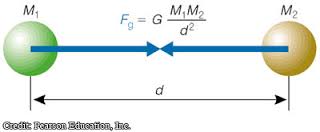
Which configuration will result in the greatest gravitational force?
small masses far apart
large masses far apart
small masses close together
large masses close together


What does free fall mean in physics?
It means we only consider gravity acting on the object and we ignore air resistance.
It means we consider all forces acting on a falling object, including air resistance and gravity.
It means an object is falling with no acceleration.
It means an object is falling with no forces acting on it.
During free fall, what kind of motion should all objects have?
acceleration
constant speed
something else
What is Newton's 2nd Law?
Every action has an equal and opposite reaction
An object at rest stays at rest, an object in motion stays in motion.
F = ma
Friction

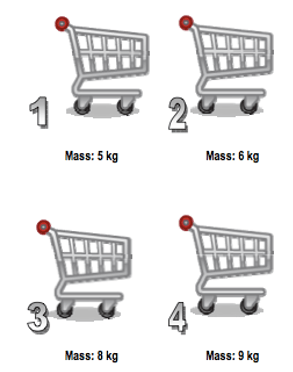
If the man pushes with an equal amount of force, which object will accelerate more?
Car because it has more mass
Lawnmower because it has less mass
Car because it has less mass
Lawnmower because it has more mass
What unit do we measure force in?
Kilometer/hr
Joules
Seconds
Newtons
What is force?
A push on an object
A pull on an object
A push or pull on an object


Newton’s law states that for every action, there is an ________ reaction.
unequal and opposite
equal and similar
stronger and opposite
equal and opposite

When a small car pushes a big truck, the truck applies an equal and opposite force on the car.
False
True

When a cannon fires a cannonball we observe Newton's third law. Which is the reaction force?
The cannon moving forward
The cannon moving backwards
The cannonball moving backwards
The cannonball moving forward

How is this an example of Newton’s Third law?
Only the ball is using the head
They are both exerting an equal force on each other
Only the head is pushing the ball

When a heavy football player and a light one run into each other, who exerts more force
The light one
Their force are equal
The heavy one

A baseball bat hits a baseball with a force of 100 Newtons. What is the force and its direction exerted by the ball on the bat?
100 Newtons, same direction
100 Newtons, opposite direction
200 Newtons, opposite direction
200 Newtons, same direction
Which object has no acceleration?
A stapler on a table.
A car moving at a constant speed in one direction.
A satellite orbiting Earth.
A bike turning a corner.
Two people are skateboarding. If person 1 has a larger mass than person 2 and person 1 pushes person 2, how much would this affect their movement?
Mass will have no affect.
They will accelerate backwards the same.
Person 1 will accelerate more, but both will move.
They will both accelerate back, but person 2 will move more.
When a person falls out of a tree, what kind of force is gravity?
A balanced force.
An unbalanced force.
An inertial force.
When force __________, acceleration _______________
increase, decrease
decrease, increase
increase, increase
decrease, decrease
Two objects are acted on by the same unbalanced force. Object 1 accelerates two times faster than object 2. What can you determine about the mass of objects 1 and 2?
Object 1 has slightly less mass than object 2.
Both 1 and 2 have the same mass.
Object 2 has about two times more mass than object 1.
Object 1 has about 2 times more mass than object 2.
A semi truck and a Volkswagen (small car) traveling at the same speed have a head on collision. Which statement is correct?
The impact force is greater on the Volkswagen.
The impact force is greater on the semi truck.
The impact force is less on the semi truck.
The impact force is equal for both.
A baseball bat hits a baseball with a force of 100 Newtons. What is the force and its direction exerted by the ball on the bat?
100 Newtons, same direction
100 Newtons, opposite direction
200 Newtons, opposite direction
200 Newtons, same direction
The nozzle of a rocket is pointed downward so that as fuel is ignited, the exhaust pushes downward. Why is this arrangement necessary for a rocket to function properly?
The rocket is protected from the heat of the exhaust.
Burned fuel can be collected on the ground.
As fuel is combusted, the rocket pushes the gases backward and the gases push the rocket forward.
This allows the rocket to be steered properly.
This is always equal and opposite to the action force
Motion
Collide
Force
Newton's 3rd Law

The illustration shows the forces in Newtons (N) acting on three different blocks. Which blocks will move under these conditions?
Blocks 1 and 2
Blocks 2 and 3
Blocks 1, 2, and 3
Blocks 1 and 3
A push or pull that can change an object’s motion
Force
Motion
Reference Frame
Direction

Students attached both ends of a long wire to the poles of a battery and wrapped the wire around a spoon. In this arrangement, the spoon is able to pick up five paper clips. The students wrap more wire around the spoon and want to determine if the strength of the magnetic force has increased. Which of the following observations would indicate that wrapping more wire has increased the strength of the electromagnet?
More wire was needed to wrap around the spoon.
The spoon now picks up seven paper clips.
Eventually the battery runs out of energy.
The ends of the wire must touch the battery's poles.
The tendency to pull other objects toward it
Magnitude
Attraction
Repulsive
Current
An astronaut way out in space is considered to be “weightless" This is because–
his mass is so small relative to the earth that gravity doesn't affect him.
gravitational force decreases greatly over long distances.
gravitational force pushes objects away from each other at long distances.
objects far away from the earth have less mass.
Which of the following does not affect the gravitational force between the earth and the sun?
The mass of the earth
The mass of the sun
The distance between the earth and the sun
The net electrical charge of the earth
The force between two masses
Gravitational force
Force
Mass
Interacting objects

Which of the following graphs shows how the mass of an object affects the amount of force needed to move it?
A
B
C
D
The momentum of an object depends upon the object's ___________&_____________.
size and shape
mass and speed
mass and veloctiy
mass and energy


Which of the following has the greatest momentum?
a scurrying cockroach
a parked semi-truck
more information is needed
Why does a semi truck have more momentum than a car if they are both traveling at 60kph?
Truck is more massive
Truck is less massive
Car is moving faster
Car is more massive
If a momentum car is moving at 2 kg m/s and crashes into a stationary momentum car, how much momentum would transfer over to the stationary car?
all of the momentum
half of the momentum
a little bit of the momentum
zero momentum
Which would have more momentum between a train moving at 0 kph and a bug flying at 0.5 kph?
Bug
Train
They are the same
Determine the momentum of 1000-kg car moving northward at 20 m/s.........
20,000 N
20,000 Joules
20,000 Kg * m/s
20,000 kg * m/s north
In any collision (crash) the ______ is ALWAYS constant
total momentum
total speed
total Velocity
Energy

Newton's 3rd Law: When a student on a skateboarder applies a force of 20 Newton to 'push' the ball in a positive direction, what does the student experience?
A positive (+) force of the same magnitude
A negative (-) force of equal magnitude
No force at all, only the ball experiences the force
A force that is smaller than the 'push' do to being more massive
Newton's 3rd Law: When a student (40 kg) on a skateboard applies a force to accelerate a medicine ball (5kg) to the right, the force acting on the student is:
A much smaller force
A much larger force
Exactly the same force applied to the ball
No answer is correct

The momentum of an object depends upon the object's ___________&_____________.
size and shape
mass and veloctiy
mass and energy

You have THREE different objects with different masses traveling at different velocities. Which has the greatest momentum?
Object A: really massive traveling slowly
Object B: low mass traveling really fast
Object C: a medium mass traveling at a medium speed
Object A has the greatest momentum
Object B has the greatest momentum
Object C has the greatest momentum
We cannot say which one has the most momentum without knowing the mass and velocity
When comparing the momentum of moving objects, which of the following is correct?
Object A: 10 kg traveling at +8 m/s
Object B: 8 kg traveling at -10 m/s
Object C: 5 kg traveling at +20 m/s
Object A has the greatest momentum
The more massive object has the greatest momentum
Object C has the greatest momentum
The object traveling the fastest will ALWAYS have the greatest momentum
When comparing the momentum of moving objects, which of the following is correct?
Object A: 10 kg traveling at +8 m/s
Object B: 8 kg traveling at -10 m/s
Object C: 5 kg traveling at +20 m/s
Momentum is vector and requires direction
Objects A and C have + momentum
Object B has -80 kg m/s of momentum
All answers are true
Two billiard balls collide. Identify the type of collision.
elastic
perfectly elastic
inelastic
perfectly inelastic
In a two-body collision,
momentum is always conserved
kinetic energy is always conserved
neither momentum nor kinetic energy is conserved
both momentum and kinetic energy are always conserved

The law of conservation of momentum states that
the total initial momentum of all objects interacting with one another usually equals the total final momentum
the total initial momentum of all objects interacting with one another does not equal the total final momentum
the total momentum of all objects interacting with one another is zero
the total momentum of all objects interacting with one another remains constant regardless of the nature of the forces between the objects

A billiard ball collides with a stationary identical billiard ball in a perfectly elastic head-on collision. After the collision, which of the following is true of Ball A?
it maintains its initial velocity
it has one-half its initial velocity
it comes to rest
it moves in the opposite direction

The law of conservation of momentum states that the total momentum of all objects interacting with each other will ________________________ no matter of the nature of the forces between the object.
increase
decrease
remain constant
fluctuate
What is the RELATIONSHIP of momentum to mass? (*Assume velocity stays constant)
Direct
Inverse
Inverse square
No relationship
What is the RELATIONSHIP of mass to velocity?
(*Assume momentum stays constant)
Direct
Inverse
Inverse square
No relationship

A rock freefalls off of a cliff toward Earth. The momentum of the falling rock is _______ on its fall.
Decreasing
Increasing
Staying constant
No idea whatsoever
A rock freefalls off of a cliff toward Earth. At exactly what point does the rock have its greatest momentum?
Upon impact with the ground
The instant the person lets go of the rock
Exactly midway through its fall
There is no way to determine

In which position (letter) does the object have ZERO momentum in the Y-direction?
Letter A
Letter B
Letter C
Letter D
Letter E

What is another name for gravitational force?
weight
gravitational potential energy
newton
height force

The apples on the tree are identical.
Which statement below is correct?
Gravitational force acting on A is higher than gravitational force acting on B.
Gravitational force acting on B is lower than gravitational force acting on C.
Gravitational forces acting on A, B and C are the same.
Gravitational force acting on C is higher than gravitational force acting on A.

The apples on the tree have the same mass.
Which statement below is correct?
Gravitational force acting on A is higher than gravitational force acting on B.
Gravitational force acting on B is higher than gravitational force acting on A.
Gravitational forces acting on A and B are the same.
Gravitational forces acting on A and B cannot be compared.

Which apple is acted by the strongest gravitational force?
A and B only
B only
B and D only
A, B, C and D are acted by the same amount of gravitational force.

Which apple has the strongest gravitational force acting on it?
A
B
C
D

The weight of an object changes when the ___________of the object changes.
mass
size
shape
colour

When you travel from Earth to a place far away from any planet, your ______________.
weight and mass remain the same
weight remains the same but not your mass
mass remains the same but not your weight
weight and mass change

An apple was thrown vertically upwards from the hand to the highest point in the air.
The gravitational force acting on the apple was ___________.
highest when the apple had just left the hand
highest when the apple was at the highest point
the same for the three positions
highest when the apple was on the way up

Which of the following correctly shows the direction of gravitational force acting on the block?


Which of the following shows the unit of mass and weight?
gram, kilogram
kilogram, Newton
kilogram and litre
litre, Newton

What is the gravitational force acting on you when you are far away from any planet?
zero
same as when you are on Earth
less than when you are on Earth
more than when you are on Earth

What is the gravitational force acting on you when you are on Moon?
zero
same as when you are on Earth
less than when you are on Earth
more than when you are on Earth
Projectile motion is caused by....
a downward force
an initial forward velocity or force
a final vertical velocity of force
a vertical force of gravity and a horizontal velocity or force
If an object has a mass of 2 kg then it's weight on the earth is.....
2 kg
20N
.2 FT
20 pounds
The acceleration due to gravity on the earth is...
9.8 m/s2
9.8 m/s
9.8 m
9.8 ft/s
The force OF GRAVITY acting on an object's mass is its.....
weight
net force
acceleration
orbit

