wayground logo

Free Printable Worksheets

Font size

S
M
L
XL
Worksheets

G12 Trimester Revision Pack

Total questions: 140

Worksheet time: 2hrs 26mins

Name
Class
Date
1.
What subatomic particles would you find in the nucleus of an atom?
a)
Protons only
b)
Protons and Neutrons
c)
Neutrons and Electrons
d)
Protons and Electrons 
2.
Which subatomic particles contribute the most to the mass of an atom?
a)
Protons, Neutrons, Electrons
b)
Protons only
c)
Protons and Electrons
d)
Protons and Neutrons
3.
Protons and Electrons balance the charge of an atom.
a)
True
b)
False
4.
Electric charges that are different _______ each other.
a)
Attract
b)
Repel
5.
Electric charges that are alike _______ each other.
a)
Attract
b)
Repel
6.
What charge does a proton have?
a)
negative (-)
b)
positive (+)
c)
neutral or no charge (0)
7.
What charge does an electron have?
a)
negative (-)
b)
positive (+)
c)
neutral or no charge (0)
8.
If a substance has a higher number of electrons than protons on its surface, what type of charge does it have?
a)
A positive charge.
b)
A negative charge.
c)
A neutral charge
d)
No charge at all
9.

Which of these is the electron?

a)

A

b)

B

c)

C

10.
If mass of one object is doubled then the force of gravity is
a)
doubled
b)
half
c)
4 times as big
d)
1/4 times as big
11.
If the distance is doubled then the force of gravity is
a)
doubled
b)
half
c)
4 times as big
d)
1/4 times as big
12.
What is the SI unit used to measure force? 
a)
pounds 
b)
grams 
c)
newtons 
d)
friction
13.
Gravity attracts all objects towards one another.
a)
False
b)
True
c)
It depends
14.
What subatomic particles would you find in the nucleus of an atom?
a)
Protons only
b)
Protons and Neutrons
c)
Neutrons and Electrons
d)
Protons and Electrons 
15.
Which subatomic particles contribute the most to the mass of an atom?
a)
Protons, Neutrons, Electrons
b)
Protons only
c)
Protons and Electrons
d)
Protons and Neutrons
16.
Protons and Electrons balance the charge of an atom.
a)
True
b)
False
17.
Electric charges that are different _______ each other.
a)
Attract
b)
Repel
18.
Electric charges that are alike _______ each other.
a)
Attract
b)
Repel
19.
If a substance has a higher number of electrons than protons on its surface, what type of charge does it have?
a)
A positive charge.
b)
A negative charge.
c)
A neutral charge
d)
No charge at all
20.

Which of these is the electron?

a)

A

b)

B

c)

C

21.

SI unit for electric charge

a)

Newton

b)

Coulomb

c)

Kilogram

d)

Watts

22.

What subatomic particles can you find at the center of nucleus?

a)

electron and proton

b)

proton only

c)

neutron and proton

d)

neutron and electron

23.

What is the fundamental value of  electron?

a)

 e=1.60×10⁻¹⁹ C

b)

e= 1.60×10−91 C

c)

e= 1.60×10⁻¹⁵ C

d)

e= 1.60×10⁻²¹ C

24.

What makes up an atom?

a)

electron and proton

b)

electron and neutron

c)

neutron, electron and friction

d)

neutron, electron and proton

25.

In an atom, where is the location of electron?

a)

at the center of the nucleus

b)

the free floating negatively charged electron cloud

c)

the positively charge very dense nucleus

d)

the very dense positively charged electron orbital

26.

Ms. Josette rubbed two balloons with a piece of wool. What will happen when the balloons are brought near each other?

a)

The balloons will attract each other.

b)

The balloons will repel each other

c)

The balloons will pop.

d)

The balloon will become colorless.

27.

The part of atom that moves from one object to another.

a)

proton

b)

neutron

c)

electron

28.
Metals such as copper, iron, gold, and silver are ...
a)
conductors
b)
brittle
c)
insulators
d)
resistors
29.
Which type of charges do these balloons have?
a)
like charges
b)
opposite charges
30.
What type of charge do these balloons have?
a)
like charges
b)
opposite charges
31.

Walking across a carpet is an example of charge being transferred by

a)

electric force

b)

induction.

c)

contact.

d)

static electricity

32.
What happens when you touch a metal doorknob after rubbing your shoes on the carpet?
a)
The doorknob sends a burst of electric current into your body
b)
Millions of electrons go from your finger into the doorknob
c)
The doorknob sends millions of electrons into your finger
d)
our finger becomes negatively charged
33.
Consider the electric field lines shown in the diagram below. From the diagram, it is apparent that object A is ____ and object B is ____.
a)
+,+
b)
+,-
c)
-,+
d)
-,-
34.

Which graph best represents the relationship between the magnitude of the electrostatic force and the distance between two oppositely charged particles?

a)
b)
c)
d)
35.

If the charge on each of two small charged metal spheres is doubled and the distance between the spheres remains fixed, the magnitude of the electric force between the spheres will be

a)

two times as great

b)

four times as great

c)

one-half as great

d)

the same

36.

In the diagram above, a positive test charge is located between two charged spheres, A and B. Sphere A has a charge of +2q and is located 0.2 meter from the test charge. Sphere B has a charge of -2q and is located 0.1 meter from the test charge. If the magnitude of the force on the test charge due to sphere A is F, what is the magnitude of the force on the test charge due to

sphere B?

a)

2F2F

b)

F2\frac{F}{2}

c)

F4\frac{F}{4}

d)

4F4F

37.

The magnitude of the electrostatic force between two point charges is F. If the distance between the charges is doubled, the electrostatic force between the charges will become

a)

F4\frac{F}{4}

b)

4F

c)

F2\frac{F}{2}

d)

2F

38.

Two positively charged masses are separated by a distance, r. Which statement best describes the gravitational and electrostatic forces between the two masses?

a)

The gravitational force is attractive and the electrostatic force is

repulsive.

b)

The gravitational force is repulsive and the electrostatic force is

attractive.

c)

Both forces are attractive.

d)

Both forces are repulsive.

39.

Two protons are located one meter apart. Compared to the

gravitational force of attraction between the two protons, the electrostatic force between the protons is

a)

weaker and attractive

b)

stronger and attractive

c)

stronger and repulsive

d)

weaker and repulsive

40.

What is the approximate electrostatic force between two protons separated by a distance of 1.0 x 10⁻⁶ meter?

a)

9.0 x 10²¹ N and attractive

b)

9.0 x 10²¹ N and repulsive

c)

2.3 x 10⁻¹⁶ N and attractive

d)

2.3 x 10⁻¹⁶ N and repulsive

41.

Electrostatic force F exists between two point charges. If the

distance between the charges is tripled, the force between the charges will be

a)

9F

b)

F3\frac{F}{3}

c)

3F

d)

F9\frac{F}{9}

42.

The diagram above shows two negatively charged balloons

suspended from nonconducting strings being held by a student. What occurs as the student brings the balloons closer to each other without allowing them to touch?

a)

The magnitude of the electrostatic force between the balloons increases, and they attract each other.

b)

The magnitude of the electrostatic force between the balloons decreases, and they repel each other.

c)

The magnitude of the electrostatic force between the balloons increases, and they repel each other.

d)

The magnitude of the electrostatic force between the balloons decreases, and they attract each other.

43.

The diagram above shows two metal spheres charged to +1.0 x 10⁻⁶ coulomb and +3.0 x 10⁻⁶ coulomb, respectively, on insulating stands separated by a distance of 0.10 meter.

The spheres are touched together and then returned to their original positions. As a result, the magnitude of the electrostatic force between the spheres changes from 2.7 N to

a)

1.4 N

b)

14 N

c)

3.6 N

d)

1.8 N

44.

An electrostatic force of magnitude F exists between two metal spheres having identical charge q. The distance between their centers is r. Which combination of changes would produce no change in the electrostatic force between the spheres?

a)

doubling q on both spheres while halving r

b)

doubling q on one sphere while halving r

c)

doubling q on both spheres while doubling r

d)

doubling q on one sphere while doubling r

45.

In the diagram above, two positively charged spheres, A and B, of masses mA and mB are located a distance d apart. Which diagram best represents the directions of the gravitational force, Fg, and the electrostatic force, Fe, acting on sphere A due to the mass and charge of sphere B? [Vectors are not drawn to scale.]

a)
b)
c)
d)
46.
In the diagram below, P is a point near a negatively charged sphere. Which direction best represents the direction of the electric field at point P?
a)
Right
b)
Left
c)
Up 
d)
Down
47.
Which quantity and unit are correctly paired?
a)
electric field strength and N/C
b)
electricity and Coulombs
c)
electrostatic force and electrons
d)
electric field strength and E
48.
A point charge Q is far from all other charges. At a distance of 2 m from Q, the electric field is 20 N/C. What is the force a charge of 5 Coulombs feels?
a)
4 N
b)
100 N
c)
40 N
d)
10 N
49.
Which of the following statements is false about electric field lines
a)
electric field lines cannot cross
b)
electric field lines point away from positive charge
c)
electric field lines are always straight lines
d)
electric field lines show how a proton would move in an electric field
50.
At which point is the electric field the strongest
a)
A
b)
B
c)
C
d)
D
51.
At which point is the electric field the weakest?
a)
A because it is the furthest away
b)
A because the field lines are further apart
c)
C because the field lines are further apart
d)
C  because it is the furthest away
52.
Consider the electric field lines shown in the diagram below. From the diagram, it is apparent that object A is ____ and object B is ____.
a)
+,+
b)
+,-
c)
-,+
d)
-,-
53.
Consider the electric field lines drawn at the right for a configuration of two charges. Several locations are labeled on the diagram. Which of these shows the ranking in order of weakest to strongest correctly
a)
A, E, C
b)
D, E, C
c)
D, B, A
d)
A, D, B
54.
An electrostatic force of 2 X 10². newtons is exerted on a charge of 4 coulomb at point P in an electric field. The magnitude of the electric field intensity at P is
a)
8 X 10² N/C
b)
5 N/C
c)
2 X 10⁻² N/C
d)
50 N/C
55.
It is observed that Balloon A is charged negatively. Balloon B exerts a repulsive effect upon balloon A. Would the electric field vector created by balloon B be directed towards B or away from B and why?
a)
towards because electric field lines point away from negative charges
b)
towards because electric field lines point away from positive charges
c)
away because electric field lines point away from negative charges
d)
away because electric field lines point toward positive charges
56.
Qand Qare two charges creating an electric field. Based on the electric field lines, we can conclude
a)
Qand Qare both positive
b)
Qand Qare both negative
c)
Qis positive and Qis negative
d)
Qis negative and Qis positive
57.
Which of the following is a true statement about the electric field between the two plates?
a)
The field is attractive between the plates and uniform in strength
b)
The field is repulsive between the plates and uniform in strength
c)
The field is attractive between the plates and strongest near the positive
d)
The field is repulsive between the plates and strongest near the positive
58.
The electrical force between charges is strongest when the charges are
a)
close together
b)
far apart
c)
 the electric force is constant everywhere.
d)
there is no pattern
59.
What is the magnitude of the electric field intensity at a point where a proton experiences an electrostatic force of magnitude 2.30 x 10⁻²⁵ newton?
a)
1.44 x 10⁻⁶ N/C
b)
3.68 x 10⁶ N/C
c)
1.44 x 1044 N/C
d)
3.68 x 10-44 N/C
60.

Materials that cut down or resist the flow of charges are called?

a)

conductor

b)

insulator

c)

resistor

d)

circut

61.
A conductor is?
a)
material that current can pass through easily
b)
material that current cannot pass through easily
c)
magnet
d)
electric current
62.

One amp is defined as the rate of charge flow equal to __ coulomb per second.

a)

3

b)

2

c)

4

d)

1

63.

What is the power when a voltage of 120 V drives a 2-A current through a device?

a)

120 Watts

b)

360 Watts

c)

240 Watts

64.

A circuit with only one path for the current to flow is a __________________.

a)

parallel circuit

b)

series circuit

c)

mini circuit

d)

device

65.

How many Volts would we need to produce a current of 8 Amps through a 6 Ohm resistor?

a)

1.33 volts

b)

24 volts

c)

0.75

d)

48 volts

66.

A light circuit is operating at 75 Volts. What is the circuit's current if the resistance is 5 Ohms?

a)

375 Amps

b)

50 Amps

c)

15 Amps

d)

0.07 Amps

67.

What resistance is needed to cause a 20A current flow with a 100V battery?

a)

0.2Ώ

b)

2000Ώ

c)

200Ώ

d)

68.
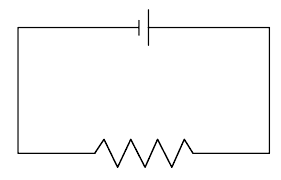
What kind of circuit is this?
a)
series
b)
parallel
c)
solo
d)
circle
69.

A shorthand method to represent the arrangement of the parts in a circuit is known as a(n):

a)

circuit diagram

b)

closed circuit

c)

electric charge

d)

switch

70.

An equation that states current = voltage / resistance is known as:

a)

potentiometer

b)

Kirchoff's current law

c)

Ohm's law

d)

resistor

71.

If the voltage across the battery was 10V in this diagram, what would be the voltage across each light bulb?

a)

10V

b)

5V

c)

20V

d)

0V

72.
If a circuit has 12 amps of current and the resistance is 20 ohms, the applied voltage is _____.
a)
120V
b)
240V
c)
270V
d)
380V
73.
If two 10-ohm resistors are connected in series, what is the total resistance of these resistors?
a)
100 ohms
b)
20 ohms
c)
5 ohms
d)
1 ohm
74.

When there is only one path for electrons to move through it is called a _____. When one light goes out, they all go out.

a)

closed circuit

b)

parallel circuit

c)

series circuit

d)

open circuit

75.

This image represents what type of circuit?

a)

open

b)

circular

c)

series

d)

parallel

76.

A circuit with 3 resistors, 10 Ohms, 30 Ohms and 20 Ohms are in series. What is the total resistance

a)

30 Ohms

b)

50 Ohms

c)

60 Ohms

d)

100 Ohms

77.
A material in which electrons are not able to move easily 
a)
Circuit 
b)
Insulator 
c)
Resistance 
d)
Conductor
78.

What is the resistance of a lamp that draws a current of 0.20A when connected to a 12V source?

a)

60Ω

b)

2.4Ω

c)

0.017Ω

d)

12Ω

79.
What size resistor would produce a current flow of 5 Amps with a battery voltage of 12.6 volts
a)
60 Ohms
b)
2.52 Ohms
c)
1.71 ohms
d)
5.04 Ohms
80.
What size resistor would produce a 3 Amp current flow with a 12 Volt battery
a)
1 Ohm
b)
3 Ohms
c)
4 Ohms
d)
12 Ohms
81.
What is current measured in?
a)
Ω (Ohms)
b)
V (Volts)
c)
A (Amps)
d)
W (Watts)
82.
What is resistance measured in?
a)
Ω (Ohms)
b)
V (Volts)
c)
A (Amps)
d)
W (Watts)
83.
What is Resistance?
a)
The flow of electrons
b)
Electric potential difference
c)
A battery
d)
The ability to reduce the flow of electrons
84.
Electricity that flows in a closed path is called a
a)
path
b)
current
c)
circuit
d)
light
85.
What types of charges attract?
a)
Positive and Positive
b)
Positive and Neutral
c)
Negative and Neutral
d)
Positive and Negative
86.
What is the Voltage of a circuit that has a resistance of 5 Ω and a current of 2 A?
a)
25 V
b)
10 V
c)
2.5 V
d)
0.4 V
87.
The mathematical relationship among Voltage, Current, and Resistance
a)
Faraday's Law
b)
Tesla's Law
c)
Edison's Law
d)
Ohm's Law
88.
Current times Resistance equals
 (I X R)
a)
Power
b)
Voltage
c)
Amperage
d)
Ohm
89.

Voltage divided by Resistance

(V / R)

a)

Current

b)

Power

c)

Ohms

d)

Watts

90.

Voltage divided by Current

(V / I)

a)

Current

b)

Power

c)

Resistance

d)

Watts

91.
If the Voltage is increased and the resistance stays the same, Current will
a)
Increase
b)
Decrease
c)
Stay the same
d)
X
92.
If the Voltage stays the same and Resistance is increased, Current will 
a)
Increase
b)
Decrease
c)
Stay the same
d)
X
93.

If the battery produced 12.6 Volts what would be the current flow for a 6 Ohm resistor?

a)

2.1 Amps

b)

2.4 Amps

c)

1.71 Amps

d)

15 Amps

94.
How many Volts would we need to produce a current flow of 8 Amps through a 6 Ohm resistor
a)
12 volts
b)
24 volts
c)
1.3333
d)
48 volts
95.
This circuit has a 24 volt battery and the resistor is 8 ohms. How many amps are running through the circuit?
a)
3 Amps
b)
192 Amps
c)
2 Amps
d)
4 Amps
96.
What word means how hard it is for electrons to flow through.
a)
Current
b)
Voltage
c)
Resistance
d)
Power
97.
What word means how fast the electrons flow.
a)
Current
b)
Voltage
c)
Resistance
d)
Power
98.
The flow of electricity requires a
a)
complete path
b)
incomplete path
c)
insulated current
d)
complex circuit
99.
To complete a circuit the switch must be
a)
unattached
b)
open
c)
closed
d)
It depends
100.
Current is measured in....
a)
Amps 
b)
Volts
c)
Ohms
d)
Coulombs
101.
What 'flows' in a wire?
a)
Protons
b)
Neutrons
c)
Atoms
d)
Electrons
102.

Voltage is measured in __.

a)

Volts.

b)

Watts.

c)

Coulombs.

103.
Electricity that flows in a closed path is called a
a)
path
b)
current
c)
circuit
104.
Voltage is simply defined as...
a)
what 'pushes' electrons
b)
what 'stops' electrons
c)
moving electrons
105.
The flow/movement of electric charges 
a)
Voltage
b)
Resistance 
c)
Current 
d)
Circuit 
106.
This is related to the force that causes electric charges to flow
a)
Voltage 
b)
Current
c)
Resistance
d)
Circuit 
107.

A current of 0.5 A flows in a circuit. Calculate the charge flowing through the circuit in one minute.

a)

0.5 C

b)

30 C

c)

120 C

108.

A large lightning bolt can carry up to 120000 A and 350 C. Calculate the time for which the current flows. 

a)

2.92 s

b)

0.0092 s

c)

2.92×10³ min2.92\times10^{-3}\ \min

d)

2.92×1032.92\times10^{-3} s

109.

The electrical energy used if a charge of 5 C is supplied by a 12 V cell is....

a)

2.2 A

b)

60 A

c)

2.2 J

d)

60 J

110.

What is the voltage of a cell if it uses 4.2 J of energy as it pushes 6 C of charge round a circuit?

a)

0.7 v

b)

26 V

c)

0.7 V

d)

26 v

111.
This is an example of a _______ circuit
a)
open
b)
series
c)
parallel
d)
square
112.
This is an example of a ______ circuit
a)
Series
b)
Parallel
c)
Open
d)
Dihexihedral
113.
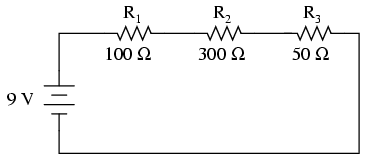
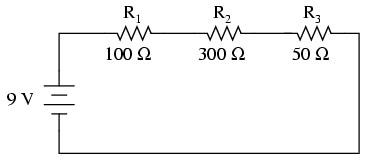
The total resistance in this circuit is 
a)
100 ohms
b)
450 ohms
c)
400 ohms
d)
30 ohms
114.
The total current through this circuit is
a)
0.02 amps
b)
0.09 amps
c)
50 amps
d)
9 amps
115.
The voltage dropped across the 300 ohm resistor is 
a)
6 V
b)
9 V
c)
2 V
d)
30 V
116.
As resistors are added in series to a circuit, the total resistance will...
a)
increase
b)
decrease
c)
stay the same
117.
As the resistance of a circuit increases, the current will...
a)
increase
b)
decrease
c)
stay the same
118.
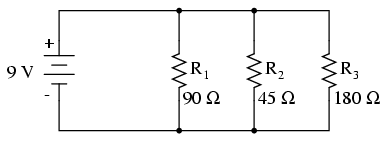
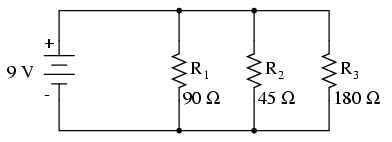
In a parallel circuit which of the following is the same value throughout the circuit?
a)
Voltage
b)
Current
c)
Resistance
d)
Charge
119.
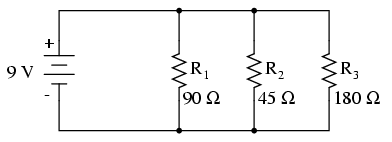
The current going through the 45 ohm resistor is 
a)
0.05 amps
b)
0.2 amps
c)
0.1 amps
d)
5 amps
120.
The total resistance of this circuit is 
a)
25.7 ohms
b)
315 ohms
c)
324 ohms
d)
90 ohms
121.
The total current going through the battery of this circuit is
a)
0.35 amps
b)
0.0286 amps
c)
0 amps
d)
9 amps
122.
A series circuit has how many pathways for the electrons to flow?
a)
Two
b)
One
c)
Many
d)
Zero
123.
What is one problem with using a series circuit? 
a)
It has a lot of series. 
b)
If one light goes down, they all go down! 
c)
It doesn't work properly.
d)
There are no problems. 
124.
What is a benefit of using a parallel circuit?  
a)
It gets confusing.
b)
There are no problems.
c)
If one light goes out, it does not affect the others. 
d)
If one light goes out, they all go out. 
125.
An ammeter is a device that can be used to measure
a)
Current
b)
Voltage
c)
Resistance
d)
Power
126.
A north pole and a south pole will attract.
a)
True
b)
False
127.
Earth acts like a giant magnet because its center is made up MOSTLY of
a)
granite
b)
limestone
c)
iron
d)
nickel
128.
True or False: All metals stick to magnets.
a)
True
b)
False
129.
It is possible for a magnet to have only one pole.
a)
True
b)
False
130.
A device that uses a free-moving magnetic needle to show direction is a:
a)
lodestone
b)
magnet
c)
compass
d)
magnetic field
131.
Earth's magnetic field and a bar magnet attract particles to the same locations. Where are they?
a)
The middle
b)
All around the outside
c)
The north and south poles
d)
First to the middle, then to the ends
132.
Where is Earth's magnetic field strongest?
a)
Along the outside lines
b)
Along the inside lines on either side
c)
Where the lines are close together at the poles
d)
In the space outside of the lines
133.
What will happen when these magnets are brought close together?
a)
They will attract each other.
b)
They will repel each other.
c)
Both magnets will turn to the left
d)
Both magnets will turn to the right
134.
How is Earth's magnetic field similar to that of a magnet?
a)
It is hundreds of miles long
b)
It has north and south poles
c)
It is made in Earth's core
d)
It is shaped like a horseshoe
135.
Magnetism is....
a)
The part of the magnet where the force is the strongest
b)
A force created by magnets that pulls some metals
c)
To Pull towards
d)
An object able to pull some metals towards itself
136.

The force exerted on a current-carrying wire

located in an external magnetic field is directly

proportional to which of the following?

a)

Current strength

b)

Field strength

c)

Length of the wire

d)

Thickness of the wire

137.

A current-carrying wire lies between the poles of

two magnets, as shown.

What is the direction of the force on the wire?

a)

Into the plane of the paper

b)

Out of the plane of the paper

c)

Towards the N-pole

d)

Towards the S-pole

138.

Assume that a 19 cm length of wire is carrying a

current perpendicular to a 4.1 T magnetic field and

experiences a force of 7.6 mN. What is the current in

the wire?

a)

3.4×10⁷ 𝐴3.4×10^{-7\ }𝐴

b)

1.0×10⁷ 𝐴1.0×10^{-7\ }𝐴

c)

9.8×10³ 𝐴9.8\times10^{-3}\ 𝐴

139.

A current carrying conductor experiences a force when placed in an external magnetic field. What is the formula for calculating this force?

a)

qvBsinθqvB\sin\theta  

b)

IlBsinθIlB\sin\theta  

c)

qvBcosθqvB\cos\theta  

d)

IlBcosθIlB\cos\theta  

140.

The force on a charged particle created by its

motion in a magnetic field is maximum at what angle

between the particle velocity and field?

a)

90

b)

0

c)

180