wayground logo

Free Printable Worksheets

NEW

Font size

S
M
L
XL
Worksheets

Rock & Mineral Quiz

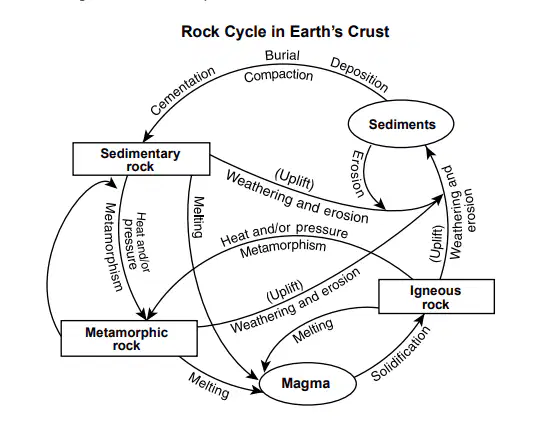
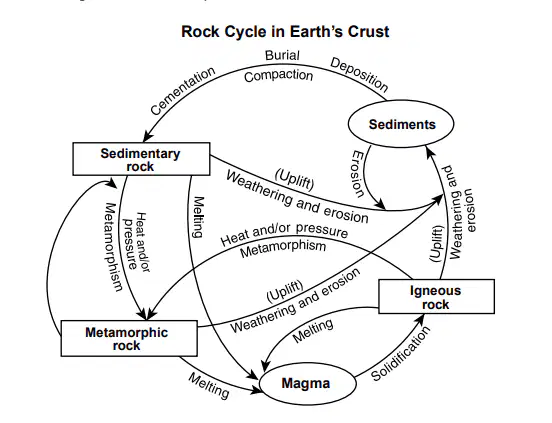
Total questions: 35

Worksheet time: 32mins
Name
Class
Date
1.

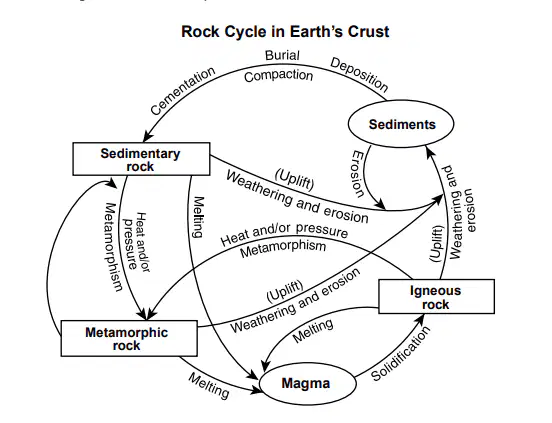
In order for sedimentary rock to form, which of the following must occur?

a)

compaction

b)

intrusion

c)

oxidation

d)

metamorphism

2.
This rock was formed when molten rock cooled into a solid. What type of rock is it?
a)

Igneous Rock

b)

Metamorphic Rock

c)

Sedimentary Rock

3.
What are the 3 major types of rocks?
a)
Igneous, Metamorphic, Sedimentary
b)
Metamorphic, Igneous, Cementation
c)
Brown, Red, Gray
d)
Streak, Hardness, Breakage
4.
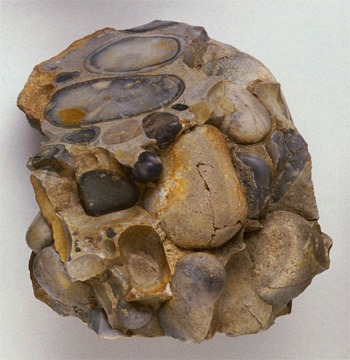
This rock was formed by smaller pieces of rock that settled at the bottom of a lake millions of years ago. What type of rock is this?
a)
Sedimentary
b)
Igneous
c)
Metamorphic
5.
Which of the words below describe mud, sand, and tiny bits of rocks that cement together to form a type of rock?
a)
stalactites
b)
magmas
c)
metamorphs
d)
sediments
6.

What causes igneous rocks to form

a)

pressure

b)

cooling magma and lava

c)

compaction

d)

cementation

7.

Rocks formed by heat and pressure beneath the Earth's surface are...

a)

igneous

b)

metamorphic

c)

sedimentary

d)

magma

8.

When heat and water and ice break down rock into sediments this is called?

a)

Erosion

b)

Compaction

c)

Weathering

d)

Deposition

9.

Which of the following describes the process of sediments being picked up and carried away . by wind, moving water or ice?

a)

Erosion

b)

Weathering

c)

Deposition

d)

Compaction

10.

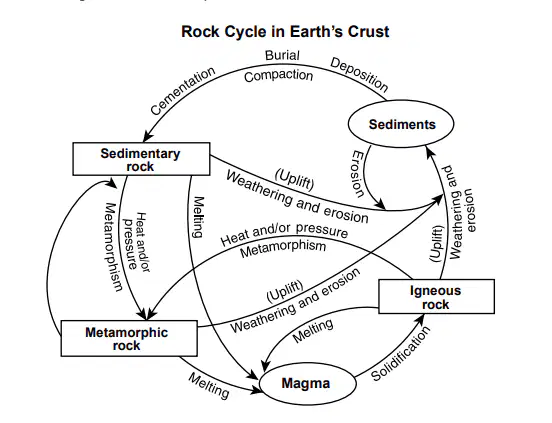
How does a Metamorphic rock become a Sedimentary rock?

a)

Heat, pressure and radiation

b)

Melting, cooling and evaporation

c)

Weathering, Erosion, Compaction and Cementation

d)

Cooling of Magma over time

11.
When particles are eroded and moved, they are eventually laid down in a process called: 
a)
deposition
b)
weathering
c)
supposition
d)
refraction
12.
The process when rocks break into smaller pieces due to exposure to natural elements is called
a)
erosion
b)
weathering
c)
sediments
13.
What are the 3 major types of rocks?
a)
Igneous, Metamorphic, Sedimentary
b)
Metamorphic, Igneous, Cementation
c)
magma, lava, crystals
14.

Which rock is formed form the cooling of volcanic ash on Earth's surface and forms small crystals?

a)

intrusive igneous

b)

foliated metamorphic

c)

extrusive igneous

d)

organic sedimentary

15.

Rocks that form from cooling magma inside Earth and form large crystals?

a)

Igneous intrusive

b)

Igneous extrusive

c)

Metamorphic foliated

d)

Metamorphic nonfoliated

16.

This is the continuous process of rock changing from one type to another.

a)

Igneous rocks

b)

Sedimentary rocks

c)

Metamorphic rocks

d)

Rock Cycle

17.

What type of rock might contain evidence of past life?

a)

Sedimentary Rock

b)

Igneous Rock

c)

Metamorphic Rock

18.

Limestone is a sedimentary rock. During the rock cycle, limestone is changed into marble, a metamorphic rock. The processes that act on limestone and change it into marble are

a)

weather and erosion

b)

heat and pressure

c)

compacting and cementing

d)

melting, cooling, and hardening

19.

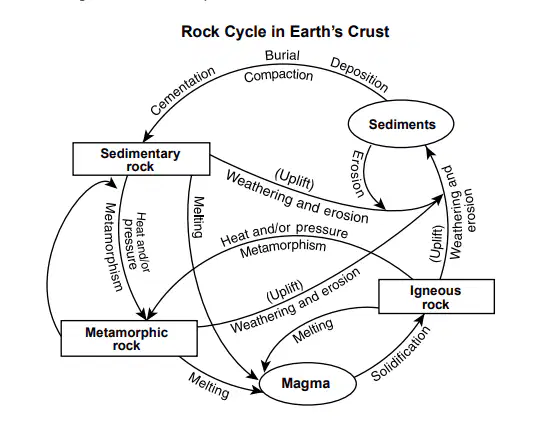
According to the diagram, what process is shown by letter A?

a)

extrusion

b)

erosion

c)

crystallization

d)

intrusion

20.

If a lot of heat is applied to a rock, it will turn into

a)

magma

b)

rocks

c)

sediment

d)

metamorphic rocks

21.
The hardest known mineral on the Mohs Hardness Scale is:
a)
Fluorite
b)
Sypsum
c)
Topaz
d)
Diamond
22.
What is the color of a mineral in powdered form called?
a)
Gas
b)
Fracture
c)
Streak
d)
Liquid
23.
What is the softest mineral on the Mohs Hardness Scale?
a)
Diamond
b)
Gypsum
c)
Topaz
d)
Talc
24.
Which mineral property is being shown here?
a)
luster
b)
hardness
c)
streak
25.
How much a mineral resists scratching is
a)
Streak
b)
Fracture
c)
Hardness
d)
Cleavage
26.
The least useful property when identifying minerals is
a)
Streak
b)
Luster
c)
Color
27.

Quartz can be scratched by Topaz.

a)

True

b)

False

28.
Which mineral could scratch topaz (hardness 8)?  
a)
Talc (hardness 1)
b)
Apatite (hardness 5)
c)
Quartz (harness 7)
d)
Corundum (hardness 9)
29.

The mineral's ability to reflect light. It can be metallic, pearly, glassy, silky, or dull.

a)

Luster

b)

Color

c)

Fracture

d)

Density

30.
Use Moh's hardness scale to answer the question. A penny has a hardness of 3.5. Which mineral has a hardness most similar to a penny?
a)
Fluorite
b)
Talc
c)

Diamond

d)
Quartz
31.
What occurs when minerals break unevenly along curved or irregular surfaces?
a)
Luster
b)
Fracture
c)
Cleavage
d)
Streak
32.
_____ is how light bounces off of a mineral.
a)
Color
b)
Hardness
c)
Luster 
d)
Streak
33.
What mineral is used for pencils?
a)
Graphite
b)
Galena
c)
Magnetite
d)
Quartz
34.

Whether or not a mineral will float in water is based on its _________.

a)

Luster

b)

Hardness

c)

Cleavage

d)

Density

35.

Atoms are arranged in a regular, repeating pattern. Classified by the number of faces and measure of angles. What property is this?

a)

Hardness

b)

Luster

c)

Density

d)

Crystal Structure