
 Worksheets
Ch. 12, 13, 14, 15
Total questions: 91
Worksheet time: 2hrs 31mins
Each mamelon forms the incisal edge of one of the primary labial lobes of the incisors. With wear, the rounded incisal edge becomes flat and is then referred to the incisal ridge.
Both statements are true.
The first statement is true; the second is false.
The first statement is false; the second is true.
Both statements are false.
Mandibular lateral incisors are generally smaller than mandibular central incisors. Mandibular lateral incisors have greater facial curvature than the central incisors.
Both statements are true.
The first statement is true; the second is false.
The first statement is false; the second is true.
Both statements are false.
Extracted mandibular central incisors are the easiest to identify as either right or left because they are located anteriorly and near the midline.
Both the statement and the reason are correct and related.
Both the statement and the reason are correct but are NOT related.
The statement is correct, but the reason is NOT correct.
The statement is NOT correct, but the reason is correct.
NEITHER the statement NOR the reason is correct.
The maxillary lateral incisor usually has a straight, thick, cylindrically shaped root. The root length of the maxillary lateral incisor is about 1.5 times the length of the crown.
Both statements are true.
The first statement is true; the second is false.
The first statement is false; the second is true.
Both statements are false.
Which incisor is not derived from four primary lobes?
Maxillary central
Maxillary lateral
Mandibular central
Mandibular lateral
All of the above are derived from four lobes.
Maxillary central incisors usually develop normally. Two anomalies that sometimes occur are a longer root or a shorter crown.
Both statements are true.
The first statement is true; the second is false.
The first statement is false; the second is true.
Both statements are false.
All incisors have two marginal ridges, a cingulum, and a lingual fossa. The mandibular central incisor has the least distinct lingual anatomy.
Both statements are true.
The first statement is true; the second is false.
The first statement is false; the second is true.
Both statements are false.
When incisors first erupt the incisal ridge is smooth. After the teeth have been in function for several months, mamelons, which aid in mastication, develop on the incisal ridge.
Both statements are true.
The first statement is true; the second is false.
The first statement is false; the second is true.
Both statements are false.
Each of the following statements correctly describes maxillary lateral incisors EXCEPT one. Which is the EXCEPTION?
The incisal aspect can resemble that of a central incisor or a canine.
Incisally, they exhibit more convexity both labially and lingually than maxillary centrals.
Of all incisors, the maxillary laterals vary the least in form.
The mesial aspect of a maxillary lateral incisor is similar to that of a small central incisor.
Frequently maxillary lateral incisors are peg-shaped.
The teeth most likely to be peg-shaped are the mandibular lateral incisors because the distal developmental lobe is large and located more lingually than its mesial lobe.
Both the statement and the reason are correct and related.
Both the statement and the reason are correct but are NOT related.
The statement is correct, but the reason is NOT correct.
The statement is NOT correct, but the reason is correct.
NEITHER the statement NOR the reason is correct.
The mandibular lateral incisors are wider mesiodistally than the mandibular central incisors because the mesial developmental lobe of the laterals is larger than that of the centrals.
Both the statement and the reason are correct and related.
Both the statement and the reason are correct but are NOT related.
The statement is correct, but the reason is NOT correct.
The statement is NOT correct, but the reason is correct.
NEITHER the statement NOR the reason is correct.
The mandibular central incisor occludes with both the maxillary central incisor and the maxillary lateral incisor. Similar to other anterior teeth, a mandibular incisor is derived from five lobes, three facial lobes and two lingual lobes.
Both statements are true.
The first statement is true; the second is false.
The first statement is false; the second is true.
Both statements are false.
Which incisor has a lingual pit?
Maxillary central
Maxillary lateral
Mandibular central
Mandibular lateral
Which anatomical landmark could make an incisor more prone to dental caries?
Cingulum
Lingual pit
Mamelons
Prominent marginal ridges
In an anterior crossbite, the maxillary central incisors would exhibit wear in which location?
Labioincisal edge
Linguloincisal edge
Cervical region
Apex
Each of the following is true of the maxillary permanent central incisor EXCEPT one. Which one is the EXCEPTION?
Evidence of calcification occurs at three months.
This is the widest mesiodistally of any of the anterior teeth.
Root formation is completed by six years of age.
Gemination is an anomaly that sometimes occurs.
Development is usually normal.
The eruption time for both the maxillary central incisor and mandibular lateral incisor is
6 to 7 years
7 to 8 years
8 to 9 years
None of the above
Which of the following are commonly found on roots of maxillary incisors?
Proximal grooves
Evidence of division
Bifurcation
Indentation
None of the above
Which of the following are characteristic of one or both maxillary incisors (select all that apply)?
Slender roots
Linguoincisal attrition
Greater labiolingual than mesiodistal crown dimension
Most prominent teeth in the mouth
Which of the following are characteristic of one or both mandibular incisors (select all that apply)?
All contact areas are in incisal third
Rounded distoincisal angle
Smooth, shallow lingual surface
Slender roots
Although the labiolingual and mesiodistal widths of the maxillary canine are about equal, the crown is usually wider mesiodistally. Viewed from the incisal aspect, the cusp tip of the maxillary canine is labial and mesial to the center of the crown.
Both statements are true.
The first statement is true, the second is false.
The first statement is false, the second is true.
Both statements are false.
The canine fossa is a depression in the maxillae below the infraorbital foramen. The canine eminence, located on the lingual surface of maxillary canines, separates the mesial and distal lingual fossae.
Both statements are true.
The first statement is true; the second is false.
The first statement is false; the second is true.
Both statements are false.
Maxillary and mandibular canines have the same time sequence for their
Calcification
Enamel completion
Eruption
Root completion
From the labial aspect the mesial surface of the mandibular canine is more convex than the distal surface because the mesial outline is more straight.
Both the statement and the reason are correct and related.
Both the statement and the reason are correct but are NOT related.
The statement is correct, but the reason is NOT correct.
The statement is NOT correct, but the reason is correct.
NEITHER the statement NOR the reason is correct.
The root of the mandibular canine is sometimes bifurcated like the
Maxillary lateral
Maxillary canine
Mandibular lateral
None of the above
Maxillary canines erupt about two years after the mandibular canines. Root formation of maxillary canines is considered complete between 13 and 15 years of age.
Both statements are true.
The first statement is true; the second is false.
The first statement is false; the second is true.
Both statements are false.
Both maxillary and mandibular canines are more rounded on the distal surface. Their distal contact area is in the incisal third.
Both statements are true.
The first statement is true; the second is false.
The first statement is false; the second is true.
Both statements are false.
Each of the following incorrectly describes the canine eminence EXCEPT one. Which one is the EXCEPTION?
Large cingulum
Projection of bone
Sharp cusp tip
Prominent labial ridge
The canines are especially efficient at pulverizing food because their double-cuspal arrangement provides assistance to the molars.
Both the statement and the reason are correct and related.
Both the statement and the reason are correct but are NOT related.
The statement is correct, but the reason is NOT correct.
The statement is NOT correct, but the reason is correct.
NEITHER the statement NOR the reason is correct.
A basic difference between canines and incisors is that canines develop from four developmental lobes whereas incisors develop from three. The canines are the most stable teeth in the mouth.
Both statements are true.
The first statement is true; the second is false.
The first statement is false; the second is true.
Both statements are false.
Compared to maxillary canines, mandibular canines have all of the following EXCEPT one. Which one is the EXCEPTION?
Narrower mesiodistal width
Smoother lingual surface
Flatter cingulum
Wider labiolingual width
Compared to their maxillary counterparts, each of the following descriptions of mandibular canines is accurate EXCEPT one. Which one is the EXCEPTION?
Mandibular canines resemble maxillary canines in their wedge-shaped outline.
A mandibular canine crown length is as long as that of a maxillary canine and sometimes longer.
The root of a mandibular canine is often longer than that of a maxillary canine.
The lingual surface of a mandibular canine is smoother than that of a maxillary canine.
Although similar in appearance, maxillary and mandibular canines have numerous different landmarks. Both maxillary and mandibular canines have prominent marginal ridges.
Both statements are true.
The first statement is true, the second is false.
The first statement is false, the second is true.
Both statements are false.
The canines' stability can be attributed to all of the following factors EXCEPT one. Which one is the EXCEPTION?
Root length
Large cingulum
Canine eminence
Location in the dentition
Each of the following is true of the cusp tip EXCEPT one. Which one is the EXCEPTION?
When a canine is newly erupted, the cusp tip is shaped like a mamelon.
The maxillary cusp tip is labially inclined.
The mandibular cusp tip is lingually inclined.
Cusps tips can become abraded with wear.
Which anterior teeth are widest mesiodistally?
Maxillary central incisors
Maxillary canines
Mandibular lateral incisors
Mandibular canines
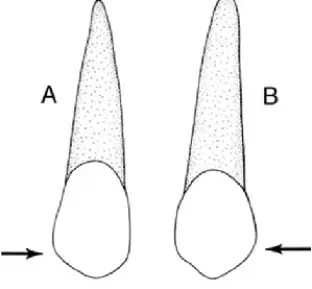
In the illustration below, figure "A" is a
Maxillary central incisor
Maxillary lateral incisor
Mandibular canine
Maxillary canine
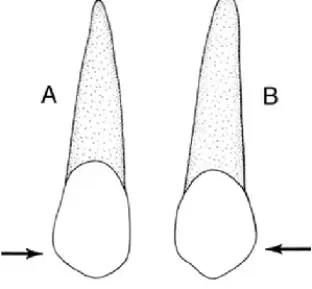
In the illustration below, Figure "B" is a
Maxillary central incisor
Maxillary lateral incisor
Mandibular canine
Maxillary canine
Which of the following accurately describe canines (select all that apply)?
They are the most stable teeth in the dentition.
Their location can only accommodate a short root.
The canine eminence is located on the lingual surface coronal to the cingulum.
Canines function as holding and tearing tools.
Their "V" shape at the corner of the mouth helps dissipate occlusal pressure.
Which of the following are true of the root of the maxillary canine (select all that apply)?
It is usually the longest root in the mouth.
In a cross-sectional view it appears to taper from the lingual toward the labial.
The apical portion often points mesially but seldom distally.
It is very strong and firmly embedded in the maxilla.
Which statements correctly describe features of canines (select all that apply)?
The three facial lobes of the maxillary canine resemble the facial lobes of the incisors.
Maxillary canines frequently have one pulp horn and one root.
Mandibular canines have one pulp horn and can have one or two roots.
The cingulum is equally developed on maxillary and mandibular canines.
Christine has sharp, pointed cusp tips on her maxillary canines. She is 12 years old and has endured some teasing about the "fang-like" appearance of her canines. She asks her dentist if he can change the shape of her canines. The dentist agrees that reducing the cusp tips will result in a positive change in Christine's appearance. If the maxillary cusp tips are flattened, which teeth will they most resemble?
Maxillary central incisors
Maxillary lateral incisors
Maxillary first premolars
Maxillary second premolars
The mandibular second premolar shows evidence of calcification at 2 1/2 years. Completion of enamel formation does not occur; until 11 to 12 years.
Both statements are true.
The first statement is true; the second is false.
The first statement is false; the second is true.
Both statements are false.
The overall height of the premolars is longer than that of the canines because the root of the premolars is considerably longer than those of the canines.
Both the statement and the reason are correct and related.
Both the statement and the reason are correct but are NOT related.
The statement is correct, but the reason is NOT correct.
The statement is NOT correct, but the reason is correct.
NEITHER the statement NOR the reason is correct.
Premolars erupt between 9 and 12 years of age. Premolars are the succedaneous teeth that replace primary canines.
Both statements are true.
The first statement is true; the second is false.
The first statement is false; the second is true.
Both statements are false.
The lingual surface of premolars is formed from how many lobes?
1
2
3
Not all premolars are formed from the same number of lobes.
Which premolar has the smallest lingual cusp?
Maxillary first
Maxillary second
Mandibular first
Mandibular second
As a rule, the mandibular first premolars are always smaller than the mandibular second premolars. The most striking identifying feature of the mandibular first premolar is the mesiolingual developmental groove.
Both statements are true.
The first statement is true; the second is false.
The first statement is false; the second is true.
Both statements are false.
Which of the following are true of both maxillary first premolars and maxillary second premolars (select all that apply)?
Both have two cusps.
Both have two roots.
Both are formed from four developmental lobes.
Both have two pulp horns.
Which premolar has buccal and lingual cusps that are almost the same height?
Maxillary first
Maxillary second
Mandibular first
Mandibular second
None of the above
A prominent characteristic of the maxillary first premolar is a
Mesiolingual developmental groove
Central fossa
Mesial marginal developmental groove
Distal marginal developmental groove
Any ridge that extends from the cusp tip to the central groove of the occlusal surface is called a marginal ridge. When two marginal ridges join, after traversing the tooth buccolingually, they form a transverse ridge.
Both statements are true.
The first statement is true; the second is false.
The first statement is false; the second is true.
Both statements are false.
The mandibular second premolar always has three cusps because this tooth always forms from five lobes.
Both the statement and the reason are correct and related.
Both the statement and the reason are correct but are NOT related.
The statement is correct, but the reason is NOT correct.
The statement is NOT correct, but the reason is correct.
NEITHER the statement NOR the reason is correct.
Which type of cusp pattern does the letter "Y" represent on the mandibular second premolar (how many total cusps)?
2
3
4
None of the above
Each of the following is evident on a maxillary first premolar EXCEPT one. Which one is the EXCEPTION?
Mesial marginal groove
Mesial developmental depression
Mesial marginal ridge
Distinct distal marginal ridge
Two small, afunctional lingual cusp tips
Which selection best describes the roots of the maxillary first premolar?
Two roots, one mesial and one distal
Two roots, one buccal and one lingual
Fused roots
One root only
Mandibular first premolars typically have two roots, a mesial and a distal. An anomaly is formation of a third auxiliary root.
Both statements are true.
The first statement is true; the second is false.
The first statement is false; the second is true.
Both statements are false.
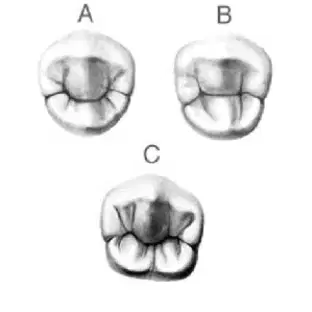
In figure "A" below, identify the tooth, the number of cusps, and groove pattern.
Mandibular first premolar; two cusps; "C" groove pattern
Mandibular second premolar; two cusps; "Y" groove pattern
Mandibular first premolar; two cusps; "H" groove pattern
Mandibular second premolar; two cusps; "U" groove pattern
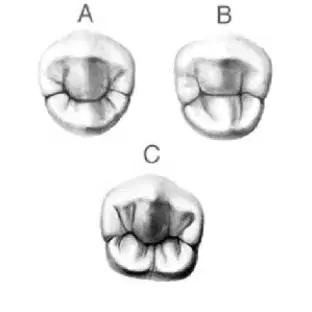
In figure "B" below, identify the tooth, the number of cusps, and groove pattern.
Mandibular second premolar; two cusps; "H" groove pattern
Mandibular second premolar; two cusps; "Y" groove pattern
Mandibular first premolar; two cusps; "U" groove pattern
Mandibular second premolar; three cusps; "U" groove pattern
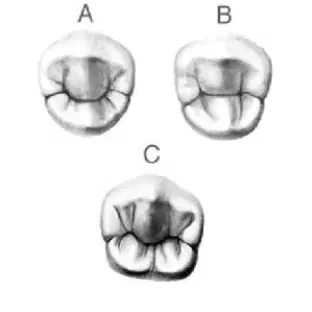
In figure "C" below, identify the tooth, the number of cusps, and groove pattern.
Mandibular second premolar; three cusps; "Y" groove pattern
Mandibular first premolar; three cusps; "H" groove pattern
Mandibular first premolar; three cusps; "U" groove pattern
Mandibular second premolar; two cusps; "C" groove pattern
Which of the following are located on the occlusal surfaces of premolars (select all that apply)?
Marginal ridges
Transverse ridges
Triangular ridges
Premolar eminence
Which of the following are true of the maxillary second premolars (select all that apply)?
Evidence of calcification is seen at 2 years of age.
Completion of enamel formation occurs at 4 years of age.
Eruption occurs at 11 to 13 years of age.
Root formation is completed by 12 to 14 years of age.
All of the premolars usually have a transverse ridge that crosses an occlusal developmental groove EXCEPT one. Which one is the EXCEPTION?
Maxillary first
Maxillary second
Mandibular first
Mandibular second
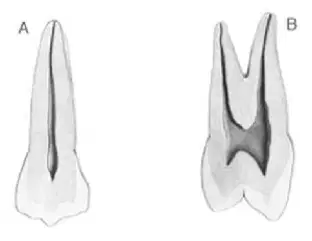
Figure "A" below is which tooth?
Maxillary right second premolar
Maxillary left second premolar
Maxillary right first premolar
Maxillary left first premolar
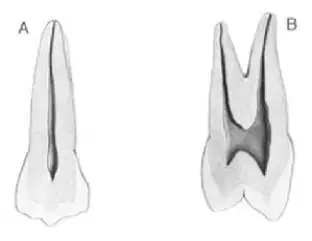
Figure "B" below illustrates a view of which surface?
Buccal
Lingual
Mesial
Distal
The distal contact area of the mandibular right first molar is located on the distal cusp. This contact area centered over the distal root.
Both statements are true.
The first statement is true; the second is false.
The first statement is false; the second is true.
Both statements are false
Which of the following is true of mandibular first and second molars?
The two buccal cusps of both teeth are divided by a buccal groove.
Only the mandibular first molar has a buccal groove dividing the two buccal cusps.
Only the mandibular second molar has a buccal groove dividing the two buccal cusps.
Both mandibular first and second molars have a fifth cusp.
Maxillary molars have sturdy anchorage because the two roots are connected to a single root trunk.
Both the statement and the reason are correct and related.
Both the statement and the reason are correct but are NOT related.
The statement is correct, but the reason is NOT correct.
The statement is NOT correct, but the reason is correct.
NEITHER the statement NOR the reason is correct.
Maxillary molars have an oblique ridge. The oblique ridge is a marginal ridge.
Both the statement and the reason are correct and related.
Both the statement and the reason are correct but are NOT related.
The statement is correct, but the reason is NOT correct.
The statement is NOT correct, but the reason is correct.
NEITHER the statement NOR the reason is correct.
The oblique ridge, unique to the maxillary molars, is considered a transverse ridge because it runs in several directions.
Both the statement and the reason are correct and related.
Both the statement and the reason are correct but are NOT related.
The statement is correct, but the reason is NOT correct.
The statement is NOT correct, but the reason is correct.
NEITHER the statement NOR the reason is correct.
The distolingual cusp of a maxillary first molar is quite small and considered afunctional. This cusp occupies 10% of the lingual surface and the mesiolingual cusp occupies the remaining 90% of the lingual surface.
Both statements are true.
The first statement is true; the second is false.
The first statement is false; the second is true.
Both statements are false.
Which molar's occlusal groove pattern resembles a cross (+)?
Maxillary first
Maxillary second
Mandibular first
Mandibular second
Each of the following statements correctly describes maxillary molars EXCEPT one. Which one is the EXCEPTION?
Roots become shorter as the maxillary molar is more posterior.
Second molar roots are closer together than first molars.
Third molar roots are usually smaller than first or second molars.
First molar roots show the most variation in root form of all three molars.
Maxillary molars have at least four pulp horns. Mandibular molars have three pulp horns except for the third molars, which have four.
Both statements are true.
The first statement is true; the second is false.
The first statement is false; the second is true.
Both statements are false.
Permanent maxillary first molars are classified as succedaneous teeth. They are generally the largest of the three molars.
Both statements are true.
The first statement is true; the second is false.
The first statement is false, the second is true.
Both statements are false.
All of the following terms are characteristic of maxillary third molars EXCEPT one. Which one is the EXCEPTION?
Congenitally missing
Impacted
Erupt between 18 and 25 years
Show variations of the crown or roots
Each of the following structures is present on maxillary first molars EXCEPT one. Which one is the EXCEPTION?
Central pit
Buccal groove
Lingual marginal ridge
Distal pit
The mesial root of the mandibular first molar often has
One pulp canal
Two pulp canals
Two distinct mesial roots
Dilaceration
Maxillary and mandibular first molars have a fifth or supplemental cusp. This additional cusp, the cusp of Carabelli, is located on the mesiolingual cusp tip.
Both statements are true.
The first statement is true; the second is false.
The first statement is false; the second is true.
Both statements are false.
The calcification of both maxillary and mandibular first molars is evident birth. The calcification of maxillary third molars is evident at 5 years whereas calcification of mandibular third molars is evident at 7 years.
Both statements are true.
The first statement is true; the second is false.
The first statement is false; the second is true.
Both statements are false.
Compared with first molars, third molars most often have _____ roots.
More
Longer
Closer
Less defined
The root completion for the maxillary first molar is how many years of age?
6
8
9 to 10
11 to 12
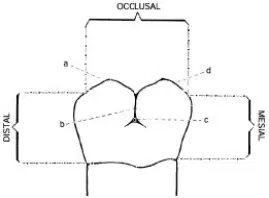
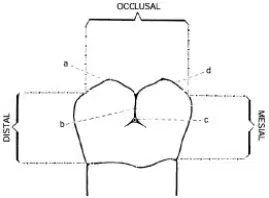
Below is an illustration of the buccal surface of a mandibular right second molar. Structure "a" depicts the
Mesiobuccal cusp
Buccal pit
Distobuccal cusp
Buccal groove
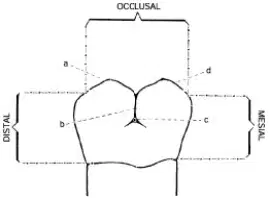
Below is an illustration of the buccal surface of a mandibular right second molar. Structure "b" depicts the
Buccal groove
Distobuccal cusp
Buccal pit
Mesiobuccal cusp
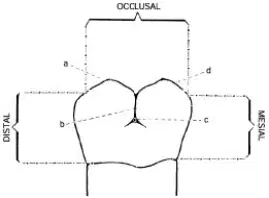
Below is an illustration of the buccal surface of a mandibular right second molar. Structure "c" depicts the
Mesiobuccal cusp
Buccal groove
Distobuccal groove
Buccal pit
Below is an illustration of the buccal surface of a mandibular right second molar. Structure "d" depicts the
Distobuccal cusp
Mesiobuccal cusp
Buccal groove
Buccal pit
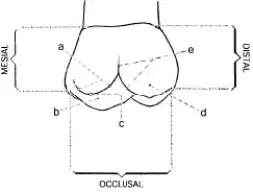
In the figure below, "a" represents the (a) .
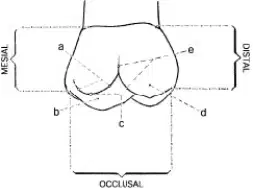
In the figure below, "b" represents the (a) .
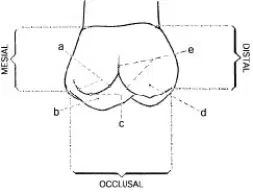
In the figure below, "c" represents the (a) .

In the figure below, "d" represents the (a) .
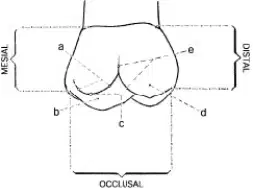
In the figure below, "e" represents the (a) .

