
 Worksheets
Year 10 Chemistry revision
Total questions: 74
Worksheet time: 2hrs 42mins
PbCl2 + AgNO3 → Pb(NO3)2 + AgCl
Combination/Synthesis
Single Displacement
Double Displacement
NH3 + HCl → NH4Cl
Combination/Synthesis
Single Displacement
Double Displacement
element displacing another element in a compound
burning of a substance
Combination/Synthesis
Single Displacement
Double Displacement
Which of the following factors does not affect the rate of a chemical reaction?
Catalysts
Surface area
Temperature
Concentration
Colour of the reactants
The ______ the surface area exposed to a chemical reaction, the ________ the rate of the reaction.
larger, faster
larger, slower
smaller, faster
How does the concentration of reactants and products generally change over time during a chemical reaction?
It stays the same for both reactants and products.
It decreases for reactants and increases for products.
It increases for reactants and decreases for products.
It decreases for reactants and products.
It increases for reactants and products.
Which of the following factors does not affect the rate of a chemical reaction?
Catalysts
Surface area
Temperature
Concentration
Colour of the reactants
The ______ the surface area exposed to a chemical reaction, the ________ the rate of the reaction.
larger, faster
larger, slower
smaller, faster
A student wants to measure the effect of surface area on the reaction of iron with dilute hydrochloric acid. The student performs the experiment several times, using the same mass of iron but changing its surface area. How does the surface area affect the total amount of H2 gas produced?
The total amount of gas produced decreases with increasing the surface area.
The total amount of gas produced increases with decreasing the surface area.
The total amount of gas produced decreases with decreasing the surface area.
The total amount of gas produced increases with increasing the surface are
It has no effect; the total amount of gas produced is always the same.
How does the concentration of reactants and products generally change over time during a chemical reaction?
It stays the same for both reactants and products.
It decreases for reactants and increases for products.
It increases for reactants and decreases for products.
It decreases for reactants and products.
It increases for reactants and products.
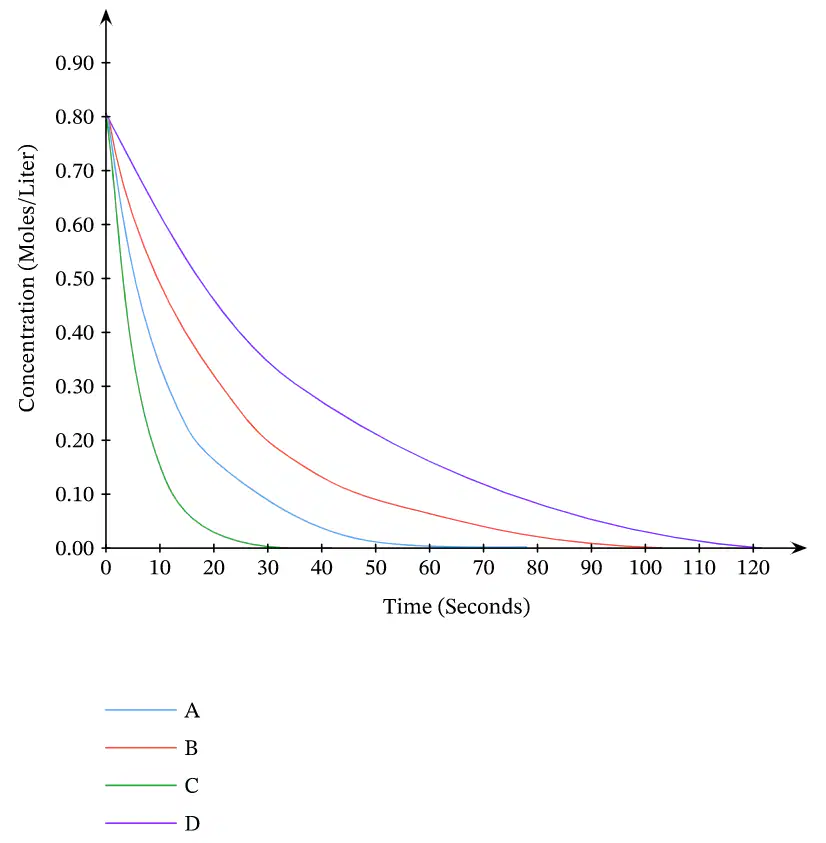
The graph below shows how the concentration of a reactant in four different reactions changes over time. Which reaction is the slowest?
A
B
C
D
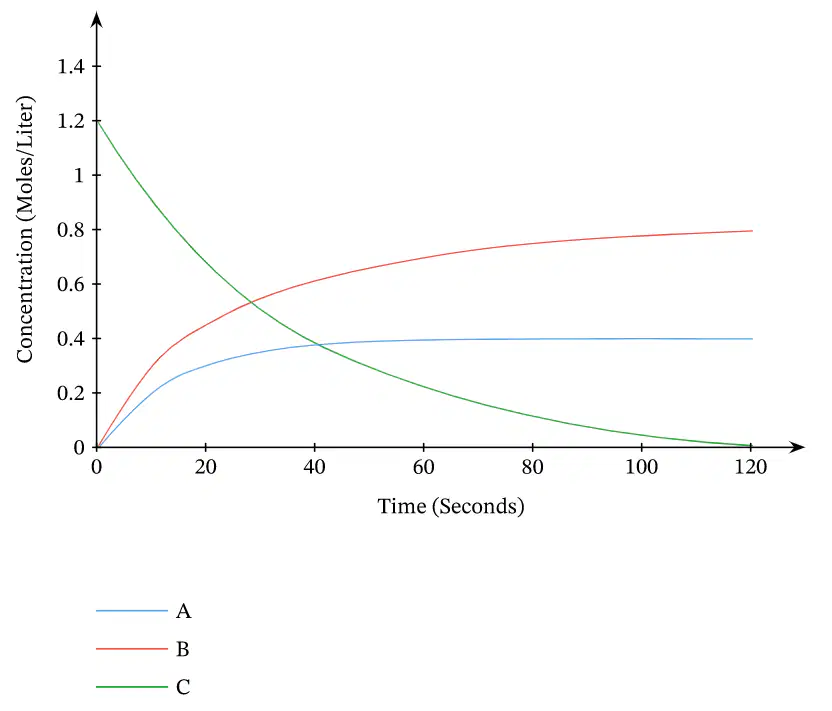
The graph below shows how the concentrations of reactants and products change during a chemical reaction. Which of the chemical species is likely to be the reactant?
A
B
C
The graph below shows how the concentrations of reactants and products change during a chemical reaction. Which of the chemical species is likely to be the reactant?
A
B
C
A temperature increase causes the particles to ......
to slow down
move faster
collide higher
in the right order
Why does a higher concentration increase the rate of reaction?
it increases the amount of reactants
it lowers the activation energy
it increases the energy of particle collisions
it increases the frequency of particle collisions
Grinding a effervescent tablet into powder increases the rate of reaction due to increased
concentration
surface area
temperature
reactants
Increasing the temperature gives particles more __________.
Time
Energy
Space
Frequency
As the frequency of ______________ increases, the rate of reaction increases.
Time
Reactions
Collisions
Reactants
The minimum amount of energy needed for colliding particles to react is called
Chemical Energy
Kinetic Energy
Activation Energy
Potential Energy
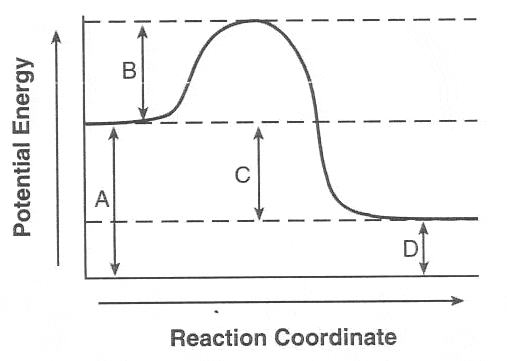
List three factors that affect the rate of a reaction
temperature
concentration
surface area
volume
What criteria must be met for reactant collisions to result in a successful product?
The reactants must collide with each other
The reactants must collide with enough energy and be in the right positions
The reactants must have enough energy to form the activated complex
What is the name of group number 1?
halogens
noble gases
alkali metals
alkaline earth metals
where are the metaloids found
far left, vertical
stair step/diagonal
far right horizontal
at the bottom
Periodic law states that the elements are arranged according to their atomic ________ so that elements with similar chemical properties are in the same ________ and properties repeat periodically.
numbers, rows
masses, rows
masses, column
numbers, column
Metals (select all that apply)
are found on the right side of the periodic table.
are found on the left side of the periodic table.
are good conductors of heat and electricity.
are brittle.
are malleable and ductile.
Nonmetals (select all that apply)
are found on the right side of the periodic table.
are found on the left side of the periodic table.
are good conductors of heat and electricity.
are brittle.
can be solid, liquids, or gases at room temperature.

Which element is found in group 2, period 6?
Oxygen (O)
Barium (Ba)
Selenium (Se)
Carbon (C)
Which halogen is found in period 4?
Krypton (Kr)
Xenon (Xe)
Bromine (Br)
Iodine (I)
Elements that have the same number of energy levels are said to be in the same ______.
group
period
family
classification


What is the symbol for the Phosphate ion?
PO42-
PO43-
PO33-
PO32-


Why do elements form bonds?
to get a charge
so they can make friends
to become stable by getting a full valence shell
to become stable by increasing their mass
Lithium (Li)
Li+
Li2+
Li-
Li2-
Chlorine/de (Cl)
Cl2-
Cl+
Cl-
Cl3-
Hydrogen (H)
H2+
H-
H+
He+
Magnesium (Mg)
Mg+
Mg2+
Mg2-
Mg2-
Oxygen (O)
O2+
O2-
O3-
O+
Helium (He)
He+
He-
Helium doesn't form ions as it has a stable outer cell
He 2+
What charge does an atom have when it GAINS electrons?
Positive
Negative
Neutral
What subatomic particle changes in an ion?
The number of electrons
The number of protons
The number of neutrons

What type of atom is element C?
Normal atom
Ion
Isotope


How many valence electrons ae in the element Carbon?
2 electrons
6 electrons
4 electrons
None of the above

What is an ion?
An atom that has gained or lost an electron.
An atom that has gained or lost a neutron.
An atom that has gained or lost a proton.
An atom that is electrically neutral.
Which of these elements is Helium ?
Protons 13
neutons 14
Electrons 10
Protons 2
Neutrons 2
Electrons 2
Protons 6
Neutrons 7
Electrons 6

Which of these elements is an Isotope ?
A
B
C
D

Which of these elements is Aluminum?
A
D
C
A AND D
Which of these elements is Aluminum?
A
D
C
A AND D

What period does element D a part of?
1
2
3
4

What group is element C a part of?
3
14
5
6

Which of these elements would be considered a metal?
C and D
B and C
A and D
A and B
Valence electrons are located...
inside the nucleus
in outer space
on the outermost orbit of an atom

10
2
8
18


Identify the element.
Ca
Na
Cu
Mg

Which of these elements are metals?
A and D
B and C
A and D and C
A and C

