
 Worksheets
Natural Selection Study Guide
Total questions: 75
Worksheet time: 45mins
What is the process where animals live or die based on their adaptations to their environment.
Genetic Drift
Natural Selection
The Circle of Life
Mammoth
Variations are caused by . . .
Kaleidoscopes
Variety Shows
Mutations
A change in phenotypic expression
A variation is . . .
when organisms have camouflage like spots or stripes
an organism from a different dimension
when you order different food than your friend
differences between organisms in the same species
Something that helps an organism survive in its environment is an . . .
Adaptation
Tool
Evolution
Sour Patch Kid
What does 'fitness' mean in natural selection?
How fast an animal can run
How much you work out
How well adapted the animal is to their environment
How strong an animal is
What is survival of the fittest?
Do you even lift brah?
Only the strong survive
Hunger Games
The best adapted animal will live and reproduce
Why is an insertion/deletion mutation worse than a substitution mutation?
Putting things into your DNA is always bad`
It causes a frameshift (affects the whole code after the mutation)
It causes a mutation
All DNA is important you can't delete even one nucleotide
What is a codon?
An allele
A three base piece of DNA that encodes for an amino acid
A computer virus
A nucleotide
A protein is made from a chain of
Amino Acids
Alice in Chains
Meat
Carbon
In the process of protein synthesis (DNA to Protein) what is the first step?
DNA to RNA
RNA to Amino Acid
Amino Acid to Protein
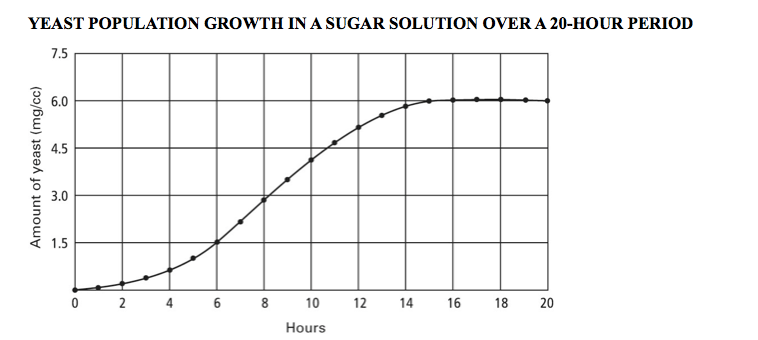
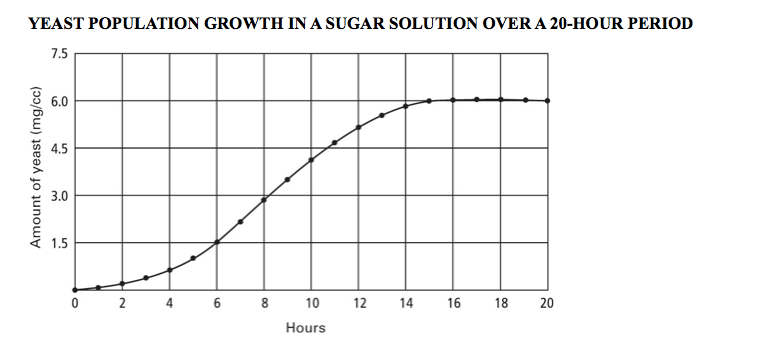
Which of the following would be an example of a biome?
A lake
Earth
Tropical Rainforest
A group of zebra
Which is a biotic factor?
soil
air
bacteria
water
Which of the following is a density independent limiting factor?
competition for resources
predation
disease
natural disasters

Why is biodiversity important to ecosystems?
It allows ecosystems to adapt to changing climates.
It establishes the separate ecosystems within a biome.
It has created antibiotic-resistant bacteria
It provides each organism with one specific role to ensure there is no competition.
Owls and snakes eat mice and other organisms. What would happen to the mice population if the owl population decreased?
The population would decrease, as the loss of owls as part of their diet is a limiting factor.
The population would decrease, as shelters created by owl nests is a limiting factor.
The population would increase, as competition for food is a limiting factor.
The population would increase, as predation by owls is a limiting factor.
Only the strong will survive refers to
Natural selection
Artificial selection
Dichotomous key
Homologous evolution
Match the following pictures with the words they represent

Analogous Structure

Homologous Structure

Adaptation

Artificial selection

Natural selection

Organism

Population

Community

ecosystem

biosphere
When Darwin was studying the finches and noticed the different types of beaks, this was an example of (a)
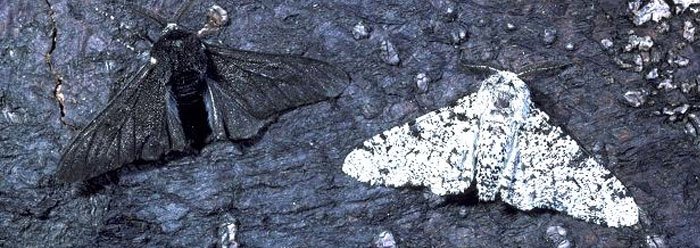
The field of biology that classifies organisms is called...
Taxonomy
Phylogeny
Paleontology
Embryology
Which of the following is NOT a domain of life?
Prokarya
Eukarya
Eubacteria
Archaebacteria
Which level of biological classification is the MOST specific?
Phylum
Kingdom
Order
Species
Which level of biological classification is the LEAST specific?
Domain
Kingdom
Genus
Family
In binomial nomenclatures, in which order are the names listed?
Genus, Species
Species, Genus
Phylum, Order
Order, Phylum
Phylogeny is...
The study of classification of different species
The study of the evolutionary history of a species
The study of prehistoric life
The study of the distribution of different species
Phylogenetic trees show...
Evolutionary relationships between different species
How one species has evolved through time
Which species has evolved the most
Which species have evolved from other species

Based on the figure, which organism is most closely related to the polar bear?
black bear
european brown bear
western north american brown bear
asian brown bear
Forming of a new species by evolution from pre-existing species.
Speciation
Extinction
Gradualism
Punctuated equilibrium
Elimination of a species.
Extinction
Gradualism
Coevolution
Adaptive radiation
A flash flood carried a raft of Amazon ants away from their original population. There is enough distance between the two groups, that they will never meet in nature again. What type of isolation is this?
Behavioral isolation
Temporal isolation
Geographic isolation
If a population becomes isolated from other populations of the same species and then genetic differences start to occur, what happens?
Competition
Extinction
Speciation
Fossils form
A group of organisms that can mate with each other and produce fertile offspring.
A group of organisms that can mate and produce offspring even if those offspring are infertile.
A group of organisms that genetically are very different from each other.
Indivual organisms that live in the same environment.
A type of speciation caused by geographic barriers separating populations that once shared a gene pool
Sympatric
Allopatric
Chemical
Temporal
behavioral isolation
temporal isolation
gametic isolation
geographic isolation
Which are causes of speciation? Choose all that apply
Isolation caused by mountains, rivers and man-made structures
preference for different foods
change in environment
different mating behaviors
Temporal isolation is different from behaviorial isolation because, temporal isolation means...
Organisms are not reproducing at the same time
Organisms are physically separated
Organisms are not attracted to the mates attraction signals
Match the following types of isolation
Temporal Isolation
populations are isolated because they breed at different times
Behavioral Isolation
populations do not interbreed because their courtship displays differ
Habitat Isolation
populations are isolated because they breed in different habitats
Gametic Barrier Isolation
matings fail because eggs and sperm are incompatible
Mechanical Isolation
mating fail because male and female reproductive structures are incompatible

What is the closest relative of humans shown in this diagram?
horse
turtle
monkey
dog
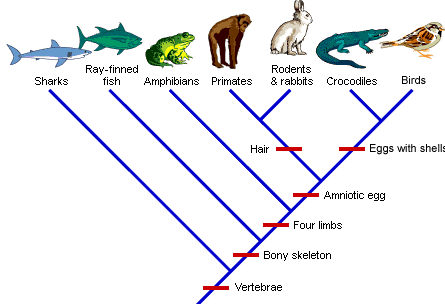
According to this cladogram, primates are most closely related to....
Amphibians
Rodents & rabbits
Crocodiles
Birds

Which group of animals on this tree are most closely related to birds?
Saurischian dinosaurs
Ornithischian dinosaurs
Crocodiles
None of these are related to birds

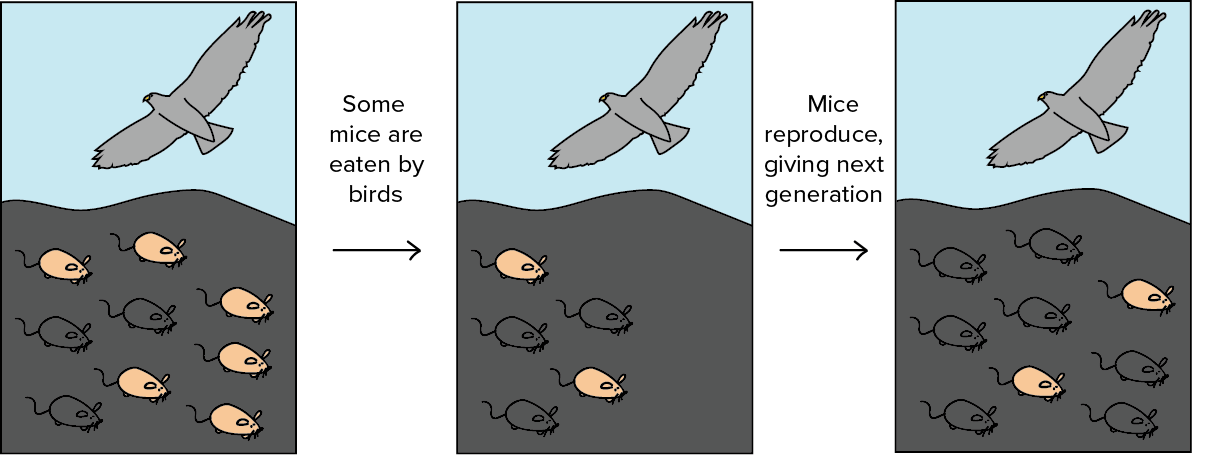
The diagram shows light- and dark-colored beetles that live on a tree. Which result is most likely to occur to the beetle population due to predation over time?
The number of light-colored beetles in the population will increase.
There will be more dark-colored beetles than light-colored beetles.
The number Of light-colored beetles will decrease.
The dark-colored beetles will move to a different type of tree.
The ecological role an organism performs in their specific environment is considered the organism's...
Habitat
Population
Biome
Niche
a relationship between two species in which both species compete for limited resources such that both species are negatively affected by the relationship
Symbiosis
interspecific competition
species richness
species-area effect
A relationship in which two different organisms live in close association with each other
interspecific competition
Mutualism
Symbiosis
Commensalism
the differentiation of niches that enables similar species to coexist in a community
character displacement
climax community
resource partitioning
pioneer species


What is an ecological community?
two or more of the same species living in an area
all of the abiotic and biotic factors in an area
one single organism in an ecosystem
all of the living parts of an ecosystem
What is an example of a decomposer?
crow
mushroom
deer
plant

Which ecosystem is more diverse?
Ecosystem A
Ecosystem B
They're have the same biodiversity
Not enough information

If the penguins from Ecosystem B were all to die from disease, what would happen to the other organisms?
If the penguins were to die, the whales would lose their major food source. Although they can still eat krill, penguin were their favorite, so the ecosystem would collapse.
If the penguins were to die, the squid would lose their major food source. This would not make the ecosystem collapse, since the squid can still hunt the seagulls and seals.
If the penguins were to die, the plankton would lose their major food source. This would make the ecosystem collapse since the plankton are this food web's foundation.
If the penguins were to die, the seals would lose their major food source. This would allow more squid and plankton to be available to other organisms. Since the seal has other food sources (squid), the ecosystem should not completely collapse.
Herbivores, carnivores and omnivores belong to which niche?
Producer
Consumer
Scavenger
Decomposer
What does the word biodiversity mean?
Bio = life
Diversity = same
Bio = Earth
Diversity = variety
Bio = life
Diversity = variety
Bio = Earth
Diversity = same

