wayground logo

Free Printable Worksheets

Font size

S
M
L
XL
Worksheets

Exam 4 Review

Total questions: 88

Worksheet time: 2hrs 39mins

Name
Class
Date
1.
Using the dihybrid cross and key provided, what is the probability of the offspring being tall and white?
a)
9
b)
2
c)
3
d)
6
2.
In a dihybrid cross
a)
one trait is crossed.
b)
two traits are crossed.
c)
four boxes are needed for the punnett square.
d)
mom's alleles are dominant.
3.

In a monohybrid cross

a)

one trait is crossed.

b)

two traits are crossed.

c)

four boxes are needed for the punnett square.

d)

mom's alleles are dominant.

4.

A single trait contains ___ different allele(s)

a)

2

b)

4

c)

3

d)

1

5.

Based off this punnett square, what fraction of the offspring will have wrinkled, yellow seeds?

a)

9/16

b)

3/16

c)

1/16

d)

16/16

6.

Based off this punnett square, what fraction of the offspring will have wrinkled, green seeds?

a)

9/16

b)

3/16

c)

1/16

d)

16/16

7.

What is the genotype for a pea plant homozygous for round seeds (R), and heterozygous for yellow seeds?

a)

RrYy

b)

RRyy

c)

RRYy

d)

rryy

8.
T2 - Which observation of dihybrid crosses led to Mendel's law of independent assortment
a)
Particular individual traits persisted for many generations
b)
Many combinations of traits were always inherited together
c)
Some combinations of traits were not passed onto offspring
d)
The presence of one trait didn't affect the presence of another
9.

Law which states that different traits are inherited independently of each other

a)

law of independent assortment

b)

law of dominance

c)

law of segregation

10.
Cross Two Homozygous plants
(
RRYY x rryy)
R = round seeds, r  = wrinkled seeds Y = yellow seeds, y = green seeds
What percent will have Round and Yellow seeds? 
a)
0%
b)
25%
c)
50%
d)
100%
11.

A mom has genotype AA and the dad has genotype Aa. If we cross these parents, what is the probability the offspring will have genotype Aa?

a)

1/4

b)

3/4

c)

4/4

d)

2/4

12.
What type of inheritance do two alleles have if their traits blend together? 
a)
Incomplete Dominance
b)
Co-Dominance
c)
Mendelian Inheritance
d)
Homozygous Inheritance
13.
A calico cat shows both the traits for orange fur and black fur. What kind of allele expression is this?
a)
Incomplete Dominance
b)
Co dominance
c)
Independent assortment
d)
Recessive inheritance
14.
A red flowered plant (RR) breeds with a White flowered plant (WW). The gene for petal color in these plants expresses incomplete dominance.  What percentage of the offspring will have pink (RW) flowers?
a)
0%
b)
25%
c)
50%
d)
100%
15.
An allele whose trait only shows up when no dominant allele is present.
a)
hidden allele
b)
dominant allele
c)
recessive allele
d)
present allele
16.
This type of inheritance pattern is a MIXTURE of both traits.
a)
incomplete dominance
b)
co-dominance
c)
complete dominance
d)
recessive pattern
17.
This type of inheritance pattern shows BOTH traits in possible offspring
a)
complete dominance
b)
incomplete dominance
c)
co-dominance
d)
dominant pattern
18.
Snap dragon color is a incomplete dominant trait.  A red flower (RR) is crossed with white flower (rr)? What color are flowers that are Rr?
a)
Red
b)
Red and White
c)
White
d)
Pink
19.
This is an example of ___________?
a)
Incomplete dominance
b)
Co-Dominance
20.
This is an example of ___________.
a)
 Incomplete Dominance
b)
 Codominance
21.

What type of inheritance is determined by multiple genes and there can be a range of traits?

a)

Codominance

b)

Incomplete dominance

c)

Polygenic traits

22.

AB blood type is an example of what type of inheritance? Both alleles show in the phenotype

a)

complete dominance

b)

incomplete dominance

c)

codominance

d)

polygenic inheritance

23.
Homozygous is when...
a)
the alleles are the same
b)
the alleles are different
c)
the alleles are absent
d)
the alleles are present
24.
If two parents have type AB blood, what is the probability that their child will have type O blood?
a)
0%
b)
25%
c)
50%
d)
100%
25.
This pattern of inheritance is demonstrated when a gene from one locus can prevent the full expression of another gene at a different locus. 
a)
Multiple alleles
b)
Polygenic Inheritance
c)
Codominance 
d)
Epistasis
26.
This pattern of inheritance is when one gene or mutation can have multiple phenotypic effects
a)
Multiple alleles
b)
Polygenic inheritance
c)
Pleiotropy
d)
Codominance
27.

Epistasis is the interaction between_____________ genes.

a)

2

b)

4

c)

3

d)

16

28.

Which best describes epistasis?

a)

An allele that changes the genotype of another allele

b)

A gene that changes the genotype of another gene

c)

An allele that controls or masks the expression of another allele

d)

A gene that controls or masks the expression of another gene

29.

One gene has many effects

a)

pleitropy

b)

phenocopy

c)

polygenic

d)

multiple alleles

30.

Multiple genes involved with one trait

a)

Polygenic

b)

Phenocopy

c)

Pleiotropy

d)

Multiple alleles

31.
What is this?
a)
Pedigree
b)
Karyotype
c)
Venn diagram
d)
Punnett Square
32.

Objective #13

On a pedigree how do we know if they have the trait?

a)

Not shaded

b)

Shaded

33.
What does a filled in square represent?
a)
Not affected Female
b)
Not affected Male
c)
Affected Male
d)
Affected Female
34.
What does an open circle represent?
a)
Not Affected Male
b)
Not Affected Female
c)
Affected Male
d)
Affected Female
35.

Which of the following has to do with your actions being because of you genetics?

a)

Nature

b)

Nurture

36.

Which of the following has to do with your actions being because of your environment?

a)

Nature

b)

Nurture

37.

Which of the following most relates to the nature-nurture issue?

a)

parents and peers

b)

genes and environment

c)

culture and norms

d)

DNA and chromosomes

38.

In the debate of Nature vs Nurture, which side is more important?

a)

Nature

b)

Both

c)

Nurture

39.

These chromosomes result in the biological sex of a human

a)

XX; Female

XY; Male

b)

XX; Male

XY; Female

c)

X; Female

Y; Male

40.

Human males have ___ chromosomes

a)

AB

b)

AA

c)

XX

d)

XY

41.

Human females have ___ chromosomes

a)

AB

b)

AA

c)

XX

d)

XY

42.

Which inheritance pattern is more likely to affect males than females?

a)

autosomal dominant

b)

autosomal recessive

c)

X-linked dominant

d)

X-linked recessive

43.
What percentage of the female offspring will be a carrier for this recessive disease?
a)
0%
b)
50%
c)
100%
d)
25%
44.
Hemophilia is a recessive x-linked disorder.
Which genotype represents a female who is a carrier for hemophilia?
a)
XHXh
b)
XhXh
c)
XHXH
d)
XhY
45.
Hemophilia is a recessive x-linked disorder.
Which genotype represents a male with hemophilia?
a)
XHXh
b)
XhXh
c)
XHY
d)
XhY
46.
Which of the following genotypes belongs in the red box in the Punnett square?
a)
XBXb
b)
XbXb
c)
XbY
d)
XBY
47.

The following punnett square depicts the x-linked cross of a female who carries hemophilia with a man showing no symptoms. Fill in the genootype represented by the blank box in the punnett square.

a)

XH XH

b)

Xh XH

c)

XH Y

d)

Xh Y

48.
If B = brown hair and b = blonde hair, what is the probability of brown hair?
a)
25%
b)
50%
c)
0%
d)
75%
49.

these genes are important for sex determination

a)

X-linked genes

b)

Y-linked genes

50.

SRY gene leads to

a)

ovary development

b)

testes development

51.
Which sequence of DNA bases would pair with this partial strand
ATG TGA CAG
a)
ATG TGA CAG
b)
TAC ACT GTC
c)
GTA AGT GAC
d)
CAT TCA CTG
52.
Which of the following best describes a DNA molecule?
a)
double helix
b)
contains ribose
c)
made of amino acids
d)
contains Uracil
53.
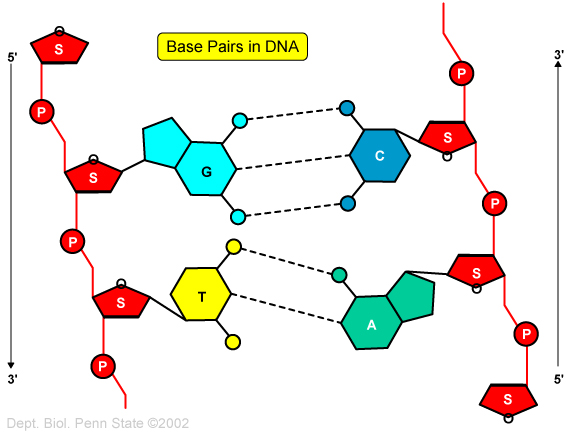
Adenine bonds with ______________.
a)
Guanine
b)
Thymine
c)
Cytosine
d)
Adenine
54.
Guanine bonds with ______________.
a)
Adenine
b)
Guanine
c)
Cytosine
d)
Thymine
55.
The enzyme that unzips the DNA to prepare for replication
a)
helicase
b)
replicase
c)
polymerase
d)
synthase
56.
Nitrogenous bases are joined by which type of bond?
a)
polar bonds
b)
ionic bonds
c)
covalent bonds
d)
hydrogen bonds
57.
In what phase of the cell cycle does DNA replication take place?
a)
G1
b)
S
c)
G2
d)
M
58.
Which enzyme is responsible for adding nucleotides ("The Builder")?
a)
Topoisomerase
b)
DNA Polymerase
c)
Ligase
d)
Primase
59.
Why is it crucial that living things are able to replicate their DNA?
a)
Each cell must have its own DNA
b)
Less copies of DNA are needed when a new cell is created
c)
A cell needs multiple copies of DNA
d)
Only muscle cells need DNA 
60.
The DNA is found in the nucleus of what type of organisms?
a)
Bacteria
b)
Eukaryotes
c)
Prokaryotes
d)
Viruses
61.

The picture below shows an enzyme unwinding and unzipping DNA.

​What is the name of this enzyme?

a)

DNA Helicase

b)

DNA Ligase

c)

DNA polyermase

d)

RNA Polymerase

62.

Which is the first step?

a)

DNA Helicase unwinds original DNA strand

b)

RNA Primase lays down RNA primer for new nucleotide bases.

c)

DNA polymerase builds new strands by bring in new nucleotide bases.

d)

Ligase knits together fragments on lagging strand

63.

Which is the second step?

a)

DNA Helicase unwinds original DNA strand

b)

RNA Primase lays down RNA primer for new nucleotide bases.

c)

DNA polymerase builds new strands by bring in new nucleotide bases.

d)

Ligase knits together fragments on lagging strand

64.

Which is the third step?

a)

DNA Helicase unwinds original DNA strand

b)

RNA Primase lays down RNA primer for new nucleotide bases.

c)

DNA polymerase builds new strands by bring in new nucleotide bases.

d)

Ligase knits together fragments on lagging strand

65.

Which is the fourth step?

a)

DNA Helicase unwinds original DNA strand

b)

RNA Primase lays down RNA primer for new nucleotide bases.

c)

DNA polymerase builds new strands by bring in new nucleotide bases.

d)

Ligase knits together fragments on lagging strand

66.

Which letter in the picture below depicts the leading strand in DNA replication?

a)

A

b)

C

c)

B

d)

None of the above

67.

Which letter in the picture below depicts the lagging strand in DNA replication?

a)

A

b)

C

c)

B

d)

None of the above

68.

Which letter in the picture below depicts the replication fork in DNA replication?

a)

A

b)

C

c)

B

d)

None of the above

69.

If a person suffered from a disorder where their DNA fragments were unable to fill in the missing slots in between the fragments of the lagging strand, they would most likely have a disorder that affected which enzyme?

a)

DNA Helicase

b)

DNA Ligase

c)

DNA polyermase

d)

RNA Polymerase

70.

Okazaki fragments appear on which strand of DNA during DNA replication?

a)

lagging

b)

leading

71.

This enzyme helps helicase unzip DNA by relieving supercoiling

a)

Topoisomerase

b)

Exonuclease

c)

DNA Primase

d)

DNA Polymerase

72.
Which process is shown?
a)
diffusion
b)
repiration
c)
recombination
d)
translation
73.
Which of the following is the blueprint for the production of RNA within a cell?
a)
DNA
b)
protein
c)
ATO
d)
carbohydrate
74.
What is the relationship between a protein, the cell, and DNA?
a)
DNA is produced by protein which is produced in the cell
b)
Protein is composed of DNA which is produced in the cell
c)
DNA controls the production of protein in the cell
d)
A cell is composed of DNA and protein
75.
Genetic info flows in one direction. Which best represents this flow?
a)
DNA-protein-RNA
b)
Protein-RNA-DNA
c)
RNA-protein-DNA
d)
DNA-RNA-protein
76.
The diagram shows the process of
a)
Transcription
b)
Translation
c)
Replication
d)
Mitosis
77.
Where does transcription take place?
a)
nucleus
b)
ribosome
c)
cytoplasm
d)
smooth ER
78.
How does RNA differ from DNA?
a)
RNA contains uracil and deoxyribose
b)
RNA contains ribose and thymine
c)
RNA contains uracil and ribose
d)
RNA contains adenine and ribose
79.
How would the DNA sequence GCTATA be transcribed to mRNA?
a)
GCUAUA
b)
CGATAT
c)
CGAUAU
d)
GCUTUT
80.

Where are proteins made?

a)

ER

b)

nucleus

c)

cytoplasm

d)

mitochondria

81.

What enzyme does transcription use?

a)

DNA polymerase

b)

ligase

c)

RNA polymerase

d)

helicase

82.

Which RNA brings amino acids?

a)

rRNA

b)

tRNA

c)

mRNA

83.

How many nucleotides equal 1 amino acid?

a)

1

b)

2

c)

3

d)

4

84.

A polypeptide is a sequence of ____________________ held together by a ______________ bond.

a)

amino acids; peptide

b)

fatty acids; ionic

c)

proteins; hydrogen

d)

fatty acids; covalent

85.

What is the term for a three-nucleotide sequence that codes for an amino acid?

a)

base

b)

codon

c)

amine

d)

serine

86.

How many amino acids are coded for by this sequence of nucleotides:

ATG GGA ACT CCA

a)

4

b)

2

c)

6

d)

12

87.
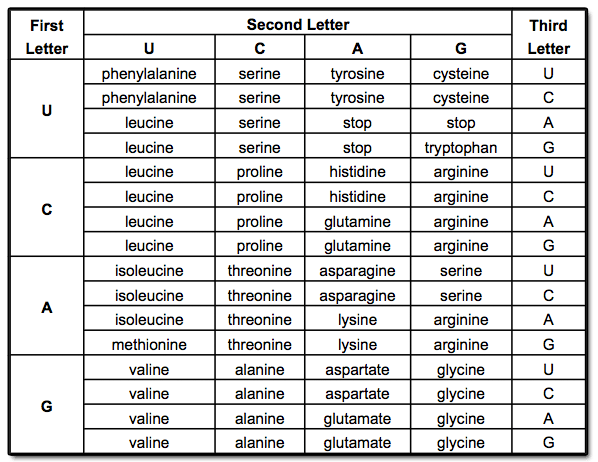
What is the correct amino acid sequence for the mRNA code AUGCCAGUAUGA
a)
Met-Pro-Ala-Val
b)
Met-Pro-Val
c)
Tyr-Gly-His
d)
Tyr-Gly-Arg-His
88.

Alternative RNA splicing involves

a)

removing introns and splicing the same exons together

b)

removing exons and splicing the same introns together

c)

removing introns and splicing different exons together

d)

removing exons and splicing different introns together