
NEW
Font size
 Worksheets
Test #7 Review - Heat and Gas Laws
Total questions: 20
Worksheet time: 34mins
Object A at 40ºC and object B at 80ºC are placed in contact with each other. Which statement describes the heat flow between the objects?
Heat flows from object A to object B
Heat flows from object B to object A
Heat flows in both directions between the objects
No heat flow occurs between the objects
What is the amount of heat absorbed when the temperature of 75 grams of water increases from 20oC to 35oC?

Refer to the image of a heating curve. Which statement describes the energy of the particles in this sample during interval DE?
Both potential energy and average kinetic energy increase
Both potential energy and average kinetic energy decrease
Potential energy increases and average kinetic energy remains the same
Potential energy remains the same and average kinetic energy increases

Refer to the image of a heating curve. Identify the amount of time that the substance exists in the liquid phase, only.
10 min
20 min
30 min
60 min
Under which conditions of temperature and pressure does a real gas behave most like an ideal gas?
A sample of gas occupies a volume of 50.0 milliliters in a cylinder with a movable piston. The pressure of the sample is 0.90 atmosphere and the temperature is 298 K. What is the volume of the sample at STP?
41 mL
49 mL
51 mL
55 mL
The temperature 30 K expressed in degree Celsius is
243oC
-243oC
303oC
-303oC

Refer to the heating curve. Which line segment represents boiling?
AB
BC
DE
EF
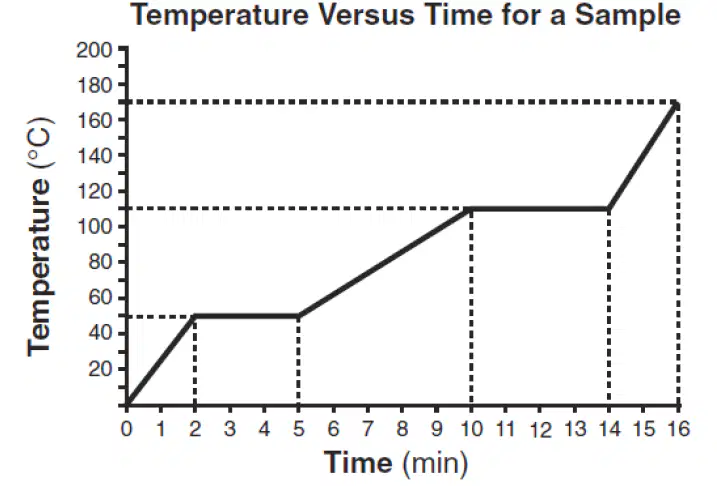
Refer to the heating curve. At which temperature would you find a mixture of the solid-liquid phase?
At 50oC which is the melting point.
At 50oC which is the boiling point.
At 110oC which is the melting point.
At 110oC which is the boiling point.
Which statement defines the temperature of a sample of matter?
Temperature is a measure of the total electromagnetic energy of the particles.
Temperature is a measure of the total thermal energy of the particles.
Temperature is a measure of the average potential energy of the particles.
Temperature is a measure of the average kinetic energy of the particles.
Which graph represents the relationship between pressure and volume for a sample of an ideal gas at constant temperature?


According to kinetic-molecular theory, a real gas behaves more like an ideal gas when the gas molecules are
close together and have strong attractive forces between them
close together and have weak attractive forces between them
far apart and have strong attractive forces between them
far apart and have weak attractive forces between them
Given the equation representing a reaction:
F + F --> F2
What occurs during this reaction?
Energy is released as a bond is broken
Energy is released as a bond is formed
Energy is absorbed as a bond is broken
Energy is absorbed as a bond is formed
Given the balanced reaction:
N2 + 3H2 --> 2NH3 + 91.8 kJ
Which statement is true about this reaction?
It is endothermic and ΔH = +91.8 kJ
It is endothermic and ΔH = -91.8 kJ
It is exothermic and ΔH = +91.8 kJ
It is exothermic and ΔH = -91.8 kJ
According to Reference Table I, which statement best describes the formation of HI(g)?
It is exothermic and heat is released.
It is exothermic and heat is absorbed.
It is endothermic and heat is released.
It is endothermic and heat is absorbed.
Determine the total amount of heat, in joules, required to completely vaporize a 50.0-gram sample of H2O(l) at its boiling point of 100oC and standard pressure.
5,000 J
16,700 J
20,900 J
113,000 J
Which sample at STP contains the same number of atoms as 2.0 liters of He(g) at STP?
1.0 liters of Ar(g)
2.0 liters of Ar(g)
3.0 liters of Ne(g)
4.0 liters of Ne(g)

