
 Worksheets
PoE - Exam 2
Total questions: 61
Worksheet time: 54mins
A motor unit consists of...
A motor neuron
A group of musclees
All the fibers the neuron innervates
A bundle of nerve fibers
A signal being sent down the parasympathetic nervous system to the heart will...
speed up the heart
speed up breathing rate
slow down the heart rate
reduce blood resistance
Small muscles have (a) fibers
Large muscles have (a) fibers
Are muscle fibers within a motor unit the same or different?
Same
Different
What are the 3 primary fiber types in human skeletal muscle?
True or false: There are significant differences between men and women with regard to fiber type distribution patterns.
True
False
True or false: Our fiber type pattern is genetically determined.
True
False
What is Phase I of the Excitation-Contraction Coupling process?
Sliding of myofilaments
Generation of an action potential (AP)
Spread of depolarization along the sarcolemma
Release of calcium from the sarcoplasmic reticulum (SR)
What is Phase II of the Excitation-Contraction Coupling process?
Spread of depolarization along sarcolemma
Binding of calcium to troponin
Release of calcium from the sarcoplasmic reticulum (SR)
Generation of force
What is Phase III of the Excitation-Contraction Coupling process?
Crossbridge formation
Sliding of filaments
Binding of calcium to troponin
Generation of force
What idea does the Sliding Filament Theory best explain?
The process of nerve conduction
Respiration of mitochondria
The process of muscle contraction
The process of muscle fiber recruitment
What are the 3 thin filaments?
(a)
What is the 1 thick filament?
(a)
What is the role of Troponin in the Sliding Filament Model?
Calcium binds to troponin, causing a shift in tropomyosin, exposing the binding site on actin
At rest, blocks the binding site on actin
Contains binding sites for myosin heads
Heads bind to actin to form crossbridges
What is the role of Tropomyosin in the Sliding Filament Model?
At rest, blocks the binding site on actin
Constructed like 2 intertwined strands of pearls
Calcium binds to troponin, causing a shift in tropomyosin, exposing the binding site on actin
Contains binding sites for myosin heads
What are the 2 roles of Actin in the Sliding Filament Model?
Constructed like 2 intertwined strands of pearls
Power stroke (like oars to a rowboat)
Contains binding sites for myosin heads
Myosin heads bind to actin to form crossbridges
What are 3 steps involved in the relaxation of muscle?
Calcium Concentration Rapidly Decreases When Muscle Stimulation Ceases
Calcium Is Actively Pumped Back Into The Sarcoplasmic Reticulum
Tropomyosin Returns To Resting Position Covering The Actin Binding Sites
Mitochondria and ATP are no longer produced as the muscle begins to relax
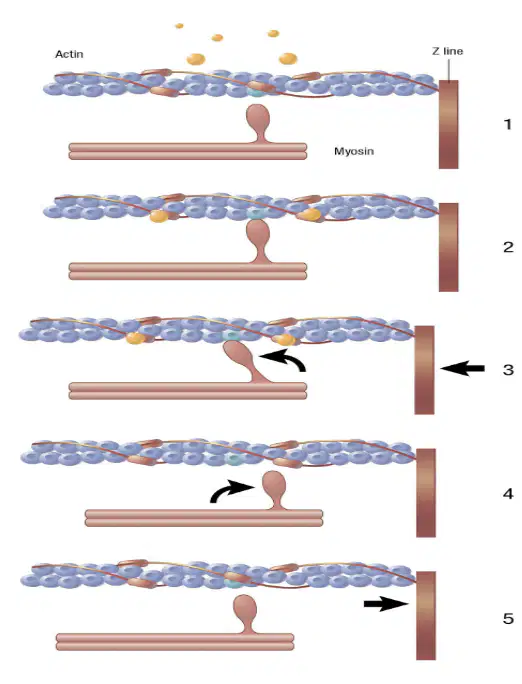
NOT A QUESTION: What is the series of events that leads to muscle contraction in the sliding filament model?
Contraction:
1. Neural stimulation causes the sarcoplasmic reticulum to release calcium.
Contraction:
2. Calcium binds to troponin, which removes the inhibitory effect of tropomyosin and actin-myosin bind.
Contraction:
3. Myosin cross-bridges swivel, pulling the actin and z-lines.
Contraction:
4. Fresh ATP binds to the myosin cross-bridges, leading to cross-bridge recycling.
Contraction:
5. Neural stimulation ceases and relaxation occurs.
Fill in the blanks for the sliding filament model:
1. _____ _____ travels along _____ _____ to _____ _____.
(a)
Fill in the blanks for the sliding filament model:
2. _____ _____ releases _____ into _____ and _____ binds to _____ _____ _____.
(a)
Fill in the blanks for the sliding filament model:
3. _____ _____ creates an _____ _____ that travels along the _____.
(a)
Fill in the blanks for the sliding filament model:
4. _____ _____ moves into the _____ _____ through the _____.
(a)
Fill in the blanks for the sliding filament model:
5. _____ _____ intersects with the _____ _____, releasing _____ into the _____.
(a)
Fill in the blanks for the sliding filament model:
6. _____ binds with _____, which is bound to _____.
(a)
Fill in the blanks for the sliding filament model:
7. _____-_____ binding causes change in shape to _____ molecule, therefore uncovering _____ _____ on the _____ molecule.
(a)
Fill in the blanks for the sliding filament model:
8. _____ cross-bridge binds with _____ molecule.
(a)
Fill in the blanks for the sliding filament model:
9. ___ breaks down to ___ and _____ _____, providing _____ used in muscle _____.
(a)
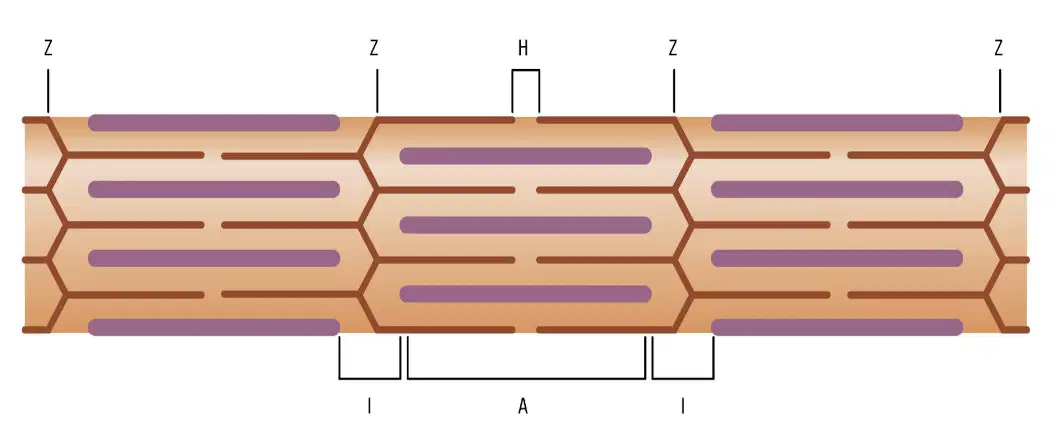
A sarcomere extends from _-line to _-line.
Z
A
I
H
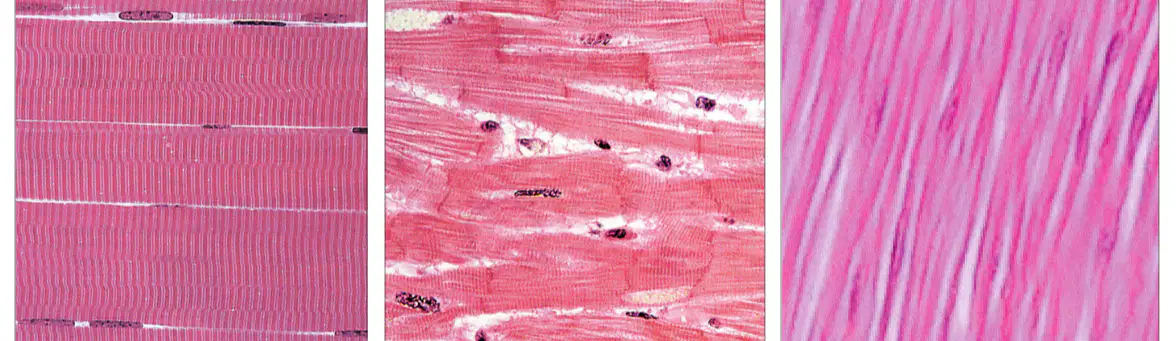
What are the 3 types of muscle?
(a)
What two types of muscle are controlled by the autonomic system?
Smooth
Cardiac
Skeletal
Which system controls the skeletal muscle?
Central nervous system
Peripheral nervous system
Somatic nervous system
Parasympathetic nervous system
Where is smooth muscle found?
In the brain, along the spine
In the skin, around the joints
In the heart, around the lungs
Walls of blood vessels, throughout internal organs
How many skeletal muscles are found in the body?
(a)
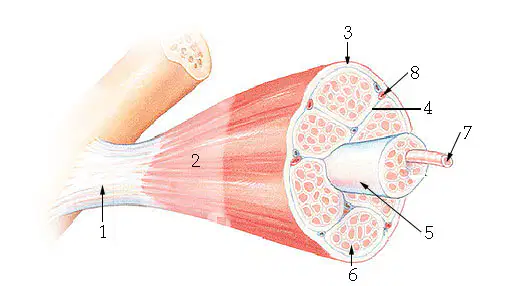
In order, what does each number correspond with on skeletal muscle?
(a)
What does the sarcoplasmic reticulum (SR) store?
Glucose
Calcium
ATP
Oxygen
Myofibrils are made up of _____
sarcomeres
filaments
muscle fibers
protein strands
A sarcomere is composed of protein filaments of _____ and _____.
Myosin
Troponin
Actin
Tropomyosin
Which filament has heads?
Actin
Troponin
Tropomyosin
Myosin
What is the functional unit of a muscle?
Sarcomere
Myofibril
ATP
Cardiac muscle is organized as...
striations
intercalated discs
One α-motor neuron innervates many muscle fibers, collectively called the _____ _____.
(a)
What is the tilt of the myosin head known as?
Power stroke
Cross-bridge
Sliding filament
Conformational change
Which bands of the sarcomere shorten during muscle contraction?
I band
Z band
A band
H band
Muscle contraction is initiated by a(n) _____ neuron action potential.
α-motor
Efferent
Afferent
Sensory
What is the power stroke?
The myosin head tilts, pulling thin filament past the thick filament (myosin)
Sarcomeres (Z-lines) lengthen
Shift in tropomyosin to expose binding sites on actin
The myosin filament is pulled by the actin filament
How many TOTAL ATP are required every time a myosin binds and detaches to actin?
4; 2 ATP to attach, 2 ATP to detach
3; 1 ATP to attach, 2 ATP to detach
2; 1 ATP to attach, 1 ATP to detach
6; 3 ATP to attach, 3 ATP to detach
Concentric motion is defined as...
(a)
Eccentric movement is defined as...
(a)
Isometric movement is defined as...
(a)
Isotonic movement is defined as...
(a)
Isokinetic movement is defined as...
(a)
What does isokinetic movement measure?
muscle strength
optimal length
muscle torque
muscle tension
At about what % of peak force do all fiber types tend to reach their peak power?
40%
10%
30%
20%
What is the size principle?
(a)
Define extensibility
(a)
Define elasticity
(a)
Elasticity of skeletal muscle is primarily due to what?
(a)
Which 3 are important physiological properties of muscles?
Contractility
Elasticity
Irritability
Conductivity
What is the all-or-none principle?
(a)
What is an example of the myotatic reflex?
Blinking of the eyes
Knee jerk response
Clenching of the fists
Body flinch

