
 Worksheets
Organisms Test Review
Total questions: 65
Worksheet time: 1hrs 29mins

What is the Linnaean system based on?
DNA similarities
characteristic similarities
physical similarities
color similarities
Genetic similarities more accurately shows?
evolutionary relationships
primal relationships
family relationships
phylogenetic relationships
Who created the most commonly used system of taxonomy?
Niels Bohr
Watson and Crick
Charles Darwin
Carl Linnaeus
Reorder the following taxonomic Categories from least related to most related
Class
Order
Family
Genus
Species
The study of naming and classifying organisms
(a)


Why is knowing a species' evolutionary history important when you are trying to classify it according to the modern classification system?
Because species with similar evolutionary history (common ancestor) are classified together
Because Charles Darwin invented both evolution and classification
Because Mr. Stoufer said so
Because having evolutionary history means species live in the same area
The correct order of classification from the BROADEST group to the most narrow is:
Species, Genus, Family, Order, Class, Phylum, Kingdom
Kingdom, Phylum, Class, Family, Order, Genus, Species
Domain, Kingdom, Family, Order, Phylum, Class, Genus, Species
Domain, Kingdom, Phylum, Class, Order, Family, Genus, Species

An organism that LACK a NUCLEUS (NO NUCLEUS)
Eukaryote
Prokaryote
Heterotroph
Autotroph
The 2-part naming system developed by Linneus is known as:
Dichotomous key
Binomial nomenclature
Taxonomy
Classification
Which Domain/Kingdom is capable of living in EXTREME ENVIRONMENTS like hot springs, geysers, or very salty waters?
Bacteria
Eukarya
Archaea

A student went outside to classify common plants found in her backyard. The student came across a tree and looked down. Near the bottom of the tree, there was a low growing plant. She picked up the damp plant and it peeled off from the tree and noticed there was just fuzz underneath the plant.
Which plant could the low-growing plant be classified with?
The low growing plant can be classified with the pine tree because this low growing plant can be found near the bottom of this tree.
The low growing plant can be classified with an apple tree because they both produce seeds from flowers.
The low growing plant can be classified with fern because they both do not produce seeds.
The low growing plant can be classified with algae because they both do not produce seeds nor do they have roots, leaves, and stems.


To what genus does a Banana tree belong to?
Musa
Ficus
paradisicum
Bamboosa
I am prokaryotic
I am found in extreme ecosystems
What kingdom do I belong to?
A cell that does not have a nucleus is a
Multicelular
Prokaryotic
Eukaryotic
Unicellular
Biologist are continually looking at the variety of life on Earth and trying to determine the best way to group it based on different characteristics. Recently, biologists have divided all life into three main groups, called domains. What are the three domains?
plants, animals, bacteria
prokaryotic, eukaryotic, viral
Bacteria, Achaea, Eukarya
biotic, abiotic, viral

The image shows an organism growing on the surface of the bread. Which kingdom would this organism belong to?
Kingdom Fungi
Kingdom Protista
Kingdom Animalia
Kingdom Plantae
Which list of characteristics describes organisms classified as animals?
Unicellular, prokaryotic, autotrophic
Multicellular, eukaryotic, heterotrophic
Unicellular, eukaryotic, heterotrophic
Multicellular, eukaryotic, autotrophic
An organism that can reproduce asexually and grows from the ground is classified into which kingdom?
Kingdom Fungi
Kingdom Plantae
Kingdom Protista
Kingdom Animalia
This kingdom is home to organisms that are eukaryotes.
Kingdom Animalia
Kingdom Fungi
Kingdom Plantae
Kingdom Protista

What two kingdoms can you see in the picture?
Fungi & Bacteria
Animals & Fungi
Fungi & Plantae
Animals & Plants

Which kingdom do humans belong to?
Plantae
Fungi
Animalia
Protista
One of the following is NOT a kingdom.
Virus
Animals
Plants
Archaea
What are the 6 kingdoms?
phylum, class, Order, Family, Genus, Species
Humans, Plants, Protists, Archaea, Fungi, Bacteria
Trees, Animals, Protists, Archaea, Fungi, Bacteria
Plants, Animals, Protists, Archaea, Fungi, Bacteria
Virus belongs to the Bacteria Kingdom.
True, it is a one-celled organism.
True, it is a many-celled organism.
False, it is not a living-thing.
False, it belongs to the Protists kingdom.
I am an autotroph
I am multicellular
What am I?
I am eukaryotic
I reproduce sexually
I am multicellular
What kingdom do I belong to?
I am prokaryotic
I am found in extreme ecosystems
What kingdom do I belong to?

Which leaf is shown in the drawing?
Magnolia
Redbud
Sweetgum
None of the above
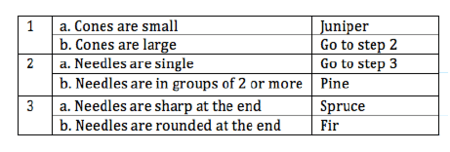
Why do scientists use dichotomous keys?
To arrange organisms based on habitat
To determine evolutionary history
To identify different organisms
To analyse feeding habits
When using a dichotomous key to identify organisms, what do we look at?
physical features
weather patterns
environment
diet
What step do we always start with when using dichotomous keys?
1
2
3
4
takes over the cell's functions.
A virus needs a host cell in order to do which of the following?
Grow
Develop
Reproduce
Live

What is the closest relative of humans shown in this diagram?
horse
turtle
monkey
dog

Which organism's DNA will differ the most from the bird?
Rodents
Raufinned fish
Sharks
Amphibians

What separates rodents and primates from crocodiles on this cladogram?
Bony Skeleton
Vertebrae
Eggs with shells and hair
Four Limbs

Which location on the phylogenic tree identifies characteristics shared by species B,C,D,E,F
Location 1
Location 2
Location 3
Location 4

Which group of animals on this tree are most closely related to birds?
Saurischian dinosaurs
Ornithischian dinosaurs
Crocodiles
None of these are related to birds
Cladistic classification traces the ___________________ of organisms.
evolutionary descent
physical similarities
naming conventions
regions of origin
A common ancestor of 2 species of organisms is
the organism most closely related to a living organism
the fossil organism most like a current organism
The most recent ancestor they share
the most frequent ancestor of organisms
This group includes every descendant of an organism and excludes everything not a descendant of that organism.
Clade
Class
Kingdom
species

What characteristic separates humans from all other species?
tail
bipedalism
Hair
lungs
Which describes the modern classification system?
based on evolutionary relationships
called Linnaean classification
based on similar appearances
called Darwinian classification

Which of these is a clade?
blue
green
all of these are clades
red

How many animals on this cladogram have lungs?
2
3
5
7

What is the name for the "trait" shown on these tree, such as "egg shells" and "four limbs"?
Derived characteristics
Trait nodes
Branching elements
Harmonious changes


What number is the common ancestor of C and D
1
2
3
4
In this cladogram. The traits are located where? Click on the correct location
In this cladogram, the root is the shared ancestor of all species on the tree. Click on the root
In this cladogram, the outgroup is used to compare the species that are similar to one another. Click on the outgroup organism

