wayground logo

Free Printable Worksheets

Font size

S
M
L
XL
Worksheets

Chemical Reactions Test Review

Total questions: 59

Worksheet time: 56mins

Name
Class
Date
1.

PCl5 + ___ H2O → ___ HCl + H3PO4

a)

4, 5

b)

1, 6

c)

3, 8

d)

2,2

2.

__ Al + __ FeO → Al2O2 + __ Fe

a)

1, 1, 2

b)

2,1,2

c)

2, 2, 2

d)

2,4,2

3.
Which side of a chemical equation is the reactant side?
a)
Left (before the yields sign)
b)
Right (after the yields sign)
4.
Which side of a chemical equation os the product side?
a)
Left (before the yields sign)
b)
Right (after the yields sign)
5.
Which problem is balanced?
a)
PbO2 + 2H2
b)
SO2 + H20 --> H2SO4
c)
2Na + 2H2O --> 2NaOH + H2
6.
What is the little number after an element in a chemical equation called.
Example: H2
a)
Coefficient 
b)
Subscript
c)
Atom
d)
Equation
7.
What does the Law of Conservation of Mass state?
a)
Matter cannot be gained or lost in a chemical reaction.
b)
Matter can only be lost in a chemical reaction.
c)
Matter can only be gained in a chemical reaction.
d)
Matter can be gained and lost in a chemical reaction. 
8.
The number of Na's in Na₂CO₃
a)
1
b)
2
c)
3
d)
6
9.
Number of C's in 2Na₂CO₃
a)
1
b)
2
c)
3
d)
5
10.
How many Aluminum are in Al2O3?
a)
3
b)
2
c)
5
11.
Balance this equation:
 2Li + Cl2 -> LiCl
a)
2Li + Cl2 -> 4LiCl2
b)
2Li + Cl2 -> LiCl2
c)
2Li + Cl2 -> 2LiCl
12.
Name the part in red:

H+ O2 -> H2O
a)
Coefficient
b)
Product
c)
Reactant
d)
Subscript
13.
Name the part in red:

H+ O-> H2O
a)
Coefficient
b)
Product
c)
Reactant
d)
Subscript
14.
Is the following equation balanced or unbalanced ? 
Al + O2 --> Al2O3
a)
Balanced
b)
Unbalanced
15.
How many hydrogens are in 4H2O?
a)
6
b)
8
c)
2
d)
4
16.
Name the part in red:

_2_H+ _1_O2 -> _2_H2O
a)
Coefficient
b)
Product
c)
Yield
d)
Subscript
17.

Which type of chemical reaction has two or more reactants to make one product?

a)

combustion

b)

single displacement

c)

double displacement

d)

synthesis

e)

decomposition

18.

Identify the following chemical reaction.

2 NaBr + 1 Ca(OH)2 ----> 1 CaBr2 + 2 NaOH

a)

Synthesis (or combination)

b)

Decomposition

c)

Single replacement

d)

Double replacement

19.

What reaction has the following general formula:

AB --> A + B

a)

Synthesis

b)

Decomposition

c)

Single Replacement

d)

Double Replacement

e)

Combustion

20.

What reaction has the following general formula:

A + CD --> C + AD

a)

Synthesis

b)

Decomposition

c)

Single Replacement

d)

Double Replacement

e)

Combustion

21.

What reaction has the following general formula:

AB + CD --> CB + AD

a)

Synthesis

b)

Decomposition

c)

Single Replacement

d)

Double Replacement

e)

Combustion

22.

What reaction has the following general formula:

A + B --> AB

a)

Synthesis

b)

Decomposition

c)

Single Replacement

d)

Double Replacement

e)

Combustion

23.

Which chemical reaction always starts with a hydrocarbon that reacts with oxygen and produces carbon dioxide and water?

a)

Decomposition

b)

Synthesis

c)

Combustion

d)

Single Replacement

24.

Which type of chemical reaction has the following configuration?


Hydrocarbon + Oxygen --> Carbon Dioxide + Water


CxHy + O2 --> CO2 + H2O

a)

Composition/Synthesis

b)

Decomposition

c)

Single Replacement

d)

Double Replacement

e)

Combustion

25.

Select each compound that can be produced by combustion reactions. (more than 1 answer)

a)

Oxygen

b)

Carbon Dioxide

c)

Water

d)

Glucose

e)

Carbon

26.

Classify the following chemical reaction


BaCl2(aq) + K2CrO4(aq) --> BaCrO4(s) + 2KCl(aq)


a)

Composition/Synthesis

b)

Decomposition

c)

Single Replacement

d)

Double Replacement

e)

Combustion

27.

Classify the following chemical reaction.


Si(s) + 2Cl2(g) --> SiCl4(l)

a)

Composition/Synthesis

b)

Decomposition

c)

Single Replacement

d)

Double Replacement

e)

Combustion

28.

Classify the follow chemical reaction.


2C6H6(l) + 15O2 --> 6H2O(l) + 12CO2(g)

a)

Composition/Synthesis

b)

Decomposition

c)

Single Replacement

d)

Double Replacement

e)

Combustion

29.

What type of chemical reaction is when a single compound is broken down into two or more products?

a)

Composition/Synthesis

b)

Decomposition

c)

Single Replacement

d)

Double Replacement

e)

Combustion

30.

What type of chemical reaction is when a single compound is broken down into two or more products?

a)

Composition/Synthesis

b)

Decomposition

c)

Single Replacement

d)

Double Replacement

e)

Combustion

31.

What is a substance that speeds up the rate of a chemical reaction?

a)

Rate

b)

Catalyst

c)

Calorimeter

d)

Hydrocarbon

32.

Identify the type of chemical reaction pictured above

a)

Composition/Synthesis

b)

Decomposition

c)

Single Replacement

d)

Double Replacement

e)

Combustion

33.

Identify the type of chemical reaction picture above

a)

Composition/Synthesis

b)

Decomposition

c)

Single Replacement

d)

Double Replacement

e)

Combustion

34.

Identify the type of chemical reaction picture above

a)

Composition/Synthesis

b)

Decomposition

c)

Single Replacement

d)

Double Replacement

e)

Combustion

35.

Identify the type of chemical reaction pictured above

a)

Composition/Synthesis

b)

Decomposition

c)

Single Replacement

d)

Double Replacement

e)

Combustion

36.

2Na +S → Na2S

a)

Double Replacement

b)

Decomposition

c)

Combustion

d)

Synthesis

37.

What type of reaction involves 2 substances combining to form 1 new compound?

a)

Decomposition Reaction

b)

Single Displacement Reaction

c)

Double Displacement Reaction

d)

Synthesis Reaction

38.
The right side of the equation below is called the
a)
products
b)
reactants
39.
Which is the name of the kind of solid substance formed in this figure?  
a)
aqueous 
b)
precipitate
c)
acid
d)
synthesis 
40.
A precipitate is...
a)
a solid that falls out of a liquid solution
b)
a reactant in a reaction
c)
a clear substance
d)
the mass of a product
41.
Mass cannot be ____ or _____.
a)
made, changed
b)
created, destroyed
c)
rearranged, unmade
d)
stagnant, unchanging
42.
A chemical reaction is...
a)
when a substance is mixed with another substance
b)
when a substance undergoes a change to form a new substance
c)
when a substance is dissolved into another substance
d)
when a substance is heated or exposed to another substance
43.
a substance that is formed as the result of a chemical reaction
a)
Product 
b)
Reactant
c)
Starters
d)
Enders
44.
the starting materials in a chemical reaction
a)
Products
b)
Reactants
c)
Starters
d)
Enders
45.
What type of chemical reaction is this?
Al(OH)3 → Al2O3  + H2O
a)
Decomposition
b)
Combustion
c)
Synthesis
d)
Single Replacement 
46.

Identify the type of chemical reaction

a)

Synthesis

b)

Decomposition

c)

Single replacement

d)

Double replacement

e)

Combustion

47.
Balance this equation:
Al2O3 -> Al + O2 
a)
2Al2O3 -> 2Al + 3O2 
b)
2Al2O3 -> 4Al + 3O2 
c)
3Al2O3 -> 2Al + O2 
d)
2Al2O3 -> 3Al + 2O2 
48.
Balance this equation:
MgCl2 --> Mg4+ Cl2
a)
It's already balanced.
b)
4MgCl2 --> Mg4+ 4Cl2
c)
4MgCl2 --> Mg4+ 5Cl2
49.

What are the coefficients that will balance the skeleton equation below?

__Na + __F₂ → __NaF

a)

1, 2, 1

b)

2, 1, 2

c)

1,1,1

d)

2,2,2

50.

What are the coefficients that will balance the skeleton equation below?

__CS₂ + __O₂ → __CO₂ + __SO₂

a)

3,1,2,1

b)

3,1,1,2

c)

2,1,1,3

d)

1, 3, 1, 2

51.

What are the coefficients that will balance the skeleton equation below?

__CH₄ + __O₂ → __CO₂ + __H₂O

a)

2,1,2,1

b)

2,1,1,2

c)

1,2,1,2

d)

1,2,2,1

52.
What is a substance called if it speeds up a chemical reaction?
a)
reusable
b)
catalyst
c)
specific
d)
fragile
53.
With what 3 letters do enzymes typically end?
a)
-ose
b)
-ase
c)
-ese
d)
-tic
54.
Any substance that is acted upon by an enzyme is called a(n)?
a)
Coenzyme
b)
Substrate
c)
Vitamin
d)
Polypeptide
55.
Enzymes are...
a)
nucleic acids
b)
proteins
c)
lipids
d)
carbohydrates
56.
An enzyme speeds up a chemical reaction in the cell but can only be used once.  True or False? 
a)
true
b)
false
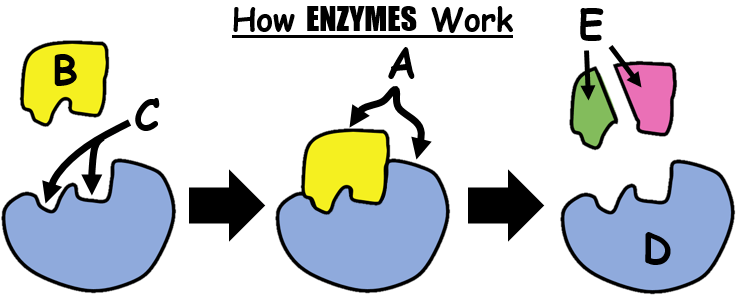
57.
Letter D...
a)
active site
b)
enzyme
c)
substrate
d)
products
58.
What is the purpose  of an enzyme?
a)
give permission for the reaction
b)
raise activation energy
c)
speed up reactions
d)
control how many reactions occur
59.

What is a substance that is similar to a catalyst, but rather than speeding up the reaction, it slows it down?

a)

Enzyme

b)

Inhibitor

c)

Exhibitor

d)

Inhaler