
Font size
 Worksheets
PRETREATMENT PHASE
Total questions: 81
Worksheet time: 47mins
CDC infection control guidelines: Pre-operative mouth-rinse
0.12% chlorhexidine gluconate
0.12% chlorine dioxide
0.12% cetylpyridinium chloride
Explain the following to the patient:
Nature of the treatment
Risks of treatment
Prognosis
Consequences
It must be freely given and all terms must be presented in a language that the patient understands.
Anxiety management
Informed consent
Premedications
Anti-anxiety regimen
Conditions for it to be informed:
The procedure and prognosis must be described.
Alternative to be recommended treatment must be presented, along with their respective prognoses.
Foreseeable risks and material risks must be described
Patients must have the opportunity to have questions answered.
HEART CONDITIONS: Key recommendations (AHA. 2017 Guidelines)
Prosthetic cardiac valves
Previous IE
Unrepaired cyanotic congenital heart disease or repaired congenital heart disease
Cardiac transplant with valve regurgitation
Antibiotic prophylaxis should be administered in a ______ dose before the procedure.
Single
Double
Triple
However, in the event that the dosage of antibiotic is inadvertently not administered before the procedure. May be administered up to ______ the procedure.
1 hour after
2 hours after
1 hour before
1 hour after

Identify letter A and B.
Amoxicillin
2g
Ampicillin
600 mg
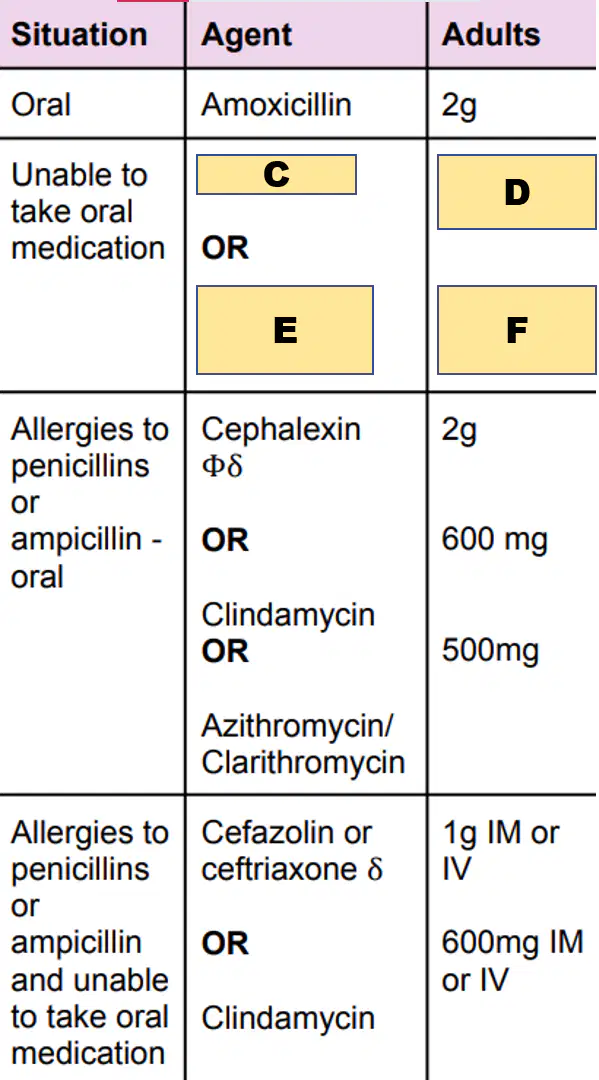
Identify C and D.
Ampicillin
2g IM* or IV*
Clindamycin
1g IM or IV
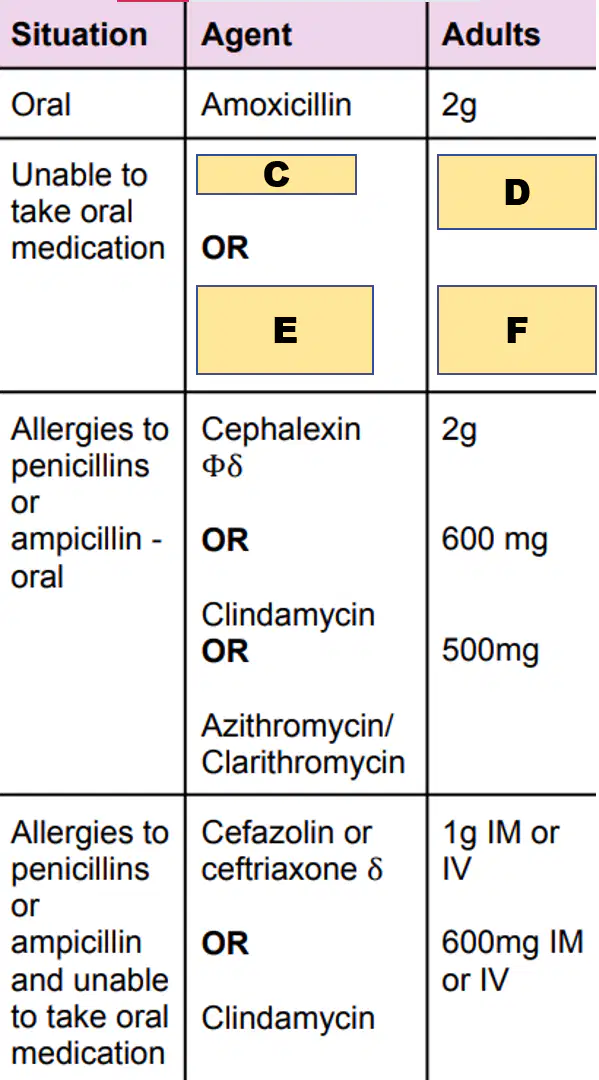
Identify E and F.
Cefazolin/ Ceftriaxone
1g IM or IV
Azithromycin/ Clarithromycin
1g IM or IV
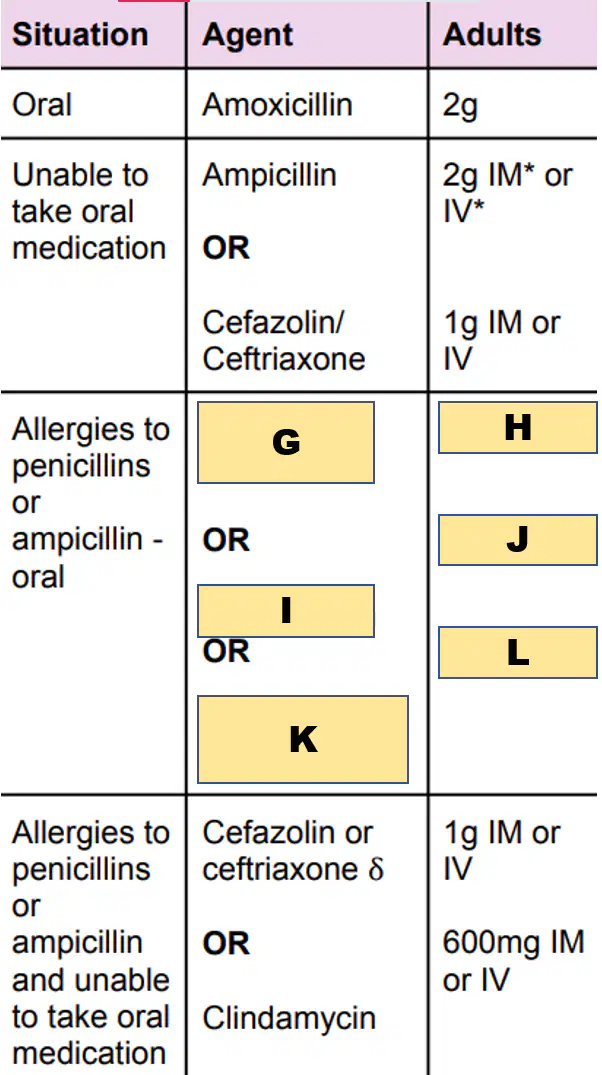
Identify G and H.
Cephalexin Φδ
2g
Clindamycin
1g

Identify I and J.
Clindamycin
600 mg
Azithromycin
500mg
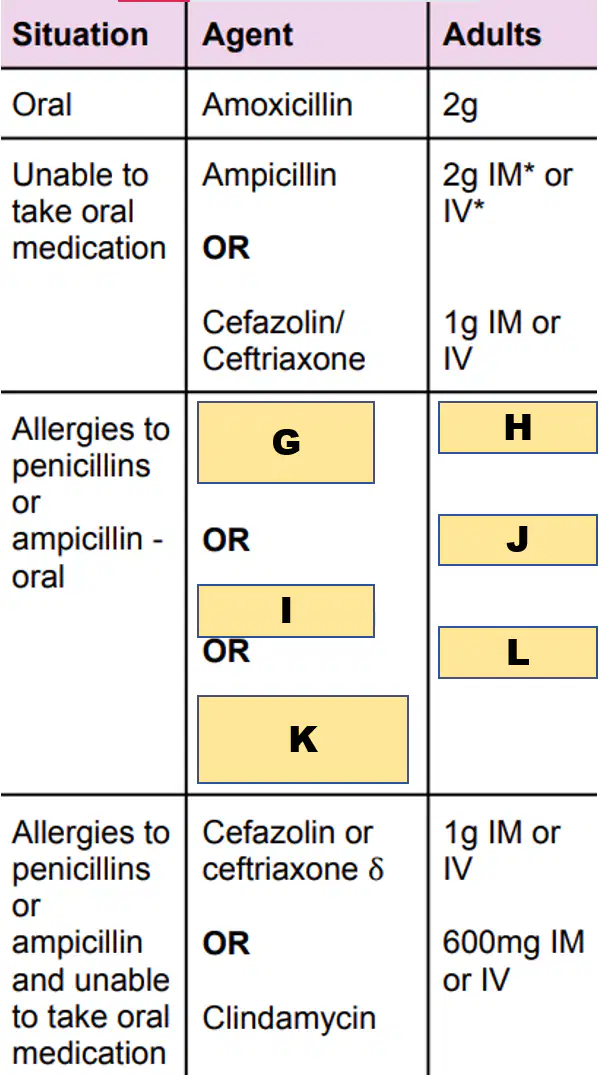
Identify K and L.
Azithromycin/ Clarithromycin
500mg
Cefazolin/ Ceftriaxone
600mg
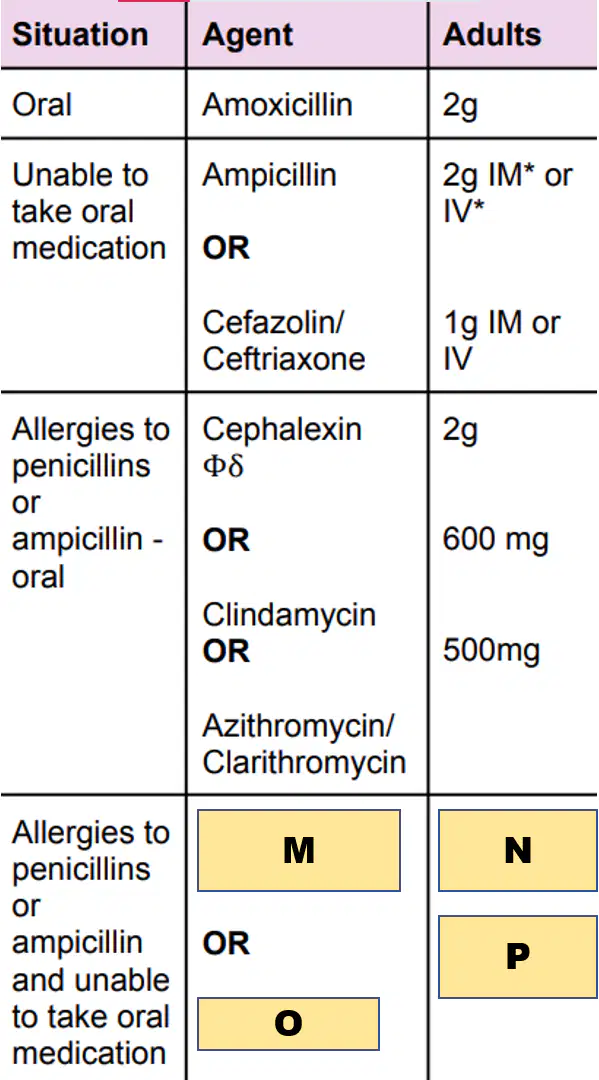
Identify M and N.
Cefazolin or ceftriaxone δ
1g IM or IV
Clindamycin
2g IM* or IV
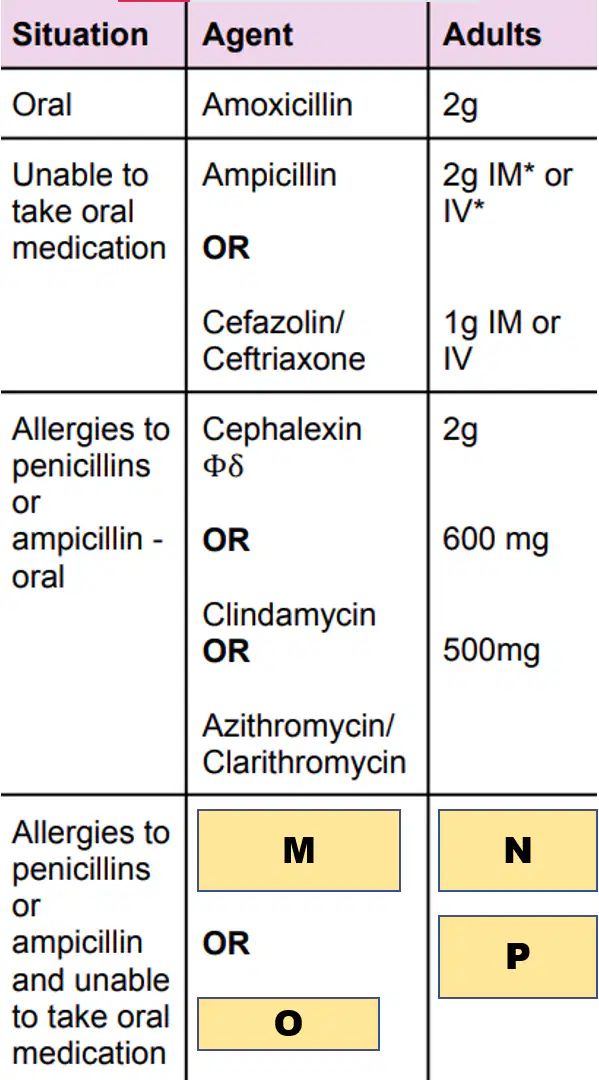
Identify O and P.
Clindamycin
600mg IM or IV
Cephalexin
500mg IM or IV
Cephalosporins should not be used in an individual with a history of anaphylaxis, angioedema, or urticaria with ______ or ______.
Penicillin
Ampicillin
Clindamycin
Amoxicillin
If behavioral solutions are not feasible and effective in a particular case.
Misinformation
Pharmacological approaches
RCT
Extraction
Pharmacologic approaches include the need for good local anesthetic technique:
Nitrous oxide plus oxygen sedation
Oral sedation
Intravenous
Oral conscious sedation
Oral sedation:
Benzodiazepines
Valium
Lorazepam
Clonazepam
Due to extrusion of small amounts of pulp tissue remnants and dentin fillings during root canal cleaning and shaping.
Pre treatment pain
Post treatment pain
Non-steroidal anti inflammatory drugs (NSAIDs), such as ________ mg of ibuprofen, ______ minutes before the procedure.
200 to 400 - 30 to 60
100 to 200 - 30 to 40
200 to 300 - 20 to 30
300 to 400 - 30 to 50
The clinician must strive for a “painless” local anesthetic injection technique.
True
False
Contribute information important for the diagnosis and the various treatment phases and Help evaluate the success or failure of treatment.
Bisecting technique
Paralleling technique
Bitewing technique
Advantages of paralleling technique:
Slight image distortion
Crown-root ratio is preserved
Image is consistent - highly reproducible
Crown-root ratio isn’t preserved
Bisecting technique:
Image shape distortion
Crown-root ratio isn’t preserved
Image is inconsistent
Slight image distortion
Problems when taking radiographs during RCT:
Reduced visibility due to rubber dam isolation
Bows of the clamp
Presence of root canal instruments
Selection of suitable film holders and cone positioners
Primary radiograph used in endodontics.
Periapical radiograph
Bitewing radiograph
Cephalometric
CMRS
It is used to identify abnormal conditions in the pulp and periradicular tissues and used to determine the number of roots and canals, location of canals,, and root curvatures.
Periapical radiograph
Bitewing radiograph
Cephalometric
CMRS
Major limitation of periapical radiograph:
1-dimensional
2-dimensional
3-dimensional
PERIAPICAL RADIOGRAPH: At least ____ mm of bone at apex of tooth
1
2
3
4
It needs vertical or horizontal angulation and should depict the tooth in the center of the film.
Periapical radiograph
Bitewing radiograph
Cephalometric
CMRS
It indicates the relationship of remaining tooth structure to the crestal height of bone, a supplemental film and has less distortion.
Periapical radiograph
Bitewing radiograph
Cephalometric
CMRS
BITEWING RADIOGRAPH: Provides critical information about the anatomic crown of the tooth
Pulp chamber
Recurrent caries
Depth of restoration
PDL
Rubber dam is mandatory in RCT.
No rubber dam = No RCT
True
False
Six principles of rubber dam isolation aside from:
1) Soft tissues are retracted and protected
2) The clinician is protected from litigation
Patient is protected from aspiration or swallowing of instruments, tooth debris, medicaments, and irrigating solutions.
A surgically clean operating field is isolated from saliva, blood, and other tissue fluids
Efficiency is increased
Visibility is improved
Its thickness vary depending on the manufacturer and has shiny and dull sides. It may also be latex or non-latex.
Sizes: 5x5 or 6x6
Rubber dam sheet
Rubber dam template
Rubber dam frame
Rubber dam clamps
It maintains border of rubber dam in position and supports the rubber dam sheet.
Rubber dam frame
Rubber dam punch
Rubber dam sheet
Rubber dam clamps
Classifications of rubber dam frame:
Young’s frame
Nygaard-ostby frame
Ivory frame
Ainsworth frame
It is used to produce clean-cut holes in the rubber dam sheet.
Rubber dam forcep
Rubber dam punch
Rubber dam clamps
Rubber dam sheet
It has notches near the tips of their beaks in which to locate the holes of a rubber dam clamp.
Ivory pattern
Ash/Ainsworth pattern
It allows a range of rotation for the clamp so that it may be positioned on teeth that are mesially or distally angled.
Ivory pattern
Ash/Ainsworth pattern
It has stabilizers that prevent the clamp from rotating on the beaks.
Ivory pattern
Ash/Ainsworth pattern
It limits the use of these forceps to teeth that are within a range of normal angulation.
Ivory pattern
Ash/Ainsworth pattern
The distance between the holes is equal to the distance from the center of one tooth to the center of the adjacent tooth, at the level of gingival tissue. Approximate distance is ___ mm.
3
4
6
7
It is used to stretch the jaws of the rubber dam clamp open in a controlled manner during placement and removal.
Rubber dam frame
Rubber dam forcep
Rubber dam clamps
Rubber dam punch
It provides convenience in marking the dam for punching.
Rubber dam template
Rubber dam sheet
Rubber dam clamps
Rubber dam frame
It is used to hold rubber dam in place.
May be winged or wingless, metal or plastic, and single or double.
Rubber dam clamps
Rubber dam frame
Rubber dam sheet
Rubber dam template
CLAMP SELECTION: Will impinge the soft tissues
Too large
Too small
CLAMP SELECTION: Will not properly grasp the tooth surface, unstable
Too large
Too small
Clamp selection should maintain 4 contact points.
True
False
Use clamps with subgingival designed jaws
➢ 2a, 8a, 14a
Partially erupted tooth, subgingival margins
Extended bow clamp
Clamp placement
Premolar clamp
For preparation involving distal surface of clamped tooth.
Extended bow clamp
Clamp placement
Partially erupted tooth, subgingival margins
Premolar clamp
In clamp placement, buccal jaws applied first to the tooth surface.
True
False
Clamp placement is positioned below the highest point on the lingual contour of the tooth.
True
False
- Position the bow of the clamp through the hole in the dam and place the rubber over the wings of the clamp (a winged clamp is required).
- The forceps stretch the clamp to maintain the position of the damp in the dam.
- The dam is attached to the plastic frame, allowing for the placement of the dam, clamp, and frame in one motion
- Once the clamp is secured on the tooth, the dam is teased under the wings of the clamp with a plastic instrument.
(Clamp + Tooth) + Dam + Frame or Clamp First Technique
(Rubber dam clamp + Rubber dam + Frame) or Single motion + Tooth
Split dam technique
- Place the clamp, usually wingless, on the tooth.
- Then stretch the dam over the clamped tooth
- Place the frame
(Rubber dam clamp + Rubber dam + Frame) or Single motion + Tooth
(Clamp + Tooth) + Dam + Frame or Clamp First Technique
Split dam technique
May be used to isolate anterior teeth without using a rubber dam clamp and useful when there is insufficient crown structure.
Split dam technique
(Clamp + Tooth) + Dam + Frame or Clamp First Technique
(Rubber dam clamp + Rubber dam + Frame) or Single motion + Tooth
Prevents the possibility of the jaws of the clamp chipping the margins of teeth restored with porcelain crowns or laminates.
(Clamp + Tooth) + Dam + Frame or Clamp First Technique
(Rubber dam clamp + Rubber dam + Frame) or Single motion + Tooth
Split dam technique
For teeth with _____ restorations: Ligation with dental floss is recommended as an alternative method to retract the dam and tissues, or the adjacent tooth can be clamped.
Porcelain
Amalgam
Composite
In split dam technique, dental floss helps carry the dam down around the gingiva.
True
False
If the dam has a tendency to slip, a _____ may be used on a tooth distal to the three isolated teeth or even on an adjacent tooth.
Premolar clamp
Molar clamp
Anterior clamp
Small holes can be blocked with:
Cavit (3M)
Rubber base adhesive
"Liquid" rubber dam
Periodontal packing
- Proper selection and placement of the clamp
- Sharply punched, correctly positioned holes
- Use of a dam of adequate thickness
- Inversion of the dam around the tooth
Leakage
Loss of tooth structure
Restorative procedures
Periodontal procedures
Excessive salivation can be reduced with an ______, such as atropine sulfate, propantheline bromide (Pro-Banthine), methantheline (Banthine), or glycopyrrolate.
Anticholinergic drug
Antihistamine drugs
NSAIDS
OTC drugs
Anticholinergic drugs:
Atropine sulfate
Propantheline bromide
Methantheline
Glycopyrrolate
Therapeutic doses of ______ for adults range from 0.3 to 1 mg per os, 1 to 2 hours before the procedure.
Atropine sulfate
Propantheline bromide
Methantheline
Glycopyrrolate
Propantheline bromide for an adult is ______ mg taken orally 30-45 minutes before the appointment.
7.5 to 15
7.0 to 15
8.5 to 14
8.0 to 16
These include partially erupted teeth, teeth prepared for crowns, and teeth fractured or broken down to the extent that their margins are subgingival.
Unusual tooth shapes or positions that cause inadequate clamp placement
Loss of tooth structure
Leakage
Periodontal procedures
Management for unusual tooth shapes or positions that cause inadequate clamp placement:
Use modified clamp
Use of orthodontic band
Gingivectomy
Crown lengthening
Must first determine whether the tooth is periodontally sound and restorable and may consider clamping of the attached gingiva and alveolar process.
Loss of tooth structure
Restorative procedures
Leakage
Unusual tooth shapes or positions that cause inadequate clamp placement
Once a tooth is deemed restorable but the margin of sound tooth structure is subgingival, using a clamp with prongs inclined apically or using an _______, should be attempted.
S-G clamp
Molar clamp
Anterior clamp
Premolar clamp
These are cemented over the remaining natural crown in restorative procedures.
Preformed copper band
Temporary crown
Orthodontic band
S-G clamp
Disadvantages of restorative procedures:
Inability to provide superior seal
Particles of these soft metals or cement can block canal systems during access opening and instrumentation
If displaced or are not properly contoured, can cause periodontal inflammation
The uses of preformed copper band, a temporary crown, or an orthodontic band include:
Enables the clamp to be retained successfully
Serves as a seal for the retention of intracanal medicaments and the temporary filling between appointments
Post placement then Crown after R.C.T.
Temporary coronal build-up using composite
Temporary coronal build-up using porcelain
Temporary coronal build-up using amalgam
Presence of gingival tissue results of excessive crown destruction or incomplete eruption.
True
False
Periodontal procedures include:
Gingivectomy
Electrosurgery
Crown Lengthening Procedure
Reduction of crown
If the electrode contacts bone, significant destruction of bone can occur.
True
False
It is not recommended when the distance between the crestal level of bone and the remaining tooth structure is minimal.
Electrosurgery
Gingivectomy
Crown Lengthening Procedure
It is done on tooth with margin below the crestal bone.
Orthodontic Extrusion
Electrosurgery
Gingivectomy
Crown Lengthening Procedure
ORTHODONTIC EXTRUSION: To erupt the tooth to provide ____ mm of root length _____ crestal bone level.
2-3; Above
2-3; Below
1-2; Above
1-2; Below

