wayground logo

Free Printable Worksheets

Font size

S
M
L
XL
Worksheets

Unit 9 Review: Taxonomy

Total questions: 71

Worksheet time: 1hrs 26mins
Name
Class
Date
1.
Which of the following organisms are LEAST closely related?
a)
organisms that share a domain
b)
organisms that share a family 
c)
organisms that share a genus 
d)
organisms that share a species 
2.
The scientific name for an organism is made from the:
a)
class and family name
b)
genus and species name
c)
domain and kingdom name
d)
kingdom and phylum name
3.

The 8 levels of classification, from most broad to most specific.

a)

Domain, Genus, Family, Order, Class, Phylum, Kingdom, Species

b)

Domain, Species, Kingdom, Genus, Phylum, Family, Class, Order

c)

Domain, Kingdom, Phylum, Class, Order, Family, Genus, Species

d)

Order, Kingdom, Species, Domain, Phylum, Family, Class, Genus

4.
Who first proposed binomial nomenclature as a way of classifying organisms?
a)
Carl Linnaeus
b)
Carl's Jr.
c)
Charles Darwin
d)
Henry Groseclose
5.
Cells that do not have a true nucleus are called....
a)
eukaryote
b)
prokaryote
c)
unicellular
d)
multicellular
6.
Cells that have a true nucleus are called....
a)
eukaryotes
b)
prokaryotes
c)
unicellular
d)
multicellular
7.
Which organisms are closely related? 
a)
American badger and leopard
b)
coyote and gray wolf
c)
european otter and leopard
d)
coyote and american badger
8.
Organisms in this smallest taxonomic group share many characteristics.
a)
domain
b)
kingdom
c)
species
d)
class
9.
Which organisms are most closely related?
a)
Equus caballas (Horse) & Equus burchellii (Zebra)
b)
Cyanea artica (Jellyfish) &
Ctenodiscus crispatus (Mud Starfish)
c)
Naja naja (cobra) & Glycine max (soya bean)
d)
Ophiocomina nigra (black brittle star) & Brassica nigra (black mustard)
10.
The science of describing, classifying, and naming living things is called:
a)
Geology
b)
Biology
c)
Taxonomy
d)
Chemistry
11.
An organism made up of more than one cell would be called:
a)
multicellular
b)
unicellular
c)
heterotroph
d)
autotroph
12.
An example of an unicellular organism would be:
a)
monkey
b)
bacteria
c)
spider
d)
human
13.
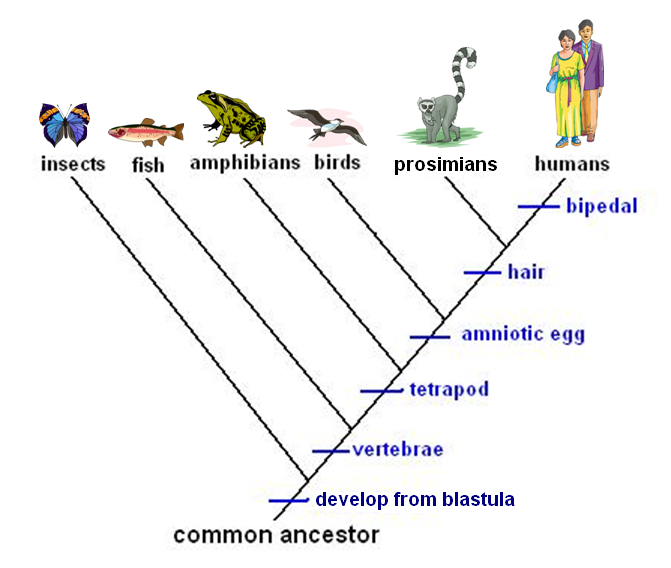
Which organisms pictured on the cladogram have hair?
a)
prosimians only
b)
prosimians and humans
c)
humans only
d)
prosimians and birds
14.
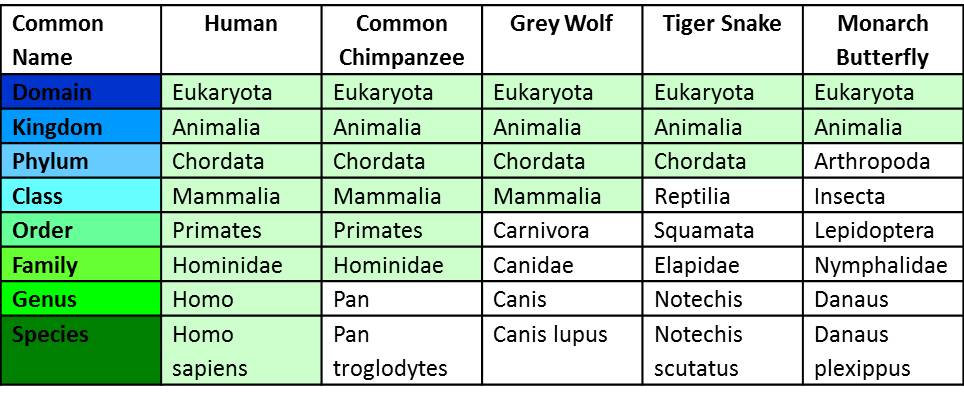
Which organism in the table is least closely related to the chimpanzee?
a)
human
b)
grey wolf
c)
tiger snake
d)
monarch butterfly
15.

Members of this kingdom are always multicellular and heterotrophic.

a)

Plantae

b)

Protista

c)

Animalia

d)

Achaebacteria

16.
What kingdom do unicellular, prokaryotic organisms that live in extreme environments?
a)
Animal
b)
Archaebacteria
c)
Eubacteria
d)
Plant
17.

I am prokaryotic and am found everywhere that's not extreme. What kingdom do I belong to?

a)

Eubacteria

b)

Archaebacteria

c)

Fungi

d)

Protista

18.

I'm motile (I can move) and have no cell walls. What kingdom do I belong to?

a)

Animalia

b)

Archaebacteria

c)

Eubacteria

d)

Plantae

19.
This organism is multicellular, heterotroph, that has a cell wall made of chitin.  What kingdom does it belong in?
a)
fungi
b)
plantae
c)
animalia
d)
eubacteria
20.
This organism is found in pond water.  It has a nucleus, is microscopic, unicellular and can perform photosynthesis.  What kingdom does it belong in?
a)
protista
b)
eubacteria
c)
archaebacteria
d)
plantae
21.
This organism is multicellular, autotroph, that has a cell wall made of cellulose.
a)
animalia
b)
plantae
c)
fungi
d)
eubacteria
22.

An early classification system had two groups: Plants and Animals. What is wrong with that system?

a)

It is too specific

b)

It is too scientific

c)

It is too broad

d)

It is too fancy

23.

Modern Classification (Phylogeny) adds what to Linnaeus's taxonomic criteria?

a)

evolutionary relationships & DNA (biochemical characters)

b)

habitat type

c)

fewer categories than Linnaeus

d)

a naming system called binomial nomenclature

24.

What makes the Protist Kingdom (Kingdom Protista) different from all other kingdoms?

a)

It's the only eukaryotic kingdom

b)

Its members aren't very similar to one another

c)

It is the only unicellular kingdom

d)

It's the only kingdom that has viruses

25.

Which kingdom sometimes has a cell well?

a)

Kingdom Protista

b)

Kingdom Plantae

c)

Kingdom Animalia

d)

Kingdom Fungi

26.

Members of these 2 kingdoms can never make their own food:

a)

animal & fungi

b)

animal & plant

c)

fungi & protist

d)

archaebacteria & eubacteria

27.
The scientific name for an organism is made from the:
a)
class and family name
b)
genus and species name
c)
domain and kingdom name
d)
kingdom and phylum name
28.

What Kingdom do I belong in?

I am unicellular.

I am prokaryotic.

I reproduce asexually.

I am autotrophic.

I live everywhere!

a)

Eubacteria

b)

Archaeabacteria

c)

Animalia

d)

Plantae

e)

Protista

29.
Autotroph or Heterotroph?
a)
Autotroph
b)
Heterotroph
30.
Why do scientists use the taxonomic system?
a)
To torture Biology students
b)
To avoid confusion in classifying organisms
c)
Because Linnaeus made it
d)
To place organisms in different groups
31.

Which of the following organisms would be most closely related to the wolf, whose scientific name is Canis lupus?

a)

Felis lupus

b)

Canis familiars

c)

Acer rubrum

d)

Felis leo

32.

Organisms belonging to the same species _______________________.

a)

live in the same place and have similar characteristics

b)

live in the same place and are active during the day

c)

can mate with one another to produce fertile offspring

d)

can mate with one another, but cannot produce fertile offspring

33.

Binomial nomenclature is ___________________________________.

a)

a numerical system of naming organisms

b)

a two-word naming system

c)

a mathematical equation for calculating carrying capacity

d)

a computer language

34.

The Dichotomous Key can be used to distinguish four species of frogs found in ponds in eastern Virginia. To which species does the frog in the image belong?

a)

Rana sphenocephala

b)

Rana virgatipes

c)

Rana clamitans

d)

Rana catesbeiana

35.

If two organisms are in the same phylum, they must also be in the same:

a)

class

b)

species

c)

family

d)

kingdom

36.
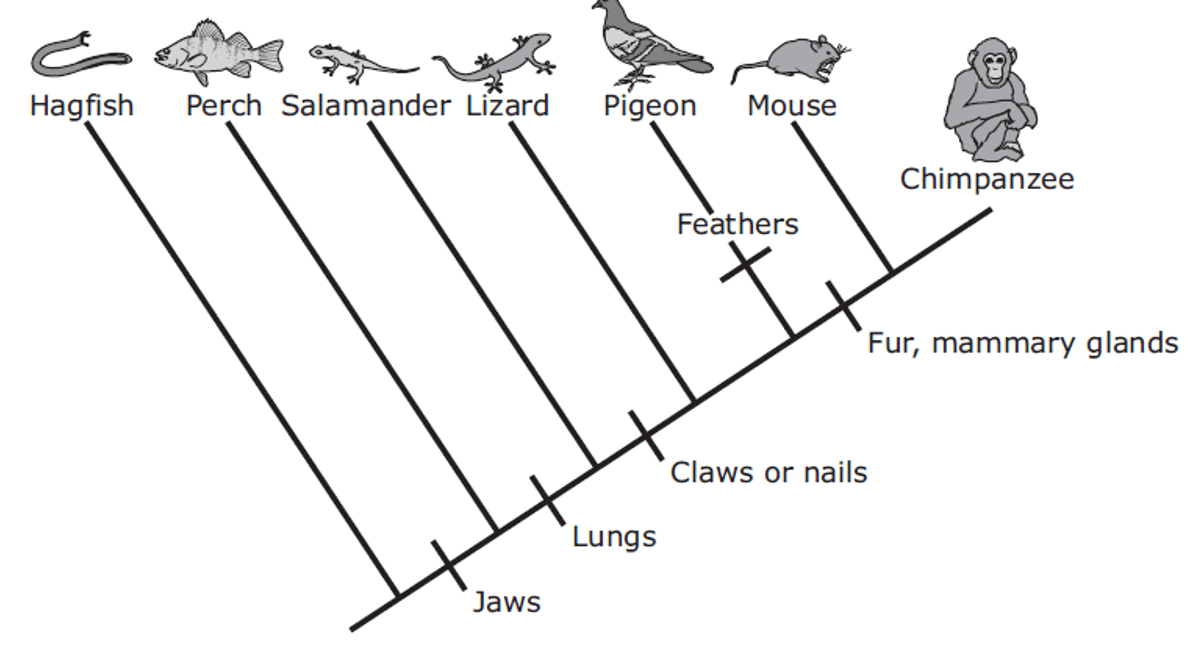
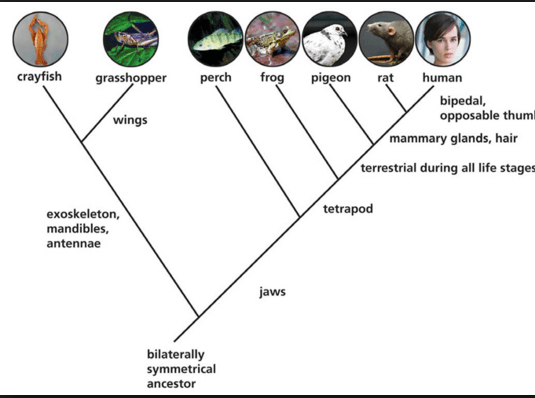
Which trait do only humans have, according to the cladogram?
a)
jaws
b)
mammary glands & hair
c)
terrestrial during all life stages
d)
opposable thumbs
37.

According to the cladogram, which organism is most distantly related to the human?

(a)  

38.

The system of classification for organisms is called -

a)

taxonomy

b)

phylogeny

c)

taxidermy

d)

cladogram

39.
Which of these is a characteristic shared between Fungi and Plantae?
a)
Heterotrophic
b)
Mobile
c)
Prokaryotic
d)
Multicellular
40.

All the animals to the right of the hagfish would have the common characteristic of -

(a)  

41.

Which organism has feathers but does not swim?

(a)  

42.

Which organism does not have four limbs?

(a)  

43.

Which organism does not have feathers but does have legs?

(a)  

44.
An illustration and a dichotomous key are given. What is the correct classification for this organism?
a)
Class Insecta
b)
Order Amblygygi
c)
Order Araneae
d)
Order Scorpiones
45.
A dichotomous key for trees is provided. Hikers found a tree that has large brown cones and single sharp needles. What species of tree have the hikers found?
a)
Juniper
b)
Pine
c)
Spruce
d)
Fir
46.
On the cladogram, which feature do all organisms inherit?
a)
A
b)
B
c)
C
d)
D
47.

All life is classified into _______ domains based on common characteristics.

a)

2

b)

3

c)

4

d)

5

48.

Prokaryotes; "true" bacteria; Ex. Pathogens

a)

Eubacteria

b)

Archaebacteria

c)

Eukarya

49.
Which organisms are closely related? 
a)
American badger and leopard
b)
coyote and gray wolf
c)
european otter and leopard
d)
coyote and american badger
50.
Organisms in this smallest taxonomic group share many characteristics.
a)
domain
b)
kingdom
c)
species
d)
class
51.
Which organisms pictured on the cladogram have hair?
a)
prosimians only
b)
prosimians and humans
c)
humans only
d)
prosimians and birds
52.

Small, unicellular, no nucleus

a)

homology

b)

phylogenetics

c)

taxa

d)

domain

e)

prokaryotes

53.

Based on the data given in the table, which two are most closely related?

a)

Human & Gorilla

b)

Gorilla & Orangutan

c)

Human & Chimpanzee

d)

Chimpanzee & Orangutan

54.

Based on the figure, which organism is most closely related to the polar bear?

a)

black bear

b)

european brown bear

c)

western north american brown bear

d)

asian brown bear

55.

Based on the figure, how long ago was the common ancestor of the European Brown Bear and the Asian Brown Bear?

a)

4.5 hundreds of thousands of years ago

b)

3.5 hundreds of thousands of years ago

c)

2.2 hundreds of thousands of years ago

d)

1.4 hundreds of thousands of years ago

56.

Which evidence would be the most accurate when developing a cladogram?

a)

morphological

b)

molecular

c)

ecological

d)

fossil

57.

Based on the figure, which organism is most closely related to A. forsteri?

a)

E. ferus

b)

D. polylepis

c)

G. gallus

d)

E. africanus

58.

Based on the figure, which organism is most closely related to E. africanus?

a)

E. ferus

b)

D. polylepis

c)

G. gallus

d)

E. africanus

59.

Based on the figure, which three organism are closely related?

a)

cat, horse, human

b)

cat, horse, pig

c)

cow, horse, human

d)

cow, horse, pig

60.

Based on the figure, which two organisms are closely related?

a)

cat & human

b)

cat & cow

c)

human & pig

d)

human & horse

61.
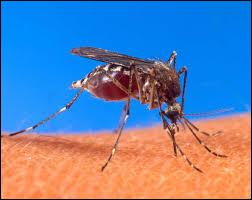
Mosquito  belongs to what kingdom?
a)
Animal Kingdom
b)
Plant Kingdom
c)
Fungi Kingdom
d)
Protista Kingdom
62.
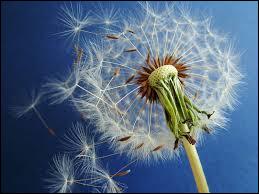
Dandelion, What kingdom does it belongs to?
a)
Plant Kingdom
b)
Animal Kingdom
c)
Fungi Kingdom
d)
Protista Kingdom
63.
Which organism in the table is least closely related to the chimpanzee?
a)
human
b)
grey wolf
c)
tiger snake
d)
monarch butterfly
64.

Which organism in the table shown is most closely related to the common dolphin?

(a)  

65.

Which of the following statements is correct based on the information shown in this cladogram?

a)

the turtle and the frog are more similar to each other than the turtle and the bass

b)

frogs have existed for a longer time that bass

c)

the frog is more closely related to the bass than to the leopard

d)

the bass is exinct

66.

What traits do the leopard and the turtle share? (Multiple choices)

a)

hair

b)

amniotic egg

c)

four walking legs

d)

jaws

67.

According to the cladogram, which organism is most distantly related to the human?

a)

rat

b)

grasshopper

c)

perch

d)

frog

68.
Using this dichotomous key, identity the name of the circled fish.
a)
band-tail puffer
b)
spotted goat fish
c)
peacock flounder
d)
trumpet fish
69.
A student discovers an arachnid with a segmented abdomen, long legs, and a tail with no stinger. The student uses the dichotomous key below to identify it. Which arachnid has the student found?
a)
Whip Scorpion
b)
Wind Scorpion
c)
Daddy long legs
d)
Scorpion
70.

Leaf Q (1ST LEAF)

a)

Eastern white pine

b)

balsam poplar

c)

sweet gum

d)

ginko

71.

What characteristic do all the organisms on this cladogram share?

a)

Being bi-pedal & having language

b)

Complex brains

c)

Fully binocular vision

d)

Partial binocular vision & opposable thumbs