wayground logo

Free Printable Worksheets

Font size

S
M
L
XL
Worksheets

Bio 221 Exam 3

Total questions: 90

Worksheet time: 53mins

Name
Class
Date
1.

Which "osteo" cell is responsible for bone reabsorption?

a)

osteoblasts

b)

osteocytes

c)

osteogenic

d)

osteoclasts

2.

Which "osteo" cell is responsible for bone formation?

a)

osteoblasts

b)

osteocytes

c)

osteogenic

d)

osteoclasts

3.

Which "osteo" cell is entrapped in matrix?

a)

osteoblasts

b)

osteocytes

c)

osteogenic

d)

osteoclasts

4.

Which "osteo" cell can be found in bone marrow?

a)

osteoblasts

b)

osteosytes

c)

osteogenic

d)

osteoclasts

5.
The human skeleton can be subdivided into two parts, what part is made up of the skull, sternum, vertebral column and rib cage?
a)
appendicular
b)
axial
6.
What type of bone is the femur?
a)
Long bone
b)
Short bone
c)
Flat bone
d)
Irregular bone
7.
Which one of the following is an irregular bone?
a)
humerus
b)
tibia
c)
temporal
d)
vertebrae
8.
The ______________ is made up of arms, wrists, hands, fingers, legs, ankles, feet, and toes.
a)
Axial
b)
Appendicular
9.

Long bones have a _____ that makes up most of bone's length and is composed of compact bone

a)

epiphyseal plate

b)

yellow marrow

c)

diaphysis

d)

articular cartilage

10.

Red bone marrow functions to

a)

produce fat

b)

produce blood cells

c)

store cells

d)

produce new bone cells

11.

Yellow marrow functions to ______.

a)

produce new bone cells

b)

store calcium

c)

store fat

d)

produce calcium

12.
The site of of bone growth on a long bone is called
a)
epiphyseal plate
b)
diaphysis
c)
periosteum
d)
medullary cavity
13.
The joints in the skull are called
a)
hinge joints
b)
synovial joints
c)
gliding joints
d)
fibrous joints
14.
A common term for chronic inflammation of a joint is 
a)
osteoporosis
b)
fracture
c)
scoliosis
d)
arthritis
15.
Which fracture is common when a person tries to break their fall with outstretched arms?
a)
greenstick fracture
b)
impacted fracture
c)
compression fracture
d)
spiral fracture
16.
A ball and socket joint is located 
a)
in the wrist
b)
in the ankle
c)
in the hip
d)
in the foot
17.
The process of bone formation from cartilage is called
a)
growth
b)
ossification
c)
fracture repair
d)
callus zone
18.
The outer covering of bone is called 
a)
spongy bone
b)
compact bone
c)
periosteum
d)
medullary cavity
19.
The shaft of a long bone is called
a)
epiphysis
b)
epiphyseal plate
c)
epiphyseal line
d)
diaphysis
20.
Rickets is caused by a deficiency of which vitamin?
a)
Vitamin A
b)
Vitamin C
c)
Vitamin D
d)
Vitamin E
21.
Which of the following is filled with yellow marrow (adipose tissue)?
a)
medullary cavity
b)
spongy bone
c)
periosteum
d)
compact bone
22.
Spongy bone is located
a)
in the epiphysis
b)
in the diaphysis
c)
in the compact bone
d)
in haversian canals
23.
Which of the following is not part of a synovial joint?
a)
cartilage
b)
joint capsule
c)
ligaments
d)
sutures
24.
attaches bone to bone
a)
tendon
b)
ligament 
c)
cartilage
d)
bone
25.
attaches muscle to bone 
a)
tendon
b)
ligament 
c)
cartilage
d)
bone
26.
Bones that originate within sheetlike layers of connective tissue.
a)
partial bones
b)
chondritic bones
c)
intramembranous bones
d)
endochondral bones
27.
Bones that begin as masses of cartilage later replaced by bone tissue.
a)
intramembranous bones
b)
entraspecific bones
c)
ethmodial bones
d)
endochondral bones
28.
Bone forming cells are called...
a)
osteoblasts
b)
osteocytes
c)
osteoclasts
d)
osteons
29.
In long bones, bone tissue begins to replace hyaline cartilage in the center of the diaphysis or the...
a)
secondary ossification center
b)
primary ossification center
c)
medullary ossification center
d)
transverse ossification center
30.
The band of cartilage in the epiphysis where secondary ossification occurs.
a)
zone of ossification 
b)
ephiphyseal plate
c)
hyaline plate
d)
Z line
31.
During endochondral ossification
a)
hyaline cartilage turns into bone 
b)
fibrocartilage turns into bone
c)
elastic cartilage turns into bone
d)
bone differentiates into cartilage
32.
Bone remodeling occurs throughout life
a)
true
b)
false
33.

Causes lengthwise growth of a long bone

a)

Periosteum

b)

Red Bone Marrow

c)

Medullary Cavity

d)

Compact bone

e)

Epiphyseal plate

34.

Type of ossification that uses a cartilage template which is gradually replaced by bone:

a)

Endochondrial ossification

b)

Intramembranous ossification

35.

The name of the "growth plate" at which long bones increase in length:

a)

diaphyseal disk

b)

epiphyseal plate

c)

medullary cavity

d)

secondary ossification center

36.

What is the primary ossification site in long bones?

a)

periosteum

b)

the epiphysis

c)

medullary cavity

d)

the diaphysis

37.

In which type of growth does the long bone increase in diameter (gets thicker)?

a)

Appositional Growth

b)

Interstitial Growth

c)

Bone Remodeling

d)

Cartilage Calcification

38.
 a fracture in which the bone breaks diagonally. 
a)
Oblique Fracture
b)
Fracture
c)
Diagonal Fracture
d)
Horizontal Fracture 
39.
Bone breaks into many fragments.
a)
Shattered Fracture
b)
Traction Fracture 
c)
Comminuted Fracture
d)
The Magic School Bus
40.
Bone breaks incompletely, occurs most commonly during the infantile stages of life.
a)
Greenstick Fracture
b)
Stable Fracture
c)
Bluestick Fracture
d)
Comminuted Fracture 
41.

The diagram shows a fracture that has two bones crushing into each other. What type of fracture is this?

a)

Simple

b)

Compound

c)

Impacted

d)

Comminuted

42.

The following is NOT one of the 3 Joint Classifications..

a)

Cartilaginous

b)

Cartilage

c)

Fibrous

d)

Synovial

43.

The joints that allow the most movement are called

a)

Fixed

b)

Fibrous

c)

Cartilaginous

d)

Synovial

44.

What type of joint is this?

a)

Ball and Socket

b)

Saddle

c)

Ellipsoid

d)

Pivot

e)

Gliding

45.

What type of joint is this?

a)

Hinge

b)

Saddle

c)

Ellipsoid

d)

Pivot

e)

Gliding

46.

What type of joint is this?

a)

Ball and Socket

b)

Saddle

c)

Ellipsoid

d)

Pivot

e)

Gliding

47.

Which joints are charactorized by a Synovial Joint

a)

Diarthrotic

b)

Amphiarthrotic

c)

Snyarthrotic

d)

No Joints

e)

All Joints

48.

What joints are freely movable and all have a joint capsule, a joint cavity, and a layer of cartilage over the ends of two joining bones

a)

Diarthrotic

b)

Amphiarthrotic

c)

Snyarthrotic

d)

No Joints

e)

All Joints

49.

What joints are characterized by a fluid filled cartilage disc that helps with their limited movement

a)

Diarthrotic

b)

Amphiarthrotic

c)

Snyarthrotic

d)

No Joints

e)

All Joints

50.

What joints are characterized by a strong fibrous mesh betweeen the bones that helps to secure the bones with no movement allowed

a)

Diarthrotic

b)

Amphiarthrotic

c)

Snyarthrotic

d)

No Joints

e)

All Joints

51.

Found attached to bones throughout the body

a)

smooth

b)

cardiac

c)

skeletal

d)

all

52.

Found in the heart

a)

smooth

b)

cardiac

c)

skeletal

d)

all

53.

Found in the walls of hollow organs; also called visceral

a)

smooth

b)

cardiac

c)

skeletal

d)

all

54.
What are the 3 types of muscles?
a)
Skeletal, muscular, ligament
b)
Skeletal, smooth, cardiac
c)
Smooth, Cellular, Cerebrum
d)
Cardiac, smooth, brain stem
55.
Skeletal muscles always work _____.
a)
in groups
b)
in pairs
c)
singly
d)
none of the above
56.

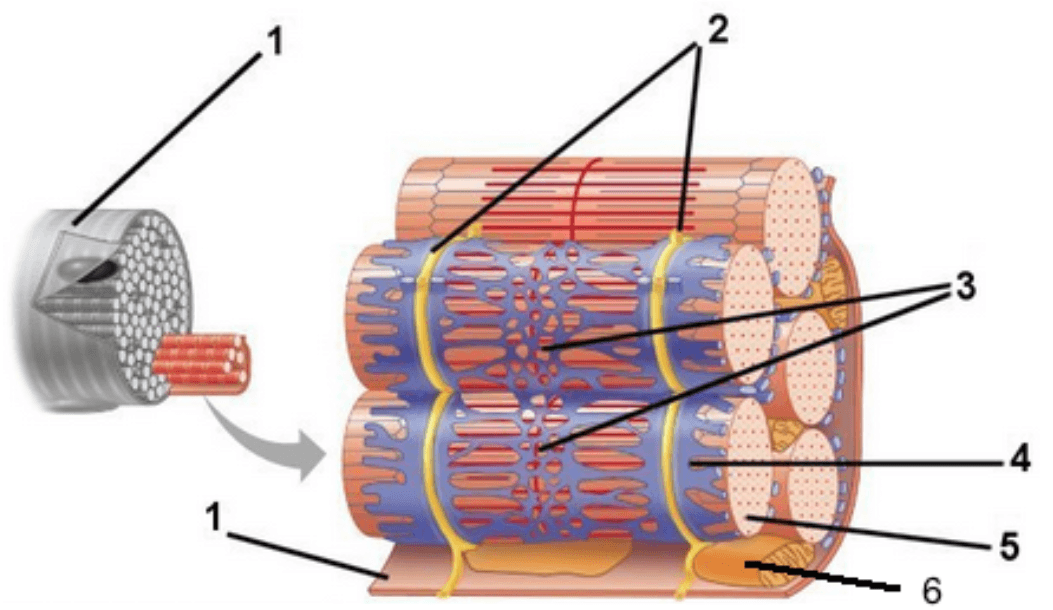
What is labeled "4" (the blue/purple part) in the diagram?

a)

sarcolemma

b)

sarcoplasmic reticulum

c)

transverse tubules

d)

myofibril

57.

What is shown in the colored part of this diagram?

a)

a whole muscle

b)

five muscle fibers

c)

five muscle fascicles

d)

five myofibrils

58.

Name the following in order from largest to smallest:

a)

muscle, muscle fascicle, muscle cell, myofibril, filaments

b)

muscle, muscle fascicle, muscle cell, filaments, myofibril

c)

muscle, muscle cell, muscle fascicle, myofibril, filaments

d)

muscle, muscle cell, muscle fascicle, filaments, myofibril

59.

What is the length between Z-lines of an actin molecule called?

a)

fascicle

b)

sarcomere

c)

myosin binding site

d)

sarcoplasmic length

60.

____________ attaches to actin to form the cross bridge.

a)

Troponin

b)

Tropomyosin

c)

Myosin

d)

Calcium

61.

What does calcium attach in a muscle contraction?

a)

Myosin

b)

Tropomyosin

c)

Troponin

d)

Actin

62.

What is released from the sarcoplasmic reticulum?

a)

Inorganic phosphate

b)

ADP

c)

Calcium

d)

ATP

63.

What is the name of the neurotransmitter released at a neuromuscular junction?

a)

Calcium

b)

Acetylcholine

c)

Dopamine

d)

Troponin

64.
What is the normal resting potential of a neuron cell membrane?
a)
+40mV
b)
-30mV
c)
+55mV
d)
-70mV
65.
Which ions are involved in an action potential?
a)
Na; Cl
b)
Na; K
c)
K; Cl
d)
Na; Ca
66.
At which point on the diagram does depolarisation of the axon occur? 
a)
A
b)
B
c)
C
d)
D
67.
When a neuron is not engaged in an impulse.
a)
Resting potential
b)
Action potential
c)
Neural potential
d)
Synaptic potential
68.
A membrane potential becoming less negative is called
a)
hyperpolarization
b)
depolarization
c)
repolarization
d)
polarization
69.
In resting potential, neurons have more _________ on the outside of the cell membrane.
a)
K+
b)
NaCl
c)
Na+
d)
Cl-
70.

What number(s) on the graph represents the THRESHOLD level of stimulus?

a)

1 and 5

b)

2

c)

3

d)

6

71.
When a membrane potential reaches +30mV, ________ channels open, ________ occurs, and ________ channels close.
a)
Sodium, depolarization, potassium
b)
Potassium, depoloarization, sodium
c)
sodium, repolarization, potassium
d)
postassium, repolarization, sodium
72.
Why is -55 mV a significant number?
a)
This is the largest charge achieved during an action potential
b)
This is the threshold required to complete an action potential
c)
This is the resting charge of a neuron
d)
This is the charge when all the sodium is inside the cell
73.
The sodium-potassium pump....
a)
Sends (Na+) into the cell
b)
Sends (K+) into the cell
c)
Exchanges (K+) & (Na+) during depolarization
d)
Exchanges (K+) & (Na+) during hyperpolarization
74.
What number on the graph represents the Hyperpolarization phase?
a)
1
b)
2
c)
3
d)
4
75.

Action potentials run along the ______ from ______ to ________.

a)

axon, dendrites, axon terminals

b)

axon, axon terminals, dendrites

c)

dendrites, axon, axon terminals

d)

axon terminals, axon, dendrites

76.
a junction at which a neuron meets another cell
a)
axon
b)
dendrites
c)
myelin sheath
d)
synapse
77.
When a neuron is depolarized, what are the first channels to open?
a)
Sodium
b)
Potassium
c)
Calcium
d)
ACTH
78.

Contractile unit of a muscle.

a)

sarcomere

b)

motor unit

c)

fascicle

d)

myofibril

79.

Thick filaments are in a myofibril are

a)

ATPase

b)

Sarcoplasmic reticulum

c)

Actin

d)

Myosin

80.

Thin filaments in a myofibril are

a)

Sarcomeres

b)

Sarcoplasm

c)

Actin

d)

Myosin

81.

Calcium:

a)

causes ATP binding to actin

b)

increases the action potential along the sarcolemma

c)

binds to proteins on myosin

d)

triggers the binding of myosin to actin

82.

What is a crossbridge?

a)

Where myosin binds to actin

b)

Where the calcium crosses into the cytoplasm

c)

Where calcium binds with troponin

d)

None of the answers are correct.

83.

The energy needed to perform a muscle contraction comes directly from

a)

ATP

b)

Oxygen

c)

Glucose

d)

Calcium

84.

Calcium binds to ___of the troponin-tropomyosin complex.

a)

troponin

b)

tropomyosin

c)

actin

d)

myosin

85.

The neurotransmitter stored in the axon terminal identified as #3

a)

Calcium Ion (Ca2+)

b)

Protein Channel

c)

Acetylcholine

d)

Synaptic Cleft

86.

What is the structure that stores the Calcium in the muscle cell.

a)

Sarcoplasm

b)

Sarcolemma

c)

Myoglobin

d)

Sarcoplasmic Reticulum

87.

What layer of connective tissue covers the muscle fiber?

a)

endomysium

b)

epimysium

c)

perimysium

88.

What layer of tissue surrounds the entire muscle?

a)

Endomysium

b)

Epimysium

c)

Perimysium

89.

Which of the following best describes the power stoke?

a)

actin's troponin pulls on the myosin filament

b)

myosin heads pull on binding sites of the actin filament

90.

Which level of muscle organization would represent the cell?

a)

muscle

b)

fascicle

c)

muscle fiber

d)

myofibril