wayground logo

Free Printable Worksheets

Font size

S
M
L
XL
Worksheets

Endocrine System Review

Total questions: 60

Worksheet time: 33mins

Name
Class
Date
1.

Endocrine glands secrete _

a)

Hormones

b)

Neurotransmitters

c)

A wide range of chemical substances

2.

What is the main function of the endocrine system?

a)

It creates chemicals, or hormones, that are sent around the body to maintain homeostasis.

b)

It creates electrical messages that are sent around the body to maintain homeostasis.

c)

It maintains the correct level of oxygen in the body to maintain homeostasis.

d)

It releases waste from the body to maintain homeostasis.

3.
An organ that produces secretions called hormones is known as a :
a)
chemical
b)
gland
c)
hormone
d)
duct
4.
This gland is located between the lungs behind the sternum and secretes thymosin that helps mature WBC's in our bodies when we are children. 
a)
thyroid
b)
parathyroid
c)
thymus
d)
brain stem
5.
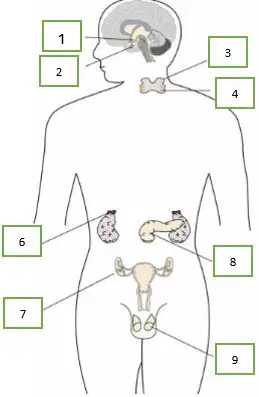
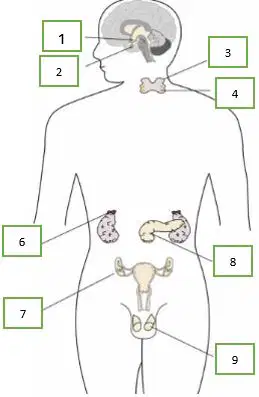
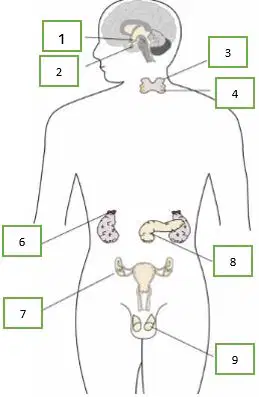
What is gland #3?
a)
Adrenal Gland
b)
Pancreas
c)
Ovaries
d)
Testes
6.
Letter H is pointing to
a)
Thymus
b)
Pancreas
c)
Pituitary
d)
Pineal
7.
Letter I is pointing to
a)
Testes
b)
Oviducts
c)
Ovaries
d)
Adrenals
8.

Letter J is pointing to

a)

Ovaries

b)

Pineal Gland

c)

Adrenal

d)

Testes

9.

The gland labeled 4 in the diagram is?

a)

the thymus gland

b)

the thyroid gland

c)

the parathyroid glands

d)

the adrenal glands

10.

What structure(s) shown in the picture above the kidneys?

a)

Thyroids

b)

Adrenal glands

c)

Testes

d)

Parathyroids

11.

What structure is this?

a)

Pancreas

b)

Thyroid

c)

Parathyroid

d)

Adrenal glands

12.
The two types of feedback systems that help organisms maintain homeostasis are:
a)
positive and negative 
b)
receptor and effector
c)
static and dynamic
d)
minor and major
13.

When you get cut, your skin cells release hormones that signal platelets to come and stop the bleeding. Platelets then release more hormones that signal even more platelets to help stop bleeding. The hormone signals continue until the cut is closed. This is an example of what type of feedback?

a)

Positive Feedback Response

b)

Negative Feedback Loop

14.

This structure releases what hormones?

a)

insulin and glucagon

b)

calcitonin and estrogen

c)

Parathyroid hormone and antidiuretic hormone

d)

epinephrine and testosterone

15.

When you eat a burger , your body produces insulin to control blood sugar . What type of feedback is that

a)

Positive feedback

b)

Negative Feedback

c)

None

d)

Both

16.

When it starts to get dark, your brain releases ____, which makes you tired.

a)

Oxytocin

b)

Melatonin

c)

Testosterone

d)

Estrogen

17.

Who/what helps glucose get into the cells?

a)

thyroid hormone

b)

small intestine

c)

insulin

d)

bloodstream

18.

Tired, constipated, cold, weight gain

a)

hypothyroidism

b)

hypoglycemia

c)

hyperthyroidism

d)

hyperglycemia

19.

Exophalmos (bulging eyes) associated with?

a)

Type 2 DM

b)

Hypothyroidism

c)

Type 1 DM

d)

Hyperthyroidism

20.

Which hormone reduces blood calcium levels?

a)

glucagon

b)

calcitonin

c)

adrenocorticotropic hormone

d)

oxytocin

21.

Which hormone promotes retention of water by kidneys?

a)

epinephrine/norepinephrine

b)

antidiuretic hormone

c)

glucagon

d)

prolactin

22.

Which hormone raises blood glucose and is secreted by the pancreas?

a)

follicle-stimulating hormone

b)

glucagon

c)

insulin

d)

thymosin

23.

Which hormone stimulates milk production?

a)

estrogens

b)

androgens

c)

thyroid-stimulating hormone

d)

prolactin

24.

Which hormone stimulates growth of bones and muscle?

a)

calcitonin

b)

progesterone

c)

thymosin

d)

growth hormone

25.

Which hormone stimulates the ovaries and the testes?

a)

luteinizing hormone

b)

follicle-stimulating hormone

c)

androgens

d)

prolactin

26.

Which hormone raises blood calcium levels?

a)

calcitonin

b)

thymosin

c)

parathyroid hormone

d)

glucagon

27.

Which hormone stimulates contraction of the uterus and the milk letdown reflex?

a)

estrogens

b)

progesterone

c)

oxytocin

d)

androgens

28.

Which hormone stimulates metabolism?

a)

thyroxine/triiodothyronine

b)

thymosin

c)

thyroid stimulating hormone

d)

antidiuretic hormone

29.

Which hormone stimulates uterine lining growth; development and maintenance of the female secondary sex characteristics?

a)

progesterone

b)

melatonin

c)

glucagon

d)

estrogens

30.

Which hormone is involved in biological rhythms?

a)

melatonin

b)

thymosin

c)

thyroid stimulating hormone

d)

adrenocorticotropic hormone

31.

Which hormone stimulates the production of ova and sperm?

a)

oxytocin

b)

follicle-stimulating hormone

c)

androgens

d)

thyroid-stimulating hormone

32.

Which hormone stimulates the thyroid gland?

a)

thyroid-stimulating hormone

b)

androgens

c)

prolactin

d)

oxytocin

33.
Follicle-stimulating hormone (FSH)
a)
Secreted by the Posterior Pituitary Gland; stimulates contraction of the uterus and release of milk from mammary glands.
b)
Secreted by Anterior Pituitary Gland; stimulates production of ova and sperm from the ovaries and testes.
c)
results when the pancreas does not produce enough insulin. The exact cause is not known.
d)
Female reproductive organ; produce the egg cells and sex hormones estrogen and progesterone.
34.
Thyroid Gland
a)
butterfly-shaped gland located below larynx in the neck; produces hormones that regulate metabolism, body heat, and calcium absorption in bone.
b)
hypercortisolism; central obesity, neck and upper back fat= buffalo hump, moon face; DM associated because of BS and central obesity
c)
Secreted by the Anterior Pituitary Gland. Causes ovulation; stimulates the secretion of progesterone by the corpus luteum. Causes the secretion of testosterone in the testes.
d)
results when the pancreas does not produce any insulin. This type of diabetes may occur at any age but it is usually diagnosed early in life. Treatment involves the injection of insulin on a regular basis.
35.
luteinizing hormone (LH)
a)
Secreted by the Anterior Pituitary Gland. Causes ovulation; stimulates the secretion of progesterone by the corpus luteum. Causes the secretion of testosterone in the testes.
b)
The posterior part of the pituitary gland; an endocrine gland that contains hormone-secreting terminal buttons of axons whose cell bodies lie within the hypothalamus
c)
results when the pancreas produces insulin, but not enough to meet the needs of the body. This type of diabetes is linked with obesity and is most common in adults over the age of 45. Treatment may involve oral medication, exercise, weight loss, and insulin injections.
d)
Female reproductive organ; produce the egg cells and sex hormones estrogen and progesterone.
36.
Prolactin (PRL)
a)
Small gland that secretes digestive enzymes into small intestine and hormones
b)
results when the pancreas produces insulin, but not enough to meet the needs of the body. This type of diabetes is linked with obesity and is most common in adults over the age of 45. Treatment may involve oral medication, exercise, weight loss, and insulin injections.
c)
Secreted by the Anterior Pituitary Gland; stimulates milk production from mammary glands.
d)
Secreted by Anterior Pituitary Gland; stimulates production of ova and sperm from the ovaries and testes.
37.
Antidiuretic Hormone (ADH)
a)
Small gland that secretes digestive enzymes into small intestine and hormones
b)
the hormone produced by the anterior pituitary gland; stimulates cell reproduction and growth that affect muscle, bone and fat cells.
c)
A hormone that stimulates water reabsorption from kidney tubule cells into the blood and vasoconstriction of arterioles, meaning retaining fluid in the body. Alcohol consumption blocks its release
d)
results when the pancreas does not produce any insulin. This type of diabetes may occur at any age but it is usually diagnosed early in life. Treatment involves the injection of insulin on a regular basis.
38.
Oxytocin (OT)
a)
secretes parathyroid hormone (PTH) that Raises blood calcium levels by stimulating the bones cells to release calcium, the intestine to absorb calcium from food and the kidneys to reabsorb calcium.
b)
ductless glands that secrete hormones directly into the bloodstream
c)
A sex hormone, secreted in greater amounts by males than by females. Promotes sperm formation and development of the male secondary sexual characteristics.
d)
Secreted by the Posterior Pituitary Gland; stimulates contraction of the uterus and release of milk from mammary glands.
39.
Parathyroid Gland
a)
Secreted by the Anterior Pituitary Gland; stimulates milk production from mammary glands.
b)
A sex hormone, secreted in greater amounts by males than by females. Promotes sperm formation and development of the male secondary sexual characteristics.
c)
secretes parathyroid hormone (PTH) that Raises blood calcium levels by stimulating the bones cells to release calcium, the intestine to absorb calcium from food and the kidneys to reabsorb calcium.
d)
Female reproductive organ; produce the egg cells and sex hormones estrogen and progesterone.
40.
adrenal gland
a)
Pair of glands on top of kidneys; composed of medulla & cortex. Hormones: Increase blood glucose concentration and break down protein. Promotes reabsorption of sodium and water by the kidneys. Produce epinephrine and norepinephrine (regulate short term stress response). Promotes sexual characteristics in males.
b)
Secreted by the Anterior Pituitary Gland; stimulates milk production from mammary glands.
c)
Female reproductive organ; produce the egg cells and sex hormones estrogen and progesterone.
d)
A hormone that stimulates water reabsorption from kidney tubule cells into the blood and vasoconstriction of arterioles, meaning retaining fluid in the body. Alcohol consumption blocks its release
41.
Insulin
a)
A hormone synthesized in the pancreas that regulates blood sugar levels by the uptake of glucose (lowering blood glucose) into the body cells.
b)
results when the pancreas produces insulin, but not enough to meet the needs of the body. This type of diabetes is linked with obesity and is most common in adults over the age of 45. Treatment may involve oral medication, exercise, weight loss, and insulin injections.
c)
Symptoms include excessive urination, thirst, and hunger. There are two types of diabetes.
d)
Secreted by the Posterior Pituitary Gland; stimulates contraction of the uterus and release of milk from mammary glands.
42.
Glucagon
a)
the hormone produced by the anterior pituitary gland; stimulates cell reproduction and growth that affect muscle, bone and fat cells.
b)
the anterior part of the pituitary gland; an endocrine gland whose secretions are controlled by the hypothalamic hormones.
c)
A hormone secreted by the pancreas that increases blood glucose in the blood.
d)
hyposecretion of cortisol; weak, low BP, bronze, weight loss
43.
Ovaries
a)
A condition of hyposecretion of the thyroid gland causing low Thyroxine levels in the blood that result in sluggishness, slow pulse, and often obesity.
b)
Female reproductive organ; produce the egg cells and sex hormones estrogen and progesterone.
c)
ductless glands that secrete hormones directly into the bloodstream
d)
A sex hormone, secreted in greater amounts by males than by females. Promotes sperm formation and development of the male secondary sexual characteristics.
44.
Estrogen
a)
A sex hormone, secreted in greater amounts by females than by males. Stimulates uterine lining growth and promotes development of the female secondary sexual characteristics.
b)
device for measuring blood glucose levels from a drop of blood obtained by a fingerstick
c)
A sex hormone, secreted in greater amounts by females than by males. Promotes the growth of the uterine lining and prevents uterine muscle contractions.
d)
ductless glands that secrete hormones directly into the bloodstream
45.
Progesterone
a)
Chemical messenger sent to many parts of the body; produce a specific effect on target cell or organ.
b)
A sex hormone, secreted in greater amounts by females than by males. Promotes the growth of the uterine lining and prevents uterine muscle contractions.
c)
hyposecretion of cortisol; weak, low BP, bronze, weight loss
d)
Secreted by the Posterior Pituitary Gland; stimulates contraction of the uterus and release of milk from mammary glands.
46.
Testes
a)
A sex hormone, secreted in greater amounts by males than by females. Promotes sperm formation and development of the male secondary sexual characteristics.
b)
The posterior part of the pituitary gland; an endocrine gland that contains hormone-secreting terminal buttons of axons whose cell bodies lie within the hypothalamus
c)
Male reproductive organ; produce the sperm cells and sex hormone testosterone.
d)
secretes parathyroid hormone (PTH) that Raises blood calcium levels by stimulating the bones cells to release calcium, the intestine to absorb calcium from food and the kidneys to reabsorb calcium.
47.
Testosterone
a)
A sex hormone, secreted in greater amounts by males than by females. Promotes sperm formation and development of the male secondary sexual characteristics.
b)
results when the pancreas does not produce any insulin. This type of diabetes may occur at any age but it is usually diagnosed early in life. Treatment involves the injection of insulin on a regular basis.
c)
hypercortisolism; central obesity, neck and upper back fat= buffalo hump, moon face; DM associated because of BS and central obesity
d)
Secreted by the Posterior Pituitary Gland; stimulates contraction of the uterus and release of milk from mammary glands.
48.
Hypothyroidism
a)
A condition of hyposecretion of the thyroid gland causing low Thyroxine levels in the blood that result in sluggishness, slow pulse, and often obesity.
b)
Symptoms include excessive urination, thirst, and hunger. There are two types of diabetes.
c)
Secreted by the Anterior Pituitary Gland; stimulates milk production from mammary glands.
d)
results when the pancreas produces insulin, but not enough to meet the needs of the body. This type of diabetes is linked with obesity and is most common in adults over the age of 45. Treatment may involve oral medication, exercise, weight loss, and insulin injections.
49.
Hyperthyroidism
a)
Female reproductive organ; produce the egg cells and sex hormones estrogen and progesterone.
b)
Male reproductive organ; produce the sperm cells and sex hormone testosterone.
c)
Small gland that secretes digestive enzymes into small intestine and hormones
d)
A condition resulting when the thyroid produces extremely high levels of Thyroxine that result in anxiety, insomnia, irregular heartbeat and weight loss.
50.
Pineal gland
a)
A sex hormone, secreted in greater amounts by females than by males. Promotes the growth of the uterine lining and prevents uterine muscle contractions.
b)
is a pea-sized gland located deep within the brain. Knowledge about this gland is limited. It produces a hormone (melatonin) that is believed to affect the sleep cycle and delay the onset of puberty.
c)
butterfly-shaped gland located above the heart. It contains lymphatic tissue. stimulates cells in the immune system.
d)
A condition of hyposecretion of the thyroid gland causing low Thyroxine levels in the blood that result in sluggishness, slow pulse, and often obesity.
51.
Cushing's disease
a)
ductless glands that secrete hormones directly into the bloodstream
b)
A hormone synthesized in the pancreas that regulates blood sugar levels by the uptake of glucose (lowering blood glucose) into the body cells.
c)
hypercortisolism; central obesity, neck and upper back fat= buffalo hump, moon face; DM associated because of BS and central obesity
d)
results when the pancreas does not produce any insulin. This type of diabetes may occur at any age but it is usually diagnosed early in life. Treatment involves the injection of insulin on a regular basis.
52.
Addison's disease
a)
A sex hormone, secreted in greater amounts by females than by males. Stimulates uterine lining growth and promotes development of the female secondary sexual characteristics.
b)
Chemical messenger sent to many parts of the body; produce a specific effect on target cell or organ.
c)
hyposecretion of cortisol; weak, low BP, bronze, weight loss
d)
The posterior part of the pituitary gland; an endocrine gland that contains hormone-secreting terminal buttons of axons whose cell bodies lie within the hypothalamus
53.
A goiter is an enlargement of what gland?
a)
Pituitary
b)
Adrenal
c)
Mammary
d)
Thyroid
54.

Identify Structure #8

a)

pineal

b)

thymus

c)

thyroid

d)

pancreas

55.

Identify Structure #6

a)

parathyroid

b)

adrenal glands

c)

testes

d)

ovaries

56.

Identify Structure #7

a)

testes

b)

ovaries

c)

pancreas

d)

thyroid

57.

The "master" gland of the endocrine system is the

a)

pituitary gland.

b)

pineal gland

c)

adrenal glands

d)

thyroid gland

58.

Which hormones are produced by the thyroid gland? Choose all that apply.

a)

Thyroxine (T4)

b)

Triiodothyronine (T3)

c)

Calcitriol

d)

Calcitonin

e)

Parathyroid Hormone (PTH)

59.

What element is particularly required for the manufacture of thyroxine (T4)?

a)

Iron

b)

Iodine

c)

Sodium

d)

Calcium

60.

Cells that have receptors for a particular hormone.

a)

gland cells

b)

neurons

c)

hormones

d)

target cells