

wayground logo

Free Printable Worksheets

Font size

S
M
L
XL
Worksheets

Pedigrees/Blood Types Together

Total questions: 46

Worksheet time: 1hrs 15mins
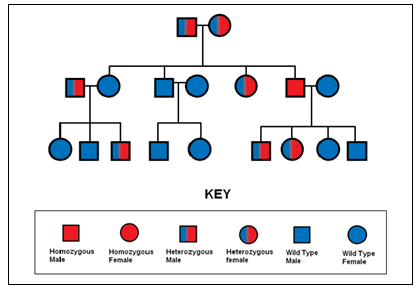
Name
Class
Date
1.

In a pedigree, which shape represents a male?

a)

circle

b)

square

2.

On a pedigree, this symbol represents a ---

a)

not affected female.

b)

not affected male.

c)

affected male.

d)

affected female.

3.

On a pedigree, this symbol represents a ----

a)

not affected male.

b)

not affected female.

c)

affected male.

d)

affected female.

4.

How many individuals are there in the 3rd generation?

a)

1

b)

2

c)

4

d)

6

5.

How are individuals III-2 and II-4 related?

a)

Brother and sister

b)

Dad and daughter

c)

Uncle and niece

d)

Grandfather and granddaughter

6.

In the second generation of this pedigree, how many people are carriers of the trait? *Remember: a carrier does not have the disorder/disease, but can pass it on to his/her children.

a)

1

b)

2

c)

3

d)

5

7.

On this pedigree, the allele for curly hair is dominant. The couple labeled 2 both have curly hair, but have a daughter who does not have curly hair. Therefore, we can tell from the chart that for the couple labeled 2 -

a)

the male is heterozygous and the female is heterozygous.

b)

the male is homozygous recessive and the female is homozygous dominant.

8.

Why do all the daughters in Generation II carry the colorblind gene?

a)

Because mom passed on the gene.

b)

Because dad passed on the X chromosome.

9.

The trait this pedigree traces is recessive because it skips a generation and individuals can be carriers. What is the most likely genotype for person III-3?

a)

GG

b)

Gg

c)

gg

10.

Which individual in the first generation is a carrier?

a)

I-1

b)

I-2

11.

If this pedigree shows a recessive disorder, what MUST the genotype of individual II-3 be?

a)

HH

b)

Hh

c)

hh

12.

What is the genotype for individual I-1?

a)

aa

b)

AA

c)

Aa

13.

What is the genotype for individual II-4?

a)

aa

b)

AA

c)

Aa

14.

What is the genotype for individual II-7?

a)

AA

b)

Aa

c)

aa

15.

What is the phenotype for individual I-2?

a)

normal

b)

carrier

c)

cystic fibrosis

16.

How many daughters did I1 and I2 have?

a)

1

b)

2

c)

3

d)

4

17.

How many generations are shown in this pedigree?

a)

1

b)

2

c)

3

d)

4

18.

What does an open/unshaded circle represent?

a)

not affected male

b)

affected male

c)

not affected female

d)

affected female

19.

Based on the pedigree shown, is the trait shown dominant or recessive?

a)

dominant

b)

recessive

20.

If this pedigree shows a recessive disorder, what MUST the genotype of individual 4 be?

a)

HH

b)

Hh

c)

hh

21.
How many alleles (letters) do each person carry for a trait?
a)
1
b)
2
c)
3
d)
4
22.
How many kids did the mother and father from the first generation have?
a)
2
b)
4
c)
5
d)
6
23.
What do half colored symbols represent?
a)
The individual is a carrier (heterozygous).
b)
The individual expresses the trait.
c)
The individual has both recessive alleles.
d)
The individual has both dominant alleles.
24.
How many children did I-3 and I-4 have?
a)
2
b)
3
c)
4
d)
5
25.
In the second generation-how many people are carriers of the trait?
a)
2
b)
3
c)
5
d)
6
26.
Lisa has two grandmothers in this picture.
a)
Mona and Jackie
b)
Marge and Mona
c)
Selma and Jackie
d)
Patty and Selma
27.
What is the genotype of the great-grandfather? (Individual 2)
a)
A_
b)
aa
c)
Aa
d)
AA
28.

The AB blood type has both the A proteins from one allele and the B proteins from another. They do not blend. We call this...

a)

Incomplete Dominance

b)

Codominance

c)

Complete Dominance

d)

Recessive Dominance

29.

What type of inheritance pattern is shown here?

a)

Codominance

b)

Incomplete dominance

30.

If you have type O blood, what is your blood genotype?

a)

Ai

b)

Bi

c)

OO

d)

ii

31.
What is the genotype of the father?
a)
AA
b)
aa
c)
Aa
d)
AA or aa
32.
What is the genotype of the mother?
a)
BB
b)
bb
c)
Bb
d)
BB or Bb
33.
If a father is AA and a mother is AB, what is the probability for a child with AB blood? 
a)
0%
b)
25%
c)
50%
d)
75%
34.
If two parents are heterozygous for type A blood, what is the probability that their offspring would have type O blood?
a)
100 %
b)
75%
c)
50%
d)
25%
35.
If a father is AA and a mother is AB, what is the probability for a child with AB blood? 
a)
0%
b)
25%
c)
50%
d)
75%
36.
If two parents have type AB blood, what is the probability that their child will have type O blood?
a)
0%
b)
25%
c)
50%
d)
100%
37.
Jim has type AB blood. His dad could be type O.
a)
True
b)
False
38.
What types of blood can a person with AB RECEIVE?
a)
B only
b)
AB, A, B, O
c)
AB and O only
d)
A only
39.
What type of blood is the universal donor?
a)
O
b)
AB
40.
If two parents are heterozygous for type A blood, what is the probability that their offspring would have type O blood?
a)
100 %
b)
75%
c)
50%
d)
25%
41.
What are the blood types of the possible children that a woman (type O) and man (type AB) can have?
a)
O and AB
b)
O and A
c)
O and B
d)
A and B
42.

if a person has an A phenotype what could be the genotype

a)

AA

b)

BO

c)

AO

d)

OO

43.
If one of your parents is blood type A and the other is type B, which of the following blood types would you likely be?
a)
O
b)
AB
c)
A or B
d)
Any
44.
What is NOT a possible genotype for someone with type B blood?
a)
IBIB
b)
IAIB
c)
IB i
45.
What is the genotype of a person with type A blood, who had a father with type O blood?
a)
IAIB
b)
IA i
c)
IAI
d)
ii
46.

A woman has type B blood and her husband has type O blood. What must be the woman's genotype, if they have a child with type O blood?

a)

IB i

b)

IB IB

c)

ii

d)

type B blood
