wayground logo

Free Printable Worksheets

Font size

S
M
L
XL
Worksheets

Plate Tectonics Review

Total questions: 38

Worksheet time: 30mins

Name
Class
Date
1.

The earth's outer shell is divided into slabs of rock called ______ .

a)

continental plates

b)

crustal plates

c)

trench plates

d)

tectonic plates

2.

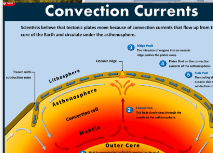
What is the driving force behind the movement of the plates?
a)

b)

c)

d)

3.

Match the following as either Continental crust or Oceanic crust

a)

Continental

crust

1.

older

b)

Continental

crust

2.

less dense

c)

Oceanic

crust

3.

recycles

d)

Oceanic

crust

4.

basalt rock

e)

Continental

crust

5.

thicker

4.

Match the following

a)
1.

divergent

b)
2.

convergent

c)
3.

transform

5.

At which plate boundary is new crust formed?

a)

divergent

b)

convergent

c)

continental

d)

transform

6.

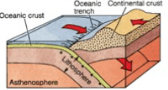
What type of crusts are involved with one plate subducting beneath another?

a)

continental and continental

b)

Oceanic and continental

c)

oceanic and divergent

d)

continental and convergent

7.

What types of landforms are formed at convergent boundaries?

PICK TWO

a)

volcanoes

b)

new crust

c)

Trenches

d)

rift valley

8.

What is the WHOLE AREA called where the oceanic crust goes beneath the continental crust?

a)

subtraction zone

b)

section zone

c)

secondary zone

d)

subduction zone

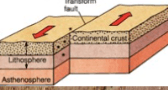
9.

At which boundary is crust neither consumed or created?

a)

divergent

b)

convergent

c)

transform

d)

oceanic

10.

The earth's plates, rigid slabs of rock, are part of the ___ .

a)

asthenosphere

b)

lithosphere

c)

mantle

d)

granitic rock

11.

Who is the scientist who proposed Continental Drift Theory?

a)
Albert Einstein
b)
Alfred Wegener
c)
Isaac Newton
d)
John Dalton
12.

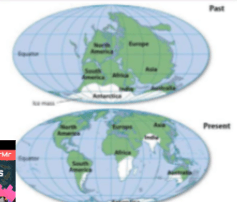
Alfred Wegener named his single supercontinent ____________, which means "all Earth" in ancient Greek.

a)

Pandora

b)

Gandowandaland

c)

Pangea

d)

Percia

13.
What was Wegener's hypothesis called?
a)

The Theory of Pangea 

b)

The Theory of Moving Continents

c)

The Theory of Continental Drift

d)

The Theory of Techtonic Plates

14.

True or False: The continental plates move so quickly that we can feel them.

a)

True

b)

False

15.

Most geologists think that the movement of Earth's tectonic plates is caused by

a)

the rotation of the Earth.

b)

the Earth's magnetic field.

c)

subduction.

d)

convection currents.

16.

When plates collide we get ________.

a)

crumbles

b)

volcanos

c)

trenches

d)

mountain ranges

17.
Associated with transform boundaries.
a)
Volcanoes
b)
mountains
c)
trenches
d)
earthquakes
18.
A location where two tectonic plates collide is known as a _________ boundary.
a)
Convergent
b)
Divergent
c)
Transform
d)
Spreading
19.

Which layer of Earth flows slowly and causes the crust to move?

a)

Crust

b)

Mantle

c)

Inner Core

d)

Outer core

20.

What is the correct order (starting from the surface) of Earth’s layers?

a)

crust, outer core, inner core, mantle

b)

mantle, outer core, inner core, crust

c)

crust, mantle, outer core, inner core

d)

outer core, inner core, crust, mantle

21.
What is an earthquake?
a)
When the earth causes an upward thrust in the epicenter.
b)
When the earth moves up and down along the ocean floor.
c)

When tectonic plates slide against each other causing the earth to move. 

d)
None of the above
22.

Subduction means.....

a)

one plate goes under another plate

b)

two plates slide past each other

c)

two plate collide and form folded mountains

23.

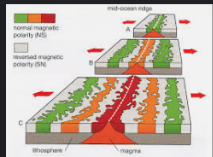
Sea-floor spreading explains how.....

a)

new crust is created at a divergent boundary

b)

volcanoes are formed on continents

c)

deep sea trenches are formed

24.
Which of the following causes Earth's tectonic plates to move?
a)
Energy from the Sun
b)
Magnetic Pole Reversal
c)
Convection currents in the mantle
d)
Faults in Mountain Ranges
25.
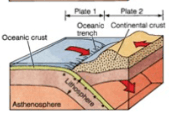
What type of event will occur at this boundary?
a)
Earthquake
b)
Volcano Eruption
c)
Tornado
d)
Mountain Building
26.
What type of plate boundary is this?
a)
Plate
b)
Divergent
c)
Convergent
d)
Transform
27.
A divergent boundary occurs when plates ....
a)
Pull apart
b)
Come together
c)
Slide past each other
d)
subducting
28.
Which of the following is NOT evidence to support the theory of plate tectonics?
a)
Fossils
b)
Mountains
c)
Glaciers
d)
Sand Erosion
29.
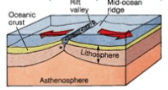
What geologic feature/event would you most likely to find at a divergent boundary between two pieces of oceanic crust?
a)
Rift Valley
b)
Mid-Ocean Ridge
c)
Island Arc
d)
Flat land
30.
What geologic feature/event would you most likely to find at a convergent boundary between two pieces of continental crust?
a)
Volcano
b)
Mountain
c)
Rift
d)
Island Arc
31.
The core is mostly made up mostly of which elements?
a)
Oxygen and Silicon
b)
Silicon and Magnesium
c)
Nickel and Iron
d)
Iron and Magnesium
32.
This is the plastic layer of the mantle on which pieces of the lithosphere move.
a)
Lithosphere
b)
Asthenosphere
c)
Mesosphere
d)
Crust
33.
This layer is divided into pieces called tectonic plates.
a)
Mesosphere
b)
Asthenosphere
c)
Mantle
d)
Lithosphere
34.
Which piece of evidence did Wegener use to prove continental drift?
a)
The shape of the continents
b)
Similar fossils found on separate continents
c)
Tree fossils found in odd places
d)
All of the above
35.
Which of the following changes would end Earth's tectonic activity?
a)
Earth's crust becomes a cooler solid
b)
Earth's mantles becomes a warmer semiliquid
c)
Earth's mantle becomes cooler and solid.
d)
Earth's outer core becomes warmer
36.
Convection currents in the mantle are thought to be the driving force behind tectonic movement. At which location do the convection currents cause the plates to diverge?
a)
strike-slip fault
b)
subduction zone
c)
mid oceanic ridges
d)
folded mountains.
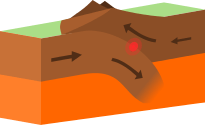
37.
The diagram shows what can occur when two continental plates collide.Which characteristic of the Indian Plate explains why it moves under the Eurasian Plate?
a)
It is larger.
b)
It is denser.
c)
It is molten.
d)
It is younger.
38.

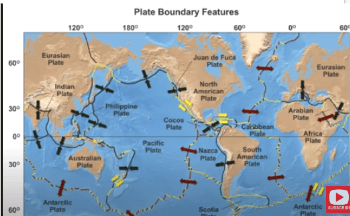
What do we call an area where more then two plates interact in different ways

a)

plate boundary zones

b)

hot spots

c)

convergent boundaries

d)

subduction