Wayground logo

Free Printable Worksheets

Font size

S
M
L
XL
Worksheets

Fingerprinting Test

Total questions: 55

Worksheet time: 49mins

Name
Class
Date
1.

IAFIS is the

a)

FBI fingerprint database

b)

CIA DNA database

c)

International union of forensic scientists

d)

national child database

2.

Minutiae are

a)

the general fingerprint patterns

b)

small unique markings on fingerprints

c)

the types of whorls

d)

the lack of ridges

3.

The most common fingerprint pattern

a)

Loop

b)

Arches

c)

Whorl

d)

Twirl

4.

Check the 3 types of general fingerprint patterns

a)

Arches

b)

Whorls

c)

Loops

d)

Minutiae

5.

Which of the following is not a type of whorl

a)

Plain

b)

Smooth

c)

Central pocket loop

d)

Accidental

e)

Double loop

6.

Identify the two types of loop fingerprints

a)

Loopty loop

b)

Ulnar loop

c)

Hula loop

d)

Radial loop

7.

The number of ridges between the core and the center of the delta is called the

a)

loop pattern

b)

print age

c)

ridge count

d)

delta location

8.

The two types of arches are plain and

a)

tented

b)

accidental

c)

scrambled

d)

wavy

9.

How many deltas are found in whorls

a)

1

b)

2

c)

3

d)

4

10.

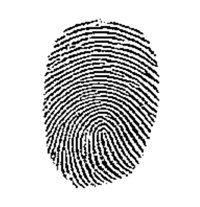
What fingerprint pattern is this?

a)

radial loop

b)

plain whorl

c)

tented arch

d)

accidental whorl

11.

If a fingerprint is pressed into thick clotted blood, the pattern that will be created is called

a)

patent

b)

latent

c)

plastic

d)

hardened

12.

The minutia that looks like a sideways letter Y is a

a)

bridge

b)

spur

c)

bifurcation

d)

short ridge

13.

In the USA, how many matching minutiae are sufficient to make a match?

a)

22

b)

8

c)

19

d)

12

14.

Iodine fuming is ideal for obtaining fingerprints from porous surfaces such as

a)

glass

b)

plastic

c)

paper

d)

metal

15.

Ninhydrin spray is used on porous surfaces and changes fingerprints to purple when it reacts with

a)

fats/oils

b)

water

c)

DNA

d)

amino acids

16.

Super glue contains cyanoacrylate and it works on non-porous surfaces, like glass, to produce this appearance

a)

white

b)

purprle

c)

orange

d)

black

17.

The best way to preserve a fingerprint is to

a)

freeze it

b)

wax coat it

c)

photograph it

d)

wrap it in plastic

18.

What pattern is this? (Right hand)

a)

Ulnar Loop

b)

Radial Loop

c)

Plain Whorl

d)

Tented Arch

19.

What pattern is this? (Left Hand)

a)

Radial Loop

b)

Ulnar Loop

c)

Plain Whorl

d)

Plain Arch

20.
The area indicated by "A" in the diagram is known as a(n)
a)
Core
b)
Delta
c)
Whorl
d)
Arch
21.
The area indicated by "B" in the diagram is known as a(n)
a)
Core
b)
Delta
c)
Whorl
d)
Arch
22.

What is the name of this minutiae?

a)

Bifurcation

b)

Splitting Ridge

c)

Delta

d)

Y

23.

What is the name of this minutiae?

a)

Enclosure/Eye

b)

Island

c)

Dot

d)

Bifurcation

24.

What is the name of this minutiae?

a)

Ending Ridge

b)

Spur

c)

Half-Ridge

d)

Partial Ridge

25.

What is the name of this minutiae?

a)

Bridge

b)

Junction

c)

Connector

d)

Zigzag

26.

What is the name of this minutiae?

a)

Island

b)

Speck

c)

Dash

d)

Hyphen

27.

What is the name of this minutiae?

a)

Spur

b)

Hanging Ridge

c)

Overhang

d)

Mini-fork

28.
What component of a fingerprint constitutes individual evidence?
a)
Class
b)
Minutiae
c)
Subclass
d)
Class and subclass
29.
5% of the population has this type of pattern
a)
loops
b)
whorls
c)
arches
d)
ripples
30.

What are the red triangles?

a)

deltas

b)

useless

c)

forks

d)

loops

31.
What is the function of the ridges on our fingers which create fingerprints?
a)
They provide insulation for the tissues under the skin.
b)
They enable us to grasp objects.
c)
They provide protection for our touch receptors.
32.
Identical twins have the exact same fingerprints.
a)
True
b)
False
33.
Which of the following types of fingerprints are more likely to be found impressed in soft wax? 
a)
visible
b)
latent
c)
hidden 
d)
plastic
34.
The most common form of developing latent prints
a)
Dusting
b)
Silver Nitrate
c)
photography
d)
Black light
35.
What is the scientific name for a fingerprint?
a)
fingergram
b)
printogram
c)
dactyloprint
d)
dactylogram
36.
What causes fingerprints to be left behind when we touch things?
a)
the dust on the things we touch
b)
the smoothness of the surfaces we touch
c)
the natural oils on skin
d)
the moisture in the atmosphere
37.
A visible fingerprint that happens when fingers with blood, ink, or some other substance on them touch a surface and transfer the pattern of their fingerprint to that surface
a)
Latent Print
b)
Plastic Print
c)
Patent Print
d)
Fingerprint
38.
A three dimensional fingerprint made in soft material such as clay, soap, or putty
a)
Latent Print
b)
Plastic Print
c)
Patent Print
d)
Print Print Print Print
39.
A hidden fingerprint made visible through the use of powders or other techniques
a)
Latent Print
b)
Plastic Print
c)
Patent Print
d)
Print Print Print Print
40.

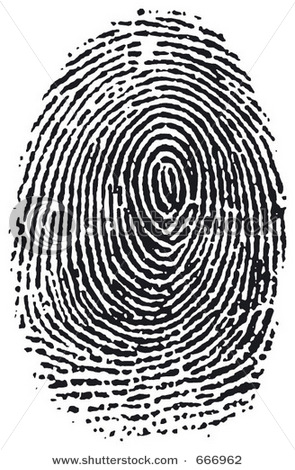
What type of fingerprint is this?

a)

Central Pocket Whorl

b)

Plain Whorl

c)

Accidental Whorl

d)

Double Loop Whorl

41.

ID this print

a)

plain whorl

b)

central pocket whorl

c)

double loop whorl

d)

accidental whorl

42.
Identify this fingerprint
a)
Arch
b)
Loop
c)
Whorl
d)
Swirl
43.
Identify the fingerprint
a)
Arch
b)
Loop 
c)
Whorl
d)
Swirl
44.
Identify the fingerprint pattern as shown.
a)
whorl
b)
loop
c)
arch
45.

Identify feature at Location 1

a)

fork / bifurcation

b)

central core

c)

ending ridge

d)

short ridge

46.

Identify feature at Location 4

a)

fork / bifurcation

b)

central core

c)

ending ridge

d)

short ridge

47.

Identify feature at Location 3

a)

fork / bifurcation

b)

central core

c)

ending ridge

d)

short ridge

48.

Identify feature at Location 2

a)

fork / bifurcation

b)

central core

c)

ending ridge

d)

short ridge

49.
Why type of evidence is DNA?
a)
Class
b)
Trace
c)
Individual
d)
Direct
50.
Name this minutiae type
a)
Sludge
b)
Island (dot) 
c)
Bifurcation (fork) 
d)
Pore
51.
Name this minutiae type
a)
Delta
b)
Core
c)
Enclosure (eye) 
d)
Hook (spur)
52.

Identify circle 3

a)

bifurcation

b)

ridge ending

c)

spur

d)

lake

53.

Identify circle 1

a)

bridge

b)

dot

c)

hook

d)

short ridge

54.

Identify circle 3

a)

Ridge ending

b)

Bridge

c)

Dot

d)

Bifurcation

55.

Identify circle 2

a)

dot

b)

Spur

c)

Bifurcation

d)

Bridge