

wayground logo

Free Printable Worksheets

Font size

S
M
L
XL
Worksheets

Chemical Bonds and Reactions

Total questions: 50

Worksheet time: 1hrs 8mins
Name
Class
Date
1.
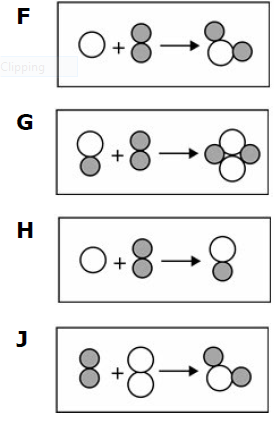
Which of the following models best demonstrates a balanced chemical equation?
a)
F
b)
G
c)
H
d)
J
2.
The reactants are on the left side of the chemical equation.
a)
True
b)
False
3.

How many atoms in all are in a molecule of serotonin?

C10H12N2O

a)
22
b)
24
c)
25
d)
4
4.
Coal contains carbon and other elements. Carbon dioxide forms when coal burns in the presence of oxygen. Which of these is the best evidence that a chemical reaction occurs when coal burns?
a)
The shape of the coal changes
b)
Oxygen is present
c)
A new substance is produced
d)
Coal is made up of more than one element
5.
Is burning wood a chemical or physical change?
a)
chemical
b)
physical
6.
Is glass breaking a chemical or phyiscal change?
a)
chemical
b)
physical
7.
Is hammering wood together to build a house a chemical or physical change?
a)
chemical
b)
physical
8.
Is a a rusting bicycle a chemical or physical change?
a)
chemcial
b)
physical
9.
Is melting butter for popcorn a chemical or physical change?
a)
chemical
b)
physical
10.
Is spoiling food a physical or chemical change?
a)
phyiscal
b)
chemical
11.
Is mixing lemonade powder with water a physical or chemical change?
a)
physical
b)
chemical
12.
What is the left part of a chemical equation called?
H2 + O → H2O
a)
Reactants
b)
Products 
c)
Yields 
d)
Chemical Equation 
13.
Is this balanced?
Al + O2 → 2Al2O3
a)
Yes
b)
No
14.
When materials combine to form new compounds it is a chemical change. Which example is a chemical change?
a)
baking powder fizzing
b)
water boiling
c)
ice melting
d)
sugar cube dissolving
15.
The substances listed on the right side of a chemical equation are the
a)
Yields
b)
Reactants
c)
Products
d)
Precipitates
16.

Determined whether the following equation is balanced or unbalanced. Ag + O2 ---> 2Ag2O

a)

Balanced

b)

Unbalanced

17.

Determine whether the following equation is balanced or unbalanced. H2 + Br2 ---> 2HBr

a)

Balanced

b)

Unbalanced

18.
Some elements combine chemically and no longer have the same ________________ they did before forming a compound.
a)
valence electons
b)
energy
c)
properties
d)
group number
19.
A _________________ is composed of symbols and subscripts indicating the number of atoms of an element in a compound.
a)
Chemical Equation
b)
Chemical Reaction
c)
Synthesis Reaction
d)
Chemical Notation
20.
Atoms gain lose, gain, or ______electrons to get a stable outer energy level.
a)
share
b)
split
c)
create
d)
destroy
21.
A ____________is the force that holds atoms together in a compound.
a)
Chemical Formula
b)
Chemical Reaction
c)
Chemical Bond
d)
Synthesis Reaction
22.
An ionic compound is held together by the _______--the force of attraction between opposite charges of the atoms.
a)
Covalent Bond
b)
Ionic Bond
c)
Synthetic Bond
d)
Molecular Bond
23.
The result of this bond is a _________compound.
a)
neutral
b)
polar
c)
positively charged
d)
negatively charged
24.
__________are neutral particles formed as  result of sharing electrons.
a)
Protons
b)
Electrons
c)
Molecules
d)
Ions
25.
A ________is the force of attraction between atoms sharing electrons.
a)
Synthetic Bond
b)
Ionic Bond
c)
Molecular Bond
d)
Covalent Bond
26.
Electrons shared in a molecule are held ________to the atoms with the larger nucleus.
a)
more closely
b)
relative
c)
adjacent
d)
next
27.

Ionic bonds form between ---

a)

nonmetals.

b)

metals and nonmetals.

28.

What are valence electrons?

a)

sum of the protons and neutrons

b)

protons minus electrons

c)

electrons in the inner shells

d)

electrons in the outer shell

29.

Atoms that gain an electron have an electric charge of ---

a)

-1.

b)

-2.

c)

+1.

d)

+2.

30.

If an atom has 7 protons and 7 electrons, its electric charge is ---

a)

-7

b)

-14

c)

0

d)

+7

31.

Which of the following is NOT a covalent bond?

a)

K2S

b)

H2O

c)

I2

d)

CO2

32.

Which of the following is NOT an ionic bond?

a)

NH3

b)

KCl

c)

K3N

d)

NaCl

33.

An electron has a ___ charge.

a)

no charge

b)

positive

c)

negative

d)

it depends

34.

A proton has a ___ charge.

a)

positive

b)

negative

c)

no charge

d)

it depends

35.

According to the Octet Rule, atoms of elements react with each other in order to attain ____ electrons in their outermost energy level or shell.

a)

2

b)

4

c)

8

d)

10

36.

In metallic bonds electrons are:

a)

shared

b)

move around the nuclei randomly

c)

transferred

37.

Which of the following lists of elements contain only metals?

a)

Li, Al, Te

b)

Ni, Pb, H

c)

Na, Os, Ga

d)

Ca, Zn, I

38.

What could be a charge on aluminum?

a)

1+

b)

2+

c)

3+

d)

4+

39.

Alloys are important because

a)

their properties are often superior to the component elements

b)

their properties are a blend of the component elements

c)

they never corrode

d)

they are less expensive than their component elements.

40.

Why are metals good conductors?

a)

they have mobile electrons

b)

they have mobile atoms

c)

they have crystal structures that can rearrange

d)

they have mobile protons

41.

Malleability means

a)

the ability to be drawn into a wire

b)

the electrons of metals are mobile

c)

the ability to be hammered into a shape

d)

the ability to be a conductor of electricity

42.

Metals are ductile because metallic bonds

a)

hold the layers of ions in rigid positions

b)

maximizes the repulsive force in a metal

c)

allows planes of protons and electrons to slide past one another

d)

are easily broken

43.

Metals are hard because metals have a

a)

sea of electrons that tightly hold the nuclei together

b)

they form triple bonds

c)

low melting point

d)

high luster

44.
Two Reactants and One Product
a)
Decomposition
b)
Synthesis
c)
Combustion
d)
Single Replacement
45.
Always starts with a Hydrocarbon that reacts with oxygen and produces carbon dioxide and water. 
a)
Decomposition
b)
Synthesis
c)
Combustion
d)
Single Replacement
46.
One reactant into several products.
a)
Decomposition
b)
Synthesis
c)
Combustion
d)
Single Replacement
47.
One element replaces another in a compound.
a)
Synthesis
b)
Combustion
c)
Single Replacement
d)
Double Replacement
48.
Ions in two compounds switch. 
a)
Synthesis
b)
Combustion
c)
Single Replacement
d)
Double Replacement
49.

Identify the type of reaction:

ZnCl2 + Mg --> Zn + MgCl2

a)

Precipitate

b)

Single Replacement

c)

Double Displacement

d)

Decomposition

50.

Identify the reaction type for the following equation:

K + F2 --> KF

a)

Double displacement

b)

Single Replacement

c)

Synthesis

d)

Decomposition
