
 Worksheets
molarity, dilution titration
Total questions: 65
Worksheet time: 3hrs 44mins
What is the molarity of a 0.5L sample of a solution that contains 60.0 g of sodium hydroxide (NaOH)
0.8 M
1.5M
3.0M
6.0M
When calculating molality, Kg of the following are included in the calculation?
solvent
solute
none of these
solvent & solute
To calculate molality you only need which of the following?
scale
flask
What is the molality of a solution in which 3.0 moles of NaCl is dissolved in 1.5 Kg of water?
2.0 M
0.22 m
135 m
2.0m

What is the molarity of a solution containing 4 moles of KCl in 2.5 L of solution?
1.6 M
0.63 M
10 M
2.6 M

What volume is needed to make a 2.45 M solution of KCl using 0.50 mol of KCl?
4.9 L
0.20 L
1.2 L

How many moles of NaCl are needed to make 5.25 L of a 0.25 M solution?
1.3 mol
21 mol
0.048 mol

How many grams of KCl would be dissolved in 5.50 L of a 0.250 M solution of KCl? *molar mass of KCl = 74.55 g/mol*
1.48 g
103 g
1640 g
3.39 g

What is the molarity of a solution made by adding 1.565 moles of PbNO3 to 0.5 L?
300. M
31.3 M
3.13 M
1.56 M
Which solution is more diluted?
Solution 1:
1000 mL of water
60g of salt
Solution 2:
500 mL of water
60 g of salt
Not enough information to tell
Solution 1
Solution 2
They are equally diluted
50 ml of a 1 M solution is diluted until the final volume is 80ml. How much water was added?
50 ml
1.3 ml
30 ml
130 ml
How many liters would you need to make a 1 M solution if you have 6 moles of Sodium Hydroxide?
2
3
4
6
What is the molarity of 122.5 g of AlCl3 in 1.0 L of solution? (MM = 133 g/mol)
1.225 M
0.92 M
0.1225 M
How many grams of AgNO3 are needed to prepare 0.125M solution in 250 mL of water? (MM 169.87g/mol)
.03g
0.5g
5.3g
84.9g
If I have 340 mL of a 0.5 M NaBr solution, what will the concentration be if I add 560 mL more water to it?
.188 M
3.78 M
.389 M
1.76 M
What mass of Iodine, (molar mass= 253.80 g/mol), must be used to prepare a .960m solution if 100.0g of ethanol, CH3CH2OH, is used? molality= kg solventmoles of solute
50.0 g
96.0 g
2.54 g
24.4 g
What is the molarity of a solution composed of 8.210 g of potassium chromate, (molar mass= 194.20g/mol), dissolved in enough water to make .500L of solution?
Molarity= L of solutionmolesofsolute
.0423 M
.0846 M
16.4 M
.172 M
In a titration, the solution changes color at the
end point
equivalence point
A titration can be used to determine the _______________ of a solution
molarity
density
boiling point
reactivity
A 25.00 mL sample of HCl was titrated to the end point with 15.00 mL of 2.00 M NaOH. The following neutralization reaction occured: HCl + NaOH → NaCl + H2O
What is the molarity of the HCl?
0.650 M
1.05 M
1.20 M
1.50 M
A 10.00 mL sample of H2SO4 was neutralized by 13.5 mL of 1.00 M KOH by the following reaction: H2SO4 + 2KOH → K2SO4 + 2H2O
What is the molarity of H2SO4?
0.675 M
0.910 M
1.05 M
1.20 M
A 5.00 mL sample of household ammonia was analyzed by titration with hydrochloric acid according to the following reaction: HCl + NH3 → NH4 + + Cl −
This titration required 19.5 mL of 0.750 M HCl. What is the molarity of the ammonia sample?
1.97 M
2.19 M
2.44 M
2.92 M
What is the role of an indicator in a reaction?
To help reactants react successfully.
To bind to the analyte to form a products.
To show when the reaction has reached or past the equivalence point.
To provide a surface for the reaction to occur.
What is an equivalence point?
It is the point when enough analyte has been added.
It is the point when the amount of added titrant is equal to the amount of analyte in the solution.
It is the point when the volume of titrant is equivalent the volume of analyte.
It is the point when the concentration of titrant added is equivalent to the volume of analyte.
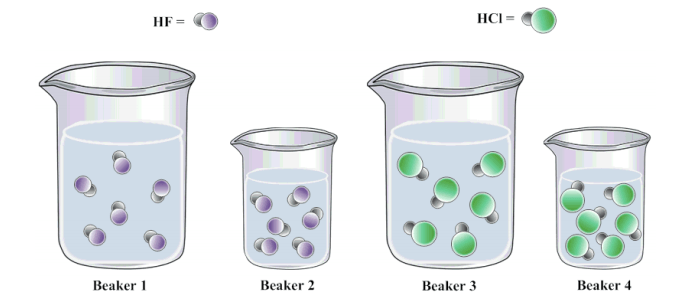
Equal moles of the indicated acids are dissolved in the amounts of water shown in the beakers below. In which solution will the percent ionization of the acid be the lowest?
Beaker 1
Beaker 2
Beaker 3
Beaker 4
When should you stop a titration?
When you have added equal volumes
When the indicator changes colour
When you run out of solution
When the solution is no longer acidic
Acid + Base ₋-->
salt + hydrogen
salt + carbon dioxide + water
salt
salt + water
If it takes 50 mL of 0.5 M Ca(OH)2 to neutralize 125 mL of hydrochloric acid (HCl), what is the concentration of the acid?
0.2 M
5 M
0.5 M
0.4 M
A titration can be used to determine the _______________ of a solution.
Molarity
Density
Boiling point
Reactivity
What is the method used to determine the concentration of an unknown acid or base through a neutralization reaction based on a color change within a certain pH range called?
Analyte
Titrant
Indicator
Titration

a
b
c
d

a
b
c
d

a
b
c
d

a
b
c
d
If I have 18 M H2SO4 and I want to make 500 mL of a 1 M H2SO4 solution, what do I do?
If there is 0.09 mol NaCl dissolved in 0.80 L of solution, what is the molarity?
(round the answer to two decimal places)
(a)
What would be the Molarity of a glass of salt water if 14 g of NaCl is dissolved to form a solution that has a volume of 500 mL? The molar mass of NaCl is 58.44 g/mol. Round to nearest hundredth.
(a)
What volume must 108 grams of NaCl be watered down to so that the molarity of the solution is 0.80 M? Round to nearest tenth.
(a)


