
 Worksheets
Chemistry Study Guide 2
Total questions: 67
Worksheet time: 2hrs 46mins
Name
Class
Date
1.
The substances listed on the right side of a chemical equation are the
a)
Yields
b)
Reactants
c)
Products
d)
Precipitates
2.
CaCO3 represents a chemical
a)
Symbol
b)
Formula
c)
Subscript
d)
Reaction
3.
The substances listed on the left side of a chemical equation are the
a)
Products
b)
Coefficients
c)
Precipitates
d)
Reactants
4.
In chemical reactions, what does the principle of conservation of mass mean?
a)
Matter is not created or destroyed.
b)
The total mass of the reactants is greater than the total mass of the products.
c)
The total mass of the reactants is less than the total mass of the products.
d)
Matter is not changed.
5.
How many Oxygen (O) atoms are in 2C2HO8Cl2
a)
2
b)
16
c)
8
d)
5
6.
How many Hydrogen (H) atoms are in NH3O5
a)
3
b)
4
c)
5
d)
1
7.
Which is the Law of Conservation of Matter?
a)
matter cannot be created or destroyed, it only changes form
b)
matter can be created but it cannot be destroyed, it never changes form
c)
matter can be destroyed but it cannot be created, it usually just changes form
d)
matter is an unproven theory created by Hans Geiger
8.
Which of the following shows the correct way to balance the chemical equation?
Fe + O2 -> Fe2O3
Fe + O2 -> Fe2O3
a)
4Fe + 3O2 -> 2Fe2O3
b)
2 Fe + 3O2 -> Fe2O6
c)
4 Fe + O6 -> 2Fe2O3
d)
None of the options are correctly balanced.
9.
Which of the following reactions is balanced?
a)
2CH4 + O2 -> CO2 + H2O
b)
CH4 + 2O2 -> CO2 + H2O
c)
CH4 + 2O2 -> CO2 + 2H2O
d)
None of the chemical equations are balanced.
10.
Balance this equation...
HgO --> Hg + O2
HgO --> Hg + O2
a)
It is balanced
b)
2HgO --> Hg + O2
c)
2HgO --> 2Hg + O2
d)
I don't know...Oh well!
11.
How many HCl molecules do you need to balance this equation?
Mg + __HCl ---> MgCl2 + H2
Mg + __HCl ---> MgCl2 + H2
a)
1
b)
2
c)
3
d)
4
12.
In the following equation, what are the reactants?
CaO + 3 C → CaC2 + CO
CaO + 3 C → CaC2 + CO
a)
CaO + 3 C
b)
CaC2 + CO
c)
3 C → CaC2
d)
the stuff on the outside
13.
In the following equation, what are the products?
HCl + Zn → H2 + ZnCl2
HCl + Zn → H2 + ZnCl2
a)
HCl + Zn
b)
H2 + ZnCl2
c)
Zn → H2
d)
the stuff on the outside
14.
Which number should go in the blank?
_ H2 + O2 -> 2 H2O
_ H2 + O2 -> 2 H2O
a)
1
b)
2
c)
3
d)
0
15.
Which number should go in the blank?
Mn + _ HNO3 → Mn(NO3)2 + H2
Mn + _ HNO3 → Mn(NO3)2 + H2
a)
1
b)
2
c)
3
d)
0
16.
The substances listed on the left side of a chemical equation are the
a)
Products
b)
Coefficients
c)
Precipitates
d)
Reactants
17.
In chemical reactions, what does the principle of conservation of mass mean?
a)
Matter is not created or destroyed.
b)
The total mass of the reactants is greater than the total mass of the products.
c)
The total mass of the reactants is less than the total mass of the products.
d)
Matter is not changed.
18.
What is the arrow in a chemical equation...
H2 + O --> H2O
H2 + O --> H2O
a)
Reactants
b)
Products
c)
Yields
d)
Chemical Equation
19.

This is used to represent the amount of each atom in a molecule. What is the arrow pointing to?
a)
Exponent
b)
Coefficient
c)
Molecule
d)
Subscript
20.

This appears on the left side of a chemical formula, and represents how many molecules there are.... What is highlighted in yellow?
a)
Atom
b)
Subscript
c)
Molecule
d)
Coefficient
21.

Is this equation balanced?
a)
yes
b)
no
c)
Not enough information
22.
Is the equation balanced?: 2H2O + O2 --> 4MgO + 3Fe
a)
Yes
b)
No
23.

Is this equation balanced?
a)
yes
b)
no
c)
Not enough information
24.
At the end of chemical reactions, what is the total mass of the reactants compared to the total mass of the products?
a)
the product is doubled
b)
the product is half the mass of the reactants
c)
the mass is the same
d)
the mass changes depending on the reaction
25.
When balancing equations a ____ can be placed to the left of a formula of a substance to make the equations balanced
a)
charge
b)
subscript
c)
random number
d)
coefficient
26.
An object with which of the following densities will float on water?
a)
0.7 g/cm3
b)
1.2 g/cm3
c)
3.5 g/cm3
d)
11.4 g/cm3
27.
Which property of matter is determined by dividing its mass by its volume?
a)
elasticity
b)
buoyancy
c)
density
d)
viscosity
28.
The following liquids are poured together in a beaker: alcohol (density=0.79), corn syrup (density=1.38), water (density=1.0), and cooking oil (density=0.93). Which of these liquids will sink to the bottom of the beaker?
a)
alcohol
b)
corn syrup
c)
water
d)
cooking oil
29.
A brick sinks in water while a wooden block of the same size floats. This is because the brick has a
a)
lower volume than the wooden block
b)
lower density than the wooden block
c)
higher volume than the wooden block
d)
higher density than the wooden block
30.
What is the density of a substance that has a mass of 30g and a volume of 6 liters?
a)
24 g/l
b)
5 g/l
c)
36 g/l
d)
180 g/l
31.
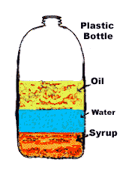
Which liquid is the least dense?
a)
oil
b)
water
c)
syrup
d)
plastic bottle
32.

Which box has a higher density?
a)
Box A
b)
Box B
c)
cannot be determined
d)
they are the same
33.
What is the formula for density?
a)
density = mass x volume
b)
density = mass / volume
c)
density = mass + volume
d)
density = mass - volume
34.
Frank has an eraser. It has a mass of 4g, and a volume of 2cm3. What is its density?
a)
8 g/cm3
b)
2 g/cm3
c)
1/2 g/cm3
d)
24 g/cm3
35.
Why do some substances float on water?
a)
they are warmer than water
b)
they are cooler than water
c)
they are more dense than water
d)
they are less dense than water
36.
What tool is used to measure the volume of a liquid?
a)
thermometer
b)
hand lens
c)
graduated cylinder
d)
ruler
37.

Name the tool.
a)
spring scale
b)
graduated cylinder
c)
hand lens
d)
ruler
38.

What is the mass on this triple beam?
a)
220g
b)
222g
c)
20g
39.

What is the name of this metric tool?
a)
Triple Beam Balance
b)
Graduated Cylinder
c)
Overflow Can
d)
Massometer
40.
A change in the size, shape, or state of matter.
a)
chemical change
b)
physical change
c)
chemical reaction
d)
electron change
41.
Stanley left an ice cube on his kitchen counter. An hour later, Stanley observed that the ice cube melted. Which statement best describes this change?
a)
Ice melting is a physical change because a new substance is created.
b)
Ice melting is a chemical change because a new substance is created.
c)
Ice melting is a chemical change because it may be reversed.
d)
Ice melting is a physical change because it may be reversed.
42.
Is a a rusting bicycle a chemical or physical change?
a)
chemcial
b)
physical
43.
Is melting butter for popcorn a chemical or physical change?
a)
chemical
b)
physical
44.
Are fireworks exploding a physical or chemical change?
a)
phyiscal
b)
chemical
45.
Is frying an egg a physical or chemical change?
a)
chemical
b)
physical
46.
Is burning leaves a physical or chemical change?
a)
chemical
b)
physical
47.
Salt dissolves in water
a)
physical Change
b)
chemical change
48.
Is a a rusting bicycle a chemical or physical change?
a)
chemcial
b)
physical
49.

a copper penny turning greenish after a few years.
a)
Chemical Change
b)
Physical Change
50.
A change in which NEW substances are formed.
a)
Chemical change
b)
Physical change
c)
Casual change
d)
Formal change
51.
In chemical reactions, the law of conservation of mass is......
a)
disobeyed
b)
not true
c)
obeyed
d)
used sometime
52.

Which evidence demonstrates that a chemical change has occurred.
a)
water level rises
b)
water becomes cloudy
c)
gas is produced (bubbles)
d)
tablet dissolves
53.
Volume is the amount of space an object takes up.
a)
True
b)
False
54.
John measures a rock and finds it to be 16 grams. What does John know about the rock?
a)
its mass
b)
its weight
c)
its volume
d)
its momentum
55.
At the end of chemical reactions, what is the total mass of the reactants compared to the total mass of the products?
a)
the product is doubled
b)
the product is half the mass of the reactants
c)
the mass is the same
d)
the mass changes depending on the reaction
56.
What is a chemical equation?
a)
A short way to show a chemical reaction using symbols
b)
A way to explain a chemical reaction using words
57.
If an acid is combined with a base of equal strength, the result will most likely be
a)
a neutral solution.
b)
a stronger acid.
c)
impossible to tell without testing the pH.
d)
a stronger base
58.
Holly has an unknown substance in a beaker. She wants to determine the relative pH of the unknown substance. She places a piece of blue litmus paper into the substance, and the litmus paper stays blue.
The substance in the beaker
The substance in the beaker
a)
is a base.
b)
has a neutral pH.
c)
is an acid.
d)
does not have a pH.
59.
The pH of a solution is tested, and it is found to be a basic solution. Of the following choices, what could the pH have been?
a)
3
b)
9
c)
7
d)
5
60.
Which of these pH values would indicate that a solution is a weak base?
a)
4
b)
5.6
c)
8
d)
13
61.
Which of the following is true about acids and bases?
a)
The lower the pH, the stronger the acid
b)
the higher the pH, the stronger the acid
c)
The lower the pH, the more neutral the acid
d)
The higher the pH, the weaker the base
62.

Which food is the most acidic?
a)
bananas
b)
lemon juice
c)
orange juice
63.

Bleach is a strong base, what is the pH level of bleach?
a)
13
b)
14
c)
1
d)
2
64.
A compound that changes color when it is in contact with an acid or base is called______________
a)
Acid
b)
Base
c)
Neutral
d)
Indicator
65.
On the pH scale what numbers are bases?
a)
8-14
b)
0-7
c)
7
d)
1
66.
On the pH scale what numbers are acids?
a)
8-14
b)
0-7
c)
7
d)
1
67.
On the pH scale what numbers are neutrals?
a)
8-14
b)
0-7
c)
7
d)
1
100 %

