wayground logo

Free Printable Worksheets

NEW

Font size

S
M
L
XL
Worksheets

2026 weather test review

Total questions: 57

Worksheet time: 41mins

Name
Class
Date
1.
When a warm air mass and a cold air mass meet, but they push at each other and neither one can move, it is called a/an - 
a)
warm front
b)
cold front
c)
occluded front
d)
stationary front
2.
The boundary between two air masses is called a/an - 
a)
flood
b)
front
c)
climate
d)
storm
3.
When a cold air mass moves into a warm air mass, it will get colder and we will have severe weather. What type of front is this?
a)
warm front
b)
cold front
c)
occluded front
d)
stationary front
4.
When a warm air mass gently slides on top of a cold air mass, and you have drizzly rain and then warmer weather, what type of front is it?
a)
warm front
b)
cold front
c)
occluded front
d)
stationary front
5.
7. Which of the following would be an area that would most likely lead to a warm or hot air mass to develop?
a)
The North pole
b)
The South pole
c)
The Equator
6.
What type of front moves quickly and can produce severe thunderstorms?
a)
Stationary
b)
Warm
c)
Cold
d)
Occluded
7.
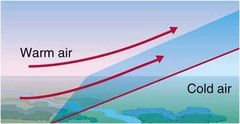
What type of front is this?
a)
Warm Front
b)
Cold Front
c)
Stationary Front
8.

Winds always travel from ______ pressure to ______ pressure

a)

High, Low

b)

Low, High

9.
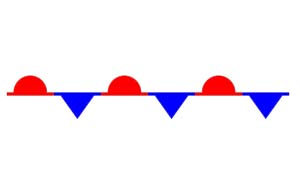
Which type of front is displayed?
a)
Cold
b)
Warm
c)
Stationary
d)
Occluded
10.
Which type of front is displayed?
a)
Cold
b)
Warm
c)
Stationary
d)
Occluded
11.
Which type of front is displayed?
a)
Cold
b)
Warm
c)
Stationary
d)
Occluded
12.
Which type of front is displayed?
a)
Cold
b)
Warm
c)
Stationary
d)
Occluded
13.

Which is the correct symbol for an cold front?

a)
b)
c)
d)
14.

Which is the correct symbol for a warm front?

a)
b)
c)
d)
15.

A low pressure system brings

a)

wind, clouds, rain

b)

dew and fog

c)

humid rainy air

d)

clear, dry air

16.

A high pressure system brings

a)

wind, clouds, rain

b)

dew and fog

c)

humid rainy air

d)

clear, dry air

17.
a)

Warm front

b)

Cold front

c)

Stationary front

d)

Occluded front

18.
a)

Warm front

b)

Cold front

c)

Stationary front

d)

Occluded front

19.

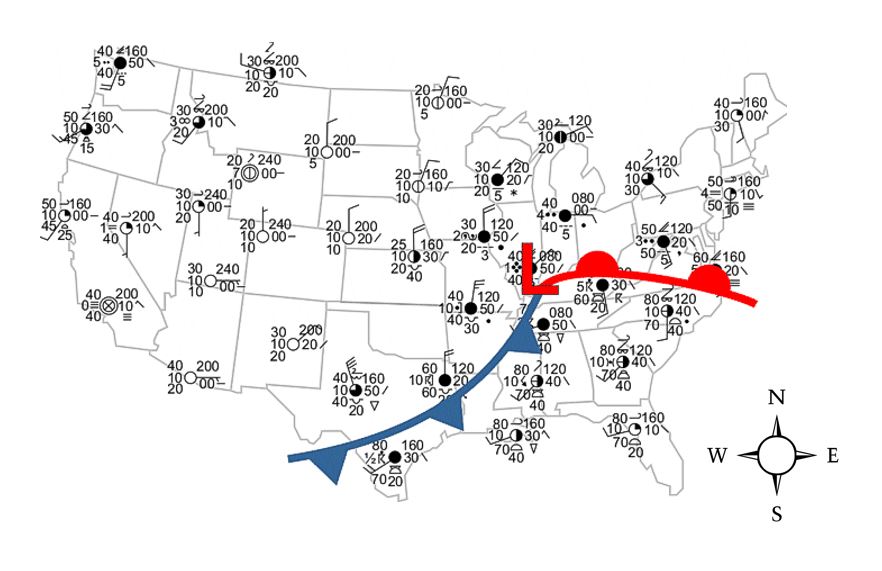
Which direction is the cold front heading

a)

north

b)

south

c)

east

d)

West

20.
What types of air masses form over oceans?
a)
Maritime
b)
Continental
c)
Polar
d)
Tropical
21.
How do we characterize an air mass that forms over land?
a)
Dry
b)
Wet
c)
Cold
d)
Warm
22.
How do we name air masses?
a)
Water and temperature
b)
Air pressure
c)
Humidity and temperature
d)
Cold and warm
23.
How do we characterize an air mass that forms near the poles?
a)
Dry
b)
Wet
c)
Warm
d)
Cold
24.
What direction is the warm front moving on the map? 
a)
North
b)
South
c)
East
d)
West
25.
What direction is the cold front moving on the map? 
a)
Southwest
b)
Northwest
c)
Southeast
d)
Northeast
26.

Which instrument is used to measure temperature?

a)

Thermometer

b)

Anemometer

c)

Barometer

d)

Hygrometer

27.

Which instrument is used to measure wind speed?

a)

Thermometer

b)

Anemometer

c)

Barometer

d)

Hygrometer

28.

Which instrument is used to measure air pressure?

a)

Thermometer

b)

Anemometer

c)

Barometer

d)

Hygrometer

29.
This weather instrument is a...
a)
anemometer
b)
Christmas ornament
c)
wind vane
d)
barometer
30.
What is weather?
a)
The measure of transparency of the atmosphere.
b)
The condition of Earth's atmosphere at a certain time and place.
c)
Cumulus clouds
d)
Stratus clouds
31.
Air _________________ , also known as atmospheric pressure, refers to the weight of the Earth's atmosphere pressing down on everything at the surface.
a)
weight
b)
pressure
c)
density
d)
mass
32.
_________ pressure is associated with storms, tornadoes, and hurricanes.
a)
High
b)
medium
c)
good
d)
Low
33.
________ pressure is associated with clear and dry conditions.
a)
High
b)
Low
c)
medium
d)
bad
34.

A severe storm with lightning, thunder, heavy rain, and strong winds

a)

blizzard

b)

hurricane

c)

thunderstorm

d)

tornado

35.

A large storm that forms over warm ocean water with strong winds that blow in a circular pattern

a)

blizzard

b)

hurricane

c)

thunderstorm

d)

tornado

36.

Small, funnel-shaped storm with very high wind speeds

a)

tornado

b)

hurricane

c)

thunderstorm

d)

blizzard

37.

Which is an image of a tornado?

a)
b)
c)
38.

Which is an image of a hurricane?

a)
b)
c)
39.

Which is an image of a thunderstorm?

a)
b)
c)
40.

During a tornado, you should...

a)

stay in your car

b)

find a safe place away from windows

c)

drive to the hospital

41.

Where are hurricanes most likely to form?

a)

over a lake

b)

Arctic Ocean

c)

anywhere over land

d)

Atlantic Ocean

42.

A hurricane rotates around the center of the storm, which is also known as...

a)

the "eye"

b)

the "calm"

c)

the "funnel"

43.
They are highest clouds in the sky. They look curly, white and feathery. Usually mean good weather.
a)
Cumulus
b)
Cumulonimbus
c)
Cirrus
d)
Stratus
44.
These clouds are the closest to the ground. Their name means layer- or sheet like. They bring rain or snow and cover most of the sky. 
a)
Cirrus
b)
Stratus
c)
Cumulonimbus
d)
Cumulus
45.
Which cloud brings nice weather?
a)
Cumulonimbus
b)
Cumulus
c)
Stratus
46.
what type of cloud is shown?
a)
cumulus
b)
cirrus
c)
stratus
47.
Low clouds (like fog), that are thick, cover the sky, and block the sun.  Usually bring continuous precipitation (rain or snow).
a)
stratus
b)
cumulus
c)
cirrus
d)

nimbo

48.
what type of cloud is shown?
a)
cumulus
b)
cirrus
c)
stratus
49.
what type of cloud is shown?
a)
cumulus
b)
cirrus
c)
stratus
50.
When are you most likely to see cumulus clouds?
a)
On a foggy day
b)
On a rainy day
c)
Before a thunderstorm
d)
On a sunny day
51.
Fog is what type of cloud?
a)
Stratus
b)
Cumulus
c)
Cirrus
d)
Cumulonimbus
52.
What makes up clouds?
a)
Distilled water and dust
b)
Condensed Water and dust
c)
Dust and steam
d)
Ice and snow
53.

What type of cloud?


Thunderstorms!

a)

cumulus

b)

stratus

c)

stratocumulus

d)

cumulonimbus

54.

What type of cloud?


Piles, heaps, puffy, fluffy and pillow-like.

a)

stratus

b)

cumulus

c)

nimbus

d)

cirrus

55.
How do clouds form?
a)
Liquid water is heated and evaporates and becomes water vapor in the atmosphere.
b)
Water vapor in the atmosphere cools and condenses to become tiny liquid water droplets in the atmosphere.
c)
Tiny liquid water droplets float upwards and gather together in the atmosphere to form a cloud.
56.
what type of cloud is shown?
a)
cumulus
b)
cirrus
c)
stratus
57.
what type of cloud is shown?
a)
cumulus
b)
cirrus
c)
stratus