
 Worksheets
H Evolution Test Review
Total questions: 70
Worksheet time: 49mins
T/F: Descent with modification occurs through inheritance of acquired characteristics.
True
False
similar body structures among different species from a common ancestor
Biogeography
Vestigial Structure
Anatomical Homology
Developmental Homolgy
Study of past and present distribution of organisms
Common Ancestor
Biogeography
Hox Genes
Stasis
A preserved remnant or impression of an organism that lived in the past.
Fossil
Common Ancestor
Hox genes
Stasis

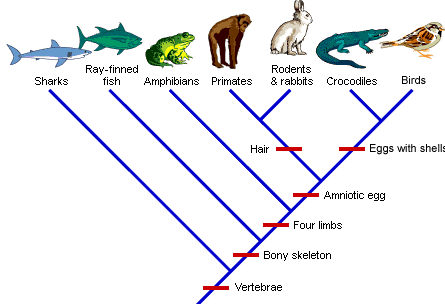
According to this cladogram, primates are most closely related to -
Amphibians
Rodents and rabbits
Crocodiles
Birds

What
type
of structure?
Homologous
Analogous
Embryological
Vestigial


Vestigial structures
structures that perform a similar function but are not similar in origin
remnants of once-important structures that have slowly lost all or most of their function
features found in different organisms that share structural similarities but may have very different functions
preserved remains of an organism


What best describes the hind leg bones seen in the whale?
The bones are analogous structures to the fins of living fish.
The bones are vestigial structures that had a function in an ancestor.
The bones are homologous structures to the wings of butterflies.
The bones are fossil structures from an extinct ancestor.
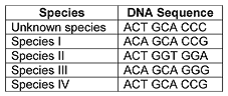

Populations consist of
a single species
multiple species
the biotic and abiotic factors of an environment
a grouping of ecosystems
A group of one species in one area that can interbreed
Multiple species that live in one area and can interbreed
All of the living and nonliving things in an area
3 or less species in different areas unable to interbreed
If a population of lizards is isolated on an island, with no new immigrants over many years, any new genetic variations are most likely to come from
recessive alleles
natural selection
mutations
speciation
Only populations can evolve. Individuals cannot evolve.
True
False
Which of these is a condition that must be met for Hardy-Weinberg equilibrium?
extremely small population size
no natural selection
gene flow
nonrandom mating
What does p stand for?
dominant allele
recessive allele
homozygous dominant
homozygous recessive
heterozygous
If the frequency of dominant phenotype is 0.36, what is the frequency of the dominant allele?
0.2
0.48
0.6
0.8
Which of the following is the equation that you use for Hardy-Weinberg equilibrium?
p2 + 2pq + q2 = 1
p2 + q2 = 1
p3 + q3 = 1
p3 + 3pq + q3 = 1
In generation 1, the recessive allele has a frequency of 0.6 and in generation 40, the recessive phenotype has a frequency of 0.36. Is the population is Hardy-Weinberg?
No, the frequency changed from one generation to another.
Yes, the frequency changed from one generation to another
No, the frequency remained the same from one generation to another
Yes, the frequency remained the same from one generation to another
If the frequency of recessive allele is 0.2, what is the frequency of the homozygous recessive individuals?
0.04
0.16
0.4
0.8
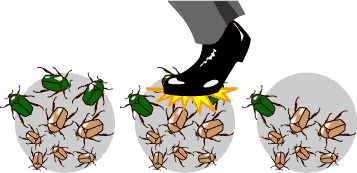
Someone steps on some bugs and randomly removes their alleles from the population. This is an example of
gene flow
genetic drift
speciation
allele frequency
Which is NOT an assumption of Hardy-Weinberg?
natural selection
large populations
no mutations
no migration
random mating
If all 5 Hardy-Weinberg assumptions are true, a population is said to be in genetic equilibrium. This means
it is evolving
it is not evolving
Select ALL of the following that violate the Hardy-Weinberg assumptions and would lead to a change in allele frequencies in a population.
natural selection
large population
no mutations
nonrandom mating
no migration
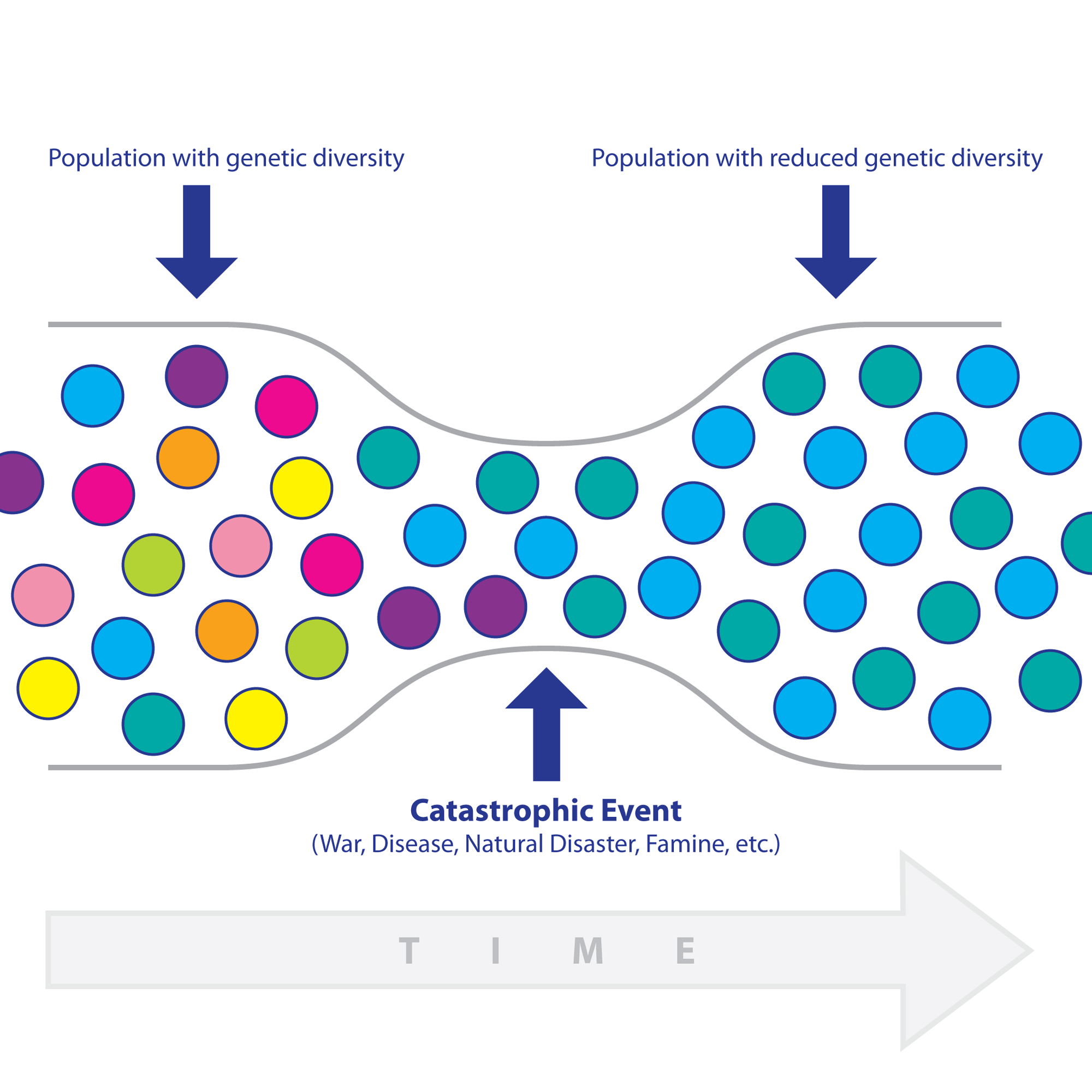
A drastic reduction in the size of a population that can change allele frequencies is called
the bottleneck effect
the founder effect
the gene flow effect
the Thanos effect
Source of new alleles in a population?
nondisjunction
natural selection
mutations and recombination
genetic drift
A type of genetic drift in which small groups of organisms separate from a larger population and form new small colonies.
Gene Flow
Founder Effect
Natural Selection
Artificial Selection

Stabilizing Selection
Directional Selection
Disruptive Selection

Stabilizing Selection
Directional Selection
Disruptive Selection

Directional Selection
Stabilizing Selection
Disruptive Selection

Which letter represents the most recent common ancestor of sponges and mushrooms?
A
B
C
D
E

Which organism goes in the B position?


Using the diagram, is organism 4 MORE closely related to organism 3 or 5?
3
5
All the different organisms in a population
A community of organisms.
Organisms of the same kind that can reproduce with one another and create fertile young.
Organisms of different kinds that can reproduce with one another.
SELECT ALL THAT APPLY: Which of the following must be true in order for organisms to be considered the same species?
They must be able to mate
They must be able to produce viable offspring
They must have structural similaries
They must have the same bone structure
behavioral isolation
temporal isolation
gametic isolation
geographic isolation
An insect lives on a goldenrod plant, while another lives on daisies. What time of isolation is exhibited?
habitat isolation
behavioral isolation
temporal isolation
mechanical isolation
gametic isolation
If one organisms breeds at night and another during the day, these species are exhibiting which of the following?
habitat isolation
behavioral isolation
temporal isolation
mechanical isolation
gametic isolation
Two flowers are able to reproduce successfully, but one plant has a long tube that required bumblebees to pollinate, while another has a wide tube that required honey bees. This type of isolation is known at what?
habitat isolation
behavioral isolation
temporal isolation
mechanical isolation
gametic isolation
Two species mate and produce offspring in the form of a zygote. The zygote is not able to grow into a formed embryo. This phenomenon is known as what?
reduced hybrid viability.
reduced hybrid fertility.
hybrid breakdown.
pre/postzygotic
Two species mate and produce vigorous offspring that are sterile. What is this phenomenon known as?
reduced hybrid viability.
reduced hybrid fertility.
hybrid breakdown.
pre/postzygotic
A generation of donkeys mate and produces vigorous, fertile offspring. These offspring, however, when bred with each other, do not produce fertile offspring.
reduced hybrid viability.
reduced hybrid fertility.
hybrid breakdown.
pre/postzygotic
Frequently, a group of related species will each have a unique courtship ritual that must be performed correctly for both partners to be willing to mate. Such a ritual constitutes a ________ and ________ reproductive barrier.
mechanical; postzygotic
gametic; postzygotic
temporal; prezygotic
behavioral; prezygotic
A speciation in which new species evolve from a single ancestral species while inhabiting the SAME geographic region.
Sympatric speciation
Allopatric speciation
Complex speciation
Divergent speciation
The emergence of a mountain range is an event that would lead to _______________ speciation
Allopatric
Sympatric
Temporal
Behavioral
Orcas occur in the same habitat but some are avoiding each other and do not interbreed. They have different diets, vocal behavior, and social structures. What type of speciation is this?
Allopatric
Sympatric
Complex
Covergent

Process in which organisms diversify rapidly into a multitude of new forms, particularly when a change in the environment makes new resources available, creates new challenges, or opens new environmental niches
Adaptive Radiation
Geographical Isolation
Diversification through domination
Recessive Isolation

Evolution occurring gradually and slowly over long periods of time
Homeostasis
Stasis
Punctuated Equilibrium
Gradualism
Hummingbirds have a beak just the right length to reach the nectar in a cardinal flower and as they feed their foreheads bump into the pollen structure. Cardinal flowers are red which hummingbirds can see but bees can’t. Cardinal flower’s pollen structure is just the right length for the hummingbird to pick up pollen as it feeds
Convergent
Divergent
Coevolution
In the ocean surrounding Antarctica, there are fish that survive the cold water by using a molecule made of glycoproteins that circulates the blood and keeps it from freezing. Certain kinds of worms that live in the Arctic ocean also make antifreeze proteins that help them live in icy water.
Convergent Evolution
Divergent Evolution
Coevolution
The Galápagos tortoises share a common ancestor, but have necks of different lengths to best reach the food they need in their environment.
Convergent
Divergent
Coevolution


What do you call the traits shown on phylogenetic trees, such as "four limbs" or "vertebrae"?
Derived characteristics
Speedy Lambofeeties
Branching elements
Harmonious changes
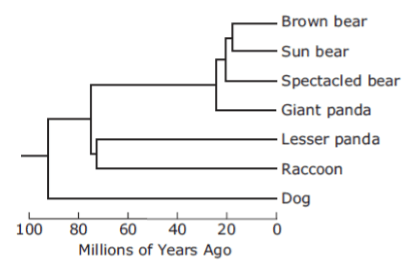
Who is the closest relative to the brown bear?
Giant panda
Dog
Lesser panda
Sun bear

What do amphibians, birds, prosimians and humans all have in common? Check all that apply.
Hair
Endothermic
Eukaryotic
Tetrapod
Vertebrate

