Wayground logo

Free Printable Worksheets

Font size

S
M
L
XL
Worksheets

Review- Circuits and Ohm's Law

Total questions: 34

Worksheet time: 38mins

Name
Class
Date
1.
What is current measured in?
a)
Ω (Ohms)
b)
V (Volts)
c)
A (Amps)
d)
W (Watts)
2.
What is resistance measured in?
a)
Ω (Ohms)
b)
V (Volts)
c)
A (Amps)
d)
W (Watts)
3.
What is Resistance?
a)
The flow of electrons
b)
Electric potential difference
c)
A battery
d)
The ability to reduce the flow of electrons
4.
Electricity that flows in a closed path is called a
a)
path
b)
current
c)
circuit
d)
light
5.

Voltage divided by Resistance

(V / R)

a)

Current

b)

Power

c)

Ohms

d)

Watts

6.
Current times Resistance equals
 (I X R)
a)
Power
b)
Voltage
c)
Amperage
d)
Ohm
7.

Voltage divided by Current

(V / I)

a)

Current

b)

Power

c)

Resistance

d)

Watts

8.
If the Voltage is increased and the resistance stays the same, Current will
a)
Increase
b)
Decrease
c)
Stay the same
d)
X
9.
If the Voltage stays the same and Resistance is increased, Current will 
a)
Increase
b)
Decrease
c)
Stay the same
d)
X
10.
What size resistor would produce a 3 Amp current flow with a 12 Volt battery
a)
1 Ohm
b)
3 Ohms
c)
4 Ohms
d)
12 Ohms
11.
How many Volts would it take to push 1 Amp through a resistance of 1 Ohm
a)
10 volts
b)
1 volt
c)
48 volts
d)
5 volts
12.
What size resistor would produce a 3 Amp current flow with a 12 Volt battery
a)
1 Ohm
b)
3 Ohms
c)
4 Ohms
d)
12 Ohms
13.
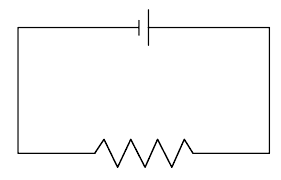
This circuit has a 24 volt battery and the resistor is 8 ohms. How many amps are running through the circuit?
a)
3 Amps
b)
192 Amps
c)
2 Amps
d)
4 Amps
14.

What is the name for the pressure that forces electrons to flow through a circuit?

a)

Voltage

b)

Capacitance

c)

Resistance

d)

Current

15.
What is the Voltage of a circuit that has a resistance of 5 Ω and a current of 2 A?
a)
25 V
b)
10 V
c)
2.5 V
d)
0.4 V
16.
What is this symbol?
a)
resistor
b)
switch
c)
battery
d)
bulb
17.
If you decreases the resistance of a circuit, what happens?
a)
Current decreases
b)
Current increases
c)
Electrons disappear
d)
Bulbs get brighter
18.
If you increase the voltage of a circuit, what happens?
a)
Current decreases
b)
Current increases
c)
Electrons disappear
d)
Bulbs get dimmer
19.

Where would you place a voltmeter (to measure voltage) in the circuit? -- Placing it at the red requires that the circuit is complete already, and placing it at the green completes the circuit using the meter --

a)

Green

b)

Red

20.

Where would you place a ammeter (to measure current) in the circuit? -- Placing it at the red requires that the circuit is complete already, and placing it at the green completes the circuit using the meter --

a)

Green

b)

Red

21.
This type of circuit only has one path for current to flow. 
a)
series
b)
parallel
c)
combination
d)
split
22.
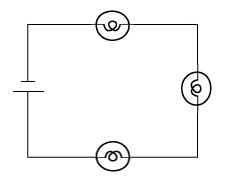
This is an example of a _______ circuit
a)
open
b)
series
c)
parallel
d)
square
23.
This is an example of a ______ circuit
a)
Series
b)
Parallel
c)
Open
d)
Dihexihedral
24.
What kind of circuit is this?
a)
Series
b)
Consecutive
c)
Parallel
d)
Training
25.
What kind of circuit is this?
a)
Series
b)
Consecutive
c)
Parallel
d)
Training
26.

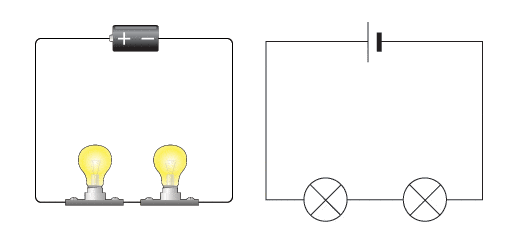
The picture shows an electrical circuit. This circuit is a series circuit because:

a)

It has 3 light bulbs.

b)

The same current flows through all three light bulbs.

c)

It uses a single battery.

d)

The electrical current is divided between the three light bulbs.

27.

What is one benefits of using a parallel circuit?

a)

It gets confusing.

b)

There are no problems.

c)

If one light goes out, it does not affect the others.

d)

If one light goes out, all the other lights go out too.

28.

What is one problem with using a series circuit?

a)

It has a lot of series.

b)

If one light goes down, they all go down!

c)

It doesn't work properly.

d)

If one light goes down, the others will stay on.

29.

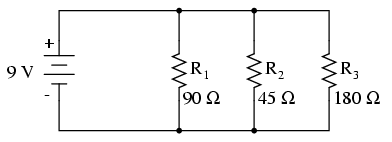
What is the total resistance of this circuit?

a)

100 Ω

b)

200 Ω

c)

0.063 Ω

d)

15.8 Ω

30.

What is the total resistance of this circuit?

a)

25 Ω

b)

75 Ω

c)

100 Ω

d)

18.75 Ω

31.

If you have two batteries, how can you set them up to maximize the voltage you get from them.

a)

in separate circuits

b)

in series

c)

in parallel

d)

it doesn't matter

32.

Which orientation of batteries below produces the most voltage?

a)

b)

c)

33.

What is the function of a capacitor?

a)

To capacitate

b)

To resist current

c)

To consume energy as heat

d)

To store energy as electric charge

34.

What is true about capacitors?

a)

capacitors store MORE energy than batteries

b)

capacitors release energy MORE QUICKLY than batteries

c)

capacitors do not require a voltage source to work

d)

capacitors store LESS energy than batteries