wayground logo

Free Printable Worksheets

NEW

Font size

S
M
L
XL
Worksheets

Chemical Reactions Exam Review

Total questions: 80

Worksheet time: 3hrs 42mins

Name
Class
Date
1.

What is the molar mass of table salt (NaCl)?

a)

116.88 g/mol

b)

35.45 g/mol

c)

22.99 g/mol

d)

58.44 g/mol

2.

What is the mass of one mole of aluminum?

a)

26.98 g

b)

13.49 g

c)

53.96 g

d)

14.00 g

3.

What is the molar mass of CO2?

a)

28.01 g/mol

b)

16.00 g/mol

c)

44.02 g/mol

d)

44.01 g/mol

4.

Calculate the molar mass of Ba(C2H3O2)2

a)

255.3 g/mol

b)

237.3 g/mol

c)

228.3 g/mol

d)

196.3 g/mol

5.

Calculate the molar mass for Al(OH)3

a)

78.0 g/mol

b)

72 g/mol

c)

28 g/mol

d)

25 g/mol

6.

Calculate the molar mass of NH4NO2

a)

50 g/mol

b)

60 g/mol

c)

64 g/mol

d)

78 g/mol

7.
What is the molar mass of AuCl3?
a)
96 g
b)
130 g
c)
232.5 g
d)
303.3 g
8.

What is the molar mass of Cl2?

a)

17 g/mol

b)

35 g/mol

c)

70 g/mol

d)

89 g/mol

9.

Calculate the molar mass of KOH.

a)

28 g/mol

b)

56 g/mol

c)

84 g/mol

d)

112 g/mol

10.

Calculate the molar mass of water (H2O).

a)

10 g/mol

b)

17 g/mol

c)

18 g/mol

d)

34 g/mol

11.

Calculate the molar mass of Cu2O.

a)

37 g/mol

b)

45 g/mol

c)

79.5 g/mol

d)

143 g/mol

12.

What is the molar mass of fluorine gas, F2?

a)

18.998 g/mol

b)

38 g/mol

c)

9 g/mol

d)

18 g/mol

13.
How many particles are in a mole?
a)
602
b)
602 million
c)
602 moles
d)
6.02 x 10²³
14.
Molar mass is in units of ________.
a)
grams
b)
grams/mole
c)
mole
d)
moles/gram
15.

Calculate the molar mass of NH4NO2

a)

50 g/mol

b)

60 g/mol

c)

64 g/mol

d)

78 g/mol

16.
Find the molar mass of Mg.
a)
12.21 g/mol
b)
24.31 g/mol
c)
25.01 g/mol
d)
13.01 g/mol
17.
Find the molar mass of C8H18.
a)
114.28 g/mol
b)
26.00 g/mol
c)
66.18 g/mol
d)
338.52 g/mol
18.
Find the molar mass of KCl
a)
36.00 g/mol
b)
78.00 g/mol
c)
74.55 g/mol
d)
178.01 g/mol
19.
What is the molar mass of sodium?
a)
11
b)
23
c)
45.98
d)
3
20.

What is the molar mass of fluorine gas, F2?

a)

18.998 g/mol

b)

38 g/mol

c)

9 g/mol

d)

18 g/mol

21.
What is the molar mass of NaOH?
a)
40 g/mol
b)
38.989 g/mol
c)
23.998 g/mol
d)
57.004 g/mol
22.

Calculate the molar mass of water (H2O).

a)

10 g/mol

b)

17 g/mol

c)

18 g/mol

d)

34 g/mol

23.

Calculate the molar mass for Al(OH)3

a)

78.0 g/mol

b)

72 g/mol

c)

28 g/mol

d)

25 g/mol

24.
The molar mass of an element is equal to its...
a)
Atomic mass
b)
Atomic number
c)
Oxidation number
d)
Valence electrons
25.
The mass of one mole of substance is called...
a)
molecular mass
b)
mole constant
c)
molar mass
d)
atomic weight
26.
What is the molar mass of sodium?
a)
11
b)
23
c)
45.98
d)
3
27.
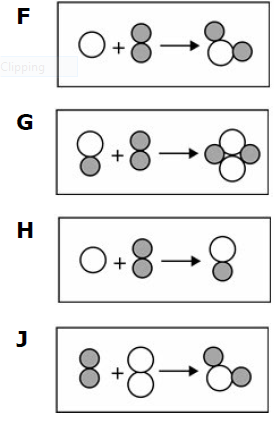
Which of the following models best demonstrates a balanced chemical equation?
a)
F
b)
G
c)
H
d)
J
28.
The reactants are on the left side of the chemical equation.
a)
True
b)
False
29.

How many atoms in all are in a molecule of serotonin?

C10H12N2O

a)
22
b)
24
c)
25
d)
4
30.
Is this balanced?
2HgO → 2Hg + O2
a)
Yes
b)
No
31.
Is this balanced?
Al + O2 → 2Al2O3
a)
Yes
b)
No
32.

Which type of chemical reaction has two or more reactants to make one product?

a)

combustion

b)

single displacement

c)

double displacement

d)

synthesis

e)

decomposition

33.

Identify the following chemical reaction.

2 NaBr + 1 Ca(OH)2 ----> 1 CaBr2 + 2 NaOH

a)

Synthesis (or combination)

b)

Decomposition

c)

Single displacement

d)

Double displacement

34.

Identify the following chemical reaction.

Pb + FeSO4 ----> PbSO4 + Fe

a)

Synthesis (or combination)

b)

Decomposition

c)

Single displacement

d)

Double displacement

35.

What reaction has the following general formula:

AB --> A + B

a)

Synthesis

b)

Decomposition

c)

Single Replacement

d)

Double Replacement

e)

Combustion

36.

What reaction has the following general formula:

A + CD --> C + AD

a)

Synthesis

b)

Decomposition

c)

Single Replacement

d)

Double Replacement

e)

Combustion

37.

What reaction has the following general formula:

AB + CD --> CB + AD

a)

Synthesis

b)

Decomposition

c)

Single Replacement

d)

Double Replacement

e)

Combustion

38.

What reaction has the following general formula:

A + B --> AB

a)

Synthesis

b)

Decomposition

c)

Single Replacement

d)

Double Replacement

e)

Combustion

39.

Which chemical reaction always starts with a hydrocarbon that reacts with oxygen and produces carbon dioxide and water?

a)

Decomposition

b)

Synthesis

c)

Combustion

d)

Single Replacement

40.
In a chemical reaction, everything to the right of the arrow is called ______________.
a)
Products
b)
Yields
c)
Molecules
d)
Reactants
41.
At the end of chemical reactions, what is the total mass of the reactants compared to the total mass of the products?
a)
the product is doubled
b)
the product is half the mass of the reactants
c)
the mass is the same
d)
the mass changes depending on the reaction
42.
What is the term for the → sign in a reaction?
a)
makes
b)
produces
c)
yields
d)
all are correct
43.
the starting materials in a chemical reaction
a)
Products
b)
Reactants
c)
Starters
d)
Enders
44.
a substance that is formed as the result of a chemical reaction
a)
Product 
b)
Reactant
c)
Starters
d)
Enders
45.
Mass cannot be ____ or _____.
a)
made, changed
b)
created, destroyed
c)
rearranged, unmade
d)
stagnant, unchanging
46.
This pictures simulates what type of reaction?
a)
Synthesis
b)
Decomposition
c)
Single Replacement
d)
Double Replacement
47.
___C3H8 +___O2 --> ___CO2 + ___H2O
a)
1,5,3,4
b)
2,10,6,8
c)
already balanced
d)
1,5,5,4
48.
__Al + __Fe3N2 -->__AlN + __Fe
a)
already balanced
b)
4,2,4,6
c)
2,1,2,3
d)
1,2,1,3
49.
__Na + __Cl2 --> __NaCl
a)
1,1,2
b)
2,1,2
c)
2,1,1
d)
already balanced
50.
__H2O2 --> __H2O + __O2
a)
already balanced
b)
2,1,1
c)
2,2,1
d)
2,1,2
51.
__C6H12O6 + __O2 --> __H2O + __CO2
a)
1,6,6,6
b)
already balanced
c)
1,6,1,6
d)
2,12,12,12
52.
__H2O + __CO2 --> __C7H8 + __O2
a)
4,7,1,9
b)
4,7,1,7
c)
2,3,1,3
d)
already balanced
53.
__NaClO--> __NaCl + __O2
a)
2,2,2
b)
2,2,3
c)
3,2,2
d)
1,2,3
54.
__BF3 + __Li2SO3 --> __B2(SO3)3 + __LiF
a)
2,3,1,3
b)
2,3,1,6
c)
4,4,2,12
d)
3,3,1,9
55.
Balance this reaction: ____ BaS + ____ PtF2 ---> ____ BaF2 + ____ PtS
a)
1,1,1,1
b)
1,2,1,1
c)
1,1,1,2
d)
2,1,1,1
56.

For the following chemical reaction, which substance is a reactant?

2HBr + Mg(OH)2  MgBr2 +2H2O2HBr\ +\ Mg\left(OH\right)_2\ →\ MgBr_2\ +2H_2O  

a)

MgBr2MgBr_2  

b)

BrBr  

c)

Mg

d)

HBr

57.

What type of reaction is the following reaction?

2Sr+O2  SrO2Sr+O_2\ \rightarrow\ SrO  

a)

Combination

b)

Decomposition

c)

Combustion

d)

Single-Replacement

58.

What type of reaction is the following reaction?

Li3PO4+3NaBrNa3PO4+3LiBrLi_3PO_4+3NaBr\rightarrow Na_3PO_4+3LiBr  

a)

Combination

b)

Decomposition

c)

Single-Replacement

d)

Double-Replacement

59.

What type of reaction is the following reaction?

2Al2O34Al+3O22Al_2O_3\rightarrow4Al+3O_2  

a)

Combination

b)

Decomposition

c)

Combustion

d)

Double-Replacement

60.

Is the following reaction balanced?

Ca+CuF2CaF2+CuCa+CuF_2\rightarrow CaF_2+Cu  

a)

Yes

b)

No

61.

What type of chemical reaction is this?

2C8H18+25O216CO2+18H2O2C_8H_{18}+25O_2\rightarrow16CO_2+18H_2O  

a)

Combination

b)

Combustion

c)

Single-Replacement

d)

Double-Replacement

62.

What number do I need to balance the following chemical equation?

2Al+6HCl3H2+2Al+6HCl\rightarrow3H_2+  _ AlCl3AlCl_3  

a)

1

b)

2

c)

4

d)

6

63.

How many Sodium atoms in the following compound?

Na3PO4Na_3PO_4  

a)

3

b)

4

c)

7

d)

12

64.

How many Phosphorus atoms in the following compound?

Na3PO4Na_3PO_4  

a)

3

b)

4

c)

1

d)

12

65.

What does the 2 in front of AlPO4AlPO_4   mean?

2AlPO4(aq)+3Mg(s)  2Al(s)+Mg3(PO4)2(aq)2AlPO_4\left(aq\right)+3Mg\left(s\right)\ \rightarrow\ 2Al\left(s\right)+Mg_3\left(PO_4\right)_2\left(aq\right)  

a)

The subscript, tells how many Al atoms I have

b)

The subscript, tells me how many AlPO4AlPO_4   molecules I have

c)

The coefficient, tells me how many Al atoms I have

d)

The coefficient, tells me how many AlPO4AlPO_4   molecules I have

66.

What is the mass of one mole of silver?

a)

32.06 g

b)

107.87 g

c)

14.01 g

d)

22.99 g

67.

48.86 g of cobalt is equal to how many moles of cobalt?

a)

2879 moles

b)

8.291 moles

c)

.8291 moles

d)

.829 moles

68.

How many molecules of water are in a 821.3 g sample?

a)

45.58 molecules

b)

8.232 x 1025 molecules

c)

8.909 x 1027 molecules

d)

2.744 x 1025 molecules

69.

How many moles of sodium chloride are in a 321.8 g sample?

a)

18810 moles

b)

3.315 x 1024 moles

c)

5.507 moles

d)

4.767 moles

70.
How many molecules of sugar (C6H12O6) are in a mole?
a)
24 molecules
b)
180 molecules
c)
180 g
d)
6.02 x 10²³ molecules
71.
How many moles are in 3.01 x 10²² atoms of magnesium?
a)
0.05 moles
b)
1.81 x 1046 moles
c)
5.00 x 10²¹ moles
d)
5 moles
72.
What is the mass of 0.89 mol of CaCl2?
a)
111 grams
b)
0.008 grams
c)
98.9 grams
d)
none of the choices
73.
How many moles are in 22 g of argon? 
a)
880 moles
b)
0.55 moles
c)
1.81 moles
d)
5 moles
74.

How many molecules of NaCl are in a mole?

a)

24 molecules

b)

180 molecules

c)

180 g

d)

6.02 x 10²³ molecules

75.
One of the signs of a chemical reaction taking place is:
a)
Bubbles are produced 
b)
Reactants are not combining
c)
Products are not forming
d)
Color is not changing
76.
A clear liquid from a flask is poured into another clear liquid in a beaker. Which of the following results of this procedure would indicate a new substance was formed?
a)
The level of the substance in the beaker is higher after the other liquid is added.
b)
A yellow solid forms and then settles to the bottom of the beaker.
c)
Small white crystals are left behind in the flask that held the first liquid.
d)
The mass of the combined liquids is greater than either original liquid.
77.
Which of the following is an example that includes evidence of a chemical reaction?
a)
A sample of zinc is placed in water and it settles to the bottom
b)
A solid block of ice is heated and it completely melts into a liquid. 
c)
Sugar that is burned gives off an odor and turns brown and then black.
d)
A tomato is placed into a blender and chopped up into smaller pieces.
78.
This is used to represent the number of each atom being represented. 
a)
An exponent
b)
The coefficient
c)
A molecule
d)
The subscript
79.
This appears on the left side of a chemical formula, and represents how many molecules there are. 
a)
An Atom
b)
The Subscript
c)
A Molecule
d)
The Coefficient
80.
Two clear colorless solutions were combined.
The student observed that the temperature changed from 25 •C to 23 •C when the solutions were combined and that a white substance rapidly formed and settled to the bottom of the container. What most likely happened to produce these results?

a)
One of the original compounds came out of solution
b)
The solutions reacted chemically
c)
Some of the water froze into ice crystals
d)
Rapid evaporation of water occurred, leaving a solid