
Font size
 Worksheets
Since review unit 7 and 8
Total questions: 82
Worksheet time: 41mins
Where are the synthetic elements located on the Periodic Table?
Toward the top
Toward the bottom
In the middle
How would you describe the state of matter of most elements on the Periodic Table?
Solid
Liquid
Gas
The "Father of the Periodic Table" arranged the elements by their properties. Which scientist is this?
Antonie van Leeuwenhoek
Dmitri Mendeleev
Albert Einstein
Metals are...
Shiny good conductors, dense
dull, poor conductors, brittle
Some shiny/dull, semiconductors, some dense/brittle
Metalloids are...
Dull, poor conductors, brittle
Some shiny/dull, semiconductors, some dense/brittle
shiny, good conductors, dense
Nonmetals are...
Dull, poor conductors, brittle
Shiny, good conductors, dense
Some dull/shiny, semiconductors, some dense/brittle
There are only two (2) liquids at room temperature on the Periodic Table. Which are they?
Mercury and Bromine
Chlorine and Bromine
Mercury and Chlorine
Metals are used for...
building, cookware and electric circuits
lasers, computer chips, and transistors
fertilizer, purifiers and fuel
Nonmetals are used for...
fertilizer, purifiers and fuel
lasers, computer chips and transistors
building, cookware and electric circuits
Metalloids are used for...
lasers, computer chips and transistors
fertilizers, computer chips and transistors
building, cookware, and electric circuits
Metals are...
Left of the zigzag line/staircase
Right of the zigzag line/staircase
On the zigzag line/staircase
Nonmetals are...
Right of the zigzag line/staircase
Left of the zigzag line/staircase
On the zigzag line/staircase
Metalloids are...
Left of the zigzag line/staircase
Right of the zigzag line/staircase
On the zigzag line/staircase
How would you describe a solid, nonmetal like Carbon?
Brittle, powder-like
Dense and highly conductive
Carbon is a gas, not a solid
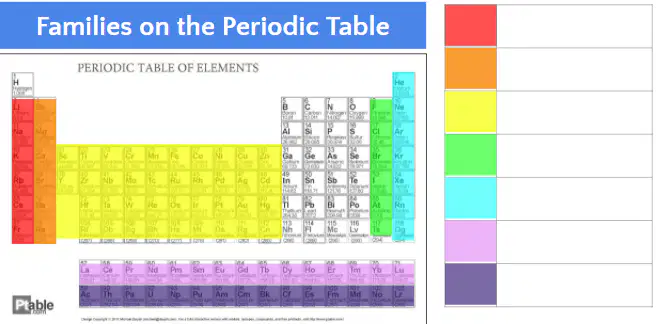
label families Red through Purple as 1-7
1Alkali Metals
2Alkali-Earth Metals
3Transition Metals
4Halogens
5Noble Gases
6Lanthanides
7Actinides
1Actinides
2lanthanides
3Nobel gases
4Halogens
5Transition metals
6Alkali-Earth metals
7Alkali metals
1Alkali-Earth metals
2Alkali metals
3Actinides
4lanthanides
5Nobel gases
6Halogens
7Transition metals
In what state of matter would you describe most nonmetals on the Periodic Table?
Solid
Liquid
Gas
Which type of element makes up most of the Periodic Table?
Metals
Metalloids
Nonmetals
Which of the following is true about groups on the Periodic Table?
Groups are also called families.
Elements in the same group have similar properties.
Elements in the same group have the same number of valence electrons.
All of the above.
Why are Noble Gases considered "inert" or "unreactive?"
They have full outer shells.
They have empty outer shells.
They have 6 valence electrons in their outer shells.
What about an atom determines its elements properties?
Number of protons
Number of neutrons
Number of valence electrons
Charge of the atom
Alkali Metals are...
Highly reactive in water
salt formers and disinfectants
Large group of metals that vary in reactivity
Alkali-Earth Metals are...
Moderately reactive in water
salt formers and disinfectants
Highly reactive in water
Transition Metals are...
A large group of metals that vary in reactivity
Moderately reactive metals
Inert metals
Halogens are...
Moderately reactive metals
Salt-formers and disinfectants
Highly reactive in water
Noble Gases are...
Inert (unreactive) gases
Moderately reactive gases
highly reactive in water

Phosphorus (P) would share properties with which element?
Nitrogen (N)
Silicon (Si)
Sulfur (S)
Oxygen (O)
What do all atoms in the same group share?
Number of protons
Number of valence electrons
Number of shells (size) of the atom
Alkali Metals (1) and Halogens (7) are...
Highly reactive
low reactivity
Moderate reactivity
Inert (unreative)
Alkali Earth Metals (2)Carbon Group (15)Oxygen Group (16) are...
Low reactivity
Moderate reactivity
Inert (unreactive)
High reactive
Transition Metals (3-12)Boron Group (13)Nitrogen Group (15) are...
Low reactivity
High reactive
Moderate reactive
Inert (unreactive)
Noble Gases (18)
Inert (unreactive)
moderately reactive
low reactivity
High reactive

Lithium (Li) would share properties with which element?
Beryllium (Be)
Sodium (Na)
Magnesium (Mg)
Which element is not part of any family?
Hydrogen (H)
Helium (He)
Lithium (Li)
Beryllium (Be)
How are most families arranged on the Periodic Table?
By the group they are in
By the period they are in
Why is an element considered part of a "family?"
It shares properties of the other elements in its period.
It shares properties of the other elements in its group.
What is true about Hydrogen and Helium?
They are the only elements in Period 1.
They are the only elements that only have 1 shell.
They are the only elements that only require 2 valence electrons to have full outer shells.
All of the above are true.
This element has been placed in the "wrong family" because it has the "right structure."
Hydrogen
Helium
This element has been placed in the "right family" even though it has the "wrong structure."
Helium
Hydrogen
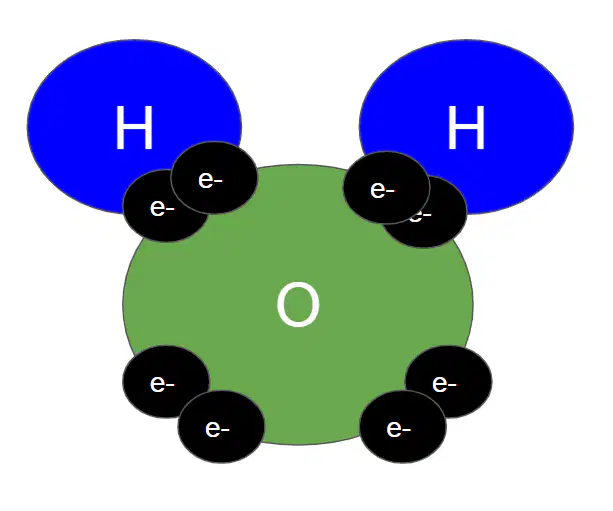
The following image is correct for H20
true
False
What is the Octet Rule?
Elements bond with other elements to have 2 valence electrons
Elements bond with other elements to have 8 valence electrons
Elements bond with other elements to have an equal number of valence electrons
Why do elements form compounds?
To fill their outer energy level
To empty their outer energy level
To match an atom of equal strength
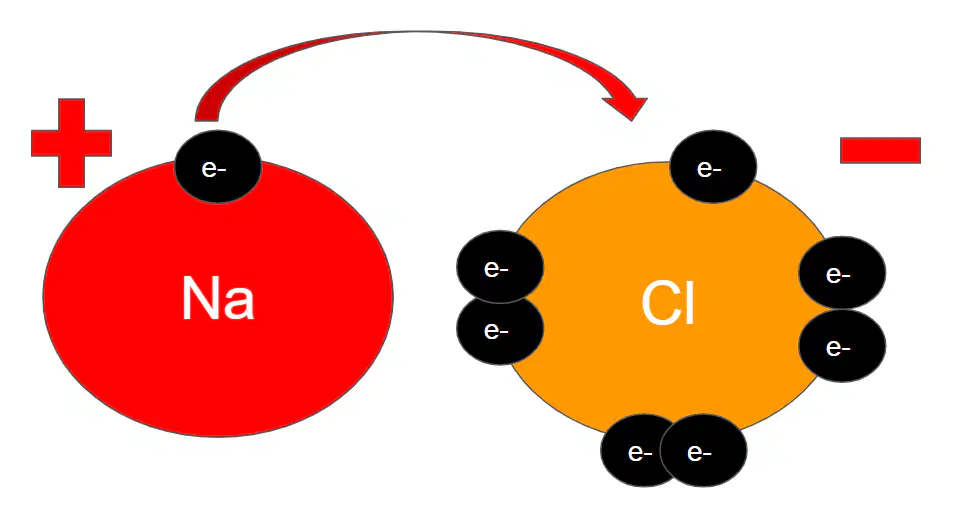
The following image is correct for H20
True
False
With which family are the Alkali Metals (Group 1) most likely to bond?
Alkali-Earth Metals (Group 2)
Halogens (Group 17)
Noble Gases (Group 18)
Which element(s) break the Octet Rule?
Both Hydrogen and Helium
Helium (He)
Hydrogen (H)
With which element would Hydrogen (H) most likely to bond?
Helium (He)
Lithium (Li)
Chlorine (Cl)
Ionic Bonds...
gain/lose electron and are between metals and nonmetals
share electrons and are between nonmetals
Covalent Bond are...
share electrons and are between nonmetals
share electrons between nonmetals and metals
Which of the following are pure substances?
Elements only
Elements and compounds
Elements, compounds, and mixtures
Which statement is true?
Responses
Any bonded set of atoms is a molecule.
Water (H2O) is an example of a molecule.
Water (H2O) is an example of a compound.
All of the above.
Salt is sodium chloride, which has the chemical formula NaCl.
Why isn't salt poisonous if it is made up of chlorine (Cl), which is a poisonous gas?
When elements bond to form compounds, their properties change.
When elements bond to form compounds, their properties disappear.
When elements bond to form compounds, their properties intensify (get stronger.)
The "element of life." is carbon
True
false
What is the most abundant element in the universe?
Hydrogen
Carbon
Silicon
The most abundant elements in Earth's crust is...
Oxygen and silicon
Hydrogen
Carbon
helium
The most abundant elements in Earth's oceans are Hydrogen, oxygen and chlorine
don't forget about sodium
What about silicon
Yup, that's all
The most abundant elements in Earth's atmosphere.
nitrogen and oxygen
helium
silicon
Which of the following is true?
All atoms have full outer shells with 2 valence electrons.
All atoms have full outer shells with 8 valence electrons.
Atoms have full outer shells with 8 valence electrons, except Hydrogen and Helium
When an atom loses its valence electrons, its outer energy level empties. It then disappears, and the full inner shell becomes the outer shell.
ionic bond
covalent bond
Valence electrons are shared between atoms so their energy levels are full.
Covalent bond
ionic bond
Why do elements form compounds?
To fill their outer shells
To share their outer shells
To empty their outer shells
A two in front of H20 represents
two molcules of H2O
Two Hs
What ions make up Na22O?
Na- Na- O+
Na+ Na+ O-
Na+ Na+ O2-
absorbs energy
Endothermic
Exothermic
releases energy
Exothermic
Endothermic
An instant cooling pack
Endothermic
exothermic
An instant heating pack
Exothermic
Endothermic
Endothermic is when heat is...
Absorb making the substance feel cool
Relased making the substance feel warm/hot
Exothermic
Heat is released making the substance feel hot/warm
Heat is absorb make the substance feel cool/cold
Does not form a new substance
Physical change
Chemical change
Does not undergo a chemical reaction
Physical Change
Chemicals change
Atoms do not rearrange
Physical Change
Chemical Change
Change of State
(Freezing, melting, etc...)
Physical Changes
Chemical Changes
Solubility
(Dissolving)
Physical Changes
Chemical Changes
Manipulation
(Bending, cutting, etc..)
Physical Change
Chemicals Change
Forms a new substance
Physical Change
Chemical Change
Undergoes a chemical reaction
Chemcial change
Physical change
Atoms rearrange
Chemical Change
Physical Change
Production of color, heat, light,
sound, or odor
Chemcial Change
Physical Change
Precipitate (solid) formation
Chemcial Change
Physical Change
Gas production
(Fizzing / bubbling)
Chemical Change
Physical Change
Compounds are two ___ elements combinding
of the same
different
Molecules are...
elements the same or different cominding
elements of the same combinding
diffrent elements combinding
What are the “Big Four” clues for a chemical change?
Temperature Change
Color Change
Participate (solid) production
Gas Production
All of the above

