wayground logo

Free Printable Worksheets

Font size

S
M
L
XL
Worksheets

5th Grade Vocabulary Review

Total questions: 100

Worksheet time: 57mins

Name
Class
Date
1.

A state of matter that does not have a definite shape or take up a definite amount of space. A ___ can expand to fill any available space in a container.

a)

liquid

b)

gas

c)

solid

d)

displacement

2.

A state of matter that does not have a definite shape but takes up a definite amount of space. A ____ fills the bottom of its container when at rest, and flows freely when poured.

a)

liquid

b)

powder

c)

solid

d)

gas

3.

A characteristic that helps to describe or identify an object, a material, or a state of matter. For example, a ______ of a liquid is that it can pour; a _______ of iron is that a magnet attracts it.

a)

gas

b)

procedure

c)

accurate

d)

property

4.

A state of matter that has a definite shape and takes up a definite amount of space. It keeps it shape when at rest, whether or not it is in a container.

a)

gas

b)

state

c)

solid

d)

volume

5.

A form, stage, or condition of something that can change. Solid, liquid, and gas are _____ of matter.

a)

observation

b)

states

c)

procedure

d)

liquid

6.

What you have discovered based on observations or other data. You should be able to support your ___________ with evidence.

a)

conclusion

b)

expand

c)

volume

d)

displacement

7.

A guess about what you think might happen during an experiment or investigation, based on what you already know

a)

weight

b)

expand

c)

prediction

d)

conclusion

8.

The measure of how heavy something is. It is often used as a measure of mass.

a)

weight

b)

air

c)

property

d)

solid

9.

The amount of space something occupies. A property of all matter.

a)

air

b)

expand

c)

volume

d)

property

10.

A mixture of gases that surround the earth.

a)

air

b)

volume

c)

weight

d)

gas

11.

The tendency of a material to dissolve in another material.

a)

expand

b)

soluble

c)

compress

d)

particle

12.

Energy resulting from the flow of electric charge through a conductor

a)

Light Energy

b)

Thermal Energy

c)

Electrical Energy

d)

Sound Energy

13.

What is needed to do work or cause change

a)

Energy

b)

Sound Energy

c)

Mechanical Energy

d)

Protein

14.

Energy that allows us to see

a)

Sound Energy

b)

Thermal Energy

c)

Mechanical Energy

d)

Light Energy

15.

energy of movement or position

a)

Thermal Energy

b)

Mechanical Energy

c)

Sound Energy

d)

Light Energy

16.

Energy that travels in waves through the air or water and vibrates the eardrum upon contact

a)

Sound Energy

b)

Thermal Energy

c)

Light Energy

d)

Mechanical Energy

17.

Energy that causes the transfer of heat between materials

a)

Mechanical Energy

b)

Light Energy

c)

Thermal Energy

d)

Sound Energy

18.

Energy at rest

a)

Potential Energy

b)

Kinetic Energy

c)

Light Energy

d)

Sound Energy

19.

Energy in motion

a)

Potential Energy

b)

Sound Energy

c)

Kinetic Energy

d)

Light Energy

20.

To Spread out evenly in a liquid

a)

soluble

b)

volume

c)

dissolve

d)

insulator

21.

A change in a substance without forming a new substance, such as changing size or state of matter

a)

physical property

b)

physical change

c)

physical state

d)

mixture

22.

A combination of 3 or more substances in which each keep their physical properties and can be separated easily.

a)

Mixture

b)

Solution

c)

Physical Property

d)

Dissovle

23.

Able to dissolve another substance

a)

Solvent

b)

Soluble

c)

Solute

d)

Volume

24.

Dissolves evenly into another sustance.

a)

mixture

b)

dissolve

c)

solute

d)

substance

25.

Anything that has mass and takes up space

a)

mass

b)

matter

c)

physical properties

d)

magnetism

26.

Material that allows electric currents or heat energy to flow through easily.

a)

matter

b)

insulator

c)

conductor

d)

volume

27.

A material that slows down or stops electric current or heat from flowing.

a)

insulator

b)

conductor

c)

mass

d)

magnetism

28.

A pushing or pulling force produced by a magnet

a)

volume

b)

magnetism

c)

mass

d)

force

29.

An amount of matter in something

a)

weight

b)

matter

c)

mass

d)

volume

30.

how dense something is compared to reference material

a)

volume

b)

relative density

c)

physical property

d)

mass

31.

A push or pull that causes an object to move, stop, or change directions.

a)

Friction

b)

Position

c)

Force

d)

Location

32.

A force that resists the motion of two surfaces sliding across one another.

a)

Force

b)

Push

c)

Location

d)

Friction

33.

The force that causes objects with mass to attract each other.

a)

Friction

b)

Gravity

c)

Force

d)

Location

34.

A change in position or location.

a)

Friction

b)

Force

c)

Movement

d)

Direction

35.
Rain, snow, sleet, or hail that falls from clouds in the sky.
a)
weather
b)
precipitation
c)
humidity
d)
climate
36.
How hot or cold something is.
a)
climate
b)
weather
c)
humidity
d)
temperature
37.
The entire body of saltwater that covers 71% of the Earth.
a)
Ocean
b)
Lake
c)
Pond
d)
River
38.
The constant movement of water through land, air, oceans and living things.
a)
Water Cycle
b)
Evaporation
c)
Condensation
d)
Rain Water
39.
Physical change in matter from a liquid to a gas.
a)
Evaporation
b)
Condensation
c)
Water Cycle
d)
Hail
40.
Physical change in matter from a gas to a liquid.
a)
Condensation
b)
Evaporation
c)
Water Cycle
d)
Ocean
41.
condensation
a)
water held underground in soil or rock.
b)
the process by which water changes from a gas to a liquid state.
c)
the gaseous state of water.
d)
thermal energy that drives the water cycle.
42.
What is the energy source for the water cycle?
a)
the sun
b)
the earth
c)
water
d)
the moon
43.
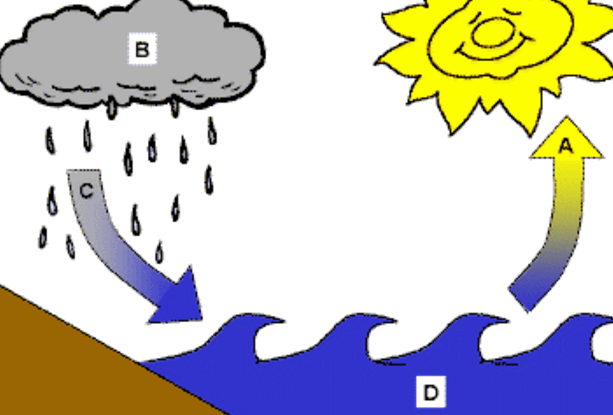
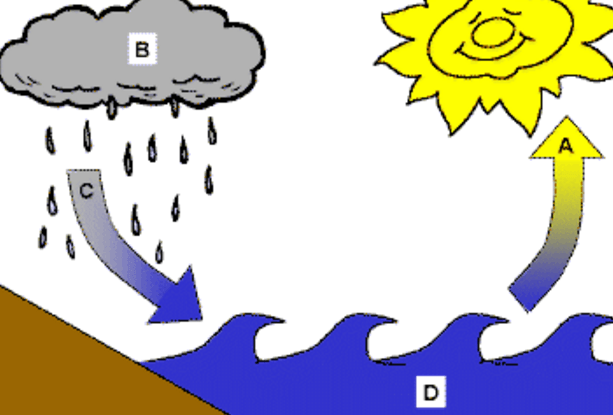
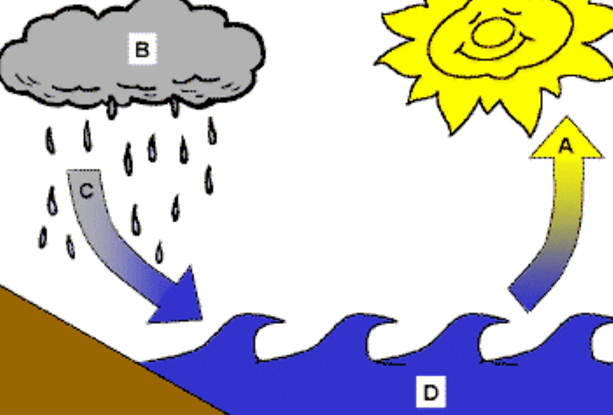
Letter A is representing what part of the water cycle? 
a)
Condenstation
b)
Evaporation
c)
Accumulation 
d)
Precipitation 
44.
Letter B is representing what part of the water cycle? 
a)
Condenstation
b)
Evaporation
c)
Accumulation 
d)
Precipitation 
45.
Letter C is representing what part of the water cycle? 
a)
Condenstation
b)
Evaporation
c)
Accumulation 
d)
Precipitation 
46.

The spinning of the Earth on its axis

a)

Rotation

b)

Revolution

c)

Seasons

d)

Axis

47.

An imaginary line that passes through Earth's center at its North and South poles

a)

Axis

b)

Pole

c)

Shadow

d)

Orbit

48.

How long it takes the Earth to rotate on its axis once

a)

365 Days

b)

One Year

c)

22 Hours

d)

24 Hours

49.

To travel in a closed path around an object such as the Earth does around the sun

a)

Orbit

b)

Revolution

c)

Axis

d)

Rotation

50.

The PATH one object takes as it revolves around another object in space

a)

Rotation

b)

Revolution

c)

Axis

d)

Orbit

51.
bowl-shaped indents or cavities on the surface of a planet, moon, or asteroid that are caused by a collision with another object, such as a meteorite.
a)
gravity
b)
orbit
c)
craters
d)
axis
52.
the star at the center of the Solar System that supplies heat and light to earth; its enormous gravity keep the Solar System in orbit.
a)
satellite
b)
sun
c)
craters
d)
moon
53.
a natural force that causes two objects to pull toward each other on their mass and the distance between them.
a)
gravity
b)
orbit
c)
atmosphere
d)
axis
54.
a natural satellite that orbits a planet. 
a)
sun
b)
atmosphere
c)
moon
d)
craters
55.
the whole mass of air surrounding the Earth.
a)
gravity
b)
atmosphere
c)
axis
d)
physical features
56.
to spin on an axis
a)
orbit
b)
rotate
c)
axis
d)
atmosphere
57.
All of the living and non-living things and all of their interactions in an area.
a)
ecosystem
b)
adaptation
c)
consumer
d)
living
58.
An organism that gets energy by eating other organisms.
a)
consumer
b)
producer
c)
herivore
d)
omnivore
59.
An animal that gets it's energy by only eating plants.
a)
herbivore
b)
omnivore
c)
decomposer
d)
carnivore
60.
An animal that gets it's energy by eating both plants and animals.
a)
omnivore
b)
hebivore
c)
decomposer
d)
carnivore
61.
An organism that consumes dead or nonliving biomass without need for internal digestion.
a)
decomposer
b)
symbiotic
c)
carnivore
d)
producer
62.
An animal that gets energy by only eating other animals.
a)
carnivore
b)
herbivore
c)
omnivore
d)
producer
63.

The path of food energy from one organism to another in an ecosystem.

a)

Food Chain

b)

Food Web

c)

Energy

d)

Nocturnal

64.

An animal that hunts and feeds on another organism.

a)

Energy

b)

Predator

c)

Nocturnal

d)

Herbivore

65.

A connection of food chains with many food enrgy paths in an ecosystem.

a)

Food Chain

b)

Food Web

c)

Predator

d)

Energy

66.

The living and nonliving things that are around an organism

a)

Change

b)

Impact

c)

Environment

d)

Population

67.

All living things that belong to the same group and live in the same area

a)

Environment

b)

Overpopulation

c)

Population

d)

Impact

68.

What is the process of plants taking in carbon dioxide and releasing oxygen called?

a)

Respiration

b)

Produce

c)

Photosynthesis

d)

Breathing

69.

A gas that is produced by plants during photosynthesis that animals use for respiration.

a)

Carbon dioxide

b)

Water vapor

c)

Oxygen

d)

Toots

70.

A gas produced by animals during respiration that plants use for photosynthesis.

a)

Oxygen

b)

Toots

c)

Carbon dioxide

d)

Water vapor

71.
When hungry, animals will stalk their _______ until the right moment to attack.
a)
adaptation
b)
hibernation
c)
camouflage
d)
prey
72.
The way an animal has evolved to survive in its ever changing habitat. 
a)
adaptation
b)
social interaction
c)
learned behavior
d)
hibernation
73.
Adaptations have allowed animals to thrive in all kinds of ______________.
a)
camouflage
b)
habitats
c)
prey
d)
trait
74.
A trait or characteristic that helps an organism survive in its environment is a/an ______________.
a)
dominant
b)
adaptation
c)
recessive
d)
gene
75.

What is niche?

a)

A hole in the ground

b)

The role or job an organism plays in the environment

c)

The seasonal movement of animals to another place

d)

A characteristic of carnivores

76.

What is weathering?

a)

When sediment is dropped in a new location

b)

A hill that is created by sediment being deposited in a specific area

c)

The breaking down of rock, soil, and mineral because of wind, water, and ice

d)

A land form that is created when sediment is deposited at the point where a river meets the ocean

77.

What is erosion?

a)

The movement of sediments due to moving wind, water, or ice

b)

A landform that is a deep narrow valley that is created due to erosion from ice or water

c)

A hill that is created by sediments being deposited in specific area

d)

When sediment is dropped in a new location

78.

What is a canyon?

a)

The movement of sediment due to moving wind, water, or ice

b)

When sediment is dropped in a new location

c)

the breaking down of rocks, soil, and mineral in a due to gas, liquid, and solids

d)

A landform that is a deep, narrow valley that is created due to erosion form ice or water,

79.
a particle that is the smallest and most basic part of an element
a)
atom
b)
molecule
c)
compound
d)
gas
80.
a change in traits - such as color, size, and shape - that does not change what the substance is made of
a)
physical change
b)
conservation of matter
c)
atomic theory
d)
effect
81.
the process where one or more kinds of matter changes into one or more different kinds of matter
a)
chemical change
b)
physical change
c)
greenhouse effect
d)
conservation of matter
82.
the scientific law that matter cannot be made or destroyed, only transferred and changed
a)
conservation of matter
b)
chemical change
c)
physical change
d)
greenhouse effect
83.
a substance where different materials are put together but keeps its own properties
a)
mixture
b)
solution
c)
molecule
d)
solid
84.
a mixture where the substances are evenly spread out and do not settle to the bottom of the container
a)
solution
b)
mixture
c)
solid
d)
molecule
85.
the layer of gases surrounding the Earth
a)
atmosphere
b)
hydrosphere
c)
lithosphere
d)
biosphere
86.
a pattern of rising and falling movement in the ocean caused by gravity
a)
tides
b)
water cycle
c)
circulation
d)
revolution
87.
a material supplied by nature that is used by humans and other organisms
a)
natural resource
b)
nonrenewable resource
c)
renewable resource
d)
pollution
88.
a substance that there is a limited amount of or is used up faster than it is made
a)
nonrenewable resource
b)
natural resource
c)
renewable resource
d)
pollution
89.
material made by nature at least as quickly as people use it
a)
renewable resource
b)
nonrenewable resource
c)
natural resource
d)
pollution
90.
energy produced by moving water
a)
hydroelectric energy
b)
natural gas
c)
salinity
d)
chlorophyll
91.
a material in air, water, or land that can cause harm
a)
pollution
b)
rock
c)
mineral
d)
natural gas
92.
the protection and care of forests, rivers, and other natural resources
a)
conservation
b)
pollution
c)
natural gas
d)
photosynthesis
93.
a giant ball of hot, glowing gases
a)
star
b)
moon
c)
asteroid
d)
comet
94.
the planets, asteroids, and comets that orbit the sun, as well as the planets' moons
a)
solar system
b)
inner planets
c)
outer planet
d)
orbit
95.
living parts of an ecosystem
a)
biotic
b)
abiotic
c)
stable
d)
efficient
96.
nonliving parts of an ecosystem
a)
abiotic
b)
biotic
c)
stable
d)
efficient
97.
the way living things and nonliving things in an area interact
a)
ecosystem
b)
community
c)
food chain
d)
competition
98.
the green substance in plant cells that absorbs light energy and helps the plant perform photosynthesis
a)
chlorophyll
b)
microbe
c)
mineral
d)
rock
99.
the process that plants use to make glucose using carbon dioxide, light, and water and producing oxygen
a)
photosynthesis
b)
cycle
c)
physical change
d)
metabolism
100.
imaginary pictures formed by stars that are used to help identify stars
a)
constellation
b)
orbit
c)
shadow
d)
pattern