wayground logo

Free Printable Worksheets

NEW

Font size

S
M
L
XL
Worksheets

Atmosphere Test Review!!

Total questions: 74

Worksheet time: 2hrs 34mins

Name
Class
Date
1.

This process produces CO2

a)

respiration

b)

burning fuel

c)

driving cars

d)

All of these

2.

Which natural process removes carbon dioxide from the atmosphere?

a)

forest fires

b)

volcanic eruptions

c)

cellular respiration

d)

photosynthesis

3.
Temperature in the stratosphere warms as altitude increases.
a)
True
b)
False
4.
The air in the troposphere has a greater density than the air in any other layer of the atmosphere,
a)
True
b)
False
5.
In which layer of the atmosphere does weather occur?
a)
Mesosphere
b)
Thermosphere
c)
Stratosphere
d)
Troposphere
6.
Which gas in our atmosphere is most abundant?
a)
Argon
b)
Oxygen
c)
Nitrogen
d)
Carbon Dioxide
7.
What is the percentage of oxygen in Earth's atmosphere?
a)
1%
b)
21%
c)
78%
d)
90%
8.
What is the percentage of nitrogen in Earth's atmosphere?
a)
1%
b)
21%
c)
78%
d)
90%
9.
What is the outer most main layer of Earth's atmosphere?
a)
Thermosphere
b)
Troposphere
c)
Stratosphere
d)
Mesosphere
10.
The layers of the atmosphere are classified according to changes in _________.
a)
altitude
b)
density
c)
composition
d)
temperature
11.
James plans to climb to the top of Mount Everest.  Which of the following statements about his climb will be the most accurate?
a)
Air pressure will rise and the temperature on a thermometer will increase.
b)
Air pressure will fall and the temperature on a thermometer will decrease.
c)
Air pressure will rise and the temperature on a thermometer will decrease.
d)
Air pressure and thermometer will not change.
12.
Which of the following is NOT a reason why the atmosphere is important?
a)
It is made of many layers.
b)
It provides gases living things need.
c)
It provides warm temperatures.
d)
It protects us from UV rays and meteors.
13.
Which of the following is the correct order of the atmosphere layers from Earth to space?
a)
troposphere, stratosphere, mesosphere, thermosphere, exosphere
b)
troposphere, mesosphere, thermosphere, exosphere, stratosphere
c)
thermosphere, stratosphere, mesosphere, troposphere, exosphere
d)
troposphere, stratosphere, mesosphere, exosphere, thermosphere
14.
Which layer is the coldest?
a)
Troposphere
b)
Stratosphere
c)
Mesosphere
d)
Thermosphere
15.
Water vapor is a greenhouse gas
a)
True
b)
False
16.
The ozone layer occurs in the 
a)
troposphere
b)
thermosphere
c)
stratosphere
d)
exosphere
17.
If the ozone layer were to be completely destroyed life on Earth would
a)
grow larger
b)
get smaller
c)
die from too much solar radiation
d)
stay the same
18.
As altitude increases, the air pressure 
a)
decreases
b)
stays the same
c)
increases
d)
all of the above
19.

Temperature increases with height in the ______ due to solar radiation.

a)

troposphere

b)

stratosphere

c)

mesosphere

d)

thermosphere

20.

Which type of cloud is this?

a)

cirrus

b)

stratus

c)

cumulus

21.

Which type of cloud is this?

a)

cirrus

b)

stratus

c)

cumulus

22.

Which type of cloud is this?

a)

cirrus

b)

stratus

c)

cumulus

23.

The rotation of the Earth causes winds to bend due to the...

a)

coriolis effect

b)

doldrums

c)

trade winds

d)

westerlies

24.

what is the main cause of the coriolis effect?

a)

earth’s rotation

b)

trade winds

c)

the sun and ocean

d)

temperature

25.
In which direction do prevailing westerlies flow?
a)
from east to west
b)
from west to east
c)
from north to south
d)
from south to north
26.
Which global winds have the greatest impact on the weather in the US?
a)
trade winds
b)
prevailing westerlies
c)
doldrums
d)
polar easterlies
27.
I am a fast-moving ribbon of AIR that moves from west to east in the Northern Hemisphere around the Earth.
a)
California Current
b)
Gulf Stream
c)
Jet Stream
d)
Atlantic Ocean
28.
What type of winds blow constantly, predictably, and over long distances?
a)
land breezes
b)
mountain breezes
c)
global winds
d)
land breezes
29.

What is the initial source for global winds and convection in the atmosphere?

a)

heat from the Earth's core

b)

the rotation of the Earth

c)

Moon's gravity

d)

unequal heating of the Earth by the sun

30.

Winds occur because hot air rises and cool air sinks in a process called...

a)

conduction

b)

convection

c)

radiation

d)

magnetism

31.

What causes wind?

a)

Too much Taco Bell

b)

Differences in elevation

c)

The uneven heating of the Earth by the sun

d)

Ocean currents

32.
The black arrows on the picture represents the:
a)
Westerlies
b)
Trade winds
c)
Polar Easterlies
33.
The blue arrows on the picture represents the:
a)
Polar Jet Stream
b)
Subtropical Jet Stream
c)
Continental Jet Stream
34.
The red arrows represent the:
a)
Polar Easterlies
b)
Westerlies
c)
Trade winds
35.
The purple arrow represents the:
a)
Polar Easterlies
b)
Westerlies
c)
Trade winds
36.
Where ever warm air is rising, expect to see an area of ________ pressure.
a)
low
b)
high
c)
medium
37.
What are 2 Greenhouse gases?
a)
water vapor and carbon dioxide
b)
carbon dioxide and oxygen
c)
oxygen and nitrogen
38.
The picture shows the sun's heat being trapped by the Earth's atmosphere. This is known as the:
a)
Coriolis Effect
b)
Greenhouse Effect
c)
Precipitation Affect
39.

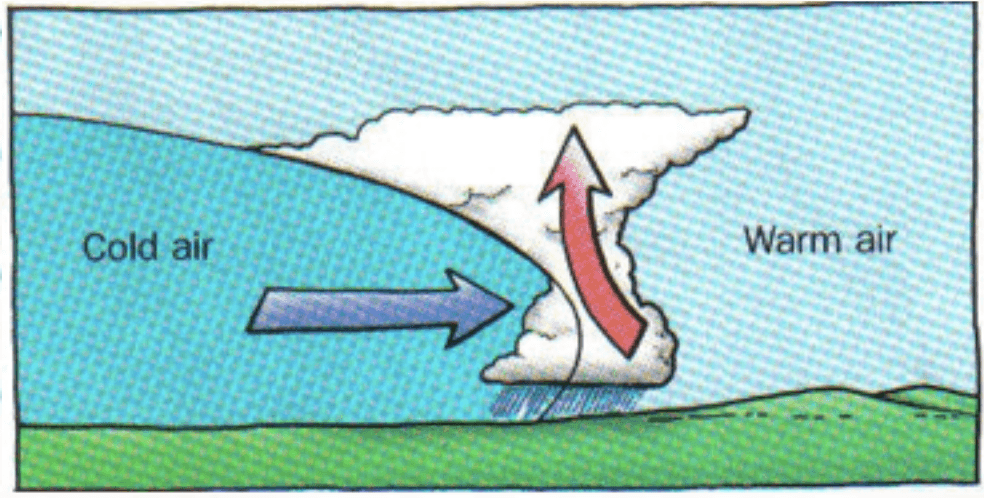
Name that front.

a)

Cold Front

b)

Warm Front

c)

Stationary Front

d)

Occluded Front

40.

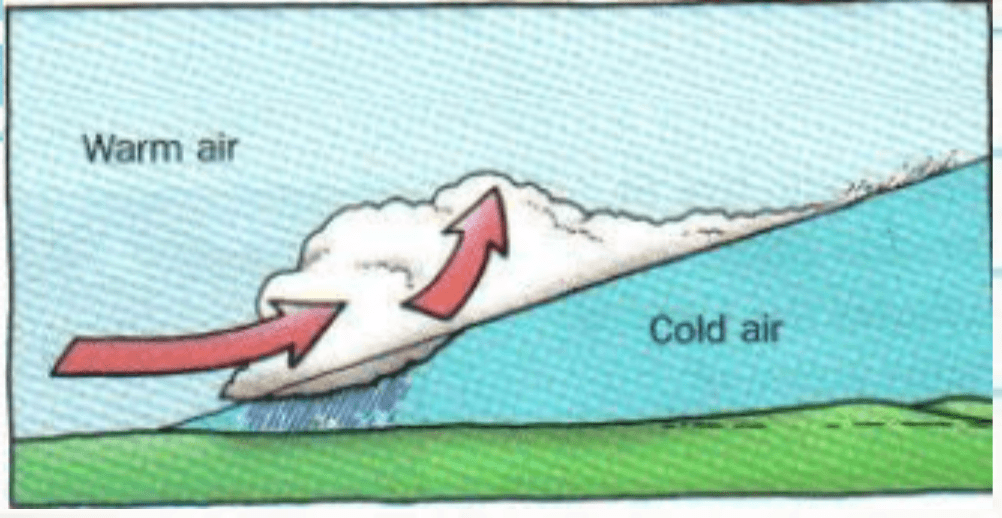
Name that front.

a)

Cold Front

b)

Warm Front

c)

Stationary Front

d)

Occluded Front

41.

Brings some clouds and gentle rains.

a)

Cold Front

b)

Warm Front

c)

Stationary Front

d)

Occluded Front

42.

Cold dense air slides underneath warm air. The warm air is forced up, cools, and condenses.

a)

Cold Front

b)

Warm Front

c)

Stationary Front

d)

Occluded Front

43.
A front is
a)
where warm air is cooling at earth's surface
b)
a line where hot and cold air are separating
c)
a line where two different air masses meet
d)
where cold air is rising and forming rain clouds
44.
If an air mass is rising, it must be
a)
cold and less dense
b)
cold and more dense
c)
warm and more dense
d)
warm and less dense
45.
This is the symbol for which type of front?
a)
cold front
b)
warm front
c)
stationary front
d)
occluded front
46.
This is the symbol for which type of front?
a)
cold front
b)
warm front
c)
occluded front
d)
stationary front
47.

What type of weather will you see along a cold front?

a)

Thunderstorms

b)

Sunny skies

c)

Gentle rain

d)

No weather

48.
What are the two main factors that determine the climate of an area?
a)
precipitation and humidity
b)
temperature and air pressure
c)
wind conditions and humidity
d)
temperature and precipitation
49.
Which sentence best describes the relationship between elevation and air temperatures?
a)
LOWER elevation = COLDER temperatures
b)
HIGHER elevation = COLDER temperatures
c)
HIGHER elevations = WARMER temperatures
50.
___________is the result of the weight of a column of air pushing on an area.
a)
air pressure
b)
density
c)
volume
d)
none of the above
51.
What is altitude?
a)
how much something weighs
b)
the distance above sea level
c)
how big something is
d)
how far away something is
52.
As you climb up a mountain what happens to the air pressure?
a)
decreases
b)
increases
c)
stays the same
53.
Cold air exerts _____________ pressure than warm air.
a)
the same
b)
more
c)
less
54.
Air pressure is greatest when near Earth's surface because?
a)
The air molecules are farther apart.
b)
The air molecules are closer together.
c)
Air molecules collide.
d)
Air molecules are tightly packed.
55.
More molecules close together, means density is:
a)
high
b)
low
56.
What happens to air pressure as you move upward into the atmosphere?
a)
increases
b)
decreases
c)
stays the same
57.

Cold air is ____________ than warm air and ___________.

a)

more dense; sinks

b)

less dense; rises

c)

more dense; rises

d)

less dense; sinks

58.
The ozone layer is damaged by
a)
CFCs
b)
Increase in greenhouse gases
c)
Increased global temperatures
d)
Sulfuric and nitric acids
59.
The ozone layer protects us from
a)
UV rays
b)
CFCs
c)
Increased atmospheric heat
d)
Decreased atmospheric heat
60.

How Ozone molecule is formed?

a)

3 Oxygen molecules interact with the UV rays from the Sun.

b)

Chlorine molecules interact with the UV rays from the Sun to form O3

c)

Oxygen and chlorine molecules produce a gas called Ozone

d)

None of them

61.

Meteors burn up in the

a)

Thermosphere

b)

Mesosphere

c)

Troposphere

d)

Stratosphere

62.

The aurora happens in this layer

a)

Troposphere

b)

Mesosphere

c)

Thermosphere

d)

Exosphere

63.

The boundary between the troposphere and the stratosphere is the ​ (a)   .

a)

tropopause

b)

mesopause

c)

stratopause

64.
Which is the correct order of the convection cells starting from the equator?
a)
polar, ferrell, hadley
b)
ferrell, hadley, polar
c)
polar, hadley, ferrell
d)
hadley, ferrell, polar
65.

Where is there the most heating?

a)

At the equator.

b)

At the North Pole.

c)

At the South Pole.

d)

In the oceans.

66.
what are isobars?
a)
lines connecting places of equal temperature
b)
lines drawn connecting places of equal pressure
c)
lines drawn to places of different temperatures
d)
lines drawn to places of different pressures
67.
This symbol represents
a)
a cold front
b)
an occluded front 
c)
a stationary front
d)
a warm front
68.

You would expect to see clouds forming and possible precipitation

a)

in Utah (the H)

b)

in Florida

c)

in Nebraska (between the H and the L)

d)

in Indiana

69.

Solutions for limiting global warming and climate change include...

a)

finding clean, renewable sources of energy.

b)

being more energy efficient.

c)

removing carbon from fossil fuel emissions.

d)

all of the above

70.

Under the Clean Air Act, what agency was charged with enforcing emission standards for new source of air pollution?

a)

National Oceanic and Atmospheric Administration

b)

U.S. Department of Justice

c)

Environmental Protection Agency

d)

U.S. Gelological Survey

71.

It is an international agreement to protect ozone layer by phasing out the use of ozone-depleting subtances. It is one of the most sucessful international environmental agreement.

a)

Paris Agreement

b)

CITES

c)

Kyoto Protocol

d)

Montreal Protocol

72.

The substanes addressed to phasing out the use in this agreement are chlorofluorocarbon (CFCs), hydrochlorofluorocarbons (HCFCs), and hydrofluorocarbons (HFCs).

a)

CITES

b)

Paris Agreement

c)

Montreal Protocol

d)

Kyoto Protocol

73.

Incentive type of agreement (Cap-and-trade), enacted in 1997.

a)

Kyoto Protocol

b)

CITES

c)

Paris Agreement

d)

Montreal Protocol

74.

The goal of this agreement is to slow global warming by reducing human-made greenhouse gas emission.

a)

CITES

b)

Kyoto Protocol

c)

Paris Agreement

d)

Montreal Protocol