
Font size
 Worksheets
Topics.4.&.5.TEST
Total questions: 62
Worksheet time: 32mins
What does every food chain and food web start with?
Producers
Sun
Consumers
Decomposers


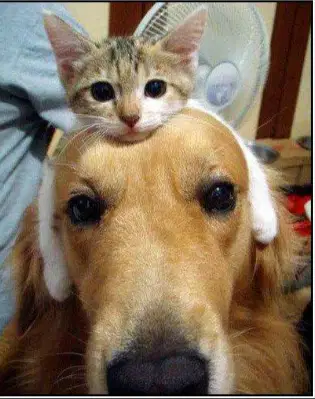
What is the term for the relationship between two organisms that live closely together?
Competition
Pioneers
Succession
Symbiosis

The area where an organism lives is considered its _______.
Habitat
Niche
Heterotroph
Biosphere


Plants are called ________, since they make their own food.
SELECT ALL THAT APPLY!
Consumers
Producers
Decomposers
Conductors
Autotrophs
How an organism gets its food, the type of food it eats, and what organisms eat it are all considered part of an organism's ______.
Habitat
Niche
Heterotroph
Biosphere
Honey guide birds alert and direct badgers to beehives. The badgers then expose the hives and feed on the honey first. Then, the honey guide birds eat as well. What type of symbiotic relationship is being described?
Predator-Prey
Parasitism
Mutualism
Commensalism
Tapeworms reside in human intestine and take nutrients from the human. What type of symbiotic relationship is being described?
Predator-Prey
Parasitism
Mutualism
Commensalism

Vines grow on a tree. The vines get light, but the tree is not affected. What kind of symbiotic relationship is being described?
Competition
Mutualism
Commensalism
Parasitism

An organism that helps to return and recycle nutrients within an ecosystem by breaking down dead or decaying organic matter is a:
Predator
Autotroph
Producer
Decomposer

The highest level consumer the fox in this food web would be considered is a:
Tertiary Consumer
Producer
Secondary Consumer
Primary Consumer
Quaternary Consumer

The populations of which organisms will most likely increase as a result of a disease that suddenly reduced the population of Texas horned lizards?
Grasses and ants
Ants and grasshoppers
Grasshoppers and Texas Cottonmouths
Texas cottonmouths and red shouldered hawks
The study of interactions between organisms and their environment
Niche
Community
Ecology
Ecosystem
Biosphere
Primary Succession
On land, succession that occurs where no soil previously existed is called _______.
Pioneer Species
The first species to populate the area are called _______.
Secondary Succession
______ occurs in areas where soil exists, but has been damaged or di
An organism that kills and eats another for food is known as a ______.
SELECT ALL THAT APPLY!
Predator
Prey
Parasite
Consumer
Heterotroph
Occurs when two or more organisms use the same resource...
Competition
Mutualism
Commensalism
Parasitism
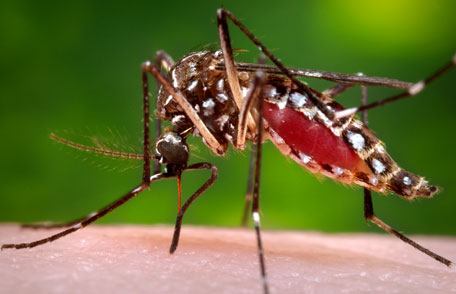
When a mosquito bites you, you are the (a) and the mosquito is the (b) .
Which organisms will compete for the Snowshoe Hare?
SELECT ALL THAT APPLY!
Red Tailed Hawk
Shrew
Red Fox
Insects
Lynx
Which organisms will compete for Insects?
SELECT ALL THAT APPLY!
Red Tailed Hawk
Shrew
Red Fox
Snowshoe Hare
Lynx
Match the following levels of classification to their definitions:
1 individual
Organism
All the same species
Population
All the different living things
Community
All the biotic and abiotic things
Ecosystem
Match the following levels of classification to the pictures:

Organism

Population

Community

Ecosystem
Carrying capacity is the (a) number of organisms that can survive in an area based on the available (b) , such as food and water.
Which type of succession occurs on freshly formed on barren land (no soil)?
Primary Succession
Secondary Succession
What do we call the first species that colonize a new area?
Foreign Species
Pioneer Species
Intraspecies
Interspecies
Which type of succession occurs after some kind of natural disaster wipes out most of the vegetation in a habitat?
Primary Succession
Secondary Succession
Where in the ecological pyramid is the greatest energy?
An ecological community in the final stage of primary or secondary succession. When all species are stable and not changing:
Pioneer species
Carrying capacity
Climax community
Limiting factor
The biosphere contain
all the ecosystems in the world
the remains of other living things
other organism
a million years
variety of live on Earth
Where in the ecological pyramid is the least biomass?
The change of an ecosystem over time, usually hundreds of years, until a stable stage is reached is called -
Competition
Carry Capacity
Succession
Parasitism
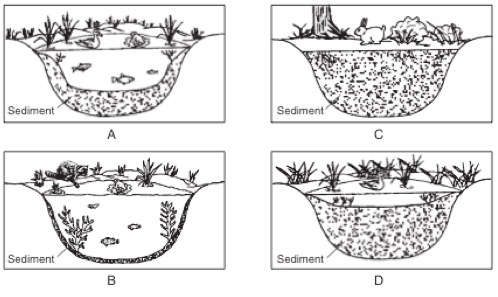
Each drawing represents different stages in community succession within the state of Virginia. Place the images in order to show primary succession?


Which choice best explains why the base of an ecological pyramid is largest?
There is less energy, but more biomass there
There is more energy and more biomass there
There is more energy, but less biomass there
There is less energy and less biomass there
Choose which levels of the ecological pyramid contain consumers.
Choose which levels of the ecological pyramid contains only carnivores or omnivores.
What do limiting factors do?
Separate biotic factors from abiotic factors.
Determine which is the predator and which is the prey.
Regulate how many organisms live in an ecosystem.
Determine which natural disasters will hit an area.
Limiting Factors can be which of the following?
Abiotic Only
Biotic Only
Abiotic and Biotic
What is the source of energy for the Water Cycle?
Ocean
Wind
Moon
Sun

Evaporation
A
Condensation
B
Precipitation
C
Occurs when the sun heats water up and it becomes vapor in the air.
Evaporation
The opposite of evaporation; it occurs when air cools and the water vapor changes into its liquid form.
Condensation
Water falling from the sky in the form of rain, sleet, hail, snow, and mist.
Precipitation
There is likely to be competition between which of the following types of organisms within a habitat?
A carnivore and a herbivore
A herbivore and a producer
A carnivore and a producer
Two carnivores
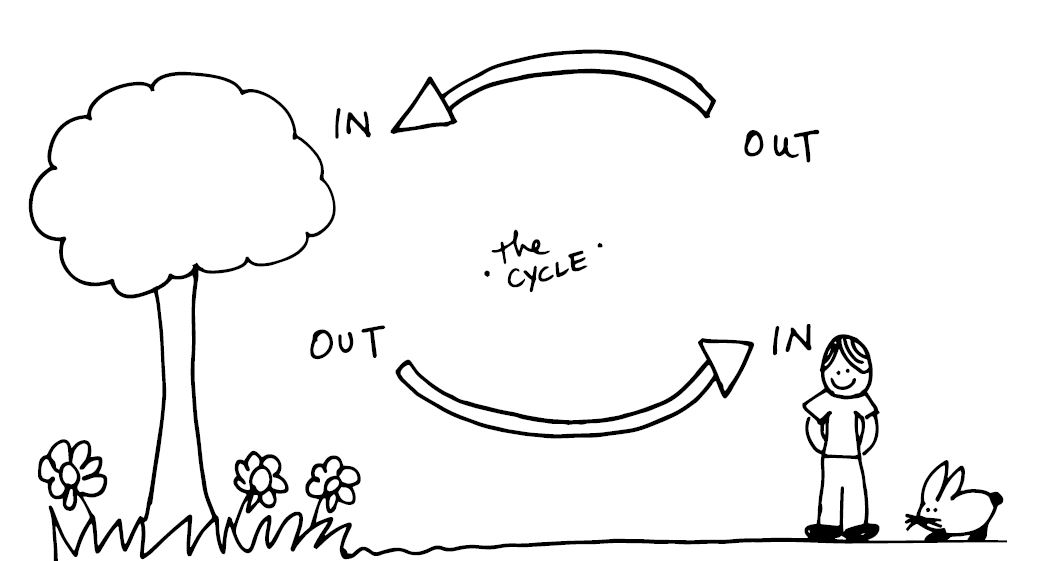
oxygen
sugar
salt
carbon dioxide
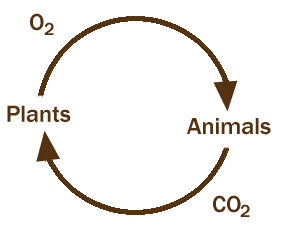
Animals and plants use substances that cycle through the environment. The plants take in (a) and release (b) into the environment for humans/animals to use. This process is known as (c) for the plants.
Humans burn fossil fuels and wood, releasing carbon dioxide into the atmosphere. This carbon dioxide is then absorbed by trees for photosynthesis. The movement of carbon between living things and the environment are a part of which cycle?
The carbon cycle
The water cycle
The nitrogen cycle
The phosphorous cycle
Match the classification to its definition.
Herbivore
Organism that eats only plants.
Carnivore
Organism that eats only meat.
Omnivore
Organism that eats plants and meat.
Which organisms conduct photosynthesis?
Primary Consumers
Herbivores
Tertiary Consumers
Top Predators
Producers

Pictured is a food web.
Which organism is an omnivore?
Deer
Berries
Black bear
Red Fox

Analyze the graph and describe the population over time of the lynx & the hare.
The hare population increases and the lynx population stays the same.
The lynx population increases and the hare population stays the same.
When the hare population increases, the lynx population increases and when the hare population decreases, so does the lynx.
The hare and lynx population stay the same over time.
The Canada Lynx relies heavily on the Snowshoe Hare as prey. As the population of lynx begins to increase, what happens to the population of hare?
The population of hare will increase.
The population of hare will stay the same.
The population of hare will decrease
The population of hare will move to another region.

