
Font size
 Worksheets
Waves
Total questions: 46
Worksheet time: 4hrs 50mins
The highest part of a transverse wave is
the crest
the trough
the wave point
the hotel transylvania
The lowest part of a transverse wave are the
crests
troughs
wave points
low nodules
The distance between two corresponding parts of a wave is its
amplitude
frequency
wavelength
velocity
The height of the wave from its resting point is called its
wavelength
amplitude
velocity
frequency
A wave that needs a medium to travel is called a(n)
electromagnetic wave
mechanical wave
ocean wave
any way can do this
A wave that can travel with or without a medium is called a(n)
electromagnetic wave
mechanical wave
surface wave
all waves can travel in any way
Longitudinal waves have:
crests and troughs
crests and compressions
compressions and rarefactions
troughs and rarefactions
Transverse waves have:
crests and troughs
troughs and rarefactions
compressions and contractions
rarefactions and crests
How often a wave occurs is the wave's
frequency
amplitude
wavelength
velocity
Transverse waves move mediums
at a right angle
in a circle
and matter too
at an acute angle
Longitudinal waves move:
at a right angle compared to the direction the wave is traveling
in a circle compared to the direction the wave is traveling
matter
in the same direction as the wave is traveling
Particles in water in an ocean wave move
in a square
in a right angle
in a circle
in a dodecahedron
True or False: Amplitude can increase or decrease wavelength
True, amplitude can increase or decrease wavelength
False, frequency can increase or decrease wavelength
False, crests can increase or decrease wavelength

What is the amplitude of this wave?
3
-3
6
4

What is the wavelength of this wave?
3
10
4
8
What happens to the frequency of a wave when the amplitude is tripled?
the frequency is tripled
the frequency is a third of what it was
amplitude does not affect frequency
What would happen to the wavelength if the frequency was doubled?
the wavelength would be halved
the wavelength would be doubled
the wavelength would stay the same
frequency does not affect wavelength
What would happen to the frequency is the wavelength was tripled?
the frequency would be a third of what it was
the frequency would be 3 times larger
the frequency would stay the same
the wavelength does not affect the frequency of a wave
What is the amplitude of this wave?
3
-3
6
4
What is the wavelength of this wave?
3
8
10
4

absorption
diffraction
reflection
refraction
transmission

absorption
diffraction
reflection
refraction
transmission
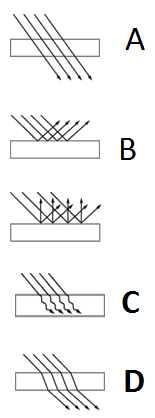


What is happening in this picture?
Reflection
Refraction
Diffraction


What is the definition reflection?
The bending of waves as they enter a new medium
Bouncing back of waves from a surface that it can’t pass through
The bending of waves as they pass through openings or around corners
When two interfering waves have a displacement in the same direction, two crests and two troughs overlap. Increased amplitude.
What is the definition of Refraction?
The bending of waves as they enter a new medium
When two interfering waves have a displacement in the opposite direction, crest and trough overlap. Zero amplitude.
When two interfering waves have a displacement in the same direction, two crests and two troughs overlap. Increased amplitude.
What is the definition of Diffraction?
The bending of waves as they enter a new medium
Bouncing back of waves from a surface that it can’t pass through
When two interfering waves have a displacement in the opposite direction, crest and trough overlap. Zero amplitude.
The bending of waves as they pass through openings or around corners


Reflection
seeing your image in a mirror
Refraction
seeing a rainbow after a rainshower
Diffraction
hearing sound from the hallway
Scattering
the reason the sky is blue
Transmission
light passing through the windows
Wave changes direction when moving from one medium to another
Refraction
Wave stays in the same medium but bends around an obstacle.
Diffraction
Wave encounters a barrier that causes the wave to return.
Reflection
Wave completely passes through a medium.
Transmission
Waves combine together to form a larger wave.
Interference

