wayground logo

Free Printable Worksheets

Font size

S
M
L
XL
Worksheets

Question Bank for Grade 8 Science

Total questions: 138

Worksheet time: 2hrs 11mins

Name
Class
Date
1.

Which of the following is an example of the formation of a mixture?

a)

Rust forming on an iron nail.

b)

Sugar crystals dissolving in water.

c)

Sodium and chlorine forming table salt.

d)

Hydrogen and oxygen reacting to produce oxygen.

2.

Which statement identifies why oxygen is classified as a pure substance and air is classified as a mixture?

a)

Oxygen is more reactive than air.

b)

Oxygen has a higher density than air.

c)

Oxygen goes under a phase change, whereas air is always a gas.

d)

Oxygen contains only one substance, but air contains several substances.

3.

Which of the following is an example of of a container filled with a pure substance rather than with a mixture?

a)

A tire filled with air.

b)

A jar filled with salt water.

c)

A balloon filled with helium.

d)

A glass filled with chocolate milk.

4.

When electricity passes through water, hydrogen and oxygen are produced. Which table correctly labels the compounds and elements involved in the process?

a)

Water-->Compound

Hydrogen-->Compound

Oxygen--->Element

b)

Water-->Compound

Hydrogen--->Element

Oxygen--->Compound

c)

Water--->Compound

Hydrogen--->Element

Oxygen--->Element

5.

Which changes MUST happen for elements to become a compound?

a)

elements are heated

b)

a gas becomes a liquid

c)

elements dissolve in water

d)

chemical bonds form between atoms.

6.

Water (H2O), is not found on the periodic table because water is a...

a)

atom

b)

liquid

c)

mixture

d)

compound

7.

Which of the following explains why saltwater is considered a mixture?

a)

It is composed of one element.

b)

It is composed of one compound.

c)

It is composed of two or more substances and has new chemical properties.

d)

It is composed of two or more substances and retains their own chemical properties.

8.

Oxygen and iron combine chemically to form rust. Rust is classified as which of the following?

a)

an atom.

b)

an element.

c)

a compound.

d)

a mixture.

9.

When the elements copper (Cu) and oxygen (O) chemically combine, they form...

a)

an ion

b)

a gas

c)

a compound

d)

a mixture

10.

This image is a model of...

a)

an element

b)

a compound

c)

a homogenous mixture

d)

a heterogeneous mixture

11.

Californium is an example of ________.

a)

an element

b)

a compound

c)

a homogenious mixture

d)

a heterogeneous mixture.

12.

This picture is a model of a...

a)

element

b)

compound

c)

homogeneous mixture

d)

heterogeneous mixture

13.

A glass of milk is an example of _____.

a)

an atom

b)

a molecule

c)

a homogeneous mixture

d)

a heterogeneous mixture

14.

The image below is an example of

a)

a homogeneous mixture

b)

a compound

c)

a heterogeneous mixture

d)

an element

15.
Contains only one kind of atom.
a)
Element
b)
Compund
c)
Mixture
16.
Contains two or more atoms combined
a)
Elements
b)
Compounds
c)
Mixtures
17.
The air is a _________. 
a)
element 
b)
mixture 
c)
compound 
d)
energy 
18.
Elements can be broken down into simpler substances. 
a)
false 
b)
true 
c)
sometimes 
19.
Examples are milk and gasoline.
a)
elements
b)
mixtures
c)
compounds
20.

Examples are diamonds (C) and Uranium (U)

a)

elements

b)

mixtures

c)

compounds

21.
Is sugar (C12H22O11) an element or a compound?
a)
Element
b)
Compound
22.
What is salad?
a)
element
b)
compound
c)
mixture
23.
Classify the picture with the correct label.
a)
Element
b)
Compound
c)
Mixture of Elements
d)
Mixture of Compounds
24.
Which of the following is an element?
a)
Sugar
b)
Salt
c)
Water
d)
Oxygen
25.
The building block of matter is
a)
Mixture
b)
Atom
c)
Element
d)
Substance
26.
A pure substance...
a)
is an element or a compound
b)
is an element or a mixture
c)
is a compound or a mixture
d)
is a mixture
27.
Water is an element
a)
true
b)
false
28.
This picture represents which of the following?
a)
element
b)
compound
c)
mixture
29.
compounds are chemically bounded together 
a)
False
b)
true
c)
I don't know?
30.
A combination of substances that are not chemically combined is called a(n)____________. 
a)
mixture
b)
compound
c)
physical
31.
Jello is an example of a...
a)
Element
b)
Compound
c)
Mixture
32.
Glucose (C6H12O6) is an example of a...
a)
Element
b)
Compound
c)
Mixture
33.
Classify the picture with the correct label.
a)
Element
b)
Compound
c)
Mixture of Elements and Compounds
d)
Mixture of Elements
34.
Classify the picture with the correct label.
a)
Compounds
b)
Mixture of Elements
c)
Mixture of Compounds
d)
Mixture of Elements & Compounds
35.
Classify the picture with the correct label.
a)
Element
b)
Compound
c)
Mixture of Compounds
d)
Mixture of Elements
36.
Classify the picture with the correct label.
a)
Mixture of Compounds
b)
Mixture of Elements
c)
Compound
d)
Mixture of Elements & Compounds
37.
Light, sound, heat, and motion are indicators that an object has _________.
a)
mass
b)
density
c)
energy
d)
volume
38.
When an arrow is shot from a bow, the energy that causes it to move comes from _________________.
a)
the length of the arrow
b)
the air molecules
c)
the bent bow
d)
the distance to the target
39.
Kinetic energy CANNOT be converted to potential energy.
a)
TRUE
b)
FALSE
40.
The amount of material affects the amount of energy that an object has.
a)
TRUE
b)
FALSE
41.
Which ball has the most potential energy?
a)
A ball held at 3 meters.
b)
A ball held at 2 meters.
c)
A ball held at 1 meter.
d)
A ball resting on the ground.
42.
Mass and height are _____ proportional to potential energy.
a)
directly
b)
indirectly
c)
exponentially
d)
not
43.
Which describes the graphed relationship between kinetic energy and an object's mass?
a)
Exponential
b)
Parabola
c)
Linear
d)
Indirect
44.
Which describes the graphed relationship between kinetic energy and an object's speed?
a)
Exponential
b)
Parabola
c)
Linear
d)
Indirect
45.
A roller coaster cart would have the greatest kinetic energy ___________________.
a)
at the top of the highest hill
b)
at the bottom of the highest hill
c)
as it makes a banked turn
d)
as it completes a loop
46.
If the speed of a roller coaster cart doubles, the kinetic energy ___________.
a)
stays the same
b)
doubles
c)
triples
d)
quadruples
47.
What do magnets stick to?
a)
copper
b)
wood
c)
iron
d)
plastic
48.
Magnetism is a type of ____________
a)
force
b)
book
c)
plant
d)
animal
49.

When two magnets attract, they ______________

a)

push apart (repel)

b)

change color

c)

get colder

d)

pull together (attract)

50.

When two magnets repel, they ________________

a)

change color

b)

pull together (attract)

c)

push apart (repel)

d)

get colder

51.

What is it called when you have an iron nail wrapped by a copper wire with electric current flowing through it?

a)

Electromagnet

b)

Magnet

c)

Refrigerator magnet

52.
The force of magnetism is stronger when magnets are ________________
a)
cold
b)
round
c)
closer together
d)
farther apart
53.
Which object would a magnet attract?
a)
a glass bottle
b)
a piece of paper
c)
a metal paper clip
compass
d)
a rubber eraser
magnetic field
54.
True or False: All metals are attracted to magnet.
a)
True
b)
False
55.
The space around a magnet where the force of a magnet can attract best is called__________
a)
magnetism
b)
bar magnet
c)
horseshoe magnet
d)
magnetic field
56.
The further two magnets are apart, the __________________ the force of magnetism.
a)
stronger
b)
weaker
c)
same
57.
True or False: A magnetic field is invisible.
a)
True
b)
False
58.
Which of these is attracted to a magnet?
a)
iron nail
b)
copper penny
c)
piece of paper
d)
notebook
59.
A magnet will pick up a nail, but not a penny because the nail
a)
has rust on it.
b)
is lighter than the penny.
c)
has a sharp point.
d)
contains iron.
60.

In an element box, the number at top is the

a)

atomic number

b)

atomic name

c)

atomic mass

d)

atomic symbol

61.

The number of neutrons in an atom can be found by

a)

adding the number of neutrons and protons together.

b)

adding the atomic mass and the atomic number.

c)

subtratcting the atomic number from the atomic mass.

d)

subtracting the atomic mass from the atomic number.

62.

If an element has an atomic number of 55 and has an atomic mass of 210. How many neutrons does this element have?

a)

210

b)

55

c)

155

d)

265

63.

___________________ are positively charged particles located in the nucleus of an atom.

a)

Electrons

b)

Neutrons

c)

Protons

d)

Isotopes

64.

The chemical symbol (Sn) is the symbol for which element?

a)

Selenium

b)

Sodium

c)

Tin

d)

Iron

65.

Elements on the Periodic Table are ordered according to their

a)

element name

b)

element symbol

c)

number of atoms

d)

atomic number

66.

Rows in the Periodic Table are called

a)

Periods

b)

Groups/Families

c)

Cousins

d)

Metals

67.

Column in the Periodic Table are called

a)

Periods

b)

Groups/Families

c)

Cousins

d)

Metals

68.

The elements that touch the zigzag line on the Periodic Table are called

a)

metals

b)

nonmetals

c)

metalloids

d)

gasses

69.

The nucleus of an atom is located in its

a)

electron cloud

b)

center

c)

proton

d)

backpack

70.

What do atoms of the same periodic group have in common?

a)

They have the same atomic number.

b)

They have the same chemical symbols.

c)

The have similar chemical properties.

d)

They have the same atomic mass.

71.

The smallest particle of an element that has the same chemical properties of the element is

a)

a molecule of that element.

b)

an atom of that element.

c)

a proton of that element.

d)

the nucleus of the element.

72.

What is the smallest unit that can still be classified as an element?

a)

Proton

b)

Neutron

c)

Electron

d)

Atom

73.

Protons have a ____________ charge, neutrons have a ____________ charge, and electrons have a ____________ charge.

a)

positive; negative, neutral

b)

positive, neutral, negative

c)

neutral, negative, positive

d)

negative, neutral, positive

74.

The chemical symbol in this element box is

a)

26

b)

Fe

c)

Iron

d)

55.845

75.

The atomic number tells us the number of

a)

protons and electrons

b)

protons plus electrons

c)

protons only

d)

protons plus neutrons

76.

Models are used to study atoms because atoms are very

a)

dangerous

b)

sneaky

c)

rare

d)

small

77.

The three kinds of elements are

a)

metals, nonmetals, and liquid metals

b)

metals, nonmetals, and metalloids

c)

metals, solids, and liquids

d)

metalloids, asteroids, and nonmetals

78.

The Periodic Table of elements have elements that are in which states of matter?

a)

solids and liquids

b)

solids only

c)

solids, liquids, gases, and plasma

d)

solids, liquids, and gases

79.

All matter is made of

a)

electrons

b)

protons

c)

neutrons

d)

atoms

80.
__________________ waves have some electrical properties and some magnetic properties.
a)
Electromagnetic
b)
Longitudinal
c)
Sound
d)
Compression
81.
Electromagnetic waves can transfer energy without a ______________.
a)
Compression
b)
Rarefaction
c)
Medium
d)
Amplitude
82.
Which of the following describes electromagnetic radiation?
a)
A subatomic particle that carries a negative charge.
b)
A subatomic particle that carries a positive charge.
c)
The energy that is transferred by electromagnetic waves.
d)
A dangerous phenomena that can cause cancer.
83.
___________ is a from of energy that we can see with our eyes.
a)
shadow
b)
light
c)
energy
d)
reflection 
84.
How does all light travel?
a)
in sources
b)
in waves
c)
in groups
d)
in gases
85.
Ultraviolet an infrared at two at two kinds of invisible light.
a)
True
b)
False
86.
Desk
a)
Transparent
b)
Opaque
87.
Plastic wrap
a)
Transparent
b)
Opaque
88.
The color you see is the color that is ___.
a)
reflected
b)
absorbed
89.
Smooth surfaces _______ a lot of light.
a)
reflect
b)
bend
c)
absorb
d)
twist
90.
an image made by light bouncing off a surface, such as a mirror or metal spoon
a)
refraction
b)
reflection
c)
absorbtion
d)
medium
91.
not allowing any light to pass through
a)
transparent
b)
opaque
c)
translucent
d)
clear
92.
allows all light to pass through
a)
transparent
b)
translucent
c)
opaque
93.
White light can be separated into different colors by using a__________. 
a)
microscope
b)
prism
c)
mirror
d)
convex lens
94.
What form of energy travels faster?  Light or Sound?
a)
light
b)
sound
95.
Light waves need matter to travel.
a)
True
b)
False
96.
Which of these colors of visible light has the shortest wavelength?
a)
green
b)
yellow
c)
red
d)
blue
97.
Which is not a name for a part of the electromagnetic spectrum?
a)
radio waves
b)
light waves
c)
sound waves
d)
x-rays
98.
What is a common everyday application for infrared waves?
a)
killing microorganisms
b)
killing cancer cells
c)
using a TV remote control
d)
looking for clues at a crime scene
99.
Which type of electromagnetic energy is used to do the following things?   ·  see images of the inside of the body for medical or dental purposes ·  scan luggage in airport security checks ·  to detect and see space objects such as stars, comets and black holes
a)
gamma rays
b)
ultraviolet rays
c)
infrared rays
d)
x-rays
100.
Which form of electromagnetic energy is so powerful that it can penetrate concrete and metal as well as being used to kill cancerous cells in the human body?
a)
ultraviolet rays
b)
gamma rays
c)
radio waves
d)
microwaves
101.
What type of electromagnetic energy is used in the tanning bed?
a)
gamma rays
b)
microwaves
c)
ultraviolet rays
d)
radio waves
102.
T or F
Light can travel through a vacuum, or empty space.
a)
False
b)
True
103.
What a the colors of light called that we can see?
a)
rays
b)
waves
c)
visible spectrum
d)
light
104.
What is the saying that can help you remember the order of the visible spectrum?
a)
ROYGBV
b)
RYOBVG
c)
ROBVIG
d)
RIBYOG
105.
What type of waves does light travel in?
a)
transverse
b)
compression
c)
high and low waves
d)
waves like the ocean
106.
What is this a picture of?
a)
reflection
b)
refraction
107.
What is this a picture of?
a)
reflection
b)
refraction
108.
T or F
White light is all the colors of the visible spectrum being absorbed.
a)
True
b)
False
109.
We see black because____________________.
a)
All of the colors of the visible spectrum are being reflected.
b)
All colors of the visible spectrum are being absorbed.
110.
Select the correct order of waves on the EMS 
a)
Radio, Micro, Infra, Visible, Ultra, X-ray, Gamma
b)
Gamma, X-ray, Ultra, Vis, Infra, Micro, Radio
c)
Vis, Micro, Infra, Ultra, X-ray, Gamma, Radio
d)
Micro, Radio, Vis, Infra, Ultra, X-ray, Gamma
111.
Which has the LONGEST wavelength and, therefore, the lowest frequency/energy
a)
Gamma Rays
b)
Radio Waves
c)
Visible Light
d)
Infrared rays
112.
Which has the SHORTEST wavelength and, therefore, the highest frequency/most energy
a)
Radio waves
b)
Ultraviolet Rays
c)
Gamma Rays
d)
X-rays
113.
Which section of the spectrum is the ONLY one we can see?
a)
X-rays
b)
Visible Light
c)
Gamma Rays
d)
Ultraviolet Rays
114.
How are electromagnetic waves different from other waves? 
a)
They have very short wavelengths 
b)
They transmit energy instead of matter 
c)
They can travel through a vacuum 
d)
They can change direction by reflection 
115.
Which of the following electromagnetic waves has the lowest energy?
a)
gamma ray
b)
infrared wave
c)
visible light wave
d)
microwave
116.
Which color has the least amount of energy?
a)
red
b)
orange
c)
green
d)
blue
117.
Which of the following has the longest wavelength?
a)
microwaves
b)
visible light
c)
x-rays
d)
infrared waves
118.
The distance between two crests or two troughs of a wave is called:
a)
frequency
b)
amplitud
c)
wavelength
d)
hertz
119.
The lowest part of the wave is?
a)
crest
b)
trough
c)
rarefaction
d)
wavelength
120.
The highest point on a wave
a)
trough
b)
amplitude
c)
crest
d)
wavelength
121.

The larger the amplitude, the less energy

a)

true

b)

false

122.
EM waves ________ a medium.
a)
require
b)
don't require
c)
can have
d)
sometimes have
123.
This type of EM wave shows a break in bones.
a)
gamma ray
b)
x-ray
c)
brokenometer
d)
radio wave
124.

________ is an EM wave used to cook Ms. Chafin's hot pocket.

a)

radio

b)

microwave

c)

visible light

d)

ultraviolet

125.
________ is an EM wave that has the LEAST energy.
a)
radio
b)
gamma rays
c)
microwaves
d)
visible light
126.

What are some USES of ultraviolet radiation the sun creates?

a)

Can kill bacteria

b)

Helps our skin produce vitamin D

c)

Some insects use it to find nectar

d)

All are correct uses

127.
ultraviolet, x-rays, gamma rays are dangerous due to their
a)
low frequency
b)
high frequency
c)
photons
d)
long wavelength
128.
A wave with a large wavelength will have a ______ frequency and _____ energy
a)
high, low
b)
high, high
c)
low, high
d)
low, low
129.
Which of the following has the longest wavelength?
a)
microwaves
b)
visible light
c)
x-rays
d)
infrared waves
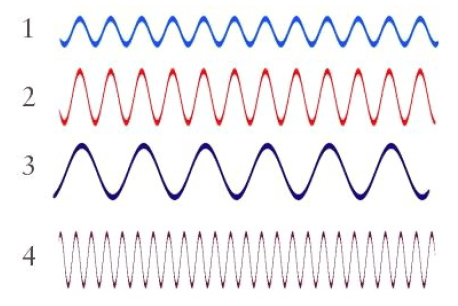
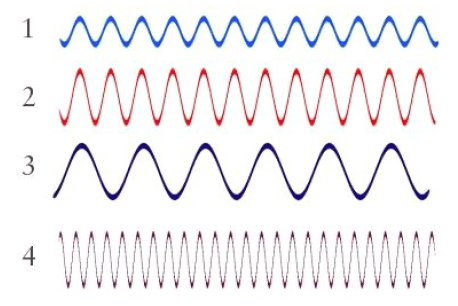
130.
Which wave in the diagram has the greatest frequency?
a)
1
b)
2
c)
3
d)
4
131.
Which wave in the diagram has the greatest wavelength?
a)
1
b)
2
c)
3
d)
4
132.
How fast do Electromagnetic waves travel?
a)
300,000,000m/s
b)
1m/s
c)
ROYGBIV/s
d)
60,000,000m/s
133.
What is visible light composed of?
a)
ROYGBIV
b)
White Light
c)
Rainbow
d)
Light that's visible
134.
What is the longest wavelength in the spectrum?
a)
Red
b)
Gamma Waves
c)
Radio waves
d)
X-Ray
135.
Which wave has the highest frequency?
a)
Radio Wave
b)
Sound Wave
c)
Gamma Wave
d)
The Moon
136.

What is the order of the colours in the spectrum?

a)

red orange yellow green indigo violet

b)

Violet indigo blue green yellow orange red

c)

Green yellow orange red violet indigo blue

d)

red orange yellow green blue indigo violet

137.
Visible spectrum is shown below. Which light has the highest energy?
a)
Red light
b)
Yellow light
c)
Green light
d)
Blue light
138.
The _______________ determines the color of visible light. 
a)
wavelength
b)
speed
c)
amplitude
d)
light