
 Worksheets
Inv #1-#8 Review
Total questions: 138
Worksheet time: 2hrs 40mins
Name
Class
Date
1.
Do sea breezes typically happen during the day or night?
a)
Day
b)
Night
2.
Do land breezes typically happen during the day or night?
a)
Day
b)
Night
3.
During a land breeze which way does the wind blow?
a)
from the sea to the land
b)
from the land to the sea
4.
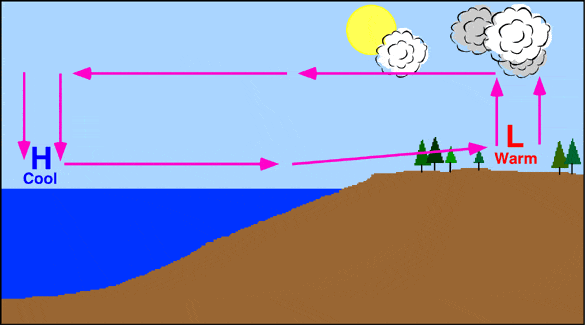
Is this a land or a sea breeze?
a)
land breeze
b)
sea breeze
5.
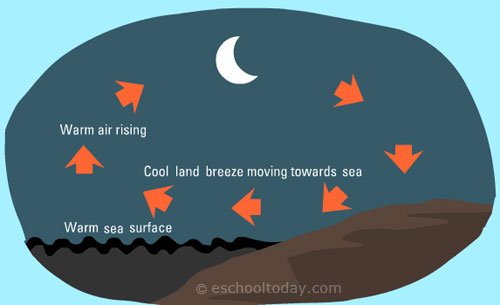
Is this a land or a sea breeze?
a)
land breeze
b)
sea breeze
6.
When warm air rises, ______ pressure forms at the surface of the land or sea.
a)
high
b)
some
c)
low
d)
none
7.
How does the air move in a land breeze?
a)
From east to west
b)
From west to east
c)
From the land to the ocean
d)
From the ocean to the land
8.
How does the air move in a sea breeze?
a)
wind moves from north to south
b)
wind moves from ocean to the land
c)
wind moves from the land to the ocean
d)
wind moves from south to north
9.
In a sea breeze, the air is warmer above the _____.
a)
land
b)
ocean
c)
sky
d)
beach
10.
Where does the initial source of energy come from that creates winds?
a)
the moon
b)
the sun
c)
the Earth's surface
d)
the rotation of the Earth
11.
Land and water absorb and release the sun’s heat in different ways. One result of this is a sea breeze. Which statement is true of sea breezes?
a)
They originate in the day and blow toward the land.
b)
They originate in the day and blow toward the water.
c)
They originate in the evening and blow toward the land.
d)
They originate in the evening and blow toward the water.
12.

Why does warm air rise?
a)
Warm air is more dense than cooler air.
b)
Warm air has more pressure than cooler air.
c)
Warm air is less dense than cooler air.
d)
Warm air has a higher dew point than cooler air.
13.
Why do land breezes occur at night?
a)
Land cools off slower than water, so the air above water is cooler.
b)
Water cools off faster than land, so the air above land is warmer.
c)
Land heats up slower than water, so the air stays cooler during the day.
d)
Water cools off slower than land, so the air above water is warmer.
14.

The air warms up how?
a)
The sun heats the air directly
b)
The sun heats the Earth's surface. The surface then heats the air above it
15.

Which cools off faster at night?
a)
Sea
b)
Land
16.
What causes wind to blow?
a)
Differences in longitude
b)
Shock waves from clouds
c)
Differences in air temperature and pressure
d)
The rotation of the earth
17.
Which term best describes how the earth's atmosphere is heated?
a)
Spirally
b)
Unevenly
c)
Circularly
d)
Kinetically
18.
A hurricane rotates _____.
a)
Clockwise
b)
Counterclockwise
19.
In order for a hurricane to form, the water must be ________.
a)
Cool
b)
Warm
c)
Cold
d)
Hot
20.

Which diagram shows the formation of a land breeze?
a)
diagram Y
b)
diagram X
c)
neither
d)
both
21.

Which diagram shows the formation of a sea breeze?
a)
diagram Y
b)
diagram X
c)
neither
d)
both
22.

What kind of breeze is this and when would it form?
a)
Land breeze - daytime
b)
Land breeze - nighttime
c)
Sea breeze - daytime
d)
Sea breeze - nighttime
23.
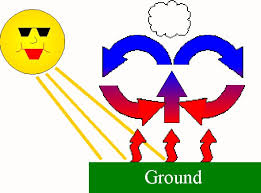
Warm air rises and the cool air sinks.
a)
conduction
b)
convection
c)
radiation
24.
A measure of the amount of water vapor in the air is called what?
a)
Air Pockets
b)
Air Fronts
c)
Cold Fronts
d)
Humidity
25.

More direct light would mean the temperature in that area would be...
a)
cooler and letter B
b)
cooler and letter A
c)
hotter at letter A
d)
hotter at letter B
26.
What causes wind to blow?
a)
Differences in longitude
b)
Shock waves from clouds
c)
Differences in air temperature and pressure
d)
The rotation of the earth
27.
Which term best describes how the earth's atmosphere is heated?
a)
Spirally
b)
Unevenly
c)
Circularly
d)
Kinetically
28.
What causes warm air to rise?
a)
the fact that it's less dense than cold air
b)
The fact that it weighs more than cold air
c)
The fact that it has higher pressure than cold
d)
the fact that its more dense than cold air
29.
What is the name for cooler air blowing from the land to the sea?
a)
Sea Breeze
b)
Land Breeze
c)
Mountain Breeze
d)
None of the Above
30.
True or False:
Land heats and cools faster than water causing wind and weather.
Land heats and cools faster than water causing wind and weather.
a)
True
b)
False
31.
What do you call winds that blow in the same direction all over the Earth?
a)
global winds
b)
Coriolis effect
c)
Greenhouse effect
d)
sea breezes
32.
What are cold winds that blow from east to west in the polar regions?
a)
polar easterlies
b)
trade winds
c)
prevailing westerlies
d)
jet streams
33.

What kind of breeze is this and when would it form?
a)
Land breeze - daytime
b)
Land breeze - nighttime
c)
Sea breeze - daytime
d)
Sea breeze - nighttime
34.
___________is the result of the weight of a column of air pushing on an area.
a)
air pressure
b)
density
c)
volume
d)
none of the above
35.
Density of air is greater at high altitudes.
a)
true
b)
false
36.
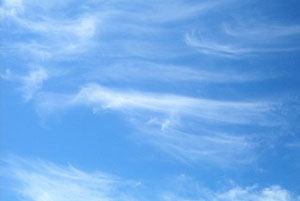
This type of cloud is thin, wispy, and made of ice crystals
a)
cumulus cloud
b)
stratus cloud
c)
cirrus cloud
d)
cumulonimbus cloud
37.
The temperature at which water vapor condenses is the
a)
relative humidity
b)
humidity
c)
freezing point
d)
dew point
38.
What are the four classes of clouds based on altitude?
a)
cirrus, nimbus, stratus, cumulus
b)
low, middle, high, vertically developed
c)
troposphere, stratosphere, mesosphere , thermosphere
d)
classes of clouds are not based on altitude
39.
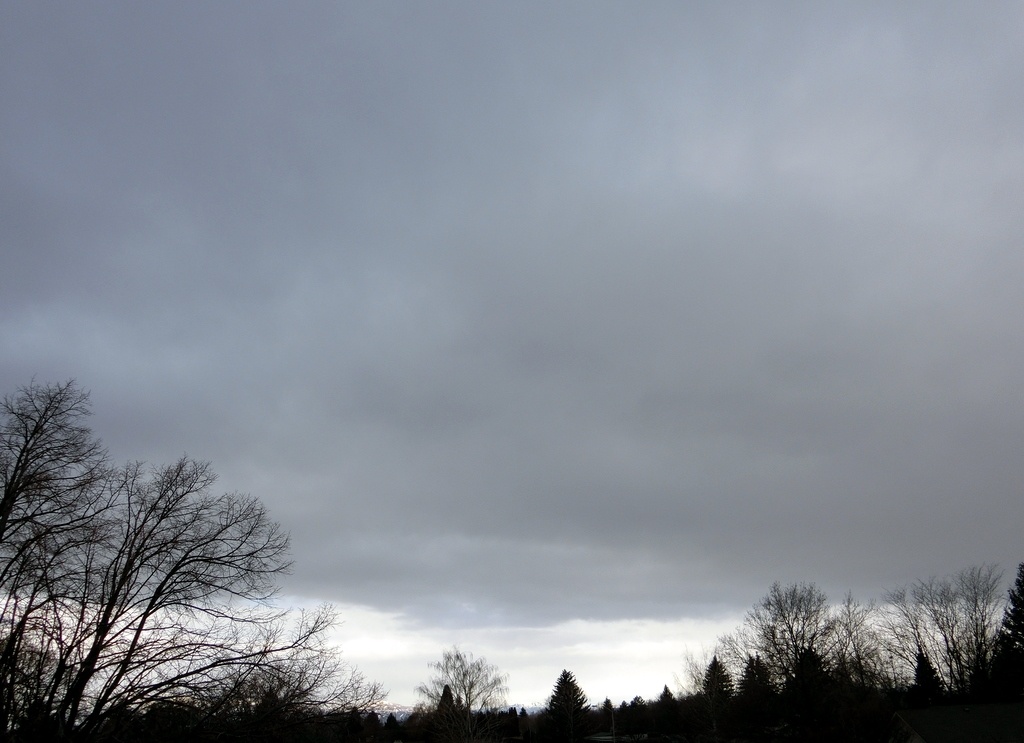
This type of cloud is thin and flat, and the edges are not clearly defined
a)
cirrus cloud
b)
cumulus cloud
c)
stratus cloud
d)
cumulonimbus cloud
40.
This type of cloud is thick and puffy on top, and generally flat on the bottom. It has well-defined edges and can change shape rapidly.
a)
cumulus cloud
b)
stratus cloud
c)
cirrus cloud
d)
cloud 9
41.
Cumulus and cirrus clouds can signal what type of upcoming weather?
a)
fair skies
b)
hot, sunny weather
c)
windy weather
d)
rainy weather
42.
Nimbostratus and cumulonimbus clouds can signal what type of upcoming weather?
a)
fair skies
b)
hot, sunny weather
c)
windy weather
d)
rainy weather
43.
Why doesn't cloud formation take place until the dew-point temperature is reached?
a)
because dew-point is the temperature at which water vapor condenses into water droplets
b)
cloud formation can take place at any temperature, and does not depend on the dew-point temerature
c)
because water sublimates at the dew-point temperature
d)
the dew-point temperature only applies on Earth's surface, not in the atmosphere
44.
Which of the following is an example of a cloud of vertical development?
a)
nimbostratus cloud
b)
cumulonimbus cloud
c)
cirrus cloud
d)
stratus cloud
45.

Which layer of the atmosphere is closest to the surface of the Earth and it is where all weather occurs?
a)
Thermosphere
b)
Mesosphere
c)
Stratosphere
d)
Troposphere
46.

What are the three basic types of clouds?
a)
Cumulus, Stratus, Cirrus
b)
Stratus, Cottontails, Mammatus
c)
Lenticular, Cumulus, Nimbus
d)
Lenticular, Cumulus, Nimbus
47.

Out of the three basic parts of the water cycle. What is the most important?
a)
Precipitation
b)
Evaporation
c)
Condensation
d)
All of the above
48.

What part of the water cycle includes clouds and there formation?
a)
Evaporation
b)
Transpiration
c)
Surface Runoff
d)
Condensation
49.

Which of these is the part of the water cycle where water is released from clouds in the form of rain, freezing rain, sleet, snow, or hail?
a)
Precipitation
b)
Transpiration
c)
Condensation
d)
Evaporation
50.

Which of these is the part of the water cycle where water vapor cools on dust particles and forms water droplets. It is key in the formation of clouds?
a)
Condensation
b)
Transpiration
c)
Evaporation
d)
Precipitation
51.

Which of these is the part of the water cycle where moisture is carried through plants from roots to small pores on the underside of leaves, where it changes to vapor and is released to the atmosphere?
a)
Evaporation
b)
Condensation
c)
Surface Runoff
d)
Transpiration
52.

Which of these is the part of the water cycle where water is converted to water vapor, by heat from the sun, and it rises into the atmosphere?
a)
Surface Runoff
b)
Evaporation
c)
Condensation
d)
Precipitation
53.

Which of these is part of the water cycle where water, from rain, snowmelt, or other sources, that flows over the land surface downhill towards rivers?
a)
Surface Runoff
b)
Transpiration
c)
Condensation
d)
Evaporation
54.

The continuous process by which water is circulated throughout the Earth and its atmosphere.
a)
The Water Cycle
b)
Dihydrogen Cycle
c)
CETROP Cycle
d)
Renewable Water Resource
55.
Clouds are made up of tiny drops of ______ or ice. The moisture in the cloud affects the weather.
a)
dust
b)
water
c)
cloud particles
d)
precipitation
56.
They are highest clouds in the sky. They look curly, white and feathery. Usually mean good weather.
a)
Cumulus
b)
Cumulonimbus
c)
Cirrus
d)
Stratus
57.
This is sometimes called a thunderhead cloud. It looks very tall like mountains and heavy rain comes from it.
a)
Cumulus
b)
Cirrus
c)
Stratus
d)
Cumulonimbus
58.
They are low in the sky and look soft and fluffy.
a)
Cirrus
b)
Cumulonimbus
c)
Cumulus
d)
Stratus
59.
Which layer of the atmosphere is closest to the surface of the Earth and it is where all weather occurs?
a)
Thermosphere
b)
Mesosphere
c)
Stratosphere
d)
Troposphere
60.
What part of the water cycle includes clouds and there formation?
a)
Evaporation
b)
Transpiration
c)
Surface Runoff
d)
Condensation
61.

What are the ingredients necessary for a cloud to be created?
a)
wind, heat, water
b)
dust, water vapor, low pressure
c)
cool temperatures, water, vapor
d)
high pressure, water, wind
62.
heavy rainfall
a)
cold front
b)
warm front
63.
cold air moves in behind the front
a)
cold front
b)
warm front
64.
light rain or drizzle
a)
cold front
b)
warm front
65.
cold air mass pushes the warm air mass upward
a)
cold front
b)
warm front
66.
stratus clouds turn into nimbostratus clouds
a)
cold front
b)
warm front
67.
cumulus clouds turn into cumulonimbus clouds
a)
cold front
b)
warm front
68.
warm air mass stretches over a cold air mass
a)
cold front
b)
warm front
69.
lightning and thunder may occur
a)
cold front
b)
warm front
70.
light snowfall or snow flurries
a)
cold front
b)
warm front
71.
blizzard like conditions
a)
cold front
b)
warm front
72.

Based on the picture, what type of front is Sponge Bob experiencing?
a)
Warm front
b)
Cold front
c)
No front - after a warm front
d)
No front - after a cold front
73.
What kind of weather happens during a cold front?
a)
Light rain or light snow
b)
Heavy rain or heavy snow
c)
Clear skies, temp. warms
d)
Clear skies, temp. cools
74.
What kind of weather happens after a cold front moves out?
a)
Light rain or light snow
b)
Heavy rain or heavy snow
c)
Clear skies, temp. warms
d)
Clear skies, temp. cools
75.
What kind of weather happens after a warm front moves out?
a)
Light rain or light snow
b)
Heavy rain or heavy snow
c)
Clear skies, temp. warms
d)
Clear skies, temp. cools
76.

What kind of front is here?
a)
Warm front
b)
Cold front
c)
Occluded front
d)
Stationary front
77.

It's been like this for the last 3 days. What kind of front is shown?
a)
warm front
b)
cold front
c)
occluded
d)
stationary
78.

There is no front in Nebraska. What is the weather like in Nebraska?
a)
Clear skies
b)
Severe weather
c)
Light rain or light snow
d)
Thunderstorms or snowstorms
79.

What kind of front is here?
a)
Warm front
b)
Cold front
c)
Occluded front
d)
Stationary front
80.

A _____________ is moving in, so this must be a ____________ front.
a)
thunderstorm, warm
b)
bank of high wispy clouds, warm
c)
tornado, occluded
d)
thunderstorm, cold
81.

Which front is this?
a)
Warm front
b)
Cold front
c)
Occluded front
d)
Stationary Front
82.
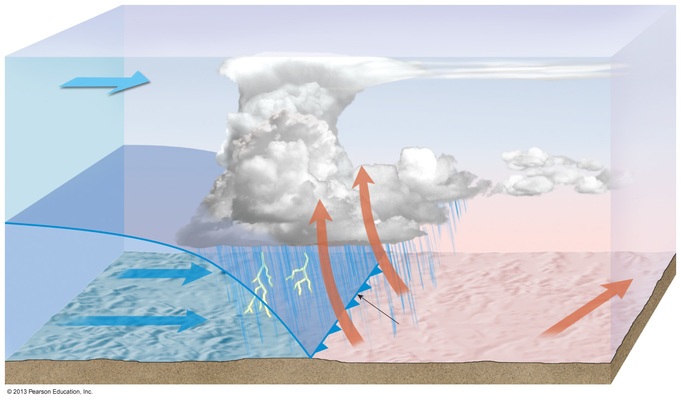
What type of storm front is this?
a)
warm front
b)
cold front
c)
stationary front
d)
occluded front
83.
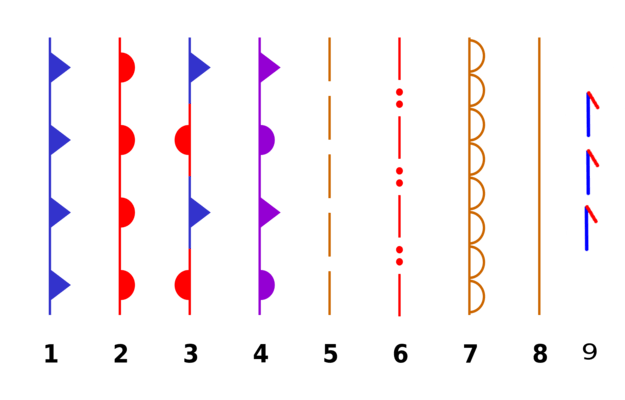
What does symbol # 3 mean?
a)
stationary front
b)
occluded front
c)
warm front
d)
cold front
84.
A front is
a)
where warm air is cooling at earth's surface
b)
a line where hot and cold air are separating
c)
a line where two different air masses meet
d)
where cold air is rising and forming rain clouds
85.
A front is
a)
where warm air is cooling at earth's surface
b)
a line where hot and cold air are separating
c)
a line where two different air masses meet
d)
where cold air is rising and forming rain clouds
86.
Which most likely produces clear, cool weather?
a)
zero air pressure
b)
stable air pressure
c)
a low pressure system
d)
a high pressure system
87.
_____________ air is more dense and tends to sink
a)
cold
b)
warm
c)
moist
d)
dry
88.
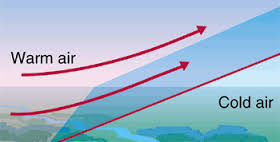
Which type of front is pictured?
a)
Cold front
b)
Warm front
c)
Occluded front
d)
Stationary front
89.
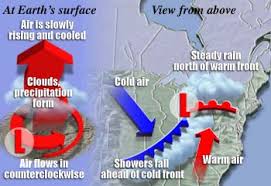
Which system results in rainy or stormy weather?
a)
high pressure
b)
low pressure
c)
hurricane
d)
weather system
90.

What type of storm front if this?
a)
Warm Front
b)
Cold Front
c)
Stationary Front
d)
Occluded Front
91.
When a cold front or a warm front stays in place for several days without invading another front, it is called a ______.
a)
stationary front
b)
cold front
c)
occluded front
d)
warm front
92.
A cold front usually brings what kind of weather?
a)
snow
b)
sunny and fair
c)
rain and/or thunderstorms
d)
cool and dry
93.

What does this symbol on a weather map indicate?
a)
High pressure system
b)
Low pressure system
c)
Cold front
d)
Warm front
94.

What does this symbol on a weather map indicate?
a)
High pressure system
b)
Low pressure system
c)
Cold Front
d)
Warm Front
95.

a)
wind vane- wind direction
b)
thermometer-temperature
c)
rain gauge-rain fall
d)
anemometer-wind speed
96.

What does this weather instrument (shown here) measure?
a)
wind speed
b)
air pressure
c)
amount of fallen rain
d)
temperature
97.

name this symbol
a)
warm front
b)
cold front
c)
stationary front
d)
occluded front
98.

This is the symbol for a...
a)
Cold Front
b)
Warm Front
c)
Stationary Front
d)
Occluded Front
99.

This is the symbol for a...
a)
Stationary Front
b)
Occluded Front
c)
Cold Front
d)
Warm Front
100.

This is the symbol for a...
a)
Stationary Front
b)
Occluded Front
c)
Cold Front
d)
Warm Front
101.

Identify the type of front that is shown in the image.
a)
Occluded Front
b)
Cold Front
c)
Stationary Front
d)
Warm Front
102.

Identify the type of front that is shown in the image.
a)
Occluded Front
b)
Cold Front
c)
Stationary Front
d)
Warm Front
103.

Identify the type of front that is shown in the image.
a)
Occluded Front
b)
Cold Front
c)
Stationary Front
d)
Warm Front
104.

What kind of breeze is this & what time of day/night would it form?
a)
Land breeze - daytime
b)
Land breeze - nighttime
c)
Sea breeze - daytime
d)
Sea breeze - nighttime
105.
How do we name air masses?
a)
Water and temperature
b)
Air pressure
c)
Humidity and temperature
d)
Cold and warm
106.
How do we characterize an air mass that forms over the ocean?
a)
Dry
b)
Wet
c)
Cold
d)
Warm
107.
How do we characterize an air mass that forms over land?
a)
Dry
b)
Wet
c)
Cold
d)
Warm
108.
How do we characterize an air mass that forms over near the equator?
a)
Dry
b)
Wet
c)
Cold
d)
Warm
109.
How do we characterize an air mass that forms near the poles?
a)
Dry
b)
Wet
c)
Warm
d)
Cold
110.
What types of air masses form over oceans?
a)
Maritime
b)
Continental
c)
Polar
d)
Tropical
111.
What's the humidity and temperature of a continental tropical air mass?
a)
Wet and cold
b)
Dry and warm
c)
Wet and warm
d)
Dry and cold
112.
What's the humidity and temperature of a maritime tropical air mass?
a)
Wet and cold
b)
Dry and warm
c)
Wet and warm
d)
Dry and cold
113.
A wet and cold air mass would be a...
a)
Maritime polar
b)
Continental polar
c)
Maritime tropical
d)
Continental tropical
114.
A dry and cold air mass would be...
a)
Maritime polar
b)
Continental polar
c)
Maritime tropical
d)
Continental tropical
115.
A dry and hot air mass would be...
a)
Maritime arctic
b)
Maritime tropical
c)
Continental tropical
d)
Continental polar
116.
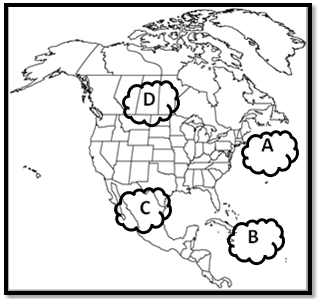
Which type of air would you find at air mass A?
a)
cold, dry
b)
warm, humid
c)
warm, dry
d)
cold, humid
117.
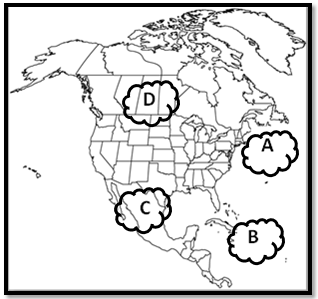
Which type of air would you find at air mass B?
a)
cold, dry
b)
warm, humid
c)
warm, dry
d)
cold, humid
118.
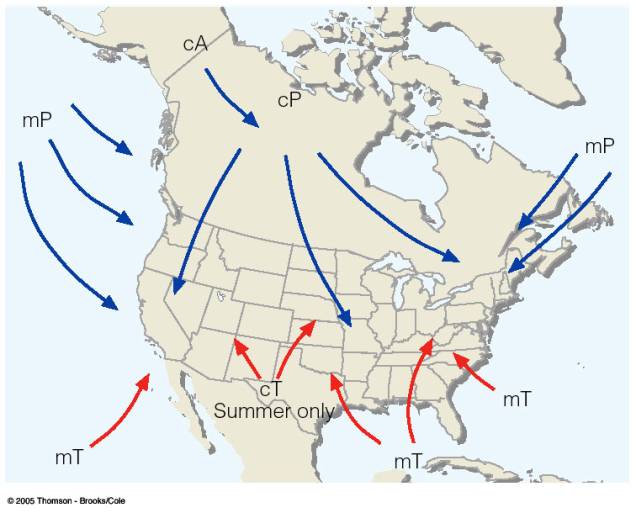
Which abbreviation of an air mass can be identified as cold and moist?
a)
cP
b)
mP
c)
cT
d)
mT
119.
Which abbreviation of an air mass can be identified as dry and hot?
a)
cP
b)
mP
c)
cT
d)
mT
120.
Air travels
a)
from high pressure to low pressure
b)
from low pressure to high pressue
121.
What kind of breeze is this & what time of day/night would it form?
a)
Land breeze - daytime
b)
Land breeze - nighttime
c)
Sea breeze - daytime
d)
Sea breeze - nighttime
122.

Which abbreviation of an air mass can be identified as dry and cold?
a)
cP
b)
mP
c)
cT
d)
mT
123.
Which abbreviation of an air mass can be identified as warm and moist?
a)
cP
b)
mP
c)
cT
d)
mT
124.
Which abbreviation of an air mass can be identified as cold and moist?
a)
cP
b)
mP
c)
cT
d)
mT
125.
Which abbreviation of an air mass can be identified as dry and hot?
a)
cP
b)
mP
c)
cT
d)
mT
126.

Which type of front is displayed?
a)
Cold
b)
Warm
c)
Stationary
d)
Occluded
127.
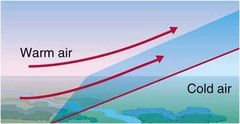
Which type of front is displayed?
a)
Cold
b)
Warm
c)
Stationary
d)
Occluded
128.

Which type of front is displayed?
a)
Cold
b)
Warm
c)
Stationary
d)
Occluded
129.

Which type of front is displayed?
a)
Cold
b)
Warm
c)
Stationary
d)
Occluded
130.
When two different air masses collide...
a)
A front forms
b)
They casually become one
c)
A new planet evolves
d)
Dinosaurs become extinct
131.
A source region
a)
provides an air mass with its characteristics
b)
is where power is generated
c)
is a small pool of water
d)
enable you to charge your phone
132.
What shape is the planet Earth?
a)
hemisphere
b)
circle
c)
sphere
d)
hemicube
133.
The invisible line at 0* latitude is the ________.
a)
equator
b)
Prime Meridian
c)
north line
134.
Low pressure areas
a)
are cooler.
b)
hold more water vapor.
c)
are more stable.
135.

Due to the orographic effect, the leeward side of mountains
a)
receives heavy rain or snowfall because of prevailing winds.
b)
dry because of the rain shadow.
c)
dry because of prevailing winds.
136.
Most tornadoes occur
a)
at night.
b)
in tropical areas.
c)
in mid-latitude thunderstorms.
137.

How does surface air flow in a middle-latitude cyclone in the Northern Hemisphere?
a)
divergent and clockwise
b)
divergent and counterclockwise
c)
convergent and clockwise
d)
convergent and counterclockwise
138.
Where does the greatest number of thunderstorms occur?
a)
middle latitudes
b)
tropics
c)
mountains
d)
high latitudes
100 %

