
NEW
Font size
 Worksheets
GMJ 6035 level 2 hot water C
Total questions: 27
Worksheet time: 14mins
Which one of the following bits of information will be provided by the installation plan?
The dwelling position on the estate
The expected completion date
The order in which work should take place
The position of the hot water pipes and valves in a dwelling
The water supply (water fittings) regulations 1999 lay down:
The regulations covering all internal and external hot and cold water systems for dwellings
The guidance for good practice when installing hot and cold pipework in a dwelling
The regulations that cover hot water systems only
The guidance for internal hot and cold water systems only within a dwelling
Which one of the following hot water components should be fixed using flexible connections?
Indirect hot water cylinder
Shower mixer valve
Booster pump for a shower
External bib tap
A rigid pipework hot water system has a working pressure is 4bar. At what pressure should the pipework be tested at for soundness?
1bar for 60mins
1½ times the working pressure for 15minutes
6bar for one hour
4bar for 30mins then 6bar for 15mins
To prevent electrolytic corrosion taking place in a system, where can the magnesium rod be placed?
Cold water storage cistern
The hot water cylinder
The circulator
The open vent
Guidance on the installation procedures for domestic hot water systems can be found in:
Domestic Water Act 2007
Specification of work
BS6700
Local Authority Regulations
In a customer’s property the CWSC supplies both the hot and cold water systems. The minimum size of this cistern is:
Equal to 48hours worth of water
230litres
100litres
Twice the size of the domestic hot water cylinder
Which of the following appliances is most likely to offer the customer low pressure at a hot water outlet?
Combination boiler
Direct cylinder
Combination unit
Indirect cylinder

1. What is this item?
Temperature relief valve
pressure relief valve
stop valve
blending valve
If hard water is allowed to be heated above 650C, what could be the consequence in the system?
Legionella could grow
The blending valve would fail to work
The pressure relief valve would open
The efficiency could be affected by limescale
To overcome a dead leg for a remove hot water draw off point, what cause of action could be taken?
Install secondary circulation
Install a more powerful circulator
Increase the size of the hot water cylinder
Increase the temperature on the cylinder thermostat
What is used at a basin outlet to prevent contamination of the water system?
AUK3 air gap
AUK2 air gap
AUK1 air gap
AUK AG air gap
A customer has intermittent flow of hot water from their bath tap, what is the most likely cause of this problem?
Too little head pressure
Too much head pressure
Air lock
Faulty float operated valve
What is the primary function of the open vent on a domestic hot water system?
Safety relief pipe
Take up a hydraulic shunt
Allow hot water to be distributed at a controlled pressu
To balance the feed from the feed from the CWSC
To prevent the risk of legionella forming in a dead leg, they should be:
No longer than 2.5m as stated in BS6700
Disinfected annually under a PPM program
As short as possible
Always heated to above 500C
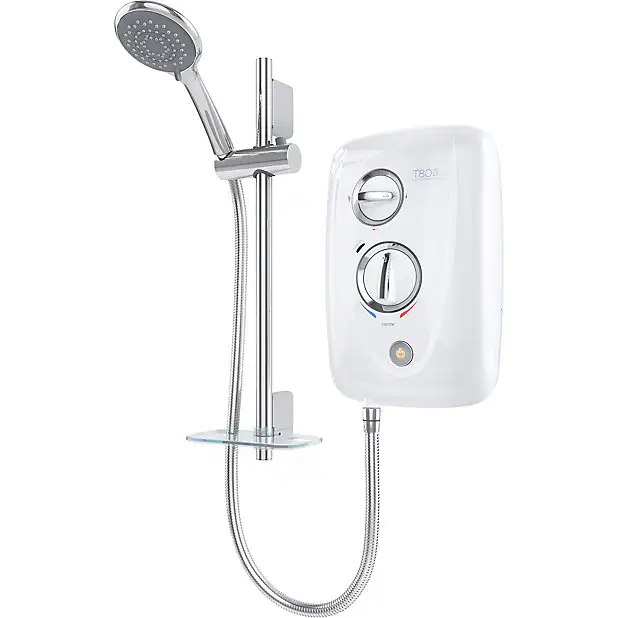
What type of shower is this?
Thermostatic shower
bar shower
instantaneous electric shower
recessed shower
Identify one advantage of a stored hot water system in a domestic property.
There is a continual supply of hot water
It is cheaper and easier to install
It does not require a secondary source of heat
It is suitable for low water pressure areas
Which one of the following heat sources is regarded as a renewable source of energy?
Coal in a solid fuel boiler
Gas in a condensing boiler
Solar panels on the roof of a property
Electricity supplying an immersion heater
Where would state the maximum flow rate and temperature for a particular pumped shower that has been installed?
BS6700
The Water Regulations
The manufacturer’s instructions
Building Regulations part G
Under Building Regulations part G, what is a new or replacement immersion heater required to have?
Temperature relief valve
Non re-setting overheat thermostat
Restricted thermostat to a maximum temperature of 600C
Protective coating to avoid electrolytic corrosion
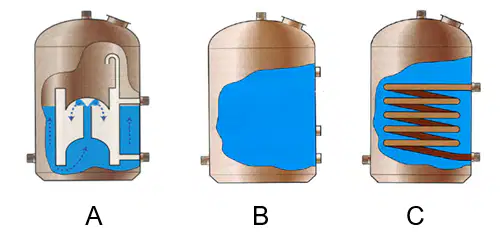
Which one of these is a direct cylinder?
A
B
C
D
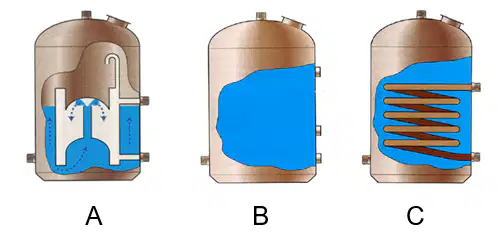
Which one of these is an indirect cylinder?
A
B
C
D
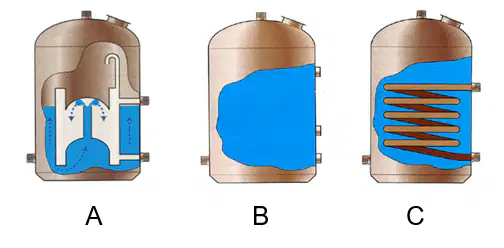
Which one of these is a primatic cylinder?
A
B
C
D
The connection for a secondary circulation system return should be made at what point in the hot water cylinder?
Bottom 1/3rd of the cylinder
Top 1/3rd of the cylinder
Middle point of the cylinder
Just prior to the open vent connection
If a system is prone to limescale build ups, this shows:
The property is in a soft water area and the temperatures are set too high
The property is in a hard water area and the temperatures are set too high
The property has a gravity hot water system that requires upgrading
The property has a gravity hot water system that requires upgrading
If a flow switch on a pumped shower does not work, what would be the result?
The water temperature will remain too high
The water temperature will remain too low
The pump will not be activated by the electrics
The pump will have restrictive water flow
Under the Water regulations, what can category 2 water be described as?
Wholesome water
Water representing a slight risk to health
Wholesome water with its aesthetic qualities impaired
Water representing a severe risk to health

