
Font size
 Worksheets
Light, Lens and Mirror 1
Total questions: 70
Worksheet time: 2hrs 45mins


Light is an example of a transverse wave
True
False

Given that the angle of incidence = 30 degrees
a. Draw a ray diagram, labelling clearly the normal, incident ray, angle of incidence, reflected ray and angle of reflection accurately.
Which is the correct diagam?

If a capital letter R is seen in an ordinary mirror, what does it look like?
A
B
C
D
When light passes from air to water, what happens to the speed of the light?
speeds up
slows down
stays the same
State the characteristics of image of plane mirror
same size
virtual
real
upright

The Diagram shows image of wall clock in a plane mirror. What is the actual time on the clock?
5.15
7.15
7.45
8.45

The diagram shows a man stand in front of a lane mirror. State the distance between the pot and the image of the man.
5 m
8 m
9 m
10 m

The diagram shows a reflection of light. Which statement is correct?
incident angle= a
reflected angle= d
incident angle= b
reflected angle= c
incident angle= c
reflected angle= b
incident angle= d
reflected angle= a


What is the focal length of the lens?

Which length is the focal length of the lens?
A
B
C
D

A lens is used to produce a magnified image, as shown in the scale diagram.
What is the linear magnification of the object?
0.33
3.0
4.0
6.0

The ray diagram shows two rays from a point on an object placed in front of a diverging (concave) lens.
What are the properties of the image produced?
real and larger than the object
real and smaller than the object
virtual and larger than the object
virtual and smaller than the object
An object is viewed through a concave (diverging) lens.
What is the correct description of the image formed?
real, inverted, magnified
real, upright, diminished
virtual, inverted, magnified
virtual, upright, diminished

Convex lenses are used in cameras and as magnifying glasses.
Which types of image are formed?
A
B
C
D

An object is placed in front of a diverging lens as shown on the scale diagram.
The principal focus F is marked on each side of the lens.
What is the position of the image formed by the lens?
A
B
C
D

A lens forms a blurred image of an object on a screen.
How can the image be made sharp and in focus on the screen?
by moving the object away from the lens and screen
by moving the screen away from the lens and object
by using a brighter object at the same position
by using a lens of longer focal length at the same position
The human eye has a converging lens system that produces an image at the back of the eye.
An eye views a distant object. What type of image is produced?
real, erect, same size
real, inverted, diminished
virtual, erect, diminished
virtual, inverted, magnified

In the diagram, which letter represents the angle of incidence?
A
B
C
D
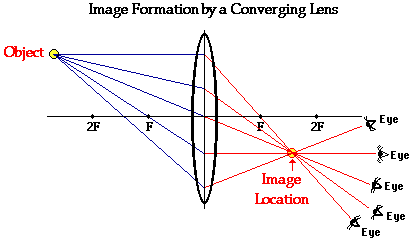
This image is.....
inverted and smaller
inverted and larger
not inverted and smaller
not inverted and larger
A real image...
is produced by virtual rays and can be projected on a screen
is produced by real rays and cannot be projected on a screen
is produced by virtual images and cannot be projected on a screen
is produced by real rays and can be projected on a screen
Choose all daily applications of the convex lens.


Choose all the correct nature of the image.
erect
inverted
magnified
virtual

The image will ...
be inverted and real
be formed at inifinity
be erect and virtual
be inverted and virtual
This real image is.....
(hints: ________ and __________)
(a)


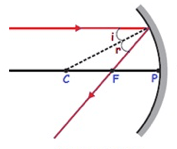
This ray diagram is for which mirror?
concave
convex
plane
window
Image behind the mirror is
virtual
real
upside down
upright

The size of an object and its image are the same in this type of mirror...
Plane
Convex
Concave

In the given ray diagram, image distance is
negative
positive
can't say
information can't be derived from figure

A concave mirror has a 7 cm focal length. You place a 2.4 cm tall object 16 cm from the mirror. Determine the image height.
HINT. use: xi=xo−ffxo and: hohi=−xoxi7 cm
4 cm
-1.9 cm
-3.5 cm
A concave mirror has a radius of curvature of 24 cm. A 6.4 cm tall object is held 26cm from the mirror. Calculate the distance between the image and the mirror.
HINT. use: f=2r xi=xo−ffxo22.3 cm
23.2 cm
32.2 cm
23.3 cm
A concave mirror has a focal length of 12 cm. A 6.4 cm tall object is held 26cm from the mirror. The distance from the image to the object is 22.3 cm. What is the height of the image.
HINT. use: hohi=−xoxi-5.5 cm
3.3 cm
5.5 cm
-3.3 cm
When an object is placed on the focal point in front of a converging lens, the image produced is ___.
real, reduced, and inverted
real, enlarged, and inverted
real, true, and inverted
There is no image
A tree is located 40 m from the converging lens of focal length 0.08 m. What does the 0.08 m represent?
do
di
f
1/f
Where can you place an object in order to get an image of the same size as the object? Select all that apply.
beyond 2F
at 2F
between F & 2F
at F
between F and the lens
Where can you place an object in order to get a smaller image than the object? Select all that apply.
beyond 2F
at 2F
between F & 2F
at F
between F and the lens
Where can you place an object in order to get a real image? Select all that apply.
beyond 2F
at 2F
between F & 2F
at F
between F and the lens


Which diagram shows how a ray of light could pass through a glass block in air?


A student draws three rays of light from point P through a converging lens. Each point labelled F is a principle focus of the lens. Which of the rays are drawn correctly?
ray Y only
ray Z only
ray X and ray Y
ray X and ray Z

The image formed by a plane mirror is upright. What are the other characteristics of the image?
magnified and virtual
laterally (left to right) inverted
laterally (left to right) inverted and virtual
laterally (left to right) inverted and magnified

Type of image formed in the diagram
real image
virtual image

In which of the diagrams is the path of the light ray not correct?
A
B
C
D
An object is placed in front of a diverging lens as shown on the scale diagram.
The principal focus F is marked on each side of the lens.
What is the position of the image formed by the lens?
A
B
C
D
Convex lenses are used in cameras and as magnifying glasses.
Which types of image are formed?
A
B
C
D
An object is viewed through a concave (diverging) lens.
What is the correct description of the image formed?
real, inverted, magnified
real, upright, diminished
virtual, inverted, magnified
virtual, upright, diminished
The ray diagram shows two rays from a point on an object placed in front of a diverging (concave) lens.
What are the properties of the image produced?
real and larger than the object
real and smaller than the object
virtual and larger than the object
virtual and smaller than the object
A lens is used to produce a magnified image, as shown in the scale diagram.
What is the linear magnification of the object?
0.33
3.0
4.0
6.0
Which length is the focal length of the lens?
A
B
C
D

Which of these provides the best explanation for why the pencil appears broken?
The pencil absorbs the light rays that hit it.
Water reflects light rays away from the pencil.
Light rays are bent by the water in the glass.
The surface of the water reflects the light rays.

Is the image considered real or virtual?
real (inverted)
virtual (upright)

The radius of curvature of a convex lens is 20cm. What is its focal length?
10 cm
20 cm
30 cm
40 cm

