Worksheets
Biology Final Review
Total questions: 159
Worksheet time: 2hrs 29mins
The brown eye trait is dominant over blue eyes. Which of the following genotypes best represents the phenotype for blue eyes?
BB
Bb
bb
bB
Each organism has 2 alleles for a particular trait. Where do these two alleles come from?
One from each parent
Both from one parent
Alleles do not come from parents
The kidney

What is the genotype for #15?
rr
Rr
RR
rR
An organism’s physical appearance of visible traits is a _____________.
Genotype
Phenotype
Homozygous
Heterozygous
b = blue eyes
What is true about these two brothers that have brown eyes?
One has genotype BB the other Bb.

The different forms of a gene.
Genes
Allele
Phenotype
Pedigree
In peas, yellow pod color is dominant to green pod color. Two heterozygous parents are crossed. What are the chances that the offspring will have green pods?
25%
50%
75%
100%
When one allele is not dominant over another, resulting in a blended phenotype for heterozygous offspring is considered....
Incomplete Dominance
Codominance
When one allele is not dominant over the other, resulting in both traits expressed in a heterozygous individual.....
Incomplete Dominance
Codominance
Some flowers are controlled by codominance. Red flowers (RR), blue flowers (BB) and Speckled flowers (RB).
Cross a red flower with a speckled flower. What is the phenotypic ratio?
2 red, 2 speckled
2 red, 2 blue
2 blue, 2 speckled
Radish color is completely dominant, red and white are pure breeding colors. While heterozygous are purple.
Cros a red radish with a white.
4 purple
1 red, 2 purple, 1 white
2 red, 2 white
1 red, 1 purple, 2 white


Codominance occurs in calico cats, which allows for the Black and Tan colors to show. What percentage of the offspring will be calico (black and tan spotted)?
25
50
75
100

Who was the Scientist most famous for his study of natural selection and evolution?
Theodor Schwann
Robert Hooke
Charles Darwin
Rudolf Virchow

What is the process in which populations CHANGE gradually over time?
evolution
species
variation
competition

What do you call similar structures that related species have inherited from a common ancestor?
Natural Selection
Analogous Structure
Vestigial Structure
Homologous Structure

What do we call structures that no longer perform their original function?
Natural Selection
Analogous Structure
Vestigial Structure
Homologous Structure

What do you call a characteristic that allows an organism to survive in an environment?
variation
adaptation
selection
overproduction

What do you call different structures with a similar function but NO common ancestor?
Natural Selection
Analogous Structure
Vestigial Structure
Homologous Structure

The pelvic bone of whales is not needed for movement within the water. This is an example of a(n) ______________ structure.
vestigial
analogous
homologous

The forelimbs of mammals have similar anatomy because these groups descended from a recent common ancestor. Their bone structure is an example of a(n) ______________ structure.
vestigial
analogous
homologous

Many different groups of organisms have wings, even though they do not share a recent common ancestor. This is because they evolved in environments with similar selective pressures. Wings are an example of a(n) ______________ structure.
vestigial
analogous
homologous
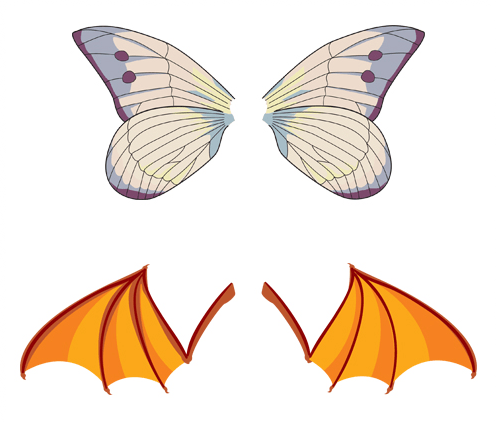

A mistake or change that occurs in the DNA sequence is called a ______________________.
Extinction
Speciation
Mutation
Genetic Variation

The image represents which process?
founder effect
bottleneck effect
gene flow
During a hurricane, a population of beetles almost gets completely wiped out. The only beetles that survived were lucky that they were in their nest at the time of the hurricane and had enough food to survive.
Natural selection
Genetic Drift
Gene Flow
Non-Random Mating
Insects become resistant to pesticides very quickly, sometime in one generation. If an insect is resistant to the chemical, most of the offspring will also be resistant. Considering that insect generations can be a matter of weeks, insects in an area can become immune to a chemical within months.
Mutation
Natural Selection
Genetic Drift
Gene Flow
A certain type of plant can produce blue or yellow flowers. During a fire, many yellow flowers are destroyed and now since blue is the dominant trait, the plant reproduces offspring that produce only blue flowers.
Non-Random Mating
Gene Flow
Mutation
Genetic Drift
Some organisms of a population of birds are born with extra-long beaks instead of a normal sized beak.
Gene Flow
Natural Selection
Genetic Drift
Mutation
Females a certain bird species are attracted to the mating calls of male species more than others
Genetic Drift
Mutation
Sexual Selection
Natural Selection
Which of the following statements about gene flow is TRUE?
Gene flow is a result of individuals that breed in an old location
Gene flow is a result of migrating individuals that breed in a new location
Gene flow is not a result of migrating individuals that breed in a new location
None of the statements are true
How do evolution directly affected by the gene flow?
It doesn’t contribute to evolution
It introduces new alleles into a population.
It reduces the number of members in a population.
It changes the environment in which a population resides.
Which of the following is NOT considered a mechanism of evolution?
Mutations
Natural Selection
Behavior Changes
Genetic Drift
Genetic Drift has a stronger effect on smaller populations
True
False

Two organisms that are closely related would have
very similar DNA sequence
exactly the same DNA sequences
no proteins in common
completely different DNA sequence
Which of the following options is NOT one of the main pieces of evidence of evolution that we have studied in class?
The Fossil Record
Embryology
Comparative Anatomy
Cosmology
The study of embryological development (evo-devo) provides anatomical evidence for evolution because...
all vertebrate embryos pass through the same stages of development in the same sequence.
all vertebrates are born with gills and a tail.
all vertebrate embryos have completely different stages of development that look nothing alike.
all plants and animals have wings, even if you can't see them when they are born.
The fossil record helps to build a timeline of life on Earth because...
the older a fossil is, the deeper it will be found within layers of sedimentary rock.
the older a fossil is, the closer it will be to the surface layers of sedimentary rock.
gaps in the fossil record tell us all of the detailed changes to life on Earth during that gap.
fossilized clocks from millions of years ago tell us exactly what time it was when specific events happened.
The study of prehistoric life using fossils is called...
Paleontology
Morphology
Biogeography
Embryology
Morphology studies the...
Anatomy of living things
Behavior of living things
Geographic location of living things
Chemical processes in living things
Which of the following could NOT be a fossil?
The bones of an animal
The footprints of an animal
The feces of an animal
The DNA of an animal
Structures that are homologous...
Have similar anatomy
Come from unrelated organisms
Are a result of convergent evolution
Have similar functions
Leftover structures with little to no function for an organism are called
Homologous Structures
Analogous Structures
Vestigial Structures
Morphological Structures
Which of the following statements about analogous structures is FALSE?
Analogous structures serve similar purposes
Analogous structures result from convergent evolution
Analogous structures evolve in related organisms
Analogous structures perform different functions
What is a pseudogene?
Genes that are non-functional
Genes that match DNA with other animals
Genes that have fused together
Genes that are homologous
Ants are the correct size and weight needed to open the flowers for the peony plant. The peony plant provides food for the ant and the ant fertilizes the peony’s flowers
divergent evolution
convergent evolution
coevolution
The Galapagos finches evolved through natural selection from a common mainland ancestor into a wide variety of different looking species.
divergent evolution
convergent evolution
coevolution
A form of evolution where two species having a close ecological relationship evolve together such that one species adapts to changes in the other, thereby affecting each other's evolution.
divergent evolution
convergent evolution
coevolution
The extinct pterosaurs (reptile) of the Jurassic period and the modern albatross (bird) both evolved wings as well as a distinct long beak, but are not derived from a common ancestor.
divergent evolution
convergent evolution
coevolution
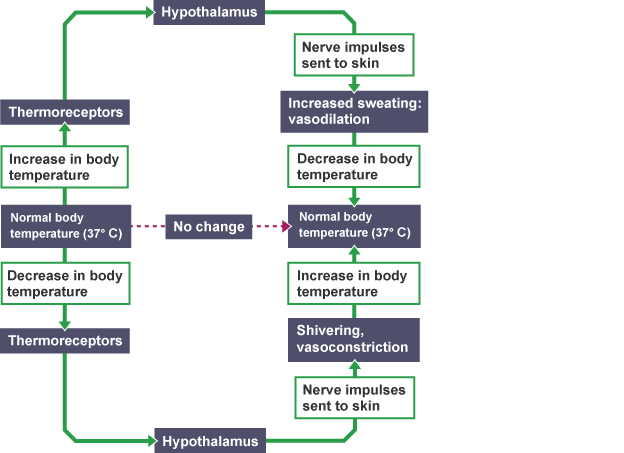
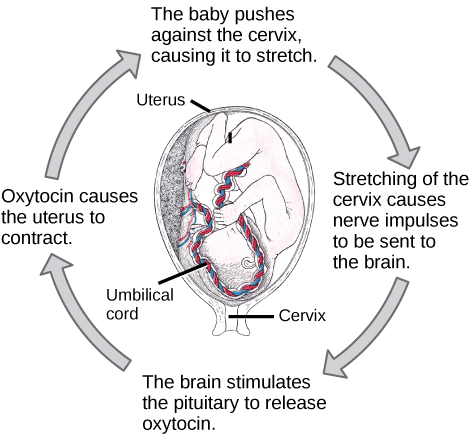

Loops that cause a response to build up and build up until something big happens are called ____________ loops
positive
negative
In a positive feedback loop, each action creates a consequence that _____________________ the other action.
decreases
has no effect on
amplifies
In a negative feedback loop, each action creates a consequence that _____________________ the other action.
decreases
has no effect on
amplifies
A ________________ feedback loop makes a system more stable.
Positive
Neutral
Negative
Circular
A _________________ feedback loop moves a system to an extreme.
Positive
Neutral
Circular
Negative
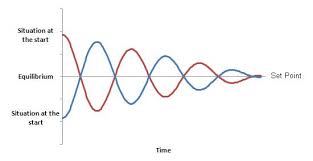
Does the graph show positive or negative feedback?
Positive, because when the red line shifts, the blue one does also
Negative, because the blue line starts below equilibrium
Negative, because the two actions are keeping each other near equilibrium
Both positive and negative because the graph moves up and down
Which body system functions to digest food, remove waste, and absorb nutrients?
excretory
digestive
circulatory
integumentary
Which organ system makes and stores hormones to communicate with the body
endocrine system
nervous system
circulatory system
muscular system
The circulatory system transports nutrients and wastes through the body in the blood. What system works together with the circulatory system to filter out cellular wastes?
digestive system
excretory system
endocrine system
immune system
The organ system that acts as a barrier against infection, injury, UV radiation, and helps to regulate the body's temperature is the...
Endocrine
Skeletal
Muscular
Integumentary
The major tissues and organs of this system include the white blood cells and spleen.
Circulatory
Immune
Endocrine
Digestive
What is the correct order of the levels of cell organization from simplest (smallest) to most complex (biggest)?
Cell, Organ, Tissue, Organ System, Organism
Organism, Tissue, Cell, Organ system, Organ
Cell, Tissue, Organ, Organ System, Organism
Tissue, Cell, Organ, Organ System, Organism
Which system moves body parts?
muscular
skeletal
digestive
respiratory
Which body system has a function to allow all organisms to reproduce?
Respiratory
Reproductive
Endocrine
Skeletal
The excretory system is responsible for
moving chemicals and hormones throughout the body
removing waste from the body
providing nutrients to the body
pass messages throughout the body
These systems work together to provide nutrients to the body
endocrine system, digestive system
muscular system, endocrine system
digestive system, circulatory system
endocrine system, muscular system
The function of this system is to control all body functions
circulatory system
excretory system
endocrine system
nervous system
These systems work together to make the body move
skeletal system, digestive system
muscular system, skeletal system
respiratory system, skeletal system
muscular system, respiratory system
The ______ system helps you move, protects your organs, gives support to the body, and makes red blood cells.
skeletal system
muscular system
digestive system
respiratory system
The _____ system's function is to break down food into molecules that the body (cells) can use for energy.
muscular
digestive
respiratory
endocrine
The _____ system is a transport system, carrying oxygen, carbon dioxide, and wastes to and away from cells using the heart and blood.
endocrine
circulatory
respiratory
excretory
The ______ system's function is gas exchange. It brings oxygen in and exhales carbon dioxide with the lungs, trachea, and diaphragm
endocrine
excretory
circulatory
respiratory
This system controls the body using the brain, spinal cord, and nerves.
nervous system
endocrine system
excretory system
digestive system

Eyes
Spinal Cord
Brain
All of these are part of which organ system?
circulatory
digestive
skeletal
nervous

symbiotic relationship in which both organisms benefit
competition
mutualism
predation
commensalism

What type of relationship is this?
parasitism
mutualism
commensalism
competition
An ecosystem thrives with biotic and abiotic components. An example of an abiotic part of an ecosystem is ______________.
Bacteria
Fungus
Water
Decaying plants
What is a community?
A habitat with abiotic factors
A very small habitat
All the abiotic factors in a specific area
All the different populations that live together in an area

Which level of organization is depicted in this image?
Population
Community
Ecosystem
Biome
Biosphere

Which level of organization is depicted in this image?
Population
Community
Ecosystem
Biome
Biosphere
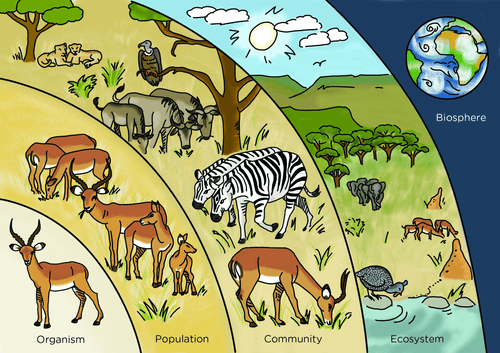
What is made up of all the populations in an area?
Habitat
Niche
Community
Ecosystem
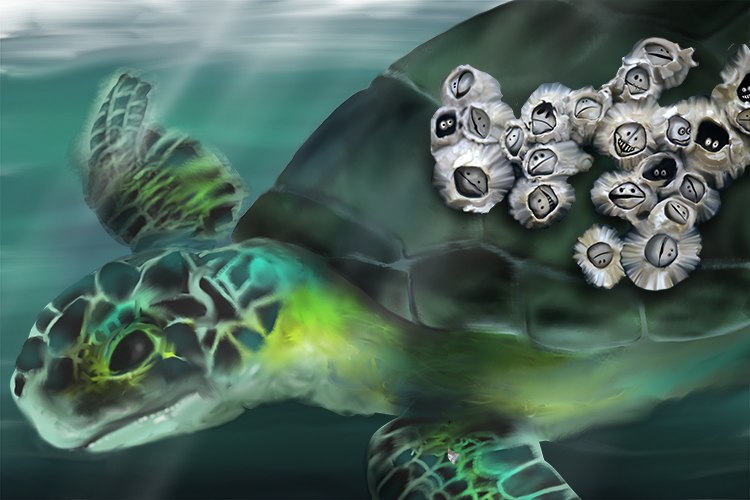
A close, ongoing relationship between species in which at least one is benefiting and the other is not helped or harmed.
Commensalism
Symbiosis
Predator & Prey
Mutualism
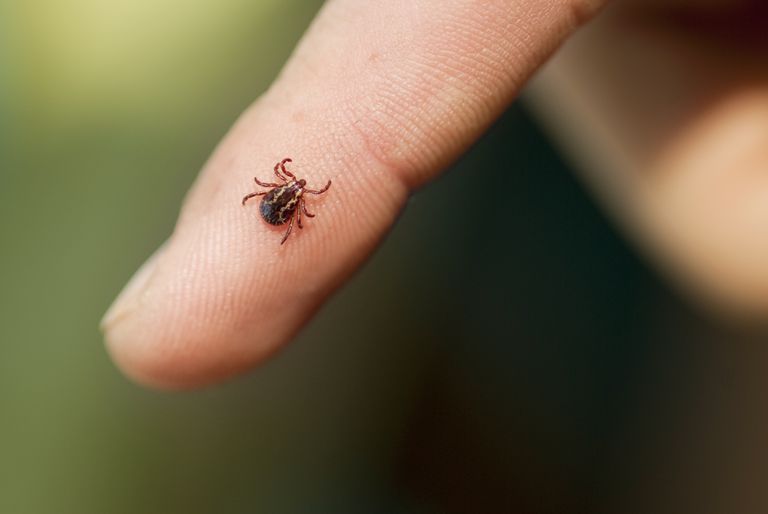
An ongoing relationship in which one organism benefits and the other is harmed.
A. Predator & Prey
B. Mutualism
C. Commensalism
D. Parasitism
There are birds that eat the food from between the teeth of alligators, leaving the alligators with clean teeth and the birds with a meal. What type of ongoing relationship is this?
A. Predator & Prey
B. Mutualism
C. Commensalism
D. Parasitism
Some limiting factors that affect populations include lack of food, lack of water, lack of living space, and the spread of disease.
True
False
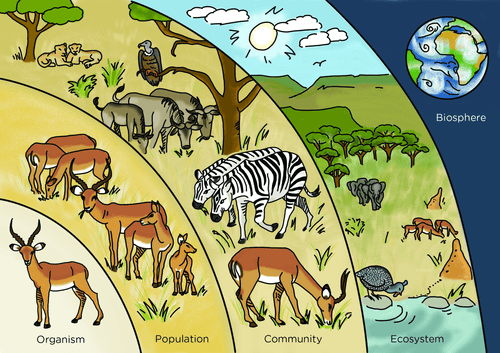
The living world is organized in levels. Biotic and abiotic factors also can be arranged into levels of biological organization. Put the words below in order from the least complex to the most complex
Community, Organism, Biome, Population, Biosphere, Ecosystem
Organism, Population, Community, Ecosystem, Biome, Biosphere
Organism, Biome, Population, Community Biosphere, Ecosystem

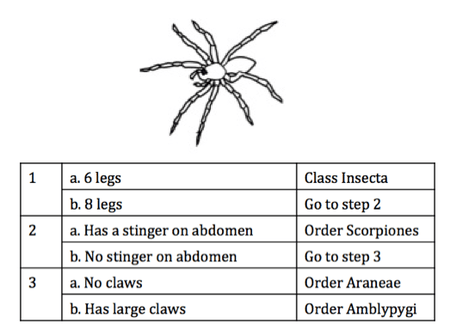

arachnids and insects?



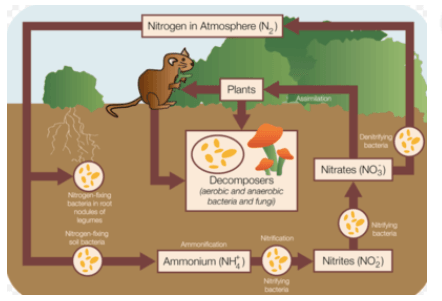
A correct path that nitrogen could take would be
air -> animals -> plants -> bacteria
animals -> air -> bacteria -> plants
bacteria -> air -> plants -> animals
air -> bacteria -> plants -> animals


Which is NOT a process of the water cycle?
precipitation
freezing
transpiration
evaporation

Which is the most abundant gas in the atmosphere?
hydrogen
oxygen
helium
nitrogen

Which process removes carbon dioxide from the atmosphere?
combustion
cellular respiration
photosynthesis
decomposition

What is the process of rain, snow, or hail falling from the sky?
evaporation
condensation
precipitation
runoff

Which one of these does not add CO2 to the atmosphere?
cooking with gas
planting trees
burning wood
riding in a bus

What is the correct formula for nitrogen gas found in the atmosphere?
N2
NO3-
NH4+
NO2-
What is one of the importances of carbon?
it provides water to all organisms
it is the source of light for producers
it provides carbon dioxide to consumers
it is a source of glucose for organisms
Which process is part of the carbon cycle?
transpiration
nitrification
combustion
sedimentation
What source is responsible for moving water in the water cycle?
the sun
the ocean
the oraganisms
the atmosphere
Soil bacteria are responsible for any steps in the nitrogen cycle. Soil bacteria are NOT responsible for
assimilation.
nitrogen fixation.
ammonification
nitrification.
Evaporation is a state change from?
Ice to liquid.
Liquid to gas.
Gas to solid.
Crystals to water.
What part of the water cycle takes place when water vapor sticks to particles in the air and forms clouds?
Precipitation
Evaporation
Condensation
Water accumulation
During the water cycle, when water changes to a gas it is during which step?
Evaporation
Condensation
Precipitation
How is nitrogen "fixed" into a usable form for plants?
Through action of bacteria only
Through lightning only
Through action of bacteria and lightning
Through photosynthesis
How do animals get the nitrogen they need?
From the air they breathe
From the water they drink
From the food they eat
From the sun
What process occurs when dead plant and animal matter decomposes and nitrogen is released back into the atmosphere?
Assimilation
Fixation
Ammonification
Denitrification
Plants and animals cannot use nitrogen directly from the air.
True
False
The biological transformation of ammonia or ammonium to nitrites and nitrates.
ammonification
denitrification
nitrification
nitrogen fixation
Number of individuals per unit area or volume.
denisty
dispersion
survivorship
immigration
New individuals move into a population.
immigration
emigration
migration
survivorship
When individuals in a population move out or away.
emigration
immigration
migration
dispersion
Survivorship curve represented with low death rates during early and middle life, then an increase among older age groups, a good example are humans.
type I
type II
type III
type IV

Which of the following are density dependent factors?
competition for resources
predation
disease
natural disasters
Which of the following are examples of a density independent factors?
forest fire
seasonal cycles
storms
disease
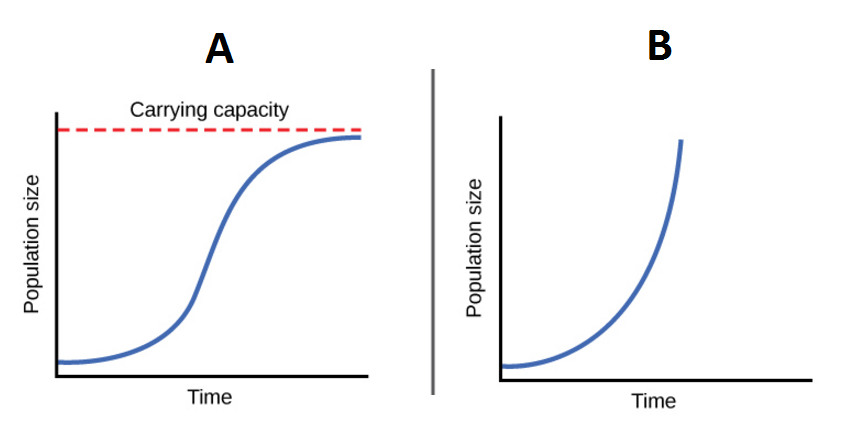
What type of growth model is shown in image A?
Exponential
Logistic