
Font size
S
M
L
XL
 Worksheets
Unit Test - Nervous, Cardio, Resp. and Digestive Systems
Total questions: 48
Worksheet time: 24mins
Name
Class
Date
1.
Impulse conduction is fastest in neurons that are:
a)
myelinated
b)
sensory
c)
motor
d)
unmyelinated
2.
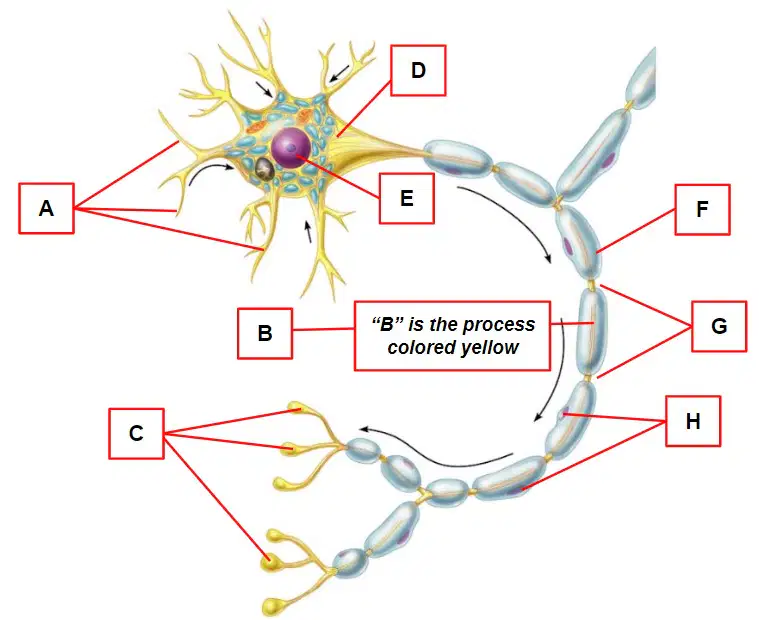
The neuron processes that normally receive incoming stimuli are called and is identified by letter ______.
a)
Nucleus, F
b)
Microglia, C
c)
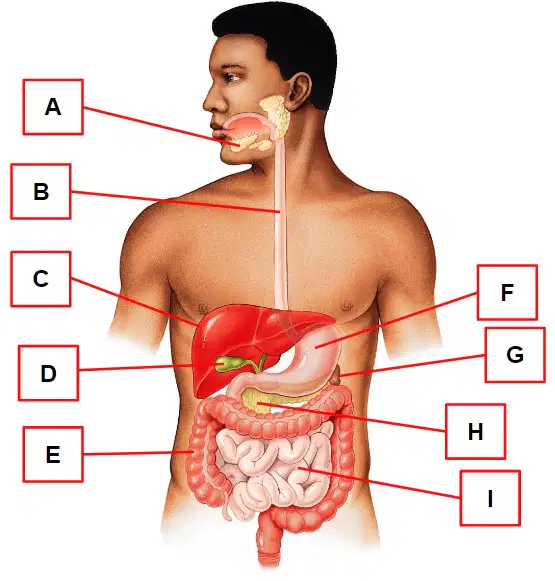
Dendrites, A
d)
Axons, E
3.
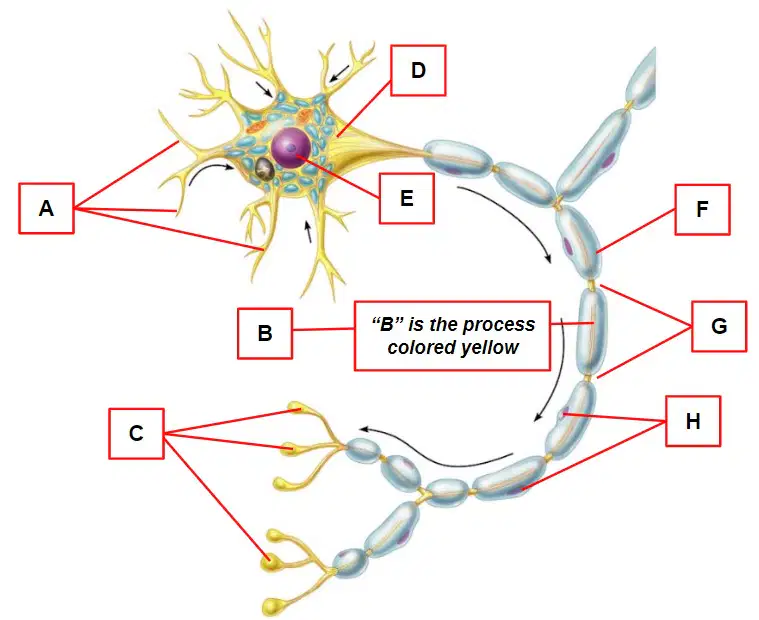
Identify B.
a)
Neurolemma
b)
Microglia
c)
Dendrites
d)
Axons
4.
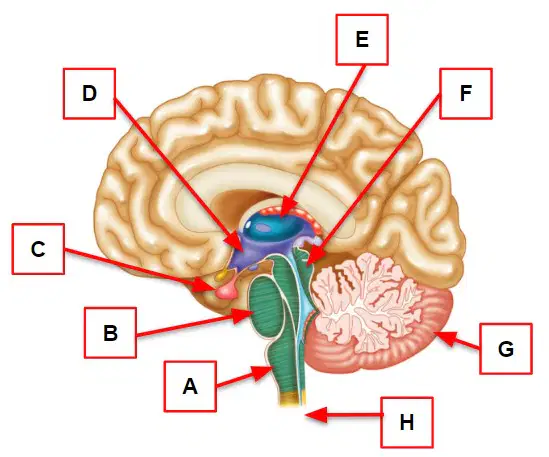
Which of the following brain structures is the Medulla Oblongata?
a)
A
b)
B
c)
C
d)
D
5.
An action potential:
a)
involves the movement of ions across an axon which depolarizes the membrane
b)
involves the movement of neurotransmitters across the axon and results in a polarization of the membrane.
c)
is initiated by potassium ion movements
d)
only takes place at the neurons synaptic cleft.
6.
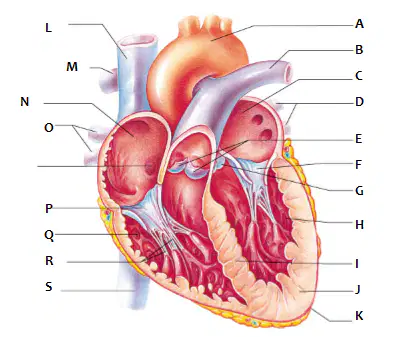
The aorta is identified by letter (a) .
7.
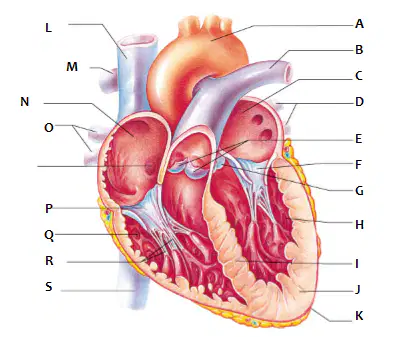
Which of the following is the bicuspid valve (also called the mitral or left AV valve)?
a)
C
b)
D
c)
E
d)
F
8.
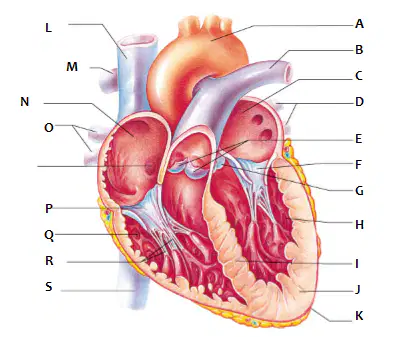
The chordae tendineae is identified by letter ___.
a)
R
b)
I
c)
B
d)
S
9.
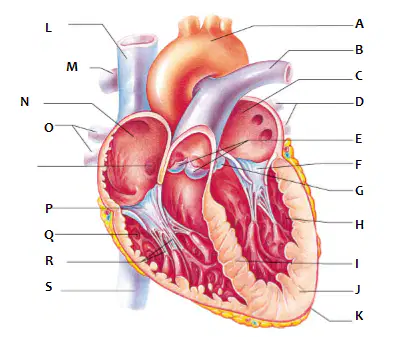
The right ventricle is identified by letter ___.
a)
C
b)
H
c)
Q
d)
N
10.
Which of the following areas received blood directly from the pulmonary veins?
a)
lungs
b)
right atrium
c)
right ventricle
d)
left atrium
11.
Arteries always carry blood away from the heart.
a)
True
b)
False
12.
Which vessel carries deoxygenated blood from the heart to the lungs?
a)
pulmonary artery
b)
aorta
c)
pulmonary vein
d)
bronchiole veins
13.
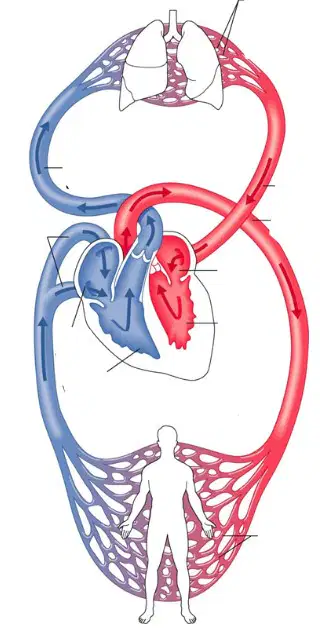
Which of the following is the correct sequence for blood flow in the heart?
a)
capillary bed - left atrium - left ventricle - aorta - lungs - pulmonary veins - right ventricle - right atrium - superior/inferior vena cava
b)
aorta - right ventricle - right atrium - superior/inferior vena cava - capillary bed - left atrium - left ventricle -pulmonary arteries - lungs
c)
Superior/inferior vena cava - right atrium - right ventricle - pulmonary artery - lungs - pulmonary veins - left atrium - left ventricle - aorta - capillary bed
d)
Right atrium - right ventricle - Superior/inferior vena cava - capillary beds - pulmonary veins - left atrium - left ventricle - aorta - lungs
14.
Which of the following refers to the contraction of heart muscle.
a)
Myocardial Rhythm
b)
Systole
c)
Dystole
d)
Bradycardia
15.
Which heart chamber pumps blood to the aorta and to the body?
a)
left ventricle
b)
right atrium
c)
right ventricle
d)
left atrium
16.
The second heart sound (the 'dup' of 'lub-dup') is caused by the _______.
a)
closure of the semilunar valves
b)
opening of the semilunar valves
c)
opening of the atrioventricular valves
d)
closure of the atrioventricular valves
17.
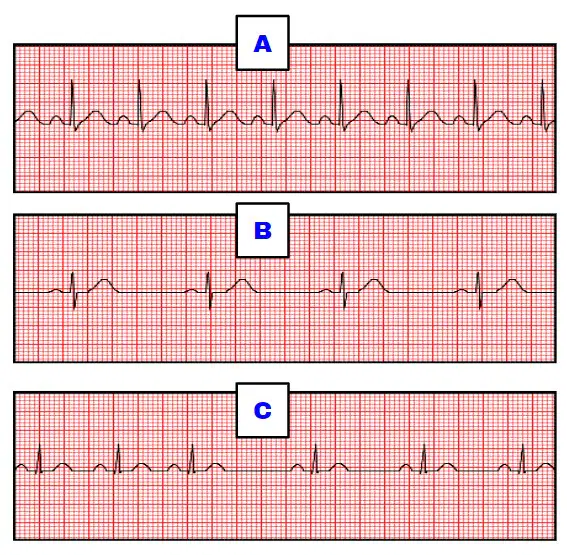
Which of the following ECG/EKG prints indicated Arrhythmia?
a)
A
b)
B
c)
C
18.
The pacemaker of the heart is the
a)
sinoatrial (SA) node
b)
atrioventricular (AV) bundle
c)
atrioventricular (AV) node
d)
vagus nerve
19.
The pacemaker of the heart is the
a)
sinoatrial (SA) node
b)
atrioventricular (AV) bundle
c)
atrioventricular (AV) node
d)
vagus nerve
20.
What is the diagnosis for a person with the following blood pressure results: a systolic reading of 150 and a diastolic reading of 95 (150/95)?
a)
normal blood pressure
b)
high blood pressure (hypertension)
c)
bradycardia
d)
low blood pressure (hypotension)
21.
Besides providing a passageway for gases that your body needs to exchange in order to survive, the nose, pharynx, trachea, and bronchioles have another very important assignment. What is that assignment? (check all that are correct) .
a)
purify the inhaled air
b)
humidify the inhaled air
c)
warm the inhaled air
d)
filter the inhaled air
22.

The lung structures where internal respiration occurs (gas exchange between the blood and tissue cells) are called ____________________.
a)
1) Bronchioles
b)
2) Alveoli
c)
3) Pleural cavities
d)
4) Trachies
23.

The Larynx is shown by letter _______.
a)
A
b)
B
c)
C
d)
D
24.

The mucosa-lined windpipe that extends from the larynx to the 5th thoracic vertebra where it branches into the main bronchi tubes to the lungs. It is reinforced with C-shaped rings of hyaline cartilage.
a)
glottis
b)
pharynx
c)
esophagus
d)
trachea
25.

The Pharynx is shown by letter _______.
a)
A
b)
B
c)
G
d)
H
26.

The Left and Right Bronchi are shown by letters _______.
a)
A & B
b)
F & J
c)
E & I
d)
G & H
27.

The muscle that creates negative pressure so that the lungs inflate with air is the Diaphragm and is indicated by letter _______.
a)
F
b)
E
c)
H
d)
K
28.
Inflammation of the sinuses that can cause marked changes in voice quality is called ____________________.
a)
Pleurisy
b)
Bronchitus
c)
Sinusitus
d)
Ashthma
29.
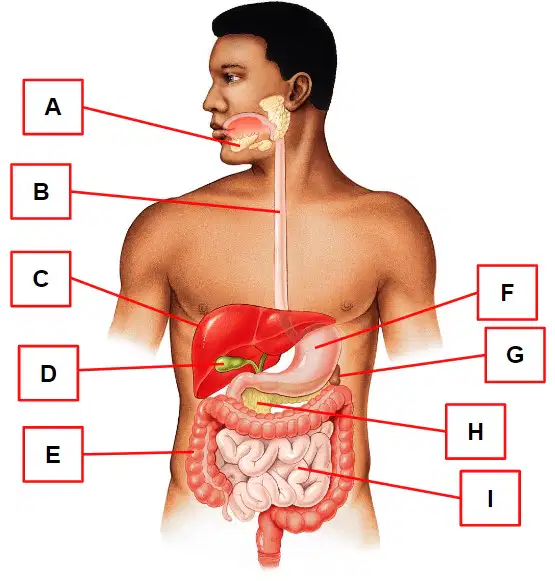
The Parotid Gland (one of the Salivary glands) is indicated by letter ______.
a)
A
b)
B
c)
C
d)
D
30.
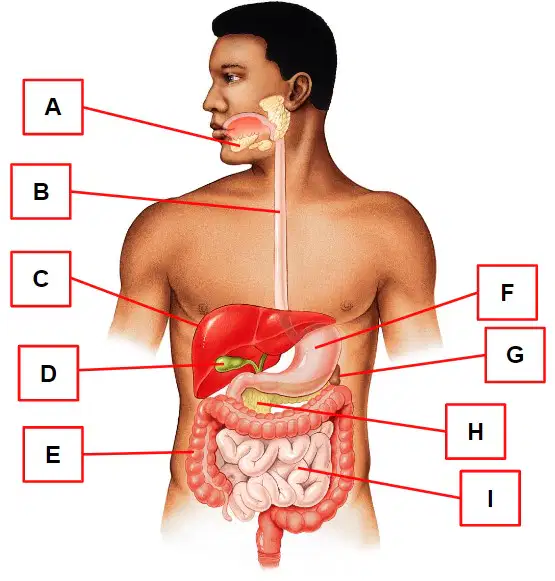
The Esophagus is indicated by letter ______.
a)
A
b)
B
c)
C
d)
D
31.
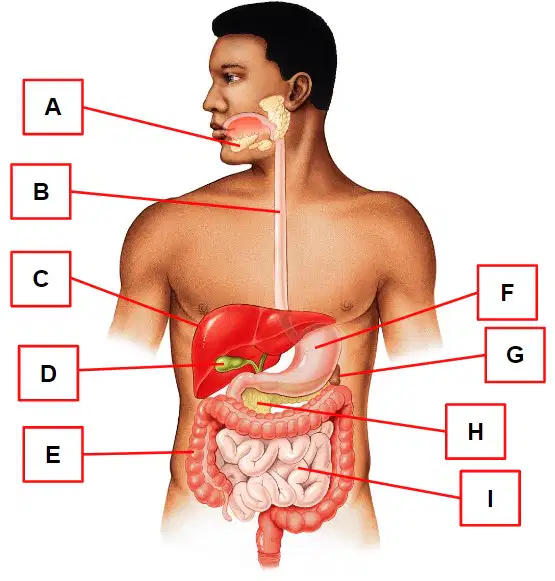
The Liver is indicated by letter ______.
a)
A
b)
B
c)
C
d)
D
32.
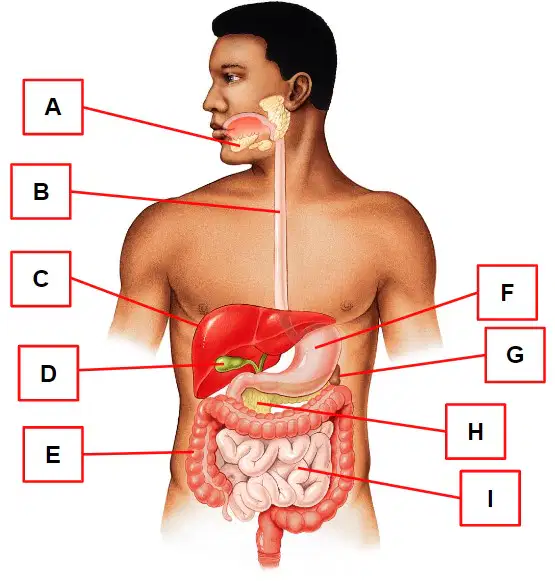
The Stomach is indicated by letter ______.
a)
C
b)
D
c)
E
d)
F
33.
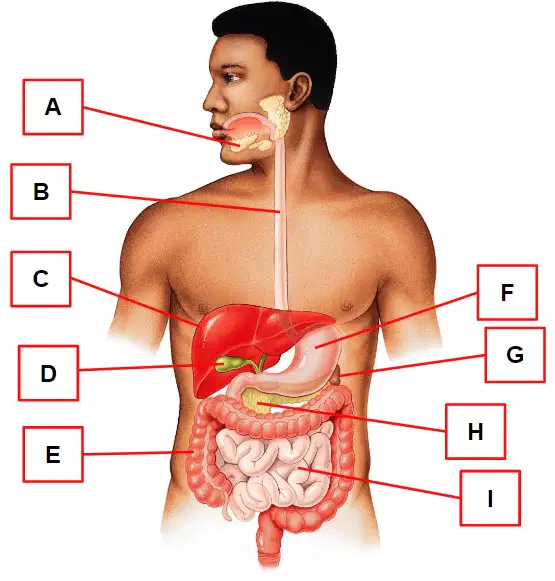
The Gallbladder is indicated by letter ______.
a)
C
b)
D
c)
E
d)
F
34.
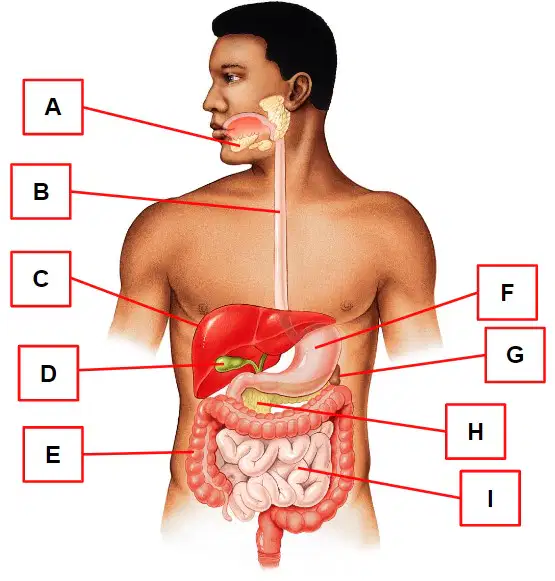
The Small Intestines are indicated by letter ______.
a)
H
b)
I
c)
G
d)
E
35.
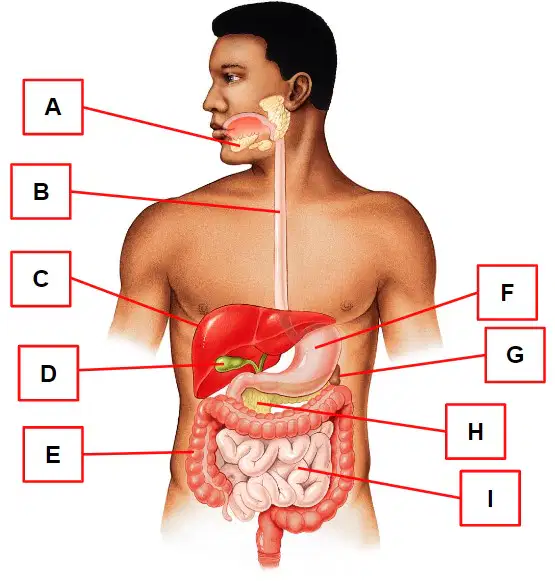
The Ascending Colon (a section of the Large Intestines) is indicated by letter ______.
a)
H
b)
I
c)
G
d)
E
36.
The Pancreas is indicated by letter ______.
a)
H
b)
I
c)
G
d)
E
37.
What organ of the Digestive System produces the hormone, insulin, which has the critical function of sugar regulation in the blood stream?
a)
Liver
b)
Stomach
c)
Spleen
d)
Pancreas
38.
Which of the following areas received blood directly from the pulmonary veins?
a)
lungs
b)
right atrium
c)
right ventricle
d)
left atrium
39.
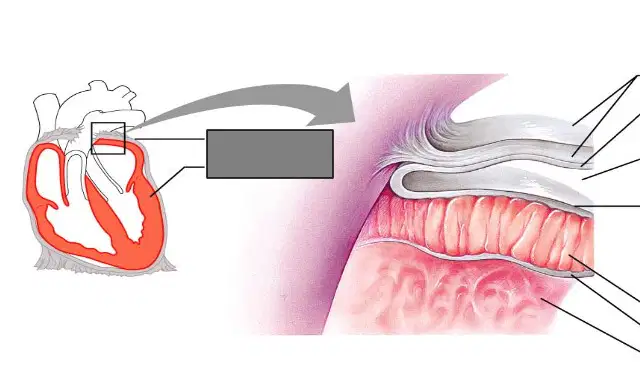
The layer of the heart wall that contains cardiac muscle tissue is the
a)
pericardium
b)
endocardium
c)
epicardium
d)
myocardium
40.
What types of blood vessels always carry blood towards the heart?
a)
Arteries
b)
Veins
c)
Systemic
d)
Pulmonary
41.
Systole means contraction of heart muscle.
a)
True
b)
False
42.
Calculate the cardiac output of an individual with a stroke volume of 70 ml and a heart rate of 70 beats/minute.
a)
1 ml/min
b)
140 ml/min
c)
4900 ml/min
43.

Wednesday (11/30/22) The P wave of an ECG
a)
is the first small wave of the ECG and represents depolarization of the atrial (atrial contraction or systole)
b)
is the second large wave of the ECG and represents repolarization of the ventricles (ventricle systole)
c)
is the third small wave of the ECG and represents repolarization of the ventricles.
d)
is the "dip" in the ECG and shows an abnormal heart rhythm.
44.
What is the diagnosis for a person with the following blood pressure results: a systolic reading of 85 and a diastolic reading of 60 (85/60)?
a)
normal blood pressure
b)
high blood pressure (hypertension)
c)
bradycardia
d)
low blood pressure (hypotension)
45.
The superior vena cava empties
a)
oxygenated blood into the left atrium
b)
oxygenated blood into the left ventricle
c)
deoxygenated blood into the right atrium
d)
deoxygenated blood into the right ventricle
46.
The second heart sound (the 'dup' of 'lub-dup') is caused by the _______.
a)
closure of the semilunar valves
b)
opening of the semilunar valves
c)
opening of the atrioventricular valves
d)
closure of the atrioventricular valves
47.
The movement of blood through the heart and body is called:
a)
Systemic circulation
b)
Pulmonary circulation
48.
What wall separates the left side and right side of the heart?
a)
Ventricle wall
b)
Atrium wall
c)
Septum
d)
The great wall
Reset

