wayground logo

Free Printable Worksheets

NEW

Font size

S
M
L
XL
Worksheets

Evolution

Total questions: 39

Worksheet time: 30mins
Name
Class
Date
1.
Where the better adapted organisms survive to pass traits along to offspring.
a)
Evolution
b)
Natural Selection
c)
Extinction
d)
Artifical Selection
2.
Natural selection is when ____________ decides who survives and who doesn't
a)
nature
b)
humans
c)
animals
d)
years
3.
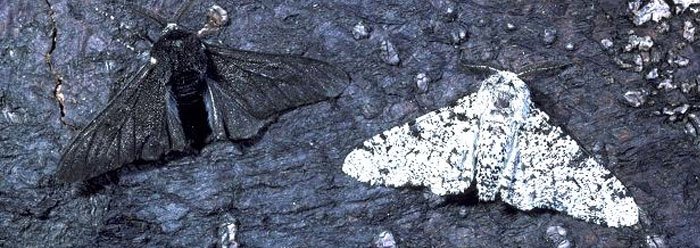
The trees these moths used to live on were white, but have been covered in soot from coal factories. Which moth will be more successful in this environment?
a)
Dark moth
b)
Light moth
c)
Both will be equally successful
d)
Neither will be successful
4.
Change over time
a)
Natural Selection
b)
Selective Breeding
c)
Homeostasis
d)
Evolution
5.
Structures with the same parts have different functions; suggests that organisms share a common ancestry
a)
vestigial structures
b)
homologous structures
c)
adaptive radiation
d)
fossil
6.
Study of embryos of various organisms to show a common ancestor because of similarities in development
a)
natural selection
b)
embryology
c)
speciation
d)
evolution
7.
The diagram shows fossils in different rock layers. Which of these statements about the age of these fossils is most likely correct?
a)
Fossil A and C are the same age
b)
Fossil B is older than fossil C
c)
Fossils A is older than fossil B
d)
Fossil D is older than fossil C
8.
What does Darwin's theory of evolution suggest?
a)
species change over time
b)
extinct species are not related to living species
c)
different species can interbreed
d)
animals that look alike are most closely related
9.

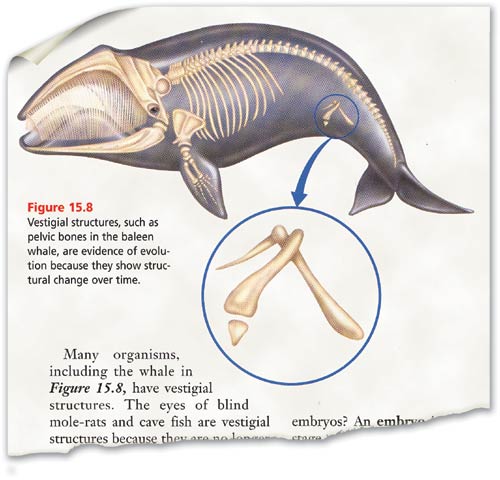
Whales are aquatic mammals that contain a pelvis (hip) bone. Even though it does not aid in its movement, the function must have been used by a common ancestor of the whale. Thus, the pelvis is referred to as a(n)

a)

vestigial structure

b)

analogous structure

c)

homologous structure

10.
The ability of an organism to survive and reproduce in its specific environment 
a)
diversity.
b)
evolution
c)
adaptation
d)
 fitness
11.
A theory has significant evidence to support it.  True or False
a)
True
b)
False
12.
Where humans have bred organisms together based on traits we like.
a)
Evolution
b)
Natural Selection
c)
Extinction 
d)
Artificial Selection
13.
Genetic differences between organisms of the same species
a)
Variation
b)
Adaptation
c)
Behavior
d)
Environment
14.
An error in DNA copying that results in a new trait
a)
Homeostasis
b)
Mutation
c)
Natural Selection
d)
Selective Breeding
15.
This scientist came up with the idea of natural selection.
a)
Jean Baptiste Lamarck
b)
Gregor Mendel
c)
Charles Darwin
d)
Thomas Malthus
16.
Inherited trait that helps an organism survive is a(n) __________.
a)
Fossil
b)
Adaptation
c)
Ancestor
d)
Natural selection
17.
Survival of the fittest or when favorable adaptations reproduce faster is called what?
a)
Evolution
b)
Adaptation
c)
Natural selection
d)
Fossilization
18.
Structures with the same parts have different functions; suggests that organisms share a common ancestry
a)
vestigial structures
b)
homologous structures
c)
adaptive radiation
d)
fossil
19.
Which of the following is an example of a vestigial structure?
a)
the wings of a red-tailed hawk
b)
the hind limbs of a house cat
c)
the fins of sharks
d)
the tailbone of a human
20.
The diagram shows fossils in different rock layers. Which of these statements about the age of these fossils is most likely correct?
a)
Fossil A and C are the same age
b)
Fossil B is older than fossil C
c)
Fossils A is older than fossil B
d)
Fossil D is older than fossil C
21.
Two organisms that are closely related would have
a)
very similar DNA sequence
b)
exactly the same DNA sequences
c)
no proteins in common
d)
completely different DNA sequence
22.
Comparing human hemoglobin of chimpanzees, horses, kangaroos, and chickens, reveal that humans have the fewest amino acid differences with 
a)
Kangaroos
b)
Horses
c)
chickens
d)
chimpanzees
23.
All the individuals of a species that live in a particular area are called a
a)
variation
b)
population
c)
fossil
d)
group
24.
According to the law of superposition, which layer is the youngest?
a)
A
b)
B
c)
C
25.
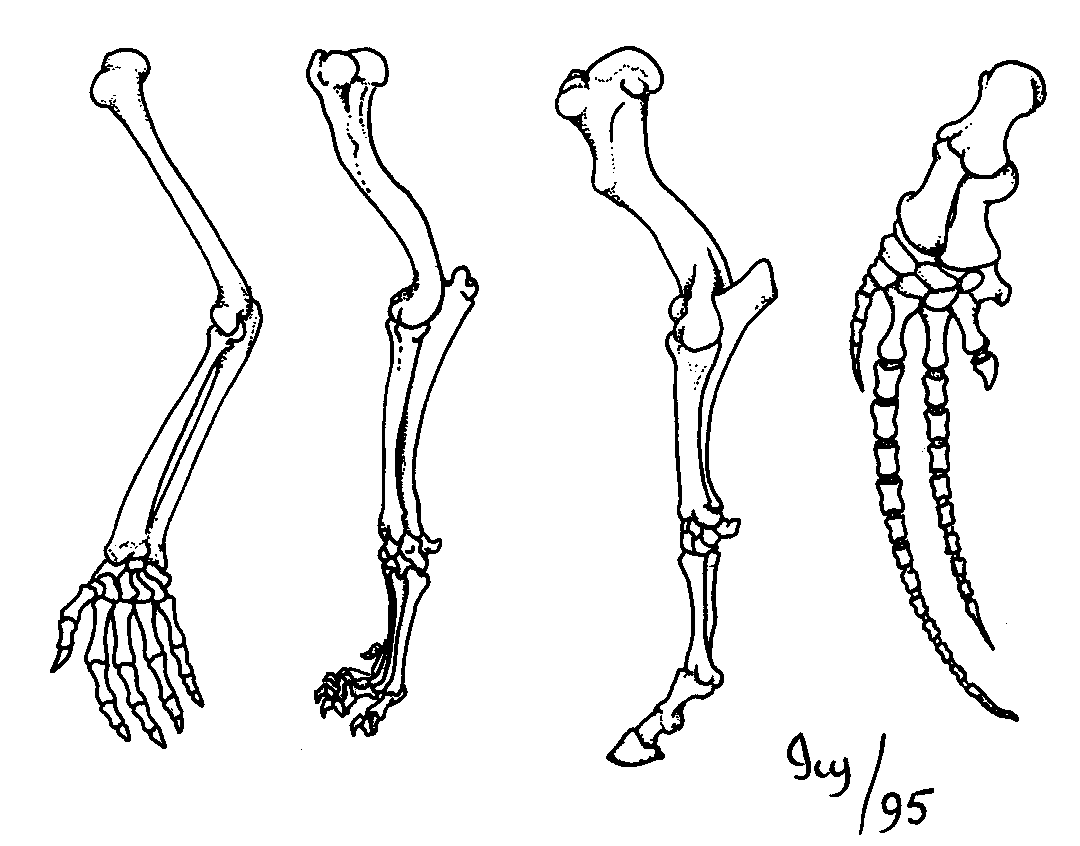
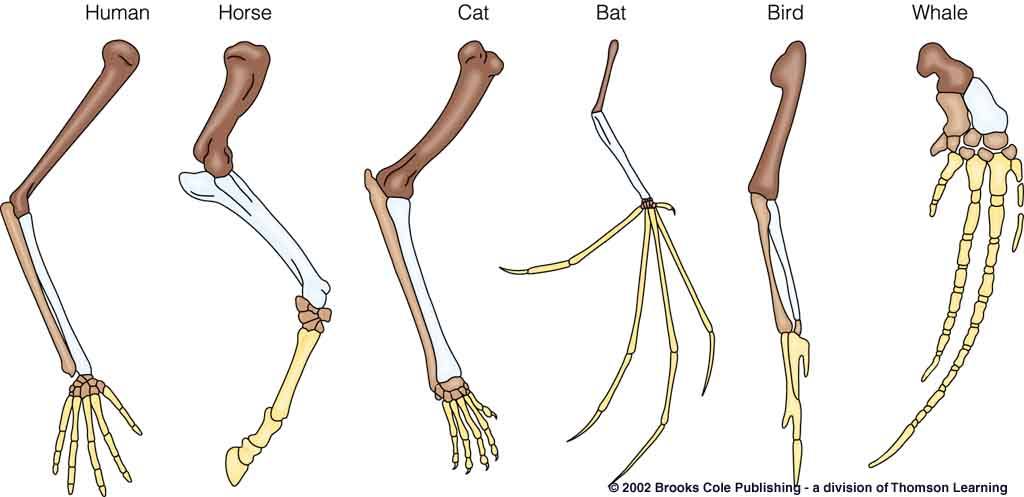
The structures shown are_________
a)
homologous
b)
heterologous
c)
analogous
d)
vestigial
26.

Darwin studied the preserved remains of ancient organisms called

a)

homologous structures

b)

fossils

c)

vestigial structures

d)

adaptations

27.

What idea did Larmarck propose that was later proven to be incorrect?

a)

All species are descended from a common ancestor

b)

There is a relationship between an organism and its environment

c)

Living organisms change over time

d)

Acquired characteristics can be inherited

28.

An inherited characteristic that increases an organism's ability to survive and reproduce in its specific environment is called a(n)

a)

vestigial structure

b)

speciation

c)

analogous structure

d)

adaptation

29.

Which of the following is the correct way to summarize natural selection?

a)

overproduction, competition, variations, fitness, survive and reproduce

b)

overproduction, variations, competition, fitness, survive and reproduce

c)

competition, fitness, survive and reproduce

d)

variations, competition, fitness, survive and reproduce

30.
What type of evolution where there is a sudden, rapid change then no change for a long time?
a)
Co-Evolution
b)
Punctuated Equilibrium
c)
Divergent Evolution
d)
Convergent Evolution
31.

Evolution occurring gradually and slowly over long periods of time

a)

Homeostasis

b)

Stasis

c)

Punctuated Equilibrium

d)

Gradualism

32.

The adaptations of wasps, flying fish, flying birds, and bats that allow them to fly are examples of:

a)

punctuated evolution

b)

convergent evolution

c)

divergent evolution

d)

gradual evolution

33.

The rapid speciation of one ancestral species into many descendant species is called

a)

Adaptive radiation

b)

Punctuated equilibrium

c)

Coevolution

d)

Divergent evolution

34.

Which best describes punctuated equilibrium?

a)

Speciation occurs due to natural selection

b)

Speciation occurs due to isolation

c)

Speciation occurs slowly in geologic time, followed by long periods with very fast evolutionary change.

d)

Speciation occurs suddenly and rapidly in geologic time, followed by long periods with little evolutionary change.

35.
In convergent evolution, organisms share physical similarities because they 
a)
have a common ancestor
b)
live in the same enviornment
c)
develop homologous structures
d)
are closely related 
36.

Fireflies make a pattern of flashes that attract mates of their own species. What type of isolation is this?

a)

Geographic Isolation

b)

Behavioral Isolation

c)

Temporal Isolation

37.

Based on the image above, what type of Isolation is shown?

a)

Geographic Isolation

b)

Behavioral Isolation

c)

Temporal Isolation

38.

One species of lizard breeds in the spring, one breeds in the summer. What type of isolation is this?

a)

Geographic Isolation

b)

Behavioral Isolation

c)

Temporal Isolation

39.
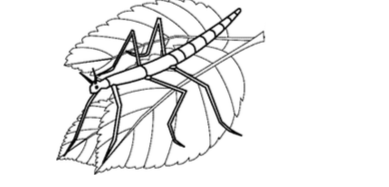
The illustration below shows an insect resting on some green leaves. 
The size, shape, and green color of this insect are adaptations that would most likely help the insect to 

a)
compete successfully with all birds 
b)
make its own food
c)
hide from predators
d)
avoid toxic waste materials