Wayground logo

Free Printable Worksheets

Font size

S
M
L
XL
Worksheets

Watershed Review

Total questions: 96

Worksheet time: 2hrs 34mins

Name
Class
Date
1.

What is the profile view to topographic map 1? 

a)

A

b)

B

c)

C

d)

D

2.

What is the profile view to topographic map 2?

a)

B

b)

C

c)

D

d)

E

3.

What is the elevation of the small island on the left side? Think about WHERE the ISLAND is located.

a)

At sea level

b)

About 40 meters

c)

About 60 meters

d)

About 200 meters

4.
What feature is formed at B?
a)

river

b)

rift valley

c)

sink hole

d)

mountain

5.

A mountaineer is planning a hike. He wants to follow the gentlest possible path, which means he needs to find the most gentle slope up the mountain. Which route should the mountaineer choose?

a)

Route A

b)

Route B

c)

 Route C

d)

Route D

6.
What do close contour lines represent on a map?
a)
waterfall
b)
steep area
c)
gradual area
d)
river
7.
What do contour lines that are farther apart represent?
a)
waterfall
b)
steep area
c)
gentle slope
d)
river
8.
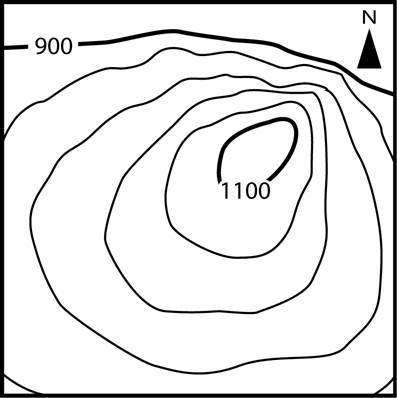
Provided is a topographic map of a hill with contour lines drawn showing elevation in meters.
The steepest slope on this hill can be found on the side that is facing which direction?
a)

South

b)

North

c)

West

d)

East

9.
Determine the contour interval
a)
10 m
b)
20 m
c)
50 m
d)
100 m
10.

What describes the shape of the land and surface features?

a)

Biology

b)

Topography

c)

Geology

d)

Oceanography

11.

All points on the same __________ have the same elevation.

a)

relief line

b)

slope

c)

valley

d)

contour line

12.
Contour lines that are very close together indicate the land is _______________
a)
gentle/gradual
b)
a forest
c)
steep
d)
a swamp
13.
Contour lines that are very far apart indicate the landscape is _____________
a)
gentle/gradual
b)
steep
c)
a forest
d)
a swamp
14.
Determine the contour interval:
a)
5 m
b)
10 m
c)
15 m
d)
20 m
15.
Determine the contour interval:
a)
5 m
b)
10 m
c)
15 m
d)
20 m
16.

Match 5

a)

A

b)

F

c)

C

d)

E

17.

Match 6

a)

B

b)

C

c)

D

d)

A

18.
Match 4
a)
C
b)
D
c)
E
d)
F
19.
What is a simple definition of a wetland?
a)
low lying lands with spongy soil that are wet all the  time every year
b)
low lying lands with spongy soil that are wet for a certain time every year
c)
high lands with spongy soil that are wet for a certain time every year
d)
low lying lands with moist soil that are wet all the  time every year
20.
Which type of wetland is best described as, "The plants growing here are grasses, reeds, sedges, and some shrubs."
a)
bogs
b)
fens
c)
swamps
d)
marsh
21.
Which type of wetland would be best described as "usually characterized by the growth of woody plants such as cypress and tupelo trees. "​ 
a)
bogs
b)
fens
c)
swamp
d)
marsh
22.
This is a wetland marsh composed of a mixture of both salt and freshwater (brackish water). 
a)
estuary
b)
fen
c)
bog
d)
river
23.
These are the three main jobs of wetlands.
a)
provide habitats, store flood waters, purify water
b)
provide habitats, store plant life, purify water
c)
purify water, store wildlife, provide habitats
d)
purify the land, store flood waters, provide habitats
24.

Wetlands store flood waters. How is this beneficial? Choose the best answer.

a)

Its not really beneficial because this may flood peoples homes.

b)

It releases the water is increments which will really increase the wildlife in that area.

c)

It releases the water in increments ( a little at a time) which slows the water down thus slowing erosion.

d)

Its really not beneficial because this will flood the habitats of the wildlife living there.

25.
Which description below best describes how wetlands purify water?
a)
Wetlands slow down the water flow when the water encounters the vegetation. This allows the sediments and pollutants to drop out of the water before the water moves on.
b)
Wetlands don't really purify the water. They just slow it down and the heat from the Sun makes it hot enough to purify the water before it moves on.
c)
Wetlands slow down the water flow so that sediments and pollutants can drop out of the water before it moves on.
d)
Wetlands can't really purify the water because they release the water in large increments which doesn't allow enough time for it to be cleaned.
26.

How would you describe the SOIL in the wetlands?

a)

always very dry

b)

always very wet

c)

like a sponge

27.

All of the following are animals found in the wetlands EXCEPT...

a)

frog

b)

turtle

c)

mosquito

d)

polar bear

28.

where are wetlands found?

a)

only in south carolina

b)

all over the USA

c)

only in ohio

d)

in the ocean

29.

wetlands are good for everything EXCEPT...?

a)

they help filter dirty water

b)

they provide a habitat for many plants and animals

c)

they help control flooding

d)

throwing old tires in

30.
What are the 3 types of wetlands?
a)
swamp, ocean, river
b)
pond, river, marsh
c)
marsh, marsh, marsh
d)
swamp, marsh, bog
31.
An ecosystem has :
a)
living things
b)
living and nonliving things
c)
nonliving things
d)
nothing
32.
A living or once-living organisms in an ecosystem is a
a)
population
b)
biotic factor
c)
abiotic factor
d)
community
33.
A nonliving element in an ecosystem is an 
a)
animal
b)
abiotic factor
c)
biotic factor
d)
organism
34.
Which of the following is not an abiotic factor?
a)
sun
b)
temperature
c)
soil
d)
grass
35.
Which of the following is not a biotic factor?
a)
mushroom
b)
air
c)
elephant
d)
coyote
36.
Is a deer an abiotic or biotic factor? 
a)
abiotic
b)
biotic
37.
Is a weather an abiotic or biotic factor? 
a)
abiotic
b)
biotic
38.
Is sunlight an abiotic or biotic factor? 
a)
abiotic
b)
biotic
39.

All water eventually empties into

a)

an ocean

b)

a river

c)

the ground

d)

a lake

40.

An area of land that drains to a particular river, lake, bay, or other body of water.

a)

Tributary

b)

Wetland

c)

Divide

d)

Watershed

41.

All bodies of fresh water, salt water, ice, and snow that are found above ground

a)

Groundwater

b)

Surface water

c)

Runoff

d)

Swimming pool

42.
The water that fills lakes and rivers
a)
groundwater
b)
surface water
c)
water table
d)
saturated zone
43.
Water stored  in cracks and pores below the Earth's surface is called:
a)
Groundwater
b)
Bogs
c)
Water in the ground
d)
surface water
44.
3 states of water found on earth
a)
solid, liquid & gas
b)
oceans, lakes & streams
c)
evaporation, transpiration
d)
rain, sleet & hail
45.

Is the level of nitrates acceptable?

Nitrates = 8.3 m/gL

Increased algae

Dissolved oxygen = 2 ppm

Lots of direct sunlight

a)

No

b)

Yes

46.

What is the temperature of the wate?

Nitrates = 8.3 m/gL

Increased algae

Dissolved oxygen = 2 ppm

Lots of direct sunlight

a)

High

b)

Average

c)

Low

47.

Is the amount of dissolved oxygen accceptable?

Nitrates = 8.3 m/gL

Increased algae

Dissolved oxygen = 2 ppm

Lots of direct sunlight

a)

Yes

b)

No

48.

What is the water quality of the pond?

Nitrates = 8.3 m/gL

Increased algae

Dissolved oxygen = 2 ppm

Lots of direct sunlight

a)

Poor

b)

Average

c)

Good

49.

An estuary is best defined as a place where--

a)

fresh and salt water meet

b)

a river meets the Chesapeake Bay

c)

a group of animals are gathered

d)

the water from the land flows into a river

50.

Which of the following is NOT TRUE of estuaries?

a)

Estuaries provide a habitat for biotic factors

b)

Estuaries create a protective refuge for living things

c)

Estuaries allow juvenile animals to grow into adults safetly

d)

Estuaries create shelter for aquatic and non-aquatic life.

51.
Which of the following is NOT true about an Estuary?
a)
They can be comprised of multiple other intertidal zones
b)
They are a common mating ground for Marine birds
c)
They are often found where a river meets the ocean
d)
They are all saltwater
52.

Why are estuaries important to our environment?

a)

Estuaries filter pollutants and prevent erosion.

b)

Estuaries provide nurseries for marine life.

c)

Estuaries act as home for many types of wildlife.

d)

All of the above.

53.
When salt and fresh water mix, what is the new water substance called?
a)
Brackish Acid
b)
Fresh Water
c)
Salt Water
d)
Brackish Water
54.

How have estuaries been affected by humans?

a)

dredged to make harbors

b)

filled in for development

c)

polluted by industrial parks

d)

all answers are correct

55.

True or False:

Estuaries are one of the most productive Ecosystems/Biomes in the world.

a)

False

b)

True

56.

Species living in the Intertidal Zone include

a)

Sharks

b)

Whales

c)

Sea Stars

d)

Jellyfish

57.

Rivers or streams that flow into larger bodies

a)

lakes

b)

tributaries

c)

gulfs and bays

d)

rivers

58.

Large streams of water that flow along a certain path

a)

lakes

b)

tributaries

c)

gulfs and bays

d)

rivers

59.

Area of land, usually rounded in shape, that is higher than the surrounding land but not as high as a mountain

a)

mountains

b)

hills

c)

plains

d)

plateaus

e)

islands

60.

Match the following

a)

Boundaries

1.

determines the area of a particular watershed

b)

Watershed

2.

an area that catches the water that falls to Earth’s surface and drains it to a common point

c)

Gravity

3.

causes water in a watershed drain to the lowest water source in the area

61.

What are some ways that watersheds can be polluted? (select all that apply)

a)

sewers emptying into rivers

b)

oil leaking

c)

littering

d)

washing car

e)

picking up after pets

62.

Match the following

a)

water traveling over the land surface before reaching a stream

1.

runoff

b)

common farming pollutants

2.

fertilizers and pesticides

c)

streams, rivers, lakes, ponds, oceans

3.

surface water

d)

water that soaks into and collects under the ground

4.

groundwater

63.

What are some ways to prevent watershed pollution? (select all that apply)

a)

picking up after pets

b)

planting trees and grass

c)

reducing fertilizer use

d)

washing car

e)

littering

64.

What types of habitats are wetlands? (select all that apply)

a)

bog

b)

desert

c)

swamp

d)

forest

e)

marsh

65.
An area of land where the surface water and ground water drain into a particular body of water.
a)
aquifer
b)
watershed
c)
subsidence
d)
divide
66.

____________ is water from precipitation that moves across the ground surface before ending up in a stream, creek, or bayou.

a)

watershed

b)

groundwater

c)

runoff

d)

aquifer

67.
Why is gravity a factor in watersheds? 
a)

it causes the water to flow away from a watershed

b)

it causes the water to flow into and through a watershed

68.

Which watershed is the largest in the United States?

a)

Mississippi River Watershed

b)

Potomac River Watershed

c)

Shenandoah River Watershed

d)

James River Watershed

69.

Water occurring in a stream, lake, river, reservoir, estuary, wetland or the ocean.

a)

Waterhsed

b)

Drainage Divide

c)

Surface Water

d)

Ground Water

70.

A barrier, such as a ridge, hill or mountain, separating one watershed land area from another.

a)

Runoff

b)

Divide (or watershed boundary)

c)

Aquifer

d)

Permeable

71.

Water that collects in cracks and pores in underground soil and rock layers.

a)

Groundwater

b)

Surface Water

c)

Permeable

d)

Impermeable

72.

A student’s model of an area near a city depicts many activities that affect the quality of the water in the area. How does the agricultural activity most likely affect the surface water of the area?

a)

Crops absorb pure water from soil, causing the remaining water to contain more salt.

b)

Crops reduce erosion, increasing the amount of soil entering the river.

c)

Excess crop fertilizer is carried by runoff into the river, causing excess growth of water plants.

d)

Excess crop material accumulates on the riverbanks, slowing the movement of the river water

73.

When runoff crosses the land, it picks up fertilizers that have been used on crops and lawns. These contaminants will eventually enter a lake, river or stream, which may lead to -

a)

the earth’s surface to sink.

b)

the water in an aquifer to drop.

c)

harmful rapid growth of algae.

d)

cleaner water for drinking and bathing.

74.

Which of these is NOT a function of wetlands?

a)

They are excellent areas for disposing waste.

b)

They provide shelter for wildlife.

c)

They help remove pollutants from the water.

d)

They help reduce erosion of the land.

75.

Water that collects in cracks and pores in underground soil and rock layers.

a)

Groundwater

b)

Surface Water

c)

Permeable

d)

Impermeable

76.

An area of land where the surface water and groundwater drain into a particular body of water

a)

Watershed

b)

Drainage Divide

c)

Erosion

d)

Aquifer

77.
All the living things in an ecosystem are called ______________________ factors.
a)
Ecosystem
b)
Environment
c)
Biotic
d)
Abiotic
78.
All the non-living things in an ecosystem are called ______________________ factors.
a)
Ecosystem
b)
Environment
c)
Biotic
d)
Abiotic
79.
An ___________________ is all the living AND non-living things in an area.
a)
Ecosystem
b)
Environment
c)
Biotic
d)
Abiotic
80.
What does the prefix "bio-" mean?
a)
Scientific
b)
Not
c)
Dead
d)
Alive
81.
What does the prefix "a-" mean?
a)
Scientifix
b)
Not
c)
Dead
d)
Alive
82.
Is the following factor Biotic or Abiotic?
Sunlight
a)
Biotic
b)
Abiotic
83.
Is the following factor Biotic or Abiotic?
Tree
a)
Biotic
b)
Abiotic
84.
Is the following factor Biotic or Abiotic?
River
a)
Biotic
b)
Abiotic
85.
Is the following factor Biotic or Abiotic?
Rocks
a)
Biotic
b)
Abiotic
86.
Is the following factor Biotic or Abiotic?
Insects
a)
Biotic
b)
Abiotic
87.
Is the following factor Biotic or Abiotic?
Tiger
a)
Biotic
b)
Abiotic
88.
Is the following factor Biotic or Abiotic?
Snake
a)
Biotic
b)
Abiotic
89.
Is the following factor Biotic or Abiotic?
Rain
a)
Biotic
b)
Abiotic
90.
Is the following factor Biotic or Abiotic?
Fallen Leaves
a)
Biotic
b)
Abiotic
91.
Is the following factor Biotic or Abiotic?
Grass
a)
Biotic
b)
Abiotic
92.
Is the following factor Biotic or Abiotic?
Temperature
a)
Biotic
b)
Abiotic
93.
Is the following factor Biotic or Abiotic?
Flowers
a)
Biotic
b)
Abiotic
94.
Is the following factor Biotic or Abiotic?
Air
a)
Biotic
b)
Abiotic
95.
Is the following factor Biotic or Abiotic?
Dirt
a)
Biotic
b)
Abiotic
96.
Is the following factor Biotic or Abiotic?
Monkey
a)
Biotic
b)
Abiotic