wayground logo

Free Printable Worksheets

Font size

S
M
L
XL
Worksheets

Chemistry: Final Opportunity 2025/2026 Academic Session

Total questions: 100

Worksheet time: 1hrs 18mins

Name
Class
Date
1.

The first step in the Scientific Method is ___________?

a)

State your HYPOTHESIS

b)

RESEARCH

c)

MAKING AN OBSERVATION

d)

ANALYZING DATA

2.

After you make an observation you state the ____________?

a)

Problem/Question

b)

Hypothesis

c)

Conclusion

d)

Research

3.

An educated GUESS OR PREDICTION

a)

CONCLUSION

b)

RESEARCH

c)

ANALYZE

d)

HYPOTHESIS

4.

LISTING PROCEDURES AND MATERIALS ARE PART OF THE __________?

a)

EXPERIMENT

b)

QUESTION

c)

HYPOTHESIS

d)

CONCLUSION

5.

CHARTS AND GRAPHS ARE ALL PART OF ___________.

a)

PROCEDURES

b)

ANALYZING DATA

c)

MATERIALS

d)

QUESTION

6.

A SUMMARY OF YOUR RESULTS

a)

CONCLUSION

b)

HYPOTHESIS

c)

QUESTION

d)

DATA

7.
A scientist is conducting research on mealworms. Which of the following pieces of equipment should be used by the scientist to determine the mass of each mealworm?
a)
electronic balance
b)
ruler
c)
graduated cylinder
d)
beaker
8.
You suggest that the absence of water could prevent the growth of bread mold. This is-
a)
a hypothesis
b)
a conclusion
c)
an experiment
d)
an analysis
9.
The hypothesis you make is always correct.
a)
True
b)
False
10.

The Scientific Method is a way for scientists to investigate the __________ around them!

a)

classroom

b)

land

c)

sun

d)

world

11.

Horseplay, practical jokes, or pranks in the classroom/lab are

a)

not dangerous.

b)

okay if you are working alone.

c)

always against the rules.

d)

okay.

12.

The following activity is not permitted in the laboratory:

a)

chewing gum.

b)

eating.

c)

drinking.

d)

all of the above.

13.

What should you do if you have long hair?

a)

Tie it up before coming into the lab

b)

Shave off those dreads!

c)

Leave it hanging

d)

It depends on what you're doing in the lab that day

14.

SELECT ALL THAT APPLY: Which of the following CANNOT be worn in the lab

a)

Closed toed shoes

b)

Open toed shoes

c)

Loose / baggy clothing

d)

Dangling jewelry

15.

A toxic substance is poisonous if it enters your body.

a)
b)
c)
d)
16.

A chemical hazard can cause chemical burns.

a)
b)
c)
d)
17.

You should be careful because an open flame is present.

a)
b)
c)
d)
18.
a)

Wash your hands

b)

wear safety goggles

c)

wear a lab apron

d)

Poison

19.

Explosive Material

a)
b)
c)
20.
During the lab it is okay to
a)
Have a snack
b)
Drink in lab
c)
Taste chemicals
d)
None of the above
21.
a)
Oxidizing Agent
b)
Flamable
c)
Fire Extinguisher
d)
No Open Flame
22.
a)
Poison
b)
Bio Hazard
c)
Environmental Hazard
d)
Not Drinking Water
23.

Used to hold and/or mix solid and liquid materials

a)

beaker

b)

graduated cylinder

c)

test tube

d)

erlenmyer flask

24.

Used to measure specific volume of liquid

a)

beaker

b)

graduated cylinder

c)

test tube

d)

erlenmyer flask

25.

Used to hold the test tubes and keep from spilling

a)

test tube

b)

test tube rack

c)

pipette

d)

mortar

26.

What is the volume?

a)

23 mL

b)

28 mL

c)

36 mL

d)

38 mL

27.

Why is a graduated cylinder more accurate than a beaker?

a)

A graduated cylinder is made of glass.

b)

It has been to school and graduated. :)

c)

It has more marks for measurement because it is tall and skinny.

d)

A beaker does not have markings.

28.

Click on the picture to zoom in: Imagine you are in a chemistry lab. You see a group of students performing experiments. Which student is following all lab safety rules?

a)

H

b)

A

c)

E

d)

G

e)

D

29.
This lab tool is used to pick up small objects.
a)
Microscope
b)
Forceps
c)
Erlenmeyer Flask
d)
Triple Beam Balance
30.
When should you tie back long hair or baggy clothing?
a)
When working with chemicals
b)
When working with a Bunsen burner
c)
When doing dissections.
d)
Any time you are working in the lab.
31.
What is the name of this piece of science equipment?
a)
Culture chamber
b)
Culture dish
c)
Plastic chamber
d)
Petri dish
32.
Part of lab safety includes reading the lab procedure...
a)
before doing the lab
b)
while doing the lab
c)
after doing the lab
d)
only if you think you really need it
33.

Which term describes when a substance is changed from a liquid to a gas?

a)

Condensation

b)

Evaporation

c)

Filtration

d)

Precipitation

34.

Which of the following represent physical changes?

a)

fruit ripening

b)

milk turing sour

c)

chopping wood

d)

mixing food color and water

e)

melting butter

35.

Which of the following represent chemical changes?

a)

chopping wood

b)

milk turning sour

c)

breaking a pencil

d)

fruit ripening

e)

roasting a marshmellow

36.
Something that takes up space and has mass.
a)
volume
b)
matter
c)
mass
d)
density
37.
The amount of space something takes up
a)
density
b)
volume
c)
mass
d)
matter
38.
What are the three states of matter?
a)
solid, volume, mass
b)
density, volume, mass
c)
solid, liquid, gas
d)
density, gas, volume
39.
__________ are the building blocks of life.
a)
solids
b)
gases
c)
atoms
d)
nutrients
40.
Sand is a ___________________.
a)
liquid
b)
solid
c)
gas
41.

Yeimel is describing the physical properties of his new gaming chair. Which two physical properties can he determine without using any measuring instruments?

a)

taste and odor

b)

volume and temperatue

c)

texture and color

d)

shape and mass

42.

The image shows a lake.


Why is the lake considered matter?

a)

It is large

b)

It is living

c)

It has mass and volume

d)

It has physical properties

43.

Which term describes when a substance is changed from a liquid to a gas?

a)

Condensation

b)

Evaporation

c)

Filtration

d)

Precipitation

44.

A scientist uses an instrument to study the small particles in a piece of matter. The diagram shows what the scientist sees.


What state of matter is the scientist most likely observing?

a)

gas

b)

solid

c)

liquid

d)

vapor

45.

A scientist uses an instrument to study the small particles in a piece of matter. The diagram shows what the scientist sees.


What state of matter is the scientist most likely observing?

a)

gas

b)

solid

c)

liquid

d)

plasma

46.

A scientist uses an instrument to study the small particles in a piece of matter. The diagram shows what the scientist sees.


What state of matter is the scientist most likely observing?

a)

gas

b)

solid

c)

liquid

d)

vapor

47.

Which is true about all matter? Select all that apply.

a)

All matter has weight

b)

All matter takes up space

c)

All matter can be seen

d)

All matter has fixed volume

48.

All matter is made up of smaller pieces of matter called ____.

a)

particles

b)

space

c)

weight

d)

chemicals

49.

What is a solid?

a)

The particles are close together and locked in position, so they cannot move around each other and can only vibrate.

b)

Shape and volume are not fixed.

c)

Has a fixed volume and shape.

d)

Particles are pretty far apart and able to move around easily.

50.

What is a liquid?

a)

Particles are pretty far apart and able to move around easily.

b)

Shape and volume are not fixed.

c)

The particles are close together but they are able to move about.

d)

Has a fixed volume but does not have a fixed shape.

51.

What is a gas?

a)

The particles are spread apart and move freely in all directions.

b)

Does not have a fixed volume or shape. The amount of space that it takes up can change.

c)

Shape and volume of particles are fixed.

d)

Particles are very tightly packed, can only vibrate.

52.

In which state of matter would you classify butter?

a)

gas

b)

solid

c)

liquid

53.

In which state would you classify helium?

a)

solid

b)

liquid

c)

gas

54.

In which state would you classify vegetable oil?

a)

solid

b)

liquid

c)

gas

55.

How can matter change from state to state? Select all that apply.

a)

Each time matter changes state, it is simply the movement of molecules in them speeding up or slowing down. 

b)

When heat is added to a solid, it turns into a liquid.  When heat is added to a liquid, it evaporates and becomes a gas.

c)

When heat is removed from a gas it condenses and turns back into a liquid.  When a liquid freezes, it turns into a solid.

d)

Matter can't change from state to state.

56.
Iron + oxygen = rust is an example of a ___________.
a)
physical property/change
b)
chemical property/change
c)
mass
d)
volume
57.
Which physical property is measured in liters?
a)
color
b)
length
c)
mass
d)
volume
58.
Which liquid has the greatest density?
a)
lamp oil
b)
karo syrup
c)
water
d)
honey
59.
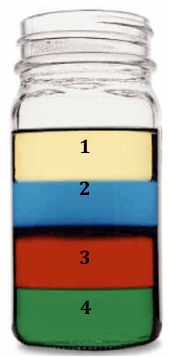
Put the liquids in order from most dense to least dense?
a)
4, 3, 2, 1
b)
1, 2, 3, 4
c)
3, 4, 2, 1, 
d)
4, 3, 1, 2
60.
What is this tool to get volume?
a)
triple beam balance
b)
ruler
c)
thermometer
d)
graduate cylinder
61.
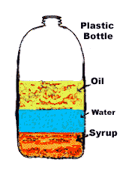
Which liquid is the least dense?
a)
oil
b)
water
c)
syrup 
d)
plastic bottle
62.
Why do the liquids form different layers?
a)
They have different densities.  
b)
They have different masses.  
c)
They have different volumes.  
d)
They are different temperatures.  
63.
A brick sinks in water while a wooden block of the same size floats.  This is because the brick has a
a)
lower volume than the wooden block
b)
lower density than the wooden block
c)
higher volume than the wooden block
d)
higher density than the wooden block
64.
Why do some substances float on water?
a)
they are warmer than water
b)
they are cooler than water
c)
they are more dense than water
d)
they are less dense than water
65.
Metric unit used to record mass.
a)
cm3
b)
grams (g)
c)
miliLiter
d)
liter (L)
66.
The metric unit used to measure the volume of a solid objects.
a)
grams
b)
miliLiter
c)
cm3
d)
Liter (L)
67.
What causes an object to float in a water?
a)
if the object's density is less than the water's density.
b)
if the object's density is the same as the water's density
c)
if the object's density is greater than the water's density
d)
if the object's density is zero
68.
What causes an object to sink in a water?
a)
if the object's density is less than the water's density.
b)
if the object's density is the same as water's density.
c)
if the object's density is greater than water's density.
d)
if the object's density is zero
69.
What property do these tools measure?
a)
volume
b)
mass
c)
length
d)
temperature
70.
What is volume of the water? 
a)
10 mL
b)
15 mL
c)
20 mL
d)
25 mL
71.
What is the volume of the rock?
a)
30cm3
b)
10cm3
c)
40cm3
d)
20cm3
72.

The formula for density is ___________.

a)

D = m / v

b)

M = d / v

c)

V = m / d

d)

D = v / d

73.

_______________________ is a method used to measure the volume of a solid object by placing it in a known amount of liquid.

a)

density

b)

volume

c)

mass

d)

water displacement

74.
Frank has a paper clip. It has a mass of 9g and a volume of 3cm3. What is its density?
a)
3 g/cm3
b)
1/3 g/cm3
c)
27 g/cm3
d)
39 g/cm3
75.
Frank has an eraser. It has a mass of 4g, and a volume of 2cm3. What is its density?
a)
8 g/cm3
b)
2 g/cm3
c)
1/2 g/cm3
d)
24 g/cm3
76.
An object with which of the following densities will float on water?
a)
0.7 g/cm3
b)
1.2 g/cm3
c)
3.5 g/cm3
d)
11.4 g/cm3
77.
Jack has a rock. The rock has a mass of 14g and a volume of 2cm3. What is the density of the rock?
a)
7 mL
b)
7 g/cm3
c)
28 g/cm3
d)
1/7 g/cm3
78.

Which SI unit is used to measure time?

a)

K

b)

s

c)

mol

d)

N

79.

What is the symbol for the prefix kilo-?

a)

L

b)

m

c)

k

d)

kg

80.
What number is the metric system based?
a)
10
b)
20
c)
1
d)
100
81.
2 kilometer = ___ meters
a)
1 meters
b)
1,000 meters
c)
2,000 meters
d)
200 meters
82.

what is the SI unit?

a)

A system that mainly measures mass

b)

a complete metric system of units of measurement for scientists

c)

length-only measuring system

d)

The system just measures temperature

83.
Write the full electronic structure for Na with 11 electrons.
a)
1s22s22p63s1
b)
1s22s23p63s1
c)
[Ne]3s1
d)
1s22s22p63p1
84.
How many electrons does potassium K contain? (click to see image)
a)
19
b)
39
c)
20
d)
40
85.
How many electrons can each p orbital hold?
a)
6
b)
3
c)
2
d)
4
86.
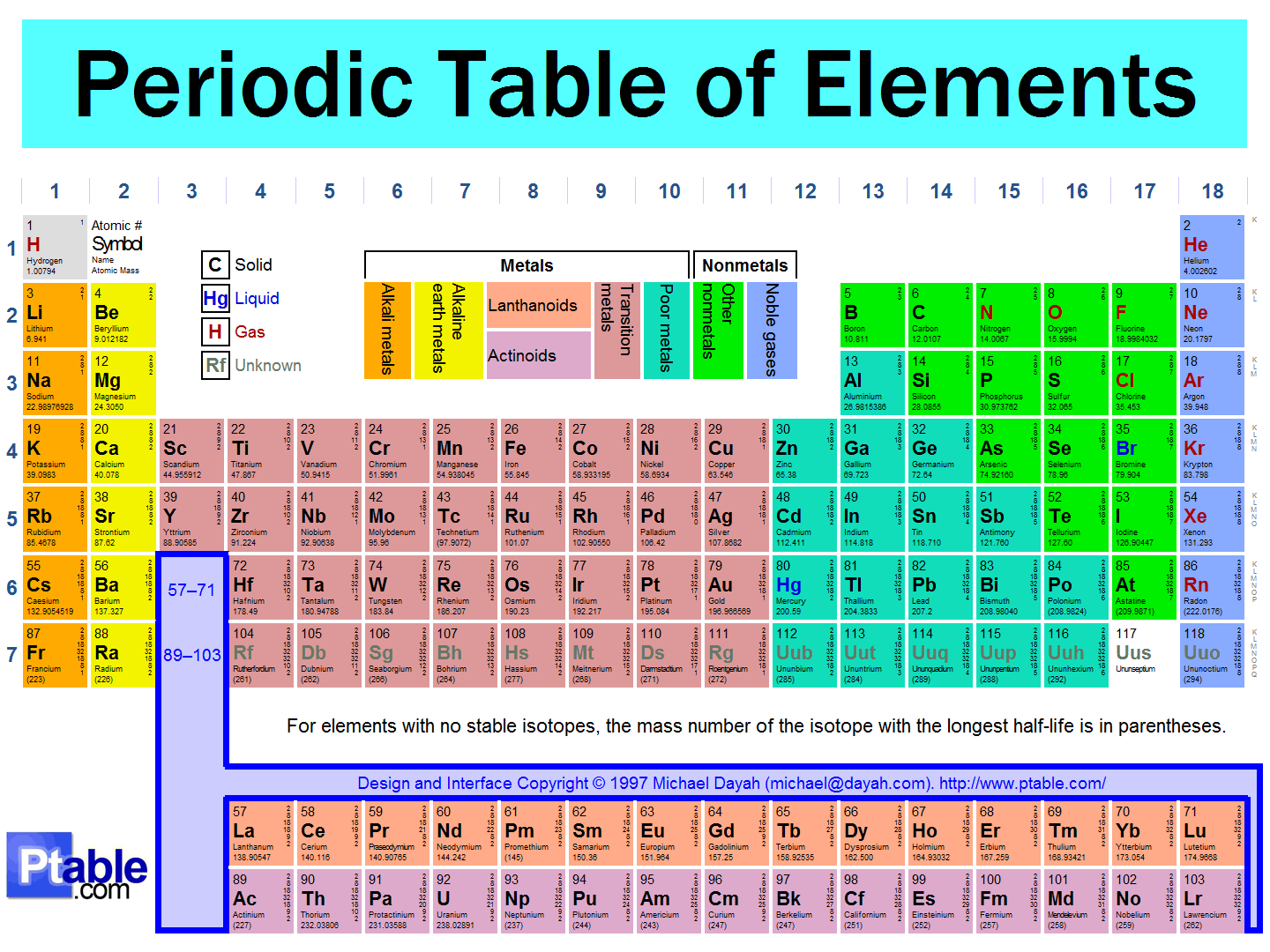
The horizontal row on the periodic table is called a
a)
group
b)
family
c)
period
d)
atomic number
87.

Atomic Number 1

a)

Hydrogen

b)

Boron

c)

Germanium

d)

Iron

88.

H

(a)  

89.

Fe

(a)  

90.

Atomic Number 118

a)

Hydrogen

b)

Astatine

c)

Oganesson

d)

Potassium

91.

Periods

a)

Goes up and down

b)

Columns on the periodic table

c)

Have the same chemical properties

d)

Rows on the periodic table

92.

Zn

a)

Zinc

b)

Xenon

c)

Krypton

d)

Helium

93.

What is the chart called that organizes all of the elements found on Earth?

a)

Element Chart

b)

Table of Elements

c)

Periodic Table of Elements

94.

What are the columns referred to on the Periodic Table of Elements?

a)

Families or groups

b)

Periods

95.

The first letter of the chemical symbol is always a capital letter and the second is always lowercase

a)

True

b)

False

96.
The horizontal row on the periodic table is called a
a)
group
b)
family
c)
period
d)
atomic number
97.

Typically, atoms are more stable when they are

a)

bonded together

b)

apart from each other

98.
Ionic bonds are between...
a)
nonmetals and nonmetals
b)
carbon and oxygen
c)
metals and nonmentals
d)
hydrogen and chlorine
99.
Covalent bonds are between...
a)
two or more nonmetals
b)
sodium and chlorine
c)
metals and metals
d)
metals and nonmetals
100.
What are valence electrons?
a)
sum of the protons and neutrons
b)
protons minus electrons
c)
electrons in the inner shells
d)
electrons in the outer shell